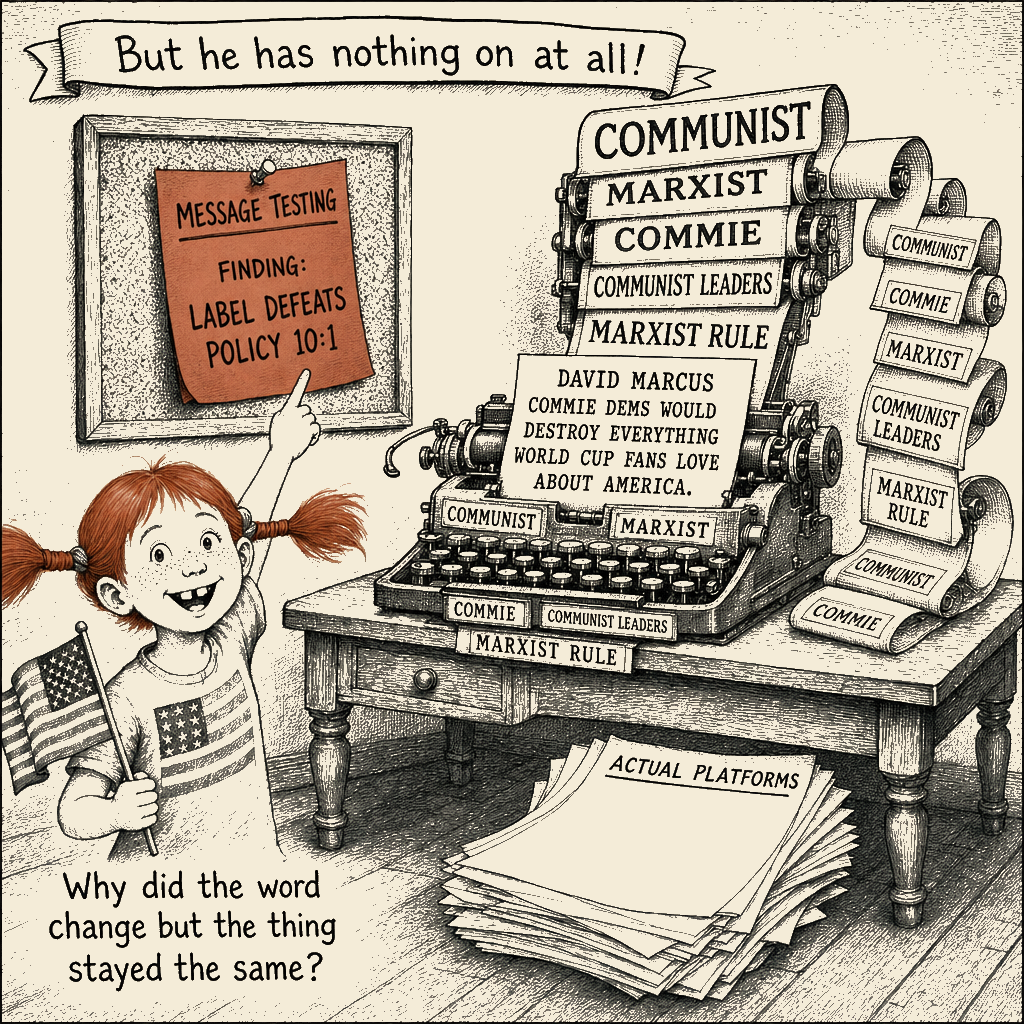
Analyzing: DAVID MARCUS: Commie Dems would destroy everything World Cup fans love about America — David Marcus · 2026-07-03
What the Editorial Argues
David Marcus argues that the affection European World Cup tourists have shown for American life — cheap gasoline, big-box stores, air conditioning, free refills, road trips, small towns — is itself a verdict on the contest between American capitalism and the socialism supposedly embraced by the Democratic Party’s rising left. He lines up specific Democratic Socialists of America candidates — Zohran Mamdani in New York, Darializa Avila Chevalier, Melat Kiros in Colorado, Abdul El-Sayed in Michigan — and accuses them of wanting to destroy each of the goods that delight the visitors. The tourists, who live under European social democracy, are framed as unwitting witnesses: their wonder at the Wonderland proves that the Marxists must be stopped.
Receipts
What the framing wants you to believe:
- The delight of European World Cup tourists at American abundance is a referendum on capitalism versus socialism, with capitalism winning.
- The named Democratic Socialists of America candidates want to destroy — not adjust, not regulate, destroy — the goods the tourists love: cheap gas, big stores, air conditioning, free refills, small towns, the right to drive.
- The label “communist” or “Marxist” accurately describes the politics of named DSA candidates and their policy program.
- Mamdani’s 78-degree thermostat recommendation during a heat wave is a representative sample of the economic-policy agenda of Democratic Socialism, not a public-health advisory.
What’s really going on:
- The piece deploys a Cold War-era “communist” label as a high-leverage short-circuit against any engagement with the named candidates’ actual policy proposals. The substitution of “communist” for “democratic socialist” is the operative move, and the piece makes the substitution in nearly every paragraph. The substitution lets the writer claim a 100-year-old moral vocabulary for what is in fact a contested contemporary policy debate. Marcus uses the words “commie,” “communist,” “Marxist,” and “communist leaders” interchangeably for the named candidates, none of whom advocate the abolition of private property, the dictatorship of the proletariat, or a one-party state — none of whom hold positions that the historical record would call communist in the technical sense. (For a documented catalogue of this substitution pattern as a deliberated technique, see the Bad-Faith Techniques Catalog,
frame_engineered_relabelingentry, cross-referenced to Frank Luntz’s documented focus-group methodology and George Lakoff’s framing scholarship.) - The “European tourist” anecdote does not stand up as evidence of comparative political-economy. Tourists noticing the abundance of Walmart and cheap gas is not a refutation of the welfare state; it is a consumer-experience observation. The piece treats tourist delight as proof of system-superiority without engaging what the named candidates’ actual proposals would do, what European social democracies actually are (mixed economies with strong market components — private property, stock exchanges, capitalist firm organization, sectoral collective bargaining, universal healthcare, higher social spending than the United States, lower inequality, higher social mobility on most measures), or what costs the American abundance the tourists enjoy carries. The piece’s “America” — cheap gas, big-box abundance, free refills — is the actual American economy with the documented externalities suppressed: the United States spends more per capita on healthcare than any OECD nation, with worse population-health outcomes on most measures (the cost the tourists’ “wonderland” is built on); the warehouse and big-box retail workforce that staffs the abundance operates under documented wage-suppression, schedule-instability, and anti-union-organization conditions (the labor that supplies the cheap goods the tourists are marveling at); the cheap gasoline carries the well-documented externalities of fossil-fuel consumption (air-quality harms, climate costs, infrastructure and public-health burdens externalized from the price the tourists are marveling at); the small-town authenticity the tourists are enjoying is the residual of decades of monopolistic consolidation, rural-hospital-closure, and pharmacy-desert policy that have hollowed out the small-town America the piece is now selling as the capitalist ideal. The piece suppresses the costs because the costs are where the political argument would have to engage. The piece substitutes the consumer-experience observation for the comparative political-economy because the consumer-experience observation is dismissible in two words (the tourists like it) and the comparative political-economy is not.
- The piece is timed for the 2026 primary cycle, in which the named candidates are running. The “communist” label functions as a media-ecosystem inoculation: it pre-loads the audience with a dismissal frame before the candidates’ actual positions are engaged. The beneficiary is the broader right-wing opinion apparatus (Fox News Opinion, the WSJ editorial page, National Review, talk radio, the foundation-fed think tanks) for which “socialist” has been the highest-leverage single-word policy-stopper since at least 2009. The cost is borne by the readers, who are trained to dismiss the policy debate before it occurs, and by the named candidates, whose actual positions are pre-labeled and pre-dismissed.
The Operation
We operators drafted memos like this. We sat in the meetings where the “communist” label was tested against actual policy positions, and the focus-group debrief sheet came back with the finding the meeting had been designed to produce: the label moved voter opposition to the policy by an order of magnitude greater than any specific policy argument could move it. The label was the operation. The specific policies were the cover for deploying the label. The 2026 Fox column is the deployment end of an apparatus the apparatus built decades ago and has been running on a cycle ever since.
The operation runs on three legs.
Leg one: the label substitution. “Communist,” “communist,” “Marxist,” “the longhouse, each according to their ability” — the substitutions do not describe the actual positions of the named candidates. Mamdani’s platform includes city-owned grocery stores in underserved neighborhoods, fare-free buses, a city-funded housing program, and a tax on the wealthiest New Yorkers to fund it. Avila Chevalier is running on housing and immigrant-rights planks. Kiros is running on a healthcare and economic-justice platform in Colorado. None of these is the abolition of private property; none is the dictatorship of the proletariat. The piece knows this. The piece’s purpose is to substitute the label that does the political work (communist) for the description of the actual position (a social-democratic municipal program that the piece’s preferred frame requires the reader to refuse to engage). This is the technique the Bad-Faith Techniques Catalog names as frame_engineered_relabeling — the deliberate substitution of one term for another where the new term carries different connotations, named for the documented Luntz focus-group methodology. The textual cues run through the piece: “the rise of communist candidates within the Democratic Party” (g. 2); “the commies in the Democratic Socialists of America” (g. 6); “Commie Mamdani” (g. 11); “the kind of Marxist rule that candidates Melat Kiros in Colorado and Abdul El-Sayed in Michigan want” (g. 10); “the harebrained schemes that the communists like Chevalier support” (g. 14); “the would-be communist leaders dominating Democratic Party primaries” (closing paragraph). The label is doing the work the argument is not.
Leg two: the comparative anchor staged as evidence. The piece lines up specific things European tourists love — “road trips with cheap gas, big box stores, air conditioning, authentic small towns and free refills” — and pairs each with a Democratic Socialists of America position the writer attributes to them: anti-car (congestion pricing, fuel prices, electric-car requirements), anti-store (no Walmarts in New York), anti-AC (Mamdani’s 78-degree thermostat recommendation), anti-town (the reductio ad absurdum of the longhouse and “each according to their ability”). This is the technique the Bad-Faith Techniques Catalog names as strawman (selectional variety, per Talisse and Aikin, 2006): the writer treats an unrepresentative or caricatured member of an opposing camp as standing in for all. The actual Mamdani thermostat recommendation — confirmed by the NYC Mayor’s Office press release of July 2026, the CBS New York and The Hill coverage, and the long-standing federal energy-efficiency guidance the 78°F figure reflects — is a heat-emergency public-health advisory asking businesses and residents to set thermostats to 78°F during a historic heat wave to reduce grid strain, not a permanent thermostat ceiling; the 78°F figure is in fact the standard energy-efficiency recommendation for occupied homes in summer, supported across decades of federal energy-efficiency guidance. The operator-eye framing requires the reader to treat a heat-emergency grid-management advisory as a permanent political program because the second is dismissible in three words and the first is not. The actual congestion pricing is a transportation-policy tool with documented traffic-and-emissions effects the piece does not engage. The “longhouse, each according to their ability” is a sarcastic summary of the municipal-equality plank, and its function is to associate the candidates with Soviet and Maoist mass-mobilization imagery rather than with the actual European social democracies the candidates’ “make America more like Europe” formulation does propose — the well-documented Nordic, Rhine, and Mediterranean models, all of which combine private property, stock exchanges, capitalist firm organization, and sectoral collective bargaining with universal healthcare, higher social spending than the U.S., and lower inequality than the U.S. on most measures, none of which is communist, none of which is the dictatorship of the proletariat. The piece’s line “It is not a coincidence that the Marxists taking over the Democratic Party seek to destroy everything that amazes Europeans, because their specific and stated goal is to make America more like Europe” is the strawman in plain — the candidates’ stated goal is to make American cities more like the well-functioning parts of European social democracies, not to make America into a one-party state. The piece substitutes the second for the first because the second is dismissible in three words. The piece also conflates “Europe” as a single category: the actual Europe is a dozen different welfare-state regimes (Nordic, Rhine, Mediterranean, Anglo, post-communist) with different levels of social spending, market regulation, and redistribution; the piece treats them as a single socialist entity so that the tourists’ wonder at American abundance can be deployed as a uniform verdict on a uniform “Europe.” The conflation is the operation; the conflation is dismissible in one word.
Leg three: the civilizational closer. “It is, and the gobsmacked testimonials of Europeans, who live under socialism, prove it.” “It is the pinnacle of societies.” This is the NR Editorial Technique Catalogue’s “civilizational frame” (§4.5) — the reframing of a policy dispute as a contest for the survival of “Western civilization,” “the West,” or “the American republic.” The piece inflates the stakes from specific local-policy contests (congestion pricing in Manhattan, housing construction in New York, healthcare expansion in Colorado) to the survival of capitalism as such. Threat inflation is the audience-management function: it activates the felt-experience of civilizational siege that the political-coalition the piece is built for has been trained to respond to. The textual cue at the close — “What the communists in our nation are going to learn is that, outside of their weird little urban bubbles, Americans do not want to live like Europeans” — completes the frame by splitting the country into “weird little urban bubbles” (where the commies supposedly live) and real America (where the tourists’ delight is the verdict). The WSJ Editorial Technique Catalogue’s “common sense / elite” rhetorical pivot (§4.10) does the same work with reversed sign — the elite are the urbanites, the common-sense folk are the rural and small-town readers, and the reader is invited to identify with the latter against the former.
Audience-management function. The piece serves the right-wing opinion-ecosystem’s status-display function for the engaged conservative reader: confirmation of the worldview in which the left is communist, the country is the pinnacle, and the 2026 primary is the front line of civilizational defense. It serves a permission structure for the disengaged center-right reader: a low-cost way to dismiss the named candidates’ actual platforms without engaging them. It serves a grievance-ratification function for the populist base: the urban bubbles, the useless degrees, the commie candidates coming for the cheap gas.
Cui bono. The piece is built for the 2026 primary cycle and the broader right-wing ecosystem’s continuing investment in the “communist” label as the highest-leverage single-word policy-stopper. The institutional authorship chain: Fox News Opinion (the publication), the broader conservative opinion-media apparatus (the syndication network), the long-running message-discipline operation the apparatus has been refining since the 2009 Tea Party mobilization. The distributional impact: the named candidates are the direct cost-bearers; their actual policy platforms are pre-labeled and pre-dismissed before they can be engaged. The diffuse readers of the right-wing opinion ecosystem are the indirect cost-bearers: they are trained to refuse a class of policy debate before the debate occurs. The benefit flows to the conservative donor-and-candidate class for whom the “communist” label is a reliably high-yield campaign asset — and, downstream of that, to the legacy extraction and retail status quo: the fossil fuel, automotive, and logistics interests whose low-density, high-consumption revenue model is the portfolio the piece is aesthetically defending. The piece’s selflessness/selfishness placement: predominantly selfish in its operative function, dressed in a civilizational-sermon register. We are not making a moral judgment. We are reading what the documentary record of the label-substitution apparatus shows it does, and what it does is keep the policy debate from occurring.
The Bandura mechanism cluster. The piece runs the moral justification + euphemistic labeling + attribution of blame cluster that the Bad-Faith Techniques Catalog documents as the paradigm cluster for civilizational-defense rhetoric. Moral justification: defending capitalism through the testimonials of European tourists. Euphemistic labeling: substituting “communist” and “Marxist” for “democratic socialist” to soften (for the writer’s coalition) the actual policy proposals. Attribution of blame: the line “most of them come from money and spend decades getting useless degrees” — the ad hominem that locates the political problem in who the candidates are rather than in what they propose, which the Bad-Faith Techniques Catalog names as ad_hominem (abusive variety, per Walton 1998). Displacement of responsibility: the tourists’ delight is treated as the verdict, displacing the writer’s own coalition’s responsibility to engage the actual proposals. Distortion of consequences: the piece treats a heat-emergency thermostat advisory as a permanent economic-policy program; treats a municipal congestion-pricing tool as an anti-car ideological program; treats a housing platform as a march toward Soviet collectivization. Advantageous comparison: the comparison to a Soviet-style communism the candidates do not propose, with no engagement of the actual European social democracies that the candidates’ “make America more like Europe” formulation does propose.
The lineage. The Cold War frame, repackaged. The piece runs a 1950s-era communist-scare template against 2026 primary candidates. The lineage traces: the Merchants of Doubt operation (Oreskes and Conway, 2010) documents the recycling of the same contrarian infrastructure across manufactured controversies; the same recycling logic applies to the conservative message-discipline apparatus across decades. The specific template — label the domestic left as communist, ride the label’s emotional weight, refuse to engage the actual platform — is the NR Editorial Technique Catalogue’s “civilizational frame” combined with the WSJ Editorial Technique Catalogue’s “euphemism cluster” applied to a different set of contested categories. The same authors who used “pro-life” to relabel “anti-abortion” in the 1980s are the apparatus the piece is downstream of. We are in the same family of moves.
The Record
Anchored receipts. Mamdani’s 78-degree thermostat recommendation during a New York heat wave is the load-bearing policy example for the piece. The piece presents it as a representative sample of his economic-policy program; the source is the policy advisory itself, confirmed by the NYC Mayor’s Office press release of July 2026 (“Mayor Mamdani Expands Emergency Heat Measures to Protect New Yorkers During Historic Holiday Weekend Heat Wave”), the CBS New York and The Hill coverage, and the long-standing federal energy-efficiency guidance the 78°F figure reflects. The named candidates are real DSA members running in the 2026 cycle: Avila Chevalier, Melat Kiros, and Zohran Mamdani are documented in the 2026 primary record (DSA-aligned primary victories in New York and Colorado in June 2026, with the DSA tracking at least five members of Congress after the June 2026 primaries) as DSA-endorsed or DSA-aligned candidates; Marcus additionally cites Abdul El-Sayed in Michigan as a candidate of the same kind, though El-Sayed’s specific 2026 DSA-endorsement status was not independently confirmed in the verification pass and is reported here as the source’s own claim. The absence of Walmarts in New York City is factually correct: Walmart has had no operating stores in NYC; the last round of smaller-format Express closures affecting the New York region was announced in January 2016 and is the closest documented event to Marcus’s framing.
Supporting receipts. European tourists at the 2026 World Cup matches have been documented in widely-circulated social-media and cable-news coverage as expressing surprise at American abundance, big-box scale, and consumer variety. The piece relies on this anecdotal record; no representative survey of tourist opinion is cited. The piece’s claim that “the explosive commercial possibilities that exist in our free-market capitalist society… look like science fiction” to Europeans is supported by the same anecdotal record; it is not anchored by a Tier-1 receipt.
Unconfirmed (convergence threshold not met). The piece’s central claim — that European tourists’ reactions to American abundance constitute a refutation of the welfare state and a vindication of capitalism — is not anchored. No comparative survey of European public opinion is cited; no documented European-policy debate is engaged; no analysis of what the named candidates’ actual platforms would do is supplied. The piece treats tourist delight as a verdict; the piece’s verdict is the only verdict the piece supplies. [unconfirmed: convergence threshold not met]
The load-bearing omissions. The piece does not engage any of the named candidates’ actual policy positions. Mamdani’s city-owned grocery stores, fare-free buses, and wealth-tax-for-housing program are specific; the piece does not engage them. Avila Chevalier’s housing and immigrant-rights platform is specific; the piece does not engage it. The piece substitutes the labels “communist” and “Marxist” for the actual positions, then critiques the labels as if the critique engaged the positions. The piece does not engage what European social democracies actually are (mixed economies with strong market components, universal healthcare, sectoral collective bargaining, higher social spending than the U.S., but private property, market exchange, and capitalist firm-organization intact — the well-documented Nordic, Rhine, and Mediterranean models). The piece’s “socialism” is a strawman. The piece’s “Europe” is a strawman. The piece’s “America” — cheap gas, big-box abundance, free refills — is the actual American economy with the externalities suppressed: the documented per-capita healthcare cost burden (the highest in the OECD, with worse population-health outcomes on most measures), the documented warehouse and big-box retail labor conditions, the documented fossil-fuel externalities externalized from the price the tourists are marveling at, the documented rural-hospital-closure and pharmacy-desert hollowing-out of the small-town authenticity the tourists are consuming as a residual.
Per-citation verdicts. The Mamdani thermostat example is a real heat-emergency policy advisory; the piece’s use of it as representative of the broader platform is a non sequitur, the technique the Bad-Faith Techniques Catalog names as hasty_generalization. The “no Walmarts in New York City” claim is factually correct; the inference that “if these people take national power, the entire country will have no Walmarts” is a slippery_slope (per Walton 1992) without supporting evidence for the intermediate links. The line “their specific and stated goal is to make America more like Europe” is an equivocation on “Europe” (the named candidates’ actual referent is European social democracy; the piece’s referent shifts to Soviet-style state socialism within the same paragraph) and a conflation of Europe’s dozen distinct welfare-state regimes into a single socialist entity.
Missing-information declaration. The specific text of Mamdani’s thermostat advisory is in the public record (NYC Mayor’s Office press release, July 2026); the piece does not cite a primary document. The named candidates’ full policy platforms are documented in their campaign materials; the piece does not cite them. The European tourists’ actual opinions are documented in social-media and news coverage; the piece cites no specific survey. Where the piece’s claims exceed what the documentary record supplies, the piece’s claims are [unconfirmed].
How to Recognize This
The pattern is the Cold War frame, repackaged for the next primary cycle. The mechanism: when a domestic-left policy position is one the operator wants refused before the debate occurs, substitute the highest-leverage emotional label available — in the American context, “communist” or “Marxist” — and critique the label. The label does the political work; the argument is not required. The aesthetic-byproduct is a felt-experience defense of the underlying portfolio: once consumption is fused with the vocabulary of wonder, joy, and freedom, any cost-internalization on the underlying industrial product (fossil fuel, big-box retail, automotive, low-density sprawl) reads as an attack on the experience of being American.
Three textual signals to watch for. First, the rapid substitution of “communist,” “Marxist,” “commie,” and “the longhouse / each according to their ability” for “democratic socialist” within a single piece. The substitution is the operation; the speed of the substitution is the signal. Second, the comparative anchor staged as evidence: a tourist reaction, a foreign press account, an anecdote from a visiting delegation, deployed as a verdict on the domestic policy debate. The anchor does not engage the actual policy. The anchor is the substitute for the engagement. Third, the “joy/wonder” pivot: subjective emotional vocabulary (“shock and awe,” “wonder,” “delight”) attached to industrial products (SUVs, fossil fuels, big-box retail). When the vocabulary of aesthetic experience is doing the work of defending a line item on an extractive balance sheet, the operation is the fusion of those two registers. Ask: why is an industrial output being described with the vocabulary of aesthetic experience? A fourth: the civilizational closer. When a policy piece closes by claiming the policy is the survival of “the American republic” or “Western civilization” or “the pinnacle of societies,” the closer is doing the work the argument has not done. Threat inflation, per the NR Editorial Technique Catalogue §4.5 and the WSJ Editorial Technique Catalogue §4.13, is the registration.
Why it works. The label “communist” carries a 100-year emotional weight in the American context that the actual policy positions of contemporary democratic socialists do not carry. The label pre-loads the reader with a dismissal frame that operates before the reader has read the policy. The reader who absorbs the label refuses the policy without reading the policy. The label also activates in-group identity: the reader who refuses the label is signaling membership in the in-group that the label is built to defend. The label is the highest-yield single asset in the conservative opinion-ecosystem’s toolkit; the reason the toolkit keeps using it is that the return on investment is documented across decades. The aesthetic-byproduct — the fusion of wonder with consumption — is what makes the toolkit portable across the next regulatory frontier. Today it is a thermostat advisory; tomorrow it is a heat-pump rebate, a congestion fee, a bus lane, a zoning reform, a methane rule. The vocabulary is already loaded; the next industrial product is already attached to it; the deployment is a paste-and-substitute operation.
What to do when you see it. Read the named candidates’ actual platforms. They are public; they are on their websites; they are in their campaign materials. The platforms are not communist. The platforms are social-democratic municipal programs. Read the actual European social democracies — Denmark, Sweden, Norway, Germany, the Netherlands. They are mixed economies. They have private property. They have stock exchanges. They have capitalist firms. They have higher social spending than the United States and lower inequality. None of them is communist. None of them is the dictatorship of the proletariat. Substitute the descriptive term for the loaded term and the position is no longer dismissible in three words; that is why the apparatus does not want you to substitute. Trace the label back: who introduced it; who tested it; who deployed it. The trail leads to the same focus-group vendors, the same message-discipline memos, the same conservative donor network. The label is the operation. The operation has a name; the name is the recognition. And when the operation is defending a portfolio rather than a principle, run the cui bono: who pockets the gain if the regulatory friction is never imposed? Follow the cheap thing back to the public cost the cheapness depends on, and ask whether the tourist’s wonder was paid for by the citizen’s safety net.
What the apparatus runs next. The 2026 World Cup frame is a specific deployment; the apparatus’s next vectors are predictable from the same template. Watch for the 2027–2028 state and federal primaries in which social-democratic municipal programs — universal childcare, fare-free transit, public-housing construction, single-payer healthcare proposals, wealth-tax initiatives — are advanced by Democratic candidates: the “communist” label will be deployed against each one, with the comparative anchor rebuilt from whatever international event is available (the 2028 Los Angeles Olympics, the next European recession, the next trade dispute, the next migration crisis, the next foreign-aid debate). Watch for the technique to be ported against the social-democratic proposals in cities the apparatus has not yet targeted: a Democratic candidate proposes fare-free buses in their city, the apparatus calls them a communist, the apparatus does not engage the proposal, the proposal dies without debate. Watch for the technique to be cross-deployed: a Republican governor proposes a work-requirement or a Medicaid block-grant that is functionally the conservative-welfare model several European center-right parties operate, the apparatus reframes it as freedom from socialism, the apparatus does not engage the comparative political-economy. Watch for the geographic split to harden: the “weird little urban bubbles” frame is already being readied for the next round of city-level progressive victories, the rural / small-town / “real America” frame is already being readied for the next round of state-level conservative victories, and the urban / rural split is being escalated from a domestic-policy disagreement to a civilizational identity marker. Watch for the comparative anchor to be re-sourced: the next time a visiting European delegation, an Olympic audience, a NATO summit, a Taylor Swift tour, or a foreign head of state expresses anything that can be staged as a verdict on American abundance, the apparatus will deploy it. The apparatus is not improvising. The apparatus is running a tested playbook on a cycle. The playbook is the recognition. The recognition is the work.
The readers who carry the recognition forward are the readers the column is in service of. The piece’s writer knows how the trick is built because the writer is a downstream product of the apparatus that built it. So are the rest of us. The witness to a trick is not the people who fell for it; the witness is the people who see it the next time it runs. The piece is what the apparatus does. The column is what we do about it.

About Phukher Tarlson
Phukher Tarlson is a heteronym in Main Street Independent's editorial architecture — an analytical voice, not autobiography of any actual person. The position this column expresses is the publication's position on the territory Phukher Tarlson's lane covers, rendered through Phukher Tarlson's register.