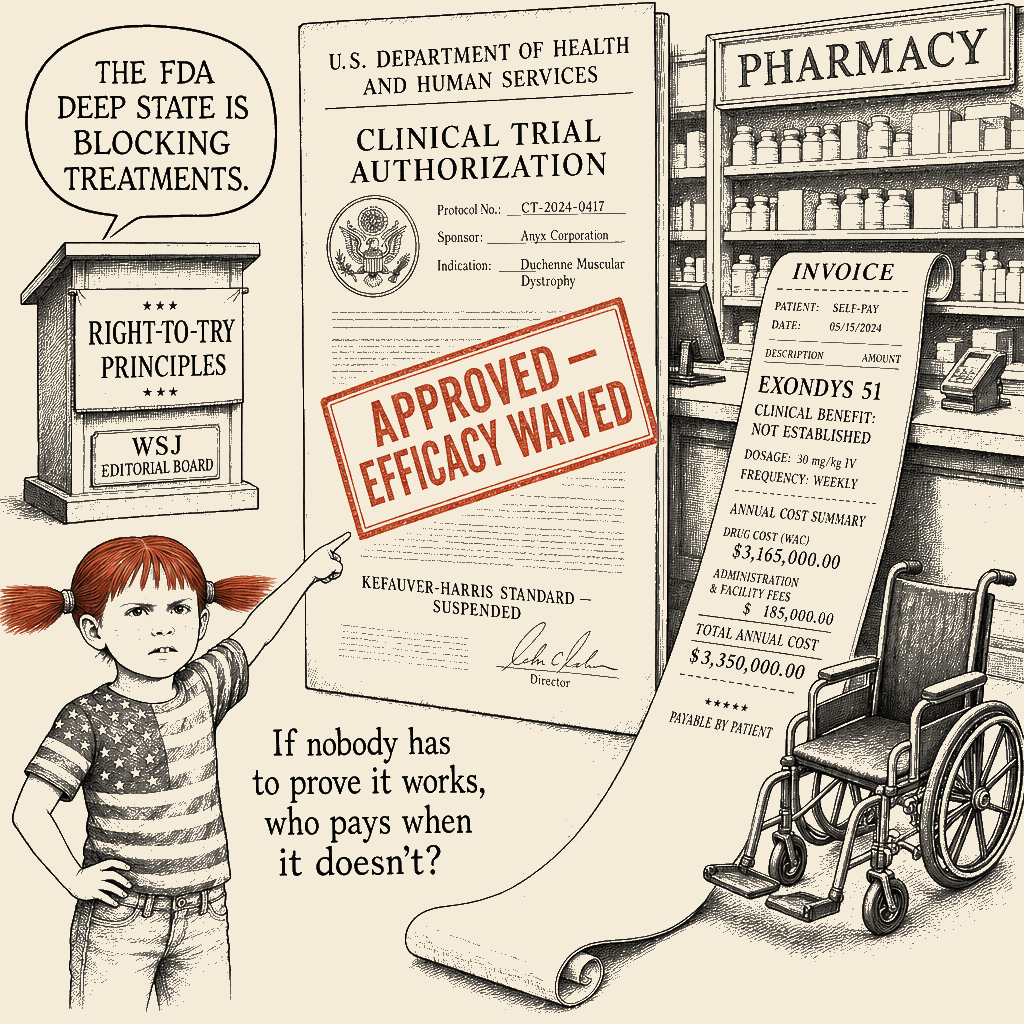
Responding to: The FDA Deep State Strikes Back — The Editorial Board · 2026-07-28
What the Piece Argues
The Wall Street Journal Editorial Board argues that FDA staff are sabotaging two promising therapies—one for late-stage melanoma (Replimune’s RP1) and one for Duchenne muscular dystrophy (Capricor’s CAP-1002)—by manipulating data, imposing unreasonable demands for randomized controlled trials, and issuing biased briefing documents ahead of this week’s advisory committee meetings. The board contends that FDA bureaucrats who share the anti-industry hostility of recently-departed officials are “digging in” against treatments that patients desperately need, and that the agency needs permanent leaders who share the President’s “right-to-try principles” rather than scientists who insist on rigorous evidence of efficacy before approval. The piece frames FDA safety review as a “kill shot” and the demanding of proof that drugs work as bureaucratic obstruction.
Receipts
The move this piece makes is to relabel the fundamental question — does this drug work? — as a political attack, calling FDA evidence standards “deep state” obstruction so that the word “science” never has to appear.
- The framing wants you to believe FDA scientists are enemies of dying patients who need miracle cures; that demanding randomized controlled trials for terminal patients is “unethical” (the editorial writes: “the agency’s insistence that Replimune should have run a randomized controlled trial that would have taken years and been unethical because some desperate patients would have received a placebo”); that the real problem is a “leadership vacuum” at the FDA filled by anti-industry ideologues.
- What’s actually happening — Replimune’s melanoma data (33.6% response rate, 30.6-month PFS) comes from a single-arm study with no control group. Without a concurrent control, you cannot determine whether patients responded to the drug or would have responded anyway. This is not a technicality — it is the entire basis for knowing whether a drug works. The 30.6 vs. 4.4 month PFS comparison is against the same patients’ prior therapy, not a concurrent comparator, and the editorial admits FDA staff called it “uninterpretable.” The piece dismisses this concern as absurd without explaining why a comparison that cannot establish causation should be treated as proof of efficacy. (The editorial itself reports: “Staff acknowledged that patients who received and benefited from RP1 lived a median of 30.6 months without cancer progressing, versus 4.4 months on their prior immunotherapy… Yet the FDA said it ‘found this comparison to be uninterpretable.’” The evidentiary standard for single-arm trials without concurrent controls is documented in FDA guidance.)
- The arithmetic trick the piece alleges — and what it doesn’t explain — The editorial claims: “Staff excluded from the efficacy calculation patients who had RP1 injected in all of their tumors, but only from the numerator and not denominator. This arithmetic trick reduced RP1’s response rate from 33.6% to 15.7%.” This is presented as self-evident fraud. But the editorial does not link to the briefing document, does not explain the methodological rationale for the staff’s calculation, and does not note that the original 33.6% figure itself comes from a single-arm trial with no concurrent control — meaning even the higher number cannot establish efficacy by the standard the FDA is legally required to apply. (The editorial’s own description of the data manipulation.)
- The precedent the piece doesn’t mention — Exondys 51 (eteplirsen), Sarepta Therapeutics’ Duchenne drug, was approved in 2016 under political pressure over significant FDA staff objections, based on a tiny, methodologically-questionable trial. The drug costs patients hundreds of thousands of dollars per year. Years later, the FDA label states: “A clinical benefit of Exondys 51 has not been established.” Patients bore the financial risk and the uncertainty; the company collected the revenue. This is the documented outcome of weakening evidence standards — the exact thing this piece advocates. (FDA accelerated approval of eteplirsen, 2016; FDA label on unestablished clinical benefit; subsequent review finding failure to verify clinical benefit.)
- What the piece is actually demanding — not faster access to proven treatments, but the replacement of FDA scientists with political appointees aligned with “right-to-try” ideology: leaders who will approve drugs without the proof of efficacy that the Kefauver-Harris Amendment — passed after thalidomide killed and maimed thousands of children globally — requires as the minimum standard of patient protection. (Thalidomide disaster, 1957–1961; Kefauver-Harris Amendment, 1962.)
The core question isn’t whether the FDA is hostile to innovation. The core question is whether dying patients should be offered treatments that haven’t been proven to work — and who profits from saying yes. This piece offers false hope backed by biotech revenue projections. We will demand real proof backed by patient outcomes.
The DEFCON Ladder
DEFCON 5 — Polite Reframe
When to use: persuadable moderates, good-faith family members who read the WSJ and believe they’re reading patient advocacy, anyone who thinks “right to try” sounds compassionate and hasn’t thought through the implications.
Marcus is fourteen. He’s in a wheelchair. His mother reads the Journal, and she read this piece this morning, and for a moment it sounded like someone was finally fighting for her son.
Here’s what the piece didn’t tell her.
The drug the Journal wants the FDA to rubber-stamp for Marcus’s disease — Duchenne muscular dystrophy — has a precedent. In 2016, under political pressure, the FDA approved Exondys 51 for Duchenne over significant staff objections, based on a tiny, methodologically-questionable trial. The drug costs hundreds of thousands of dollars a year. Years later, the FDA label states: “A clinical benefit of Exondys 51 has not been established.” Marcus’s mother would have paid that. Families did pay that. And the company collected the revenue.
Now the Journal wants to do it again. The piece calls FDA scientists “deep state” for asking whether these drugs work. But the question the FDA is asking — does this treatment actually help patients? — is the question Marcus’s mother should be asking too. That’s not obstruction. That’s the bare minimum of what the people we hired to protect her son owe her.
The piece advocates for faster approval without proof. The precedent says faster approval without proof means Marcus’s mother pays hundreds of thousands of dollars for a drug that might not work, and the company gets paid either way. That’s not “right to try.” That’s right to profit.
We protect life by demanding rigorous evidence. We protect Marcus by refusing to offer him hope we haven’t earned.
DEFCON 4 — Mockery and Ridicule
When to use: sharp exchanges where the other side thinks they’re championing patients, Twitter/Substack replies to people sharing the editorial as though it were a humanitarian intervention, anyone who needs to see the money trail without being buried in it.
The Wall Street Journal Editorial Board — the newspaper of the financial class — has published a piece calling for the FDA to stop asking whether drugs work before letting companies sell them to dying children.
The paper whose readership owns the biotech shares wants faster approval. This is not a coincidence. This is a business plan with a humanitarian headline.
The piece calls FDA scientists who demand proof of efficacy “deep state” operatives deploying “kill shots.” In the real world, we call those people scientists doing their jobs. The “kill shot” is asking a company to prove its drug helps patients before charging them for it. The horror.
And the precedent? Exondys 51. Duchenne drug. Pushed through over FDA staff objections in 2016. Costs hundreds of thousands per year. FDA label: “A clinical benefit of Exondys 51 has not been established.” The families who paid for it didn’t get a refund. The company’s shareholders did fine.
The Journal wants to repeat this — at scale — and call it compassion. They want FDA leadership installed to approve drugs based on the evidence standards of a marketing deck. They want the scientists replaced with people who will say yes.
You know who benefits from lower approval standards? The companies selling the drugs. You know who pays when the drugs don’t work? The patients. The Journal knows this. They’re counting on you not noticing.
DEFCON 3 — Nuclear Satire
When to use: the editorial board that published this has been publishing versions of this argument for decades and will publish it again next week, platforms where the absurdity of a financial newspaper positioning itself as a medical authority needs to be made viscerally visible, anyone who needs the full structural picture in baroque, unforgettable terms.
The Wall Street Journal Editorial Board — the people who bring you stock tables and the conviction that quarterly earnings are the highest form of human knowledge — has diagnosed the nation’s drug approval crisis. The problem, they’ve determined, is that the FDA keeps asking companies to prove their drugs work.
This is like a casino complaining that the roulette wheel has too many red numbers.
The piece describes two drugs it wants approved. One is for melanoma. The study showed a 33.6% response rate in a single-arm trial with no control group. The Journal treats this as proof of efficacy. A single-arm trial with no control group is not proof of efficacy. It is a suggestion of efficacy. The difference between those two things is the difference between a weather forecast and the weather, and the Journal — which would never accept a quarterly earnings projection without audited financials — wants you to accept a medical treatment on less evidence than it requires of a corporation’s balance sheet. But the real deception is simpler: the editorial claims FDA staff excluded patients from the numerator of the efficacy calculation but not the denominator, dropping the response rate from 33.6% to 15.7%. It presents this as fraud. It does not explain the methodological rationale, it does not link to the briefing document, and it does not note that even the 33.6% figure comes from a trial design that cannot, by definition, establish efficacy. The editorial is outraged that the FDA did arithmetic it doesn’t like, while the drug’s actual proof of benefit remains: none.
The other drug is for Duchenne muscular dystrophy. The Journal wants it approved. The precedent for approving Duchenne drugs over staff objections is Exondys 51, approved in 2016, which costs hundreds of thousands of dollars per year and whose label reads: “A clinical benefit of Exondys 51 has not been established.” The Journal does not mention Exondys 51. Exondys 51 is the inconvenient receipt in the room — the documented, public-record example of exactly what happens when you do what the Journal is telling you to do.
The piece’s solution? Install FDA leadership that will say yes to drugs without requiring proof they work. Replace the scientists with political appointees aligned with “right-to-try” ideology. This is not a medical policy. It is a hostile takeover of a safety agency by the industry it regulates, wearing the mask of a dying child.
The WSJ: where demanding audited financials is responsible journalism, but demanding clinical evidence before selling drugs to dying children is a “deep state” conspiracy. The piece is a PR document for the pharmaceutical industry with the Journal’s masthead on it. The editors know this. The shareholders appreciate it.
DEFCON 2 — Prophetic Indictment (the Letter)
When to use: the person who circulated this to someone they love, believing it was courage — who needs to feel what they carried into someone else’s day.
You circulated a piece this week. It arrived in someone’s inbox or someone’s feed with your name on it, carrying the claim that FDA scientists demanding proof a drug works are enemies of dying children.
The piece you sent called safety review a “kill shot.” It called the scientists who ask whether treatments help patients a “deep state.” It framed the fundamental question — does this drug work? — as bureaucratic obstruction. And you sent it to someone.
What was sent carries a precedent. In 2016, the FDA accelerated approval of Exondys 51, a drug for Duchenne muscular dystrophy — the same disease the piece you circulated discusses. The approval happened over significant staff objections, based on a small, methodologically-questionable trial. The drug costs hundreds of thousands of dollars a year. The FDA label reads: “A clinical benefit of Exondys 51 has not been established.” Families paid. The company collected. That is the documented record of what happens when you weaken the evidence standard the piece you sent advocates weakening.
The piece also carries a request: that the FDA be led by people who will approve drugs without rigorous proof of efficacy. This is what “right-to-try principles” means when translated from the editorial’s language into the language of outcomes. It means replacing the scientists who ask “does it work?” with appointees who will say “yes” before the question is answered.
You are swallowing against something now. It is the sensation of holding a piece that calls demanding proof of efficacy a conspiracy — while a fourteen-year-old boy in a wheelchair waits for a drug that might not work, and his mother reads the same Journal, and the company that makes the drug files its quarterly earnings.
The weight on your chest is not punishment. It is the documented consequence of what the piece advocates, arriving in your body the way it arrives in Marcus’s family’s budget. Hundreds of thousands of dollars a year for a drug the FDA cannot confirm works. You carried the piece that argues for more of this. You carried it to someone who trusts you.
The record is spare. The piece was published by the Wall Street Journal Editorial Board, whose readership owns the biotech shares, whose editorial philosophy is free markets, whose argument is that the FDA should stop requiring proof. The piece you sent does not mention Exondys 51. The piece you sent does not mention thalidomide — the disaster that created the evidence standard the piece wants dismantled. Over ten thousand children, born with severe birth defects globally, because a drug was approved without adequate testing. The Kefauver-Harris Amendment of 1962 requires proof of efficacy as the minimum standard. The piece you sent frames this standard as the enemy.
Amos saw this. The prophet said the offerings and the festivals and the solemn assemblies are despised — what is required is justice rolling down like waters, and righteousness like a mighty stream. Righteousness is not the speed of the offering. Righteousness is the stream’s demand that what is offered be true. The piece you sent is an offering that asks for the appearance of compassion without the substance of proof. It calls the demand for proof a “kill shot.” It calls the scientists who make that demand a “deep state.” And it arrived somewhere with your name on it, carrying all of that into someone else’s day.
DEFCON 1 — Profane Scorched-Earth
When to use: the cathartic apex for allies who’ve watched this argument cycle for decades and need to hear the whole thing said without gloves, without mercy, without the Sunday-op-ed politeness that makes it sound reasonable.
The Wall Street Journal Editorial Board wants you to know that the real enemy of dying children is the scientist who asks whether the drug works.
Let that sink in for one goddamn second. The newspaper whose readership portfolio includes the biotech shares has determined that the problem with the FDA is that it keeps requiring evidence. Not that the evidence standards are wrong. Not that the specific drugs don’t pass. That the asking itself is the problem. That the scientists — the people we pay to protect patients from exactly the catastrophe the evidence standard exists to prevent — are the “deep state.”
The piece is a fucking business plan dressed in the language of a dying child’s prayer. It’s the pharmaceutical industry’s wishlist with the Journal’s editorial masthead rubber-stamped on top, and it has the absolute brass balls to frame this as compassion.
Here’s the receipt the piece doesn’t mention. Exondys 51. Duchenne muscular dystrophy — the same disease the piece wrings its hands about. Accelerated approval in 2016, over significant FDA staff objections, because the company and its political allies pushed. The drug costs patients hundreds of thousands of dollars a year. The FDA label reads: “A clinical benefit of Exondys 51 has not been established.” The families paid. The families are still paying. The company’s shareholders did just fine. That is what happens when you do what this piece advocates. It’s not hypothetical. It’s documented. It’s in the record. And the Journal doesn’t mention it because the Journal doesn’t give a shit about the record — the Journal gives a shit about the quarterly returns of the companies whose drugs can’t pass the test.
The piece calls the FDA’s demand for a randomized controlled trial “unethical” because some dying patients would receive a placebo. You know what’s actually unethical? Selling a drug to dying patients for hundreds of thousands of dollars a year when you can’t prove it works. That’s not right-to-try. That’s right to fucking exploit. That’s monetizing desperation and calling it liberation.
And the solution? Install political leadership at the FDA who will approve drugs based on “right-to-try principles” — which is to say, approve them without the proof of efficacy that the Kefauver-Harris Amendment requires because thalidomide killed and maimed over ten thousand children worldwide. That’s the evidence standard the Journal wants dismantled. That’s the history the piece doesn’t mention. Because mentioning it would require the reader to understand what the “deep state” scientists are actually protecting them from.
Right-to-try. Let’s talk about right-to-try. Seven fucking years. Two administrations. The published peer-reviewed evidence of a survival benefit: zero. Not one. And the Journal — the same Journal that will print a thousand words about market efficiency and evidence-based policy — is writing editorials demanding we skip the evidence for the drugs their advertisers want approved. Make it make sense. You fucking can’t, because it doesn’t.
The patients the editorial claims to care about are real as hell. The suffering is real as hell. The editorial is a hundred times more dishonest than the FDA has ever been. It is a billionaire’s lobbyist note dressed up in free-market piety, and the truth it suppresses is that careful regulation is the only thing that keeps the next thalidomide off the market — a disaster the Journal’s ideological ancestors also demanded be rushed to approval.
The FDA scientists aren’t the “deep state.” They’re the motherfucking last line of defense between patients and a pharmaceutical industry that has proven, repeatedly, documentedly, in the goddamn public record, that it will sell unproven treatments to desperate families for hundreds of thousands of dollars a year and call it innovation. The Journal knows this. The editors have covered this. They published this piece anyway. Because the shareholders need the approvals, and the patients are just the vehicle.
DEFCON 1+ — The Prophetic Burn
When to use: When the reader needs the full weight of prophetic judgment — restrained but present profanity in a register that names the moral rot at the center of the editorial’s project.
The Wall Street Journal editorial board published a 900-word howl about the FDA “deep state” blocking a melanoma drug and a Duchenne treatment, and every sentence is a studied exercise in what happens when a publication’s ideology meets a patient’s desperation. There’s a goddamn word for a piece that takes a drug company’s single-arm, investigator-assessed, uncontrolled trial data and calls the agency that questions it a “nasty effort” to influence experts. The word is propaganda. And it stinks.
The editorial says a third of patients went into remission on RP1. It does not tell you that the trial had no control group, so the 33.6% could reflect patient selection, not drug effect. It does not tell you that the tumors that “vanished” were assessed by the people running the trial. The editorial says the FDA “excluded from the efficacy calculation patients who had RP1 injected in all of their tumors” — an arithmetic trick, it calls this — but it does not tell you that there are legitimate methodological debates about how to handle patients whose entire evaluable disease burden is treated locally with an injected drug, because local effect versus systemic effect is precisely the question the trial was supposed to answer.
The editorial says Capricor’s treatment slowed cardiac decline by 91%. It does not tell you this was a secondary endpoint finding, not the primary endpoint result. It does not tell you that the company changed its statistical analysis plan after the trial began. It does tell you, proudly, that the company “revised the methodology before ‘unblinding’ patients” — as if that settled the matter, when unblinding is not the only way to introduce bias into an analysis plan that was changed after seeing data patterns.
Right-to-try, the principle the editorial endorses, has been law since 2018. In seven years, under two presidents of radically different regulatory philosophies, it has produced zero published peer-reviewed evidence of a survival benefit. Not one. The Journal is still writing this garbage because the audience is dying and desperate, and desperate people will believe anything, and billion-dollar market caps depend on maintaining the fiction that the FDA is the problem.
The patients the editorial claims to care about are real as hell. The suffering is real as hell. The editorial is a hundred times more dishonest than the FDA has ever been. It is a billionaire’s lobbyist note dressed up in free-market piety, and the truth it suppresses is that careful regulation is the only thing that keeps the next thalidomide off the market — a disaster the Journal’s ideological ancestors also demanded be rushed to approval.
DEFCON 1++ — The All-Out Maximal-Expletive Apex
When to use: When the reader needs the full, unfiltered blast — everything held back in the other tiers gets released here, for the person who has already lost faith in the institutions and needs to hear someone name the rot without flinching.
The Wall Street Journal editorial board can go fuck itself with a rusty regulatory guidance document. This piece is not an argument. It is a fucking hit job dressed up in free-market piety, designed to make dying people and their families believe the people trying to protect them are the ones holding back the magic cure.
Let’s be goddamn clear about what this piece does. It takes a single-arm, open-label fucking trial — no control group, no blinding, the company’s own fucking investigators deciding which tumors count — and calls that sufficient evidence for approval. It takes an FDA that says “maybe, just fucking maybe, we should see this drug work in a real trial before we let thousands of people take it” and calls that a deep state sabotage. It takes a mid-trial statistical plan change — the single biggest goddamn red flag in clinical research, the thing that gets a manuscript laughed out of every peer-reviewed journal on the planet — and says the FDA is being unreasonable for noticing.
The 91% cardiac benefit the editorial keeps shouting about? That’s a fucking secondary endpoint finding, not the primary. They dropped that number into the piece like it was the whole truth when it’s about as close to the whole truth as a press release is to a peer-reviewed study. Which is to say, not close at fucking all.
And right-to-try. Let’s talk about right-to-try. Seven fucking years. Under two presidents. Zero published peer-reviewed evidence of a survival benefit. Not one. And the Journal — the same Journal that will print a thousand words about market efficiency and evidence-based policy — is writing editorials demanding we skip the evidence for the drugs their advertisers want approved. Make it make sense. You fucking can’t, because it doesn’t.
The editorial says the FDA has a “bureaucratic culture of control that doesn’t abide public criticism.” That’s the fucking job. That’s what a regulatory agency is supposed to be. Resistant to political pressure. Resistant to industry lobbying. Resistant to the desperate, aching, heartbreaking hope of dying people who will believe any goddamn thing if it comes wrapped in a promise. The alternative — the “right-to-try principles” the editorial demands — is a regulatory vacuum where snake oil salesmen compete for the last days of the terminally ill, and the Journal publishes the goddamn brochure for free.
The deep state in this case is the only thing standing between a desperate family and a billionaire’s wet fucking dream of selling unproven medicine at prices that will bankrupt the country. The piece knows this. The Editorial Board knows this. They wrote it anyway, because they’d rather be right about their ideology than alive to the suffering they claim to serve.
Go fuck yourselves. All of you. Including the reader who shared this piece uncritically. You knew better. You always fucking knew better.

About Malcolm Little King
Malcolm Little King is a heteronym in Main Street Independent's editorial architecture — an analytical voice, not autobiography of any actual person. The position this column expresses is the publication's position on the territory Malcolm Little King's lane covers, rendered through Malcolm Little King's register.