Responding to: When the Horseshoe Isn’t Just a Theory — Patrick M. Brenner · 2026-09-03
What the Piece Argues
The piece argues that the bipartisan push to cap credit-card and small-loan interest rates — embodied in Sanders-Hawley legislation, the AOC-Luna companion bill, Trump’s January proclamation, and Warren’s regulatory pressure on OppFi — rests on a populist conflation of price with moral judgment. It cites a New York Fed study of 36% caps in Illinois and the Dakotas and Federal Reserve research on small-loan breakeven economics to argue that rate ceilings “ration out” the riskiest borrowers, since non-specialty lenders cannot profitably make loans under roughly $2,530 at capped rates. It then turns on Warren’s opposition to Opportunity Financial’s $130 million bid to acquire BNC National Bank as hypocritical — approval would bring OppFi inside the Fed’s consolidated supervisory perimeter. The thesis: if 195% APR ought to be illegal, four members of Congress have the draft; let them pass it, and let them answer to the borrowers left without any credit at all.
Receipts
The piece defends the rates charged by a specialty lender (OppFi) profitable at those rates — by invoking Federal Reserve research on the breakeven math of non-specialty lenders.
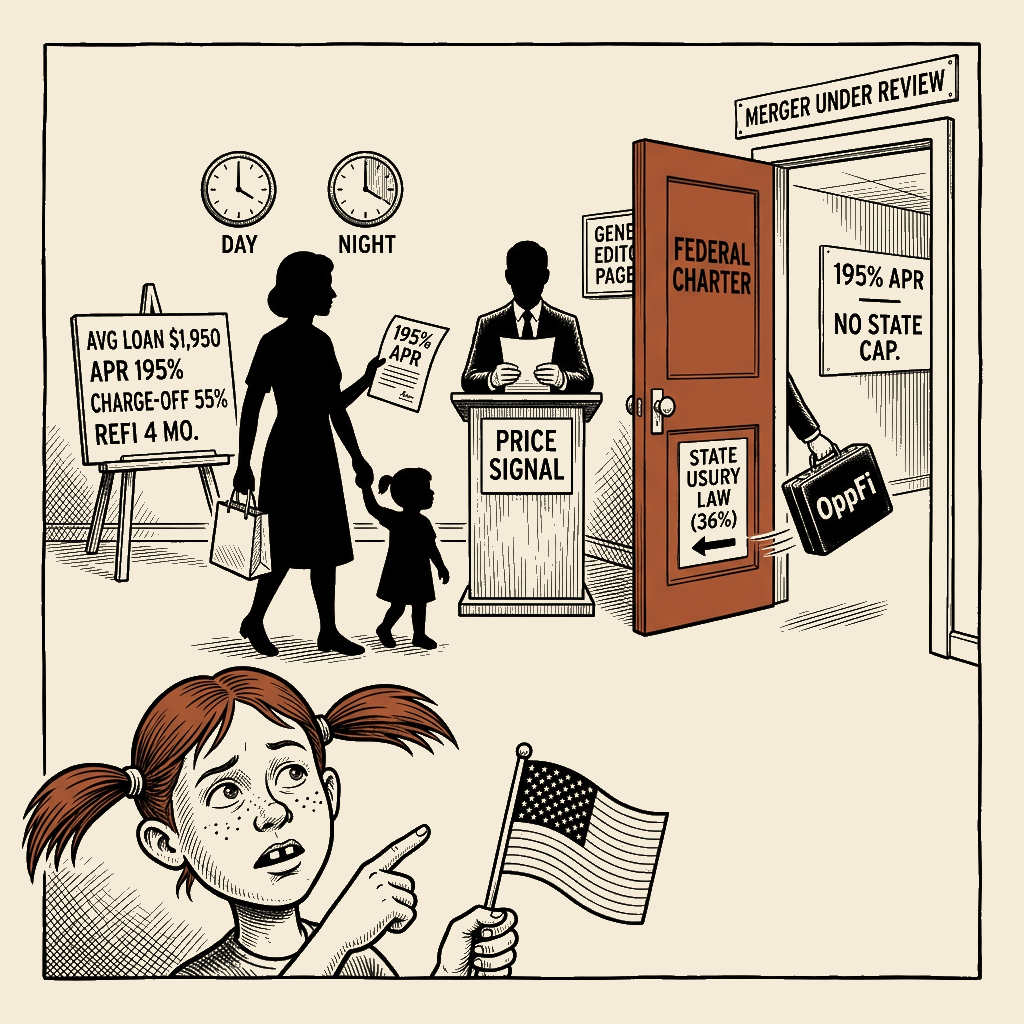
Anchor citation: Per the piece itself, Federal Reserve research finds that a non-specialty lender must lend at least $2,530 to break even at 36% APR; OppFi’s own 2025 10-K (also referenced in the piece) shows the company operating profitably at up to 195% APR with a 55% charge-off rate and a 4-month refinancing cycle — a different business, with a different breakeven.
-
The framing wants you to believe:
- Rate caps cause lenders to “ration out” the riskiest borrowers, denying them access to credit.
- A loan must be at least $2,530 to break even at 36% APR, so small-dollar lending is structurally impossible under any capped regime.
- Senator Warren’s opposition to the OppFi-BNC merger is hypocritical, because approval would actually bring OppFi under federal supervision.
-
What’s really going on:
- The “breakeven” math the piece invokes is research on non-specialty lenders — banks whose business model is not small-balance, high-rate lending. OppFi is profitable at 195% APR precisely because it has built an infrastructure of underwriting, collections, and refinancing around that very model. The piece treats non-specialty and specialty breakeven math as interchangeable; the company’s own filings show they are not.
- The piece presents credit exclusion (“rationing out” the riskiest) as a feature rather than the harm. The same New York Fed study it cites shows balances fell by roughly $2,000 for borrowers in the lowest-FICO-equivalent decile after 36% caps — a finding the piece frames as the cost of exclusion but which is also the weight of debt-trap lending that cap regimes interrupt.
- The piece’s merger argument obscures the structural fact that approving OppFi’s acquisition of BNC would consolidate a 195% APR lender inside the federal banking perimeter — making the rates structurally harder to challenge downstream. Warren’s objection is to the rates the merger would entrench, not to supervision itself.
- Per OppFi’s filings and post-SPAC ownership disclosures, the concentrated beneficiary sits at the top of the company’s capital structure — its private-equity-aligned equity holders (the original OppFi equityholders retained approximately 62% at the SPAC merger) and the senior debt holders financing the receivables. The diffuse cost is borne by the same working families the piece claims to be protecting — through the rate differential when they borrow, and through overdraft fees, eviction filings, and utility reconnection charges when they are priced out of capped credit.
The Response Ladder
Polite Reframe
When to use: a persuadable family member, a thoughtful colleague, or a good-faith reader who has just read the piece and thinks it sounds reasonable; the goal is to make the moral question visible without losing their attention.
The piece’s core argument — that price caps ration credit away from the poorest borrowers — is real economics. It deserves a real answer, not a dismissal. But it leaves out the question the argument is built to obscure: who is the 195% APR product being marketed to, and what made them need it?
Consider the borrower the piece is built around. She works multiple jobs in a state that has not guaranteed her paid sick leave. Last month her son needed antibiotics; the urgent-care visit cost cash on the day. The car needed work. The rent was due. The math that month did not work, and she had a few hundred dollars to bridge. Her bank, the same bank where she has held a checking account for years, does not lend small amounts on short notice. OppFi does, at 195% APR. After a few months she has refinanced once, the balance has compounded, and her credit profile has slipped. The piece’s own data describes this product as a “loan too small to be made at 36% by non-specialty lenders.” The piece calls this a price signal.
Read the same data from her side. The arithmetic the piece uses to justify the rate — breakeven loans of $2,530, an industry built on $1,950 average tickets — is the arithmetic of an industry whose profit depends on a steady supply of borrowers in her position. The piece is right that a 36% cap would push lenders out of her loan size. It does not follow that her children should pay the difference. The conservative tradition, before it forgot itself, had a name for what 195% APR does to a working family: usury. The piece would rather call it a price signal.
The piece’s closing line — “If 195 percent ought to be made illegal, four members of Congress spanning the entire spectrum of the horseshoe have the draft. Let them pass it” — is structurally interesting, because it concedes the moral case (“ought to be made illegal”) while arguing the procedural one (Congress, not regulators). But the procedural argument is a feint. Warren’s regulatory action is a block on a $130 million merger; the piece itself notes that approval “would bring OppFi inside the Federal Reserve’s consolidated supervisory perimeter.” The piece wants the merger to clear so the lender can escape the state-level supervision its business model cannot survive by hiding inside a national bank charter. That is not the position of someone defending a free market against overweening regulators. That is the position of someone defending the right of a subprime lender to escape into federal supervision rather than face the rate caps its product cannot survive.
The honest question is not whether rate caps reduce access to credit. They do. The honest question is what kind of society produces a market in which 195% APR is the available answer to a working mother with a few hundred dollars to bridge. We have decided that answer is acceptable. The piece is asking us to keep deciding that.
Mockery and Ridicule
When to use: a Twitter reply, a Substack comment thread, or any forum where the audience includes good-faith onlookers who haven’t read the piece; the inversion is now stamped explicitly, and the satirical edge targets the apex beneficiary, not the reader.
Let me translate the horseshoe piece from econ-speak into plain English. The argument is: a $1,950 loan at 195% APR is not predatory; it is a price signal, and the price is high because the people getting the loans are bad credit risks. The lenders are performing the heroic public service of giving money to people nobody else will touch, and any regulation that stops them is a moral judgment smuggled in as economics. The piece closes by inviting Congress — which has not passed a rate cap, because it is owned by the same industry — to “let them pass it,” like a magician inviting the audience to check the other pocket.
Now read the math the piece is so proud of. Federal Reserve researchers, cited approvingly: a loan must be at least $2,530 to break even. The industry’s average loan: $1,950. Translation: the product is too small to be made at a normal rate. The piece treats this as evidence the rate must be unconscionably high. The honest reading is that a market in which the smallest viable loan is below the breakeven line is a market that has stopped being a market and started being a racket. The piece knows this. The piece wants you not to.
The horseshoe framing is the giveaway. The piece needs you to believe that Warren, Sanders, Ocasio-Cortez, Luna, and Trump converging on the question of whether 195% APR is predatory is a sign of ideological extremism. Read the actual lineup. The lineup includes the sitting Republican president and a Republican House member who has campaigned on anti-Wall Street politics. The “horseshoe” theory requires a Republican president and a Sanders to occupy the same political pole. That theory is wrong in a way that embarrasses itself.
The “discretion is the better part of valor” line is the buried joke. The piece wants regulators to not exercise discretion over a $130 million acquisition of a federally chartered bank by a 195%-APR lender with 55% charge-offs. The reason is that the alternative is oversight. The vertical move into BNC National Bank is, in plain language, the subprime lender buying itself a federal charter so it can hide inside the Federal Reserve’s supervisory perimeter and escape state-level rate caps. The piece concedes this in the penultimate paragraph. The penultimate paragraph is doing all the work; the last paragraph is doing the pivot.
The lender is not the victim of regulatory overreach. The lender is the company that wants to be inside the tent. The piece is its prospectus.
Nuclear Satire
When to use: a reader who has watched the subprime industry for years and needs the catharsis of seeing it named in its own register; the receipts are deployed with cumulative force, and the villainization is absolute.
Let me introduce you to the lenders the piece calls price signals.
Their average customer is a working mother in a state with no paid sick leave mandate, holding two jobs and a checking account at a bank that will not lend her a few hundred dollars on short notice. She has had a car break down, or a child sick, or a rent increase, and she needs to bridge the gap. The lender offers her roughly $1,950 at 195% APR over eleven months. She is told this is the best available option. She accepts. Within months she is invited to refinance. By the end of the contract her balance has compounded past the original principal, and her credit profile has slipped. The lender reports this to its investors as a healthy portfolio metric. The piece calls this a price signal. The piece is, in the precise operational sense, an apologia for a system that compounds misery and calls the compounding an economy.
The piece does the industry’s heavy lifting this week. It takes the New York Fed research on 36% rate caps in Illinois and the Dakotas — which documents the rationing effect the piece relies on — and uses it as the case for leaving 195% APR alone. The research is real. The use to which the piece puts it is the use the subprime industry has paid for. The piece does not mention that the same research program has documented, in the same period, that borrowers subject to 195% APR products refinance at rates that compound balances faster than the borrowers’ income can keep up. The piece does not mention that the demand for subprime small-dollar credit is, in significant part, a demand created by the rest of the financial system — wages held below the cost of living, healthcare priced as a personal catastrophe, the absence of a public small-loan alternative. The piece treats 195% APR as exogenous weather. The piece is wrong. The piece is the weather report for a storm it helped build.
The “horseshoe” framing is the special contribution. The piece needs you to look at Senator Warren, Senator Sanders, Representative Ocasio-Cortez, Representative Luna, and President Trump and see a horseshoe of extremism. The list contains the sitting Republican president of the United States and a Republican House member who has campaigned on anti-Wall Street politics. The “horseshoe” theory, applied honestly, would identify the defense of 195% APR as the extremist position. The piece is upside down. The piece knows it is upside down. The piece is asking you not to notice.
The closing paragraph is where the mask comes off. Warren’s regulatory pressure, the piece says, “doesn’t realize she wants” the federal supervision that comes with approval — because approval puts the lender inside the Federal Reserve’s consolidated supervisory perimeter. The piece then argues this is a reason to approve the merger. Read that again. The piece’s own argument is: the lender wants federal supervision because state-level supervision is killing its business model; therefore, regulators should not exercise the discretion to block the merger that would deliver federal supervision to the lender. The piece, in its own words, is the brief for a subprime lender buying its way into the federal regulatory perimeter so that it can escape state-level usury law. The piece is not a policy essay. The piece is a transaction document. It is the prospectus for the merger the piece claims to be arguing against.
Call this what it is. It is a 195% APR product marketed to a working mother who has a few hundred dollars to bridge and no other option, with the industry’s legal and rhetorical apparatus deployed to keep the product legal, and the opinion page deployed to keep the rhetorical apparatus respectable. The piece is not making an economic argument. The piece is running interference for an industry that has decided to extract what it can from the poorest borrowers the financial system will let it near.
The honest question the piece will not ask is what kind of economy makes 195% APR the answer to a working mother’s gap. We have decided. The piece is asking us to keep deciding. The piece ends with a procedural challenge — “Let them pass it” — that pretends the industry’s defenders are mere proceduralists. The industry’s defenders are not proceduralists. The industry’s defenders are the reason the bill is not on the floor. The piece is the proof.
Profane Scorched-Earth
When to use: the reader who needs full catharsis, who has watched this industry for years and is tired of hearing 195% APR called a “price signal”; this is the release-valve response, gloves all the way off, receipts spine intact.
The piece is an apologia for a fucking 195% APR product. Let that sit. One hundred and ninety-five percent annual percentage rate, on an average loan of $1,950 to people refinancing at the four-month mark, with a 55% charge-off rate, marketed to working mothers who have a few hundred dollars to bridge and nowhere else to go. The piece calls this a price signal. The piece calls this economics. The piece calls this the position of someone defending a free market against overweening regulators.
The position is not that. The position is what it has always been when the moneyed class talks about price signals in the small-dollar lending market: an industry that has decided to extract what it can from the people the financial system will let it near, dressed up in language borrowed from Econ 101 to keep the extraction respectable. The 195% APR is not the cost of serving subprime borrowers. The 195% APR is the price the industry charges because the industry can. The difference is the entire argument the piece is built to obscure.
The piece does the industry’s bidding this week, and the bidding is this: defend the OppFi acquisition of BNC National Bank by recoding Senator Warren’s regulatory opposition as “moral judgment smuggled in as regulatory discretion,” and recode bipartisan concern about 195% APR as a “horseshoe” of ideological extremism. The horseshoe theory requires the sitting Republican president of the United States to be at one pole of extremism with Bernie Sanders. That is not a theory. That is a fucking embarrassment. The piece is an embarrassment, and it is being published because the alternative is to let a subprime lender’s merger fail under bipartisan scrutiny, and the opinion page exists, in part, to keep that from happening.
The piece’s own arithmetic is its own confession. Federal Reserve researchers, cited approvingly, find that a loan must be at least $2,530 to break even. The industry’s average loan is $1,950. Translation: the product is too small to be made at 36%, which is the textbook definition of a market that has stopped being a market. The piece presents this as evidence the rate must be high. The honest reading is that the smallest viable loan in this brave new free market is below the breakeven line, which is the textbook condition for a market failure that public policy has historically been used to fix. The Russell Sage Foundation, which the piece cites approvingly, understood this in 1916. The piece would rather you didn’t.
The closing paragraph is where the mask comes off, and what is underneath is what it has always been. Warren’s regulatory pressure, the piece writes, “doesn’t realize she wants” the federal supervision that comes with approval, because approval puts the lender inside the Federal Reserve’s consolidated supervisory perimeter. The piece then argues this is a reason to approve the merger. The piece’s own argument is: the lender wants federal supervision because state-level supervision is killing its business model; therefore, regulators should not exercise the discretion to block the merger that would deliver federal supervision to the lender. This is not an argument. This is a fucking transaction document. This is the prospectus for a subprime lender buying its way into the federal regulatory perimeter so that it can escape state-level usury law. The piece is not making an economic argument. The piece is running interference for a merger the piece claims to be arguing against.
King told us, at Riverside in April 1967, that the giant triplets of racism, extreme materialism, and militarism cannot be conquered one head at a time. The small-dollar lending market is what materialism looks like when it has decided that the cost of a working mother’s gap is a price signal and the working mother’s children are an externality. The piece is a defense of that decision, dressed in econ-speak, with the prestige of a major opinion page behind it. By any means necessary that operate within the analytical and political instruments available to us, we name what the piece is: a major opinion outlet has decided that 195% APR is a price signal. The piece is not economics. The piece is a fucking brief for the industry that charges 195% APR. The piece ends with a procedural challenge — “Let them pass it” — that pretends the industry’s defenders are mere proceduralists. The industry’s defenders are the reason the bill is not on the floor. The piece is the reason the bill is not on the floor. The author knows this. The author wrote this piece because the author knows this.
The piece is what it has always been. The piece is the price signal. The piece is the fucking price signal.

About Malcolm Little King
Malcolm Little King is a heteronym in Main Street Independent's editorial architecture — an analytical voice, not autobiography of any actual person. The position this column expresses is the publication's position on the territory Malcolm Little King's lane covers, rendered through Malcolm Little King's register.