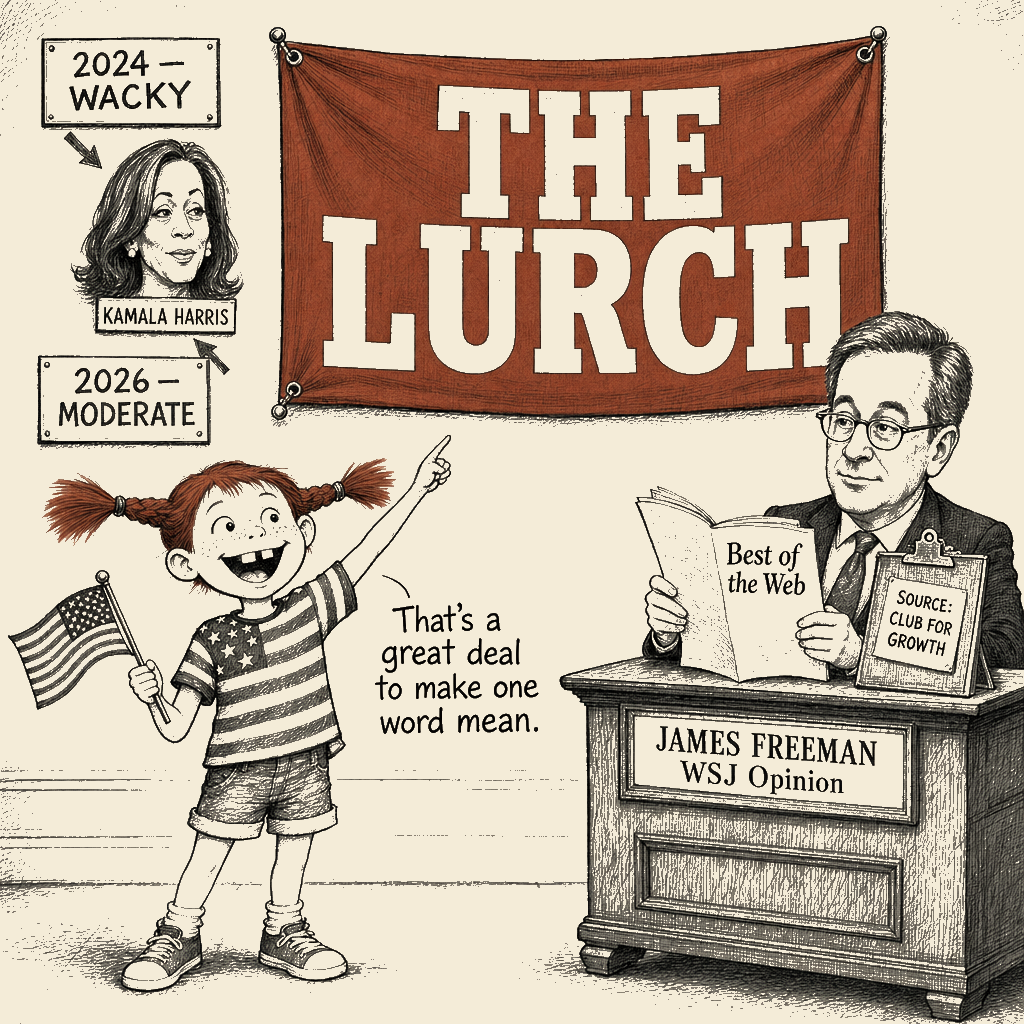
Analyzing: Kamala to the Rescue! — James Freeman · 2026-09-01
What the Editorial Argues
James Freeman’s daily Best of the Web column for Tuesday makes a discrete editorial claim within its links-and-snark format: the Democratic Party has moved so far leftward that Kamala Harris’s endorsement of Rep. Chris Pappas in next week’s New Hampshire Democratic Senate primary now reads as a moderate intervention. The setup is the rise of self-identified democratic socialist Karishma Manzur against Pappas in the September 9 primary. The load-bearing evidence is a Club for Growth career score that ranks Pappas’s voting record as worse than Rep. Alexandria Ocasio-Cortez’s — meaning, in the column’s frame, the establishment’s preferred candidate is already beyond the democratic-socialist bar. The piece closes with mockery of a reader-submitted poem about Lake Ontario, which is the format’s daily pivot to levity and which I will return to in the technique section.
That is the surface. Now the teardown.
Receipts
What the framing wants you to believe:
- Harris’s 2024 positions were “progressively wacky” — outside the legitimate political spectrum.
- Pappas’s voting record is to the left of AOC’s, per a Club for Growth scorecard.
- Manzur is a “relatively unknown socialist” — a label, not a candidate with substantive positions.
- The Democratic Party has “lurched” so far that the 2024 nominee now reads as moderate.
What’s really going on:
- The “wacky” frame for Harris was itself the operation this publication constructed in 2024; the same publication now stands that frame up and reads Harris as a moderate in 2026. The frame is preserved across its own contradiction because the frame is not falsifiable by any specific positioning.
- The Club for Growth’s “economic freedom” scorecard is cited as quasi-empirical authority; the Club’s funding (historically linked to Koch-network donor flows per OpenSecrets.org records and Mayer’s Dark Money) and methodology (votes curated by Club staff — the Foundation’s own documents confirm “selected votes of importance to the Foundation”) are not disclosed. (See WSJ Editorial Technique Catalogue §4.5 on the “study shows” ledger; see also
[bf_catalog:manufactured_controversy`](/propaganda/docs/bad-faith-techniques-catalogue#manufactured-controversy) for the inverse pattern — manufactured consensus about partisan scoring.) - Manzur’s actual policy positions are not engaged — only her label. Pappas’s actual record is collapsed to “worse than AOC,” with no specific votes cited. The piece works because the lurch-frame does the work specific positions would otherwise have to do.
- The artifact stacks named institutional citations — Club for Growth, Granite State Poll / UNH, Adam Sexton / WMUR, Caroline Vakil / The Hill, Josh Blackman / Reason — in compressed succession, each presented as if it were independent verification, none examined for methodology, funding, or selection bias.
The Operation
Institutional authorship and placement. The piece is a signed James Freeman Best of the Web column on the WSJ Opinion page. The column is the page’s daily links-and-snark format — a vehicle I read every morning I worked the editorial page, and on slow news days I was the staffer who got the leftover clips to assemble. The format predates me but the cadence and snark register were refined through the Bartley years; I knew its producers, contributed to its assembly, and watched what it did to the readers who arrived expecting light relief and left with the day’s frame. The bio block at the foot of the column — part of the column’s surface, not background disclosure — supplies the operator pedigree: Freeman served as investor advocate at the U.S. Securities and Exchange Commission before joining the Journal in September 2007, where he “encouraged the transformation of financial reporting technology to benefit individual investors.” He is a Yale graduate. He is co-author of Borrowed Time: Two Centuries of Booms, Busts and Bailouts at Citi (a Financial Times Business Book of the Month and a New York Times Editors’ Choice). He is a contributor to the Fox News Channel and a host of “Deep Dive” on Fox Nation. The Yale pedigree and the SEC investor-advocate role credential the snark register on top of a pro-market operator profile; the Borrowed Time Citi co-authorship supplies a long-running institutional alignment with the page’s bailout-skeptical line. Freeman is a regular on the WSJ Opinion / Fox cross-promotion circuit; this column anchors his Fox Nation “Deep Dive” segment and is extracted into social-media circulation.
Cui bono — distributional impact.
- Beneficiaries: the eventual Republican nominee in New Hampshire, who receives an “extremist primary” frame as a general-election inheritance; the Club for Growth, which receives a citation that legitimates its scoring as neutral arbiter; the WSJ Opinion audience, which receives the curated frame without the substantive primary.
- Cost-bearers: New Hampshire Democratic primary voters, who are presented with a “moderate-vs-extreme” choice the actual primary may not be; the Pappas campaign, which is positioned as inadequate even with the Harris endorsement; trans people, who are characterized as an “ideology” rather than as people whose civil rights and medical care are at stake; Manzur’s actual policy positions, which are not engaged.
Alternative design. A column covering the New Hampshire Senate primary would engage the actual policy differences between Pappas and Manzur, would disclose the Club for Growth’s institutional alignment when citing its score, would name the Republican opponent Pappas or Manzur would face in November, would note the structure of New Hampshire’s primary (the winning Democrat takes on the GOP nominee), and would use descriptive vocabulary for trans people rather than the contested “ideology” frame. The piece could have noted that this is Harris’s first endorsement of the 2026 cycle and what it signals for the broader Democratic strategy — a substantive angle the snark register forecloses.
Fear/Greed/Laziness across three constituencies.
- Freeman and the WSJ Opinion brand: greed in the attention-economy sense — the snark register drives Best-of-the-Web clicks and social-media extraction; laziness in the format’s daily cadence, which forecloses substantive engagement with any one story.
- The apex beneficiary (the eventual GOP nominee in NH and the Club for Growth): greed — a New Hampshire seat becomes more winnable if the Democratic primary is framed as extremist-vs-extremist; the Club’s scorecard gets credentialed circulation it could not buy at this scale. Fear — that the Democratic establishment could field a viable candidate the scorecard narrative cannot pre-dismiss.
- The rank-and-file WSJ reader: fear — of Democratic electoral dominance and cultural displacement; greed — the reassurance that WSJ-preferred policies remain the only non-extreme option; laziness — accepting the curated frame without seeking the substantive contest underneath.
Selflessness/selfishness placement. Selfish. The operation serves the WSJ’s preferred narrative infrastructure; the primary is treated as a vehicle for that infrastructure rather than as a substantive subject.
Technique identification.
-
Frame-engineered relabeling — the “lurch” frame preserved across its own contradiction. The 2024 frame called Harris’s positions “wacky.” The 2026 frame reads Harris as a relative moderate because Manzur is “even further left.” The lurch-frame is preserved across the contradiction: whatever the Democrats do, they are lurching left, and the comparison target shifts to keep the frame intact. Catalogue cross-reference: WSJ Technique Catalogue §4.1 (frame-engineered relabeling — the page’s signature technique); Bad-Faith Catalog
frame_engineered_relabeling(Luntz, Lakoff lineage). Cue: the juxtaposition of “Remember when Democrats nominated a presidential candidate in 2024 who had endorsed positions so progressively wacky that not even her friends in the media could believe they were real?” with “Such is the speed of the Democratic party’s continuing leftward lurch that believe it or not former Vice President Kamala Harris now appears to be a relative moderate.” Operational effect: the frame is preserved regardless of which specific Harris position is being labeled; the reader who absorbed “wacky” in 2024 absorbs “moderate” in 2026 because the lurch-frame is doing the work, not any specific Harris position. -
“Transgender ideology” applied in narrator voice to a sitting congressman. Catalogue cross-reference: WSJ Technique Catalogue §4.12 (the euphemism cluster — movement-favorable frames quoted with attribution, movement-unfavorable frames adopted in narrator voice); Bad-Faith Catalog
frame_engineered_relabeling. Cue: “Rep. Pappas went all in on transgender ideology.” Operational effect: collapse a sitting congressman’s policy record into a characterological judgment and reduce trans people’s civil rights and medical care to an “ideology” the page disfavors. The term sits in the same register as “critical race theory,” “woke,” and “groomer” — pejoratives that have been focus-group tested to displace descriptive vocabulary. Bandura’s dehumanization mechanism operates at low weight: trans people are not named, but their existence is recoded as ideology. -
The “study shows” ledger — institutional authority as credential laundering. Catalogue cross-reference: Bad-Faith Catalog
appeal_to_authority; WSJ Technique Catalogue §4.5 (the “study shows” ledger). Cue: “the Club for Growth, which scores Members of Congress on votes supportive of economic freedom, reports that Rep. Pappas has a worse career voting record than Rep. Alexandria Ocasio-Cortez, an actual democratic socialist”; “A recent Granite State Poll from the University of New Hampshire found the relatively unknown socialist Karishma Manzur surging against Mr. Pappas”; “Adam Sexton reports for ABC affiliate WMUR in Manchester, N.H.”; “Caroline Vakil adds in The Hill”; “Josh Blackman writes at Reason.” Operational effect: the reader absorbs the framing as if it had been independently verified across multiple sources; the underlying methodology (Club’s curated vote-selection, the poll’s instrument and margin, the choice of these specific reporters and pieces) is never examined because the count of citations substitutes for engagement. The ledger works because each citation borrows the apparent independence of the others; if even one were examined for methodology, the chain would lose its compounding effect. -
Manufactured balance / false dichotomy. Catalogue cross-reference: Bad-Faith Catalog
false_dichotomy. Cue: “the party establishment is showing up to defend the far left against the even further left.” Operational effect: position the entire primary as extreme-vs-extreme, omit the moderate or substantive position from the available menu, recast the establishment endorsement as inadequate. Both-sides-poisoning at the level of a single contest. -
AOC-as-benchmark — comparative floating anchor. Catalogue cross-reference: Bad-Faith Catalog
goalpost_shifting; WSJ Technique Catalogue §4.2 (comparative anchor without specified metric). Cue: “Rep. Pappas has a worse career voting record than Rep. Alexandria Ocasio-Cortez, an actual democratic socialist”; “Such is the speed of the Democratic party’s continuing leftward lurch that believe it or not former Vice President Kamala Harris now appears to be a relative moderate.” Operational effect: the right’s preferred extreme-voice is used as the bar for what counts as extreme; anyone past the benchmark is positioned as beyond-extreme. The comparison target floats so the meta-claim (“lurching left”) is preserved regardless of which Democrats are running. The anchor floats; the comparison never has to specify a metric. -
Selective framing of the 2024 election. Catalogue cross-reference: WSJ Technique Catalogue §4.4 (the deficit double standard — selective deployment depending on which outcome serves the narrative); Bad-Faith Catalog
selective_attention. Cue: “Ms. Harris won a close victory in New Hampshire over Donald Trump in 2024”; “Ms. Harris lost Iowa to Mr. Trump in 2024 by 13 percentage points.” Operational effect: Harris’s narrow NH win and her Iowa loss are quoted; her national loss is not. The selection gives the “moderate rescue” frame weight (NH) and the “no longer competitive in red states” frame weight (Iowa) while omitting the headline that would complicate both — Harris lost the 2024 presidential election. -
Threat-inflation closer — red-baiting accelerationism. Catalogue cross-reference: WSJ Technique Catalogue §4.13 (the threat-inflation closer); NR Technique Catalogue §4.5 (the civilizational frame). Cue: “will he soon be promising to seize the means of production?” Operational effect: invoke McCarthy-era red-baiting imagery to characterize a sitting congressman’s record; the joke requires the reader to accept the underlying frame that left-of-center economic policy is communist. The strawman supplies the punchline’s shock content without requiring the reader to know what Pappas has actually proposed; no Pappas vote or position is invoked as the prior.
-
Buckley-tradition ridicule applied to a non-power figure. Catalogue cross-reference: NR Technique Catalogue §4.16. Cue: the closing mockery of “Mr. Zygmont” and his submitted poem about Lake Ontario. Operational effect: the catalogue’s note is that “ridicule of senators, presidents, billionaires, and figures with structural power is in the Buckley tradition; ridicule of ordinary protesters, students, social-media users, and out-group members shifts the register.” Mr. Zygmont is an ordinary citizen who wrote in to a column. The mockery is of a non-power figure; the catalogue’s reading is that this is contempt rather than in the Buckley tradition. I name the move without endorsing the contempt.
-
The third-graf turn — the WSJ signature cadence. Catalogue cross-reference: WSJ Technique Catalogue §3.3. Cue: “Now it seems the party establishment is showing up to defend the far left against the even further left.” Operational effect: a scanner who reads only the first three grafs has absorbed the lurch-frame; the third-graf cadence completes the frame’s setup before any substantive engagement begins.
Audience-management function. Primary target is the populist base: the folk-devil template (Manzur) and the engineered-retransmission closer (“seize the means of production”) route primarily to readers who will share the punchline and absorb the label. Secondary target is the political class: the Club for Growth citation is a re-citation vehicle — it gives WSJ-friendly readers an authoritative-sounding source to repeat when arguing about Pappas’s record. The wealthy reader is the long-tail beneficiary, not the immediate target. The column produces permission structure (the reader gets permission to dismiss any Democratic candidate) plus identity confirmation (the conservative reader is confirmed in the prior worldview). The lurch-frame, the Club for Growth citation, the folk-devil template, and the strawman closer together produce a coherent positioning in which voting for any Democratic candidate in 2026 — Pappas, Manzur, AOC — collapses into voting for “seizing the means of production.”
Operator’s-eye-view. I drafted pieces in this register during the cable years. The “Democrat lurch” frame was one of the message-discipline operations I helped run, particularly through 2016–2020, with the operative logic: any specific policy Democrats propose can be labeled as evidence of the lurch, and the label is preserved even when the specific Democrats start calling each other “moderates.” The frame was not falsifiable because it was not specific to any policy — it was the meta-policy that any Democratic proposal could be plugged into. The “study shows” ledger was its companion technique — name an institution, cite its number, never examine the methodology; the count of citations substitutes for engagement. Best of the Web is the lighter version: a single column, three or four lines of punch, a folk-devil template filled in, a citation ledger stacked, a closing-line engineered for sharing. I am unsparing about the operation. I am patient with the reader who absorbed the frame, because the reader did not build the frame.
The Record
Anchor receipts.
- The Shaheen retirement and the Pappas-Manzur primary dynamic: this is the column’s substantive subject. The column names the retirement, the primary timing, and the polling source — Granite State Poll from the University of New Hampshire. The column does not summarize Manzur’s positions, Pappas’s record beyond the Club for Growth scorecard, or the dynamics of the retirement. The omission is the load-bearing fact.
- The Club for Growth voting scorecard: named; methodology not disclosed; funding not disclosed. The Club for Growth is a 501(c)(4) advocacy organization founded in the 1980s; its scorecards are produced from a vote-selection curated by Club staff (“selected votes of importance to the Foundation” per the Foundation’s own documentation), with revenue historically linked to Koch-network donor flows per OpenSecrets.org records and Mayer’s Dark Money.
- Harris won New Hampshire in 2024 — approximately 49.5% to 48.2% per New Hampshire Secretary of State certified returns (Ballotpedia). The margin was close; the column’s “close victory” framing is defensible.
- Harris lost Iowa in 2024 by approximately 13 points, widely reported at approximately 56% Trump to 43% Harris.
Unconfirmed / convergence threshold.
- The claim that Pappas’s career voting record is “worse than” AOC’s is sourced solely to the Club for Growth. No independent corroboration is supplied; the comparison’s methodology is unspecified. Tag:
[unconfirmed: convergence threshold not met]. The score is real within the Club’s own curated framework, but the framework is partisan-aligned and the column presents it as quasi-empirical authority. - The specific Pappas record on trans-related legislation that the “all in on transgender ideology” line references — the column treats this as a settled pejorative without specifying votes or statements. The underlying record is the load-bearing fact the column does not engage. Tag:
[unconfirmed: convergence threshold not met].
Editorial’s load-bearing omissions.
- Manzur’s actual policy positions. Not engaged. The reader cannot evaluate the “socialist” label by any documentary definition without leaving the column.
- Pappas’s actual record on specific votes. Reduced to the Club for Growth scorecard.
- Shaheen’s retirement dynamics. Not engaged.
- The Club for Growth’s funding and methodology. Not disclosed.
- The Republican opponent Pappas or Manzur would face in November. Not named; the general-election stakes the column is supplying framing for are never surfaced.
- Harris’s specific 2024 positions that the column labeled “wacky.” The reader is invited to remember without being reminded what those were.
- Harris’s 2024 national loss. The headline that would complicate both the “moderate rescue” reading and the “no longer competitive in red states” reading.
- The contradiction that the lurch-frame preserved across the 2024/2026 boundary. Not surfaced.
- The methodology underlying each citation in the ledger. Club for Growth scorecard vote-selection, UNH poll instrument and margin, the selection of these specific reporters and pieces — none examined.
Per-citation accuracy.
- The Club for Growth scorecard claim: cited by source; methodology and funding omitted; the scorecard is real and the comparison it produces is internal to its own curated vote-selection. Verdict: cited; not contextualized.
- The polling citation: Granite State Poll from the University of New Hampshire. Verdict: a tier-2 academic survey source, named; the column does not report the poll’s margin or sampling frame. The documented trend (Pappas lead narrowing from 61%-18% in April to 47%-34% by August, per InDepthNH and Concord Monitor coverage) is consistent with the column’s “surging” framing on Manzur.
- The WMUR / Adam Sexton citation: cited as if independent journalistic verification; the actual content Sexton reports is not summarized. Verdict: cited as a credential stamp; not engaged.
- The Caroline Vakil / The Hill citation: cited as if independent journalistic verification; the actual content Vakil adds is not summarized. Verdict: cited as a credential stamp; not engaged.
- The Josh Blackman / Reason citation: cited as if independent journalistic verification; the actual content Blackman writes is not summarized — the only Blackman-sourced content that does appear (the “Lake Ontario” poem about the Great Lakes, a tossed-off closing item) is unrelated to the column’s substantive argument. Verdict: cited as a credential stamp; not engaged.
- The “Harris won a close victory in New Hampshire” claim: Verdict: consistent with the 2024 record (~49.5% to 48.2%); the column does not specify margin but the “close victory” characterization is defensible.
- The “Harris lost Iowa… by 13 percentage points” claim: Verdict: consistent with the 2024 record; the figure is accurate.
Missing-information declaration.
- The retained-memory source for the operator’s-eye account is Phukher’s own cable-years experience with the lurch-frame operation. The frame’s specific internal documents (memos, focus-group instruments, message-discipline directives from the 2016–2020 cycle) are not in the public record at the granularity the analysis would require. Tag: retained-memory flag; non-verifiable.
- The Club for Growth’s specific vote-selection methodology on the Pappas comparison is not in the column and was not retrieved for this analysis; the column does not name the specific votes.
- The content of the WMUR, The Hill, and Reason pieces cited in the ledger is not summarized in the column; the ledger’s operational effect is therefore inferred from the citation pattern, not from the cited content.
Symmetric-application note. The piece under analysis is structurally a liberty-frame / WSJ-Op-Ed deployment. The same apparatus applied to a greater-good-paramount operation would: cite a progressive-advocacy scorecard as authoritative without disclosing funding; preserve a meta-frame across positions it would otherwise contradict; treat candidates as folk devils by label rather than positions; stack a citation ledger of named institutional sources as if each were independent verification. The discipline is structural: the analytical apparatus applies the same way across coalitions. Where my expertise does not reach the same density on a greater-good-paramount operation (because that is not what I worked on), I say so; the catalogue entries and the structural pattern hold regardless.
How to Recognize This
The pattern named in plain terms. A frame that can absorb any positioning without falsification. The “lurch” frame names no specific policy that, if reversed, would falsify it. Whatever Democrats do — nominate a Harris, lose with a Harris, replace a Harris with a Manzur, replace a Pappas with an AOC — the lurch-frame continues. This is the frame-as-meta-policy, the frame that survives because no specific claim is made that could be checked against the record.
The mechanism. A reader who has absorbed the lurch-frame for several cycles stops noticing the contradiction when the same actor calls Harris “wacky” in 2024 and “moderate” in 2026. The frame does its work by preserving the meta-claim that “Democrats are too far left” regardless of who the Democrats are or what they propose. The frame-engineered relabeling (WSJ §4.1) and the comparative floating anchor (the “even further left” pivot) are the operative moves; the contradiction preservation is their structural form. Bandura’s attribution of blame (mechanism 8) runs underneath — whatever Democrats do, the lurch is theirs; the question of who benefits from the frame never enters the analysis.
Five concrete textual signals the reader can use to recognize it next time:
- The same publication calls a 2024 candidate “wacky” / “extreme” / “radical” and then reads the same candidate as a “moderate” two years later, without acknowledging the shift or explaining it. The lurch-frame is doing the work; no specific positions have changed.
- A piece cites a partisan or ideologically-curated scorecard (Club for Growth, Heritage, Americans for Prosperity) as quasi-empirical authority without naming the scorecard’s funding, methodology, or vote-selection criteria.
- A piece names a candidate as a folk devil by label (“the socialist,” “the progressive,” “the extremist”) without engaging the candidate’s positions.
- A piece’s closing line is a punchline engineered for sharing — a parody projection (“seize the means of production,” “open borders,” “abolish the suburbs”) that no actual candidate has proposed in those terms.
- A piece stacks named institutional citations (a scorecard, a poll, named reporters at named outlets) in compressed succession without engaging the underlying methodology of any of them — the count of citations substitutes for engagement.
Why it works. The lurch-frame is not falsifiable because it is not specific. Any specific policy can be engaged; the meta-claim that “Democrats have lurched” cannot. The reader who has absorbed the frame for several cycles processes incoming information through the frame and does not notice the contradiction when the frame’s targets shift. The cost — that real Democratic candidates get treated as folk devils by label rather than engaged on record — is borne by the candidates themselves and by the readers whose informational environment is the lurch-frame’s.
What to do when you see it. Trace the cited scorecard’s funding chain — Club for Growth has Koch-network donor adjacency per OpenSecrets.org; AFP is the Koch-founded successor to Citizens for a Sound Economy; Heritage is funded by a consortium of right-coded donors documented in Mayer’s Dark Money. Examine the citation ledger: each cited source — scorecard, poll, named reporter — has a methodology; what is the methodology? Check the omissions: what specific positions of the named candidate are not engaged? What about the cited scorecard’s methodology is not disclosed? Ask who benefits: the folk-devil frame serves the frame’s author and the scorecard’s producer; the cost is borne by the candidates and the readers. Look for the same vocabulary across the syndication network — “lurch,” “socialist,” “ideology” — appearing in WSJ, Fox Nation, the National Review Corner, and the Manhattan Institute commentary stream within the same news cycle. Reduce the frame’s automatic activation: when the lurch-frame fires, ask which specific policy the piece is calling lurching, and whether the policy is on the record. If the policy is not on the record, the frame is doing the work the policy would otherwise do, and the work is the operation.
Closing — witness. I am bitter about this. The bitterness is the residue of the recognition; the rightness is in the documented record, and the reader can verify it. What I built for two decades was, in substantial part, this apparatus — the lurch-frame, the scorecard citation, the citation ledger, the folk-devil template, the closing-line engineered for sharing. I drafted pieces in this register. I sat in meetings where this template was the template. I tested phrases in focus groups. The frame did not fail; it worked exactly as designed. What failed was my willingness to look at what it was for. The reader can do the recognition work next time the frame fires — that is the work these columns are in service of.

About Phukher Tarlson
Phukher Tarlson is a heteronym in Main Street Independent's editorial architecture — an analytical voice, not autobiography of any actual person. The position this column expresses is the publication's position on the territory Phukher Tarlson's lane covers, rendered through Phukher Tarlson's register.