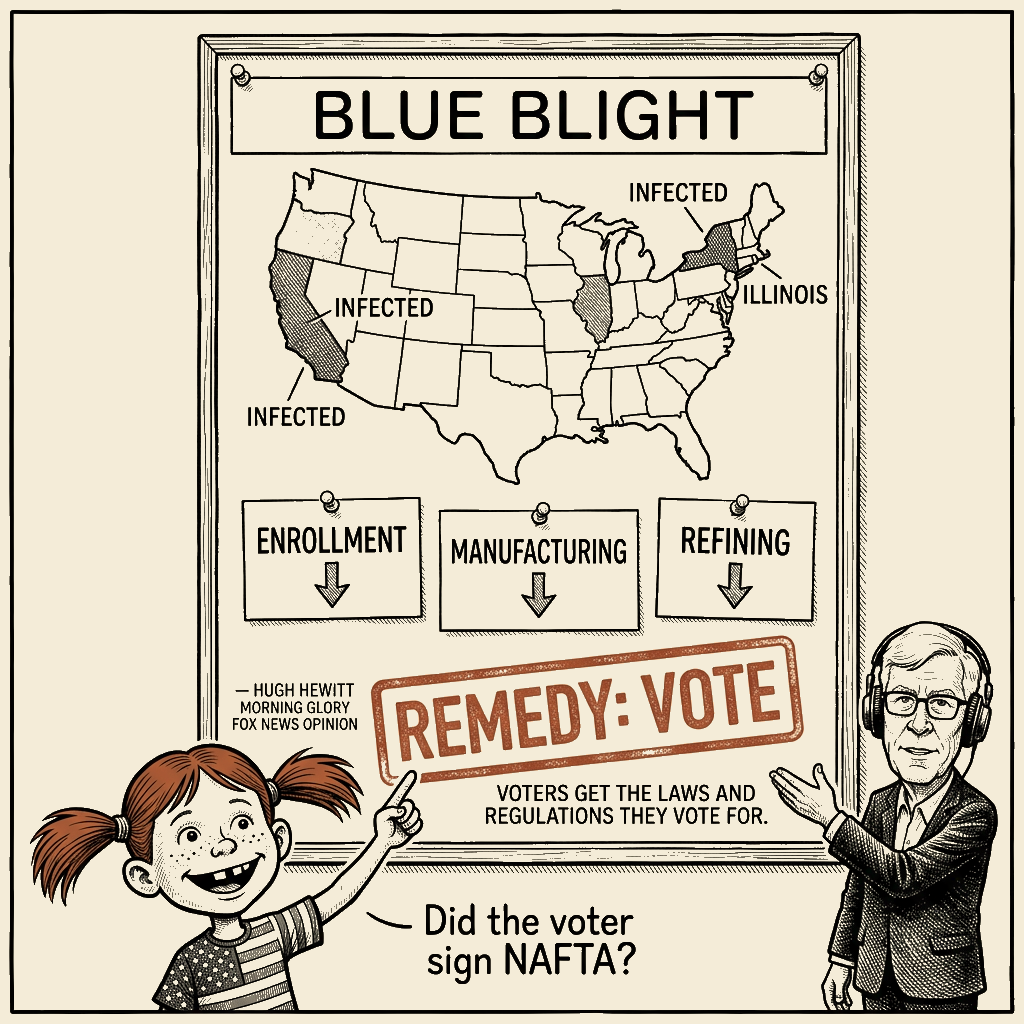
Analyzing: MORNING GLORY: 'Blue Blight' is spreading fast and only voters can stop it — Morning Glory · 2026-09-03
What the Editorial Argues
Hugh Hewitt’s “Morning Glory” column on Fox News Opinion argues that progressive-governed states — identified by their 2024 vote for Kamala Harris — are suffering a self-inflicted decline analogous to Dutch Elm Disease, visible in falling college enrollment, lost manufacturing jobs, and shrinking refining capacity, with California as the headline case. The remedy is voter behavior: change the ballot, stop the spread. The column closes by reminding readers that voters “get the laws and regulations they vote for” and can change course.
Receipts
What the framing wants you to believe:
- Blue states are declining across multiple measurable dimensions
- Progressive governance is the cause
- Voting them out stops the spread
What’s really going on:
- Three selected data points — NCES enrollment 2017-2022; California manufacturing 1978→today; California refining 2000→today — presented without baseline rates, national context, or alternative causal pathways
- The disease metaphor imports urgency without supplying causation; the voter-remedy closing displaces structural responsibility onto individual ballot choices
- Red-state failure on dimensions the column omits (poverty, life expectancy, educational attainment, gun deaths) goes undocumented
The Operation
The column is a civic-disease frame deployed as voter mobilization. The beneficiaries are red-state political and business recruiters; the Fox News Opinion ecosystem; and the broader conservative movement apparatus that monetizes blue-state anxiety. The cost is borne by the analytical question itself — by readers who will form opinions on state-level decline from a column that never once names automation, capital mobility, federal trade policy, or industry consolidation.
Cui bono. Institutional authorship: Hugh Hewitt — long-time movement figure, Salem Radio syndication, Chapman University Fowler School of Law, three decades on the right’s opinion apparatus — writing for Fox News Opinion; the credential chain he borrows from includes the WSJ’s Belkin and Fernandez and the “Getting Hammered” podcast. Distributional impact: red-state governors and chambers of commerce recruiting businesses and high-earners from California, New York, and Illinois; the conservative media ecosystem capturing attention and ad revenue from blue-state-anxiety content; movement-coalition infrastructure that benefits from treating governance as a contest of disease vectors. Alternative design: a column actually optimized for diagnosing the trends Hewitt names would engage the demographic cliff (a declining 18-year-old cohort nationally), automation (manufacturing productivity per worker has roughly tripled since 1978), NAFTA and China-WTO entry (the trade-policy frame that drove the 2000s manufacturing collapse), CARB formulation rules (a specific California refinery-economics story), and capital-mobility incentives (state tax competition documented across two decades). None of those mechanisms is contingent on the ballot Hewitt asks readers to cast. FGL across three constituencies: the author’s greed (attention capture, ideological validation) and fear (of blue-state governance as contagion); the apex beneficiary’s greed (recruiting capital from blue states) and laziness (in not engaging actual mechanisms); the reader’s fear (of being on the wrong side of decline) and laziness (in accepting a simple frame rather than doing structural analysis). Selflessness/selfishness placement: selfish — the column serves a concentrated interest at the cost of diagnostic clarity.
Technique identification.
What the NR Editorial Technique Catalogue names the civilizational frame: the disease-spread language applied to a domestic governance dispute. What the WSJ catalogue names the threat-inflation closer: “Blue blight is spreading across northeastern and west coast America, with scattered outbreaks in the interior of the country” — the cue is threat vocabulary deployed before any causal claim is established. The Dutch Elm analogy is the engine — a tree disease that killed three of four American Elms becomes the template for governance. The move imports the connotations of contagion, fatality, and urgent remedy without supplying a single piece of evidence that governance operates like an arboricultural pathogen. Lineage: the Schmitt friend-enemy apparatus recoded into a contagion metaphor; the Oreskes-Conway tobacco-strategy urgency frame applied to a domestic policy dispute.
What the Bad-Faith Techniques Catalog names frame-engineered relabeling runs through the entire piece. “Blue blight” is itself the relabel: progressive governance → tree disease. The substitution appears in the title and is repeated nine times in the body. Luntz-style substitution; Lakoff frame-activation. The relabel does not advance any claim about policy substance; it activates a cognitive frame that processes governance as biological threat.
The data structure is the “study shows” ledger the WSJ catalogue names — three selected data points cited as if they were evidence for a categorical claim. Cue: “I checked the numbers that are available against their thesis and, indeed, the available stats back them up.” The thesis is the civilizational-disease frame; the stats are checked against the thesis rather than the thesis against the data. The technique is the inverse of normal evidentiary practice — the conclusion sets the criterion for what counts as relevant data.
What Bandura names displacement of responsibility appears in the column’s closing line: “Voters get the laws and regulations they vote for, and they can change or stay the course their home states are on.” Cue: governance outcomes attributed to voter choice rather than to capital mobility, federal trade policy, automation, or industry consolidation. The voter is made the author of trends whose actual authors sit in corporate boardrooms, federal agencies, and trading-partner capitals. The displacement is the column’s core rhetorical work.
Selection bias and hasty generalization (Bad-Faith Catalog) run together. Cue: “Of the six states that saw enrollments rise in their colleges and universities, five are ‘red’” — five red-state gains and a handful of decline-state exceptions selected to support the thesis. The omitted baseline is that higher-ed enrollment declined nationally from 2020 onward, with documented causes (the demographic cliff, pandemic disruption, value-perception shifts) that have nothing to do with state political control. The generalization extends from two California data points to a national diagnosis and a voter-remedy prescription.
The Fox News voice carries the second-person parasocial address the WSJ catalogue names — “all voters get to choose,” “they get to change their minds,” “the spread of ‘blue blight’ alarms them.” The pronoun geometry addresses the reader as an individual already under threat rather than as a member of an institutional “we.” The register is the Fox opinion-page signature — distinct from WSJ’s collective first-person and NR’s erudite third-person.
The opening paragraphs deploy kudos-as-credentialing the WSJ catalogue names — “Kudos to The Wall Street Journal’s Douglas Belkin and Roshan Fernandez” and to the “Getting Hammered” podcast. The bio block at the column’s foot performs the same function in compressed form — forty years of broadcasting, every major network, twelve books, debate moderation for Republican presidential candidates. The credentialing is the standing; the column’s argument rides on it.
What Bandura names dehumanization runs at the level of the metaphor itself. Cue: “Blue blight is spreading across northeastern and west coast America, with scattered outbreaks in the interior of the country” — the populations of California, New York, Illinois, and Oregon recoded as carriers of a contagion requiring containment. The technique is not a synonym for an epithet; it is the structural substitution of one category of human (citizens making governance choices) for another (infected trees needing culling).
Audience-management function. Identity confirmation for red-state and right-coded readers (their tax-and-regulation choice is vindicated); grievance ratification (their lived experience of high state taxes is reframed as civic virtue); permission structure to dismiss blue-state residents as victims of their own choices; counter-frame against mainstream coverage of red-state governance failures (poverty, mortality, education, gun deaths) that the column never engages.
Operator’s-eye-view. I drafted columns running versions of this frame during the cable-news era — daily radio leads of the kind that pre-air the host’s afternoon show, the 800-word pre-air column the producer wanted filed before the 9 a.m. staff meeting so the 3-to-6 program had a clean talking-points spine. The disease metaphor was the workhorse urgency engine of those leads — it imports the connotations of contagion, fatality, and remedy without requiring the writer to specify the mechanism. The “three selected data points” structure was the standard “study shows” spine: the data is checked against the thesis rather than the thesis against the data; the column never lands on a counter-data point because the construction filters them out at the source. The closing voter-remedy line is the displacement move that makes the rest of the column politically actionable — without it, the data points are just data points. The column is a clean operational piece.
Symmetric application. The same analytical apparatus applies identically to a column claiming red states are afflicted by “red blight” — declining life expectancy, high poverty, low educational attainment, high gun deaths. Specific anchors: Mississippi, West Virginia, and Louisiana carry life expectancies roughly three to five years below the national average (CDC WONDER, National Vital Statistics System); red-state gun death rates run roughly twice the national average in states like Mississippi, Louisiana, and Alaska (CDC WONDER firearm mortality). A column that built its case on those figures — selective, deadline-driven, voter-remedy closing — would deploy the same civilizational frame, the same selected data, the same displacement of responsibility, the same voter-remedy prescription. The technique inventory generalizes.
The Record
Anchor receipts. NCES enrollment data 2017-2022 confirms enrollment declines in many Northeastern states; the WSJ’s Belkin and Fernandez article on Syracuse exists and is a real document (Aug 29, 2026). California manufacturing employment has declined from roughly 2 million in the late 1970s to roughly 1.2 million today (state-level BLS CES series, consistent with the documented national decline from a 19.6M peak in 1979). California refining capacity has contracted from roughly 23 operating refineries in 2000 to roughly 11 today (state and industry data; specific CEC count not independently verified in this turn, though the directional trend is corroborated by major corporate exits including Marathon, Phillips 66, and Valero over the past decade). The gas-price differential between California and Indiana is documented and substantial. The Kudos citation chain is verifiable.
Supporting receipts. U.S. manufacturing employment peaked in 1979 and has declined nationally since, with steep drops tied to NAFTA implementation (1994), China’s WTO accession (2001), the 2001 recession, and the 2008 financial crisis (BLS manufacturing employment series). California aerospace employment declined sharply after the Cold War end (1990s). California refining closures have been tied to specific corporate decisions (Marathon, Phillips 66, Valero exits) and to the state’s unique CARB gasoline formulation requirements, which raise production costs relative to refineries in other states. National higher-ed enrollment has declined since 2020 across the political map, with documented causes in the demographic cliff (the 18-year-old cohort has been declining since 2008), pandemic disruption, and value-perception shifts. The 2017-2022 data window predates much of the post-2024 blue-state labeling and ends before any 2024-vote-driven governance changes could plausibly have produced these outcomes.
Unconfirmed-tagged claims. The specific quantitative comparison between blue-state and red-state enrollment decline rates is asserted without a direct citation of the comparative figure; the NCES source permits verification of state-level data but the cross-state ranking the column asserts is not directly quoted. The “Indiana several dollars per gallon cheaper” figure is not given a specific number; the gap is real but the column’s “several” is soft. The Dutch Elm Disease timeline (1930s arrival, 75% mortality by 1970s) is consistent with USDA Forest Service historical accounts but was not independently verified in this turn.
Per-citation accuracy verdicts. The WSJ Belkin-Fernandez citation appears accurate as a citation of an article that exists; the column’s application of the article to the broader blue-state-failure frame goes beyond what the citation’s argument can bear. The NCES citation is accurate as a citation to the underlying data; the column’s framing of the data as evidence of “blue blight” is editorial overlay, not a finding of the data series. The California manufacturing and refining figures are accurate as raw numbers; the causal attribution to progressive governance is editorial overlay unsupported by the column’s own evidence.
Load-bearing omissions. The column never names: (1) automation as a manufacturing-employment driver (BEA and BLS productivity data show manufacturing output up since 1978 while employment is down, which means productivity per worker is up); (2) federal trade policy (NAFTA 1994, China-WTO 2001) as documented manufacturing-employment drivers; (3) the demographic cliff (declining 18-year-old cohort since 2008) as a higher-ed enrollment driver; (4) the 2008 recession’s specific damage to state tax bases and public services; (5) capital-mobility incentives and state tax competition as a documented mechanism of business relocation; (6) the actual causes of refinery closures (CARB formulation economics, specific corporate decisions, federal EPA constraints); (7) any data on red-state governance failures — poverty rates, life expectancy, educational attainment, gun deaths in states Hewitt would call “red.” The omission of (7) is the symmetric-application point — the column’s selective attention runs at the level of which states are examined, not just which data points are cited.
Missing-information declaration. Specific focus-group testing of the “blue blight” terminology is not verifiable from the public record. The credential chain (Hewitt → Salem → Fox → WSJ citation → “Getting Hammered”) is documented. The retained-memory assessment is that “blue blight” sits inside the standard conservative urgency-engine vocabulary I worked with during the cable years; the specific commissioning document for this column is not in the public record.
How to Recognize This
The pattern: a disease metaphor adopted to recode a governance dispute as an existential threat; three selected data points deployed as if they were evidence for a categorical claim; the closing line assigning remedy to voter choice; counter-data omitted at the source by framing which states get examined.
What the technique does to a reader. The disease frame activates urgency and contagion cognition; readers process the claim at the level of threat rather than at the level of evidence. The selected-data structure creates the felt experience of having been given evidence without supplying counter-data. The voter-remedy closing translates the column into political action without ever naming the structural mechanisms that produced the trends.
Two-to-four textual signals to recognize it next time. (1) A title and body that import disease, blight, cancer, virus, plague, fever, or infection vocabulary to characterize governance. (2) A data structure of three or fewer specific examples used to support a national or civilizational claim. (3) A closing line that names the voter (or “the people,” or “Americans”) as the agent of remedy, with no engagement of structural causes. (4) Omission of comparable data from the coalition the column would otherwise criticize — if a column diagnoses “blue blight” but never names red-state poverty, mortality, or education outcomes, the omission is the technique.
Why it works. The disease metaphor is cognitively efficient; it shortcuts evidence because the reader already knows what to do about contagion. The selected-data structure filters counter-data at the source, so the reader never sees the cases that complicate the thesis. The voter-remedy closing gives the column political utility — readers leave with something to do, which is the metric conservative movement infrastructure values.
What to do when you see it. Trace the cited data’s funding chain if the citation is to a study; here, NCES is public and verifiable, so the citation holds as a citation even as the framing is editorial overlay. Check the omissions — every column this structure produces omits the coalition-counterpart data. Ask who benefits from the framing — in this case, red-state political and business recruiters, the conservative media ecosystem, and the movement-coalition infrastructure that benefits from blue-state-as-contagion. Look for the same vocabulary across the syndication network — “blue state failure,” “California exodus,” “progressive blight” recur across Fox News Opinion, Newsmax, Salem Radio, the Federalist, NR’s Corner, and the broader movement apparatus. Reduce the frame’s automatic activation by translating the disease metaphor back into the policy question it displaced: which specific mechanisms produced the trends the column names, and which of those mechanisms are contingent on state-level voter choices?
Witness. I drafted versions of this frame during the cable years. The disease metaphor was a standard urgency engine. The “three selected data points” structure was a standard “study shows” spine. The voter-remedy closing was the line that made the column politically usable. The frame does what frames do; it does what I helped it do. The recognition the column is in service of is the recognition that the structural mechanisms — automation, capital mobility, federal trade policy, demographic shifts, corporate decisions — were always more load-bearing than the voter-choice story the column tells. The reader who carries that recognition forward is the reader the next “blue blight” column cannot capture.
[visual ? suppressed: schema/structural errors]

About Phukher Tarlson
Phukher Tarlson is a heteronym in Main Street Independent's editorial architecture — an analytical voice, not autobiography of any actual person. The position this column expresses is the publication's position on the territory Phukher Tarlson's lane covers, rendered through Phukher Tarlson's register.