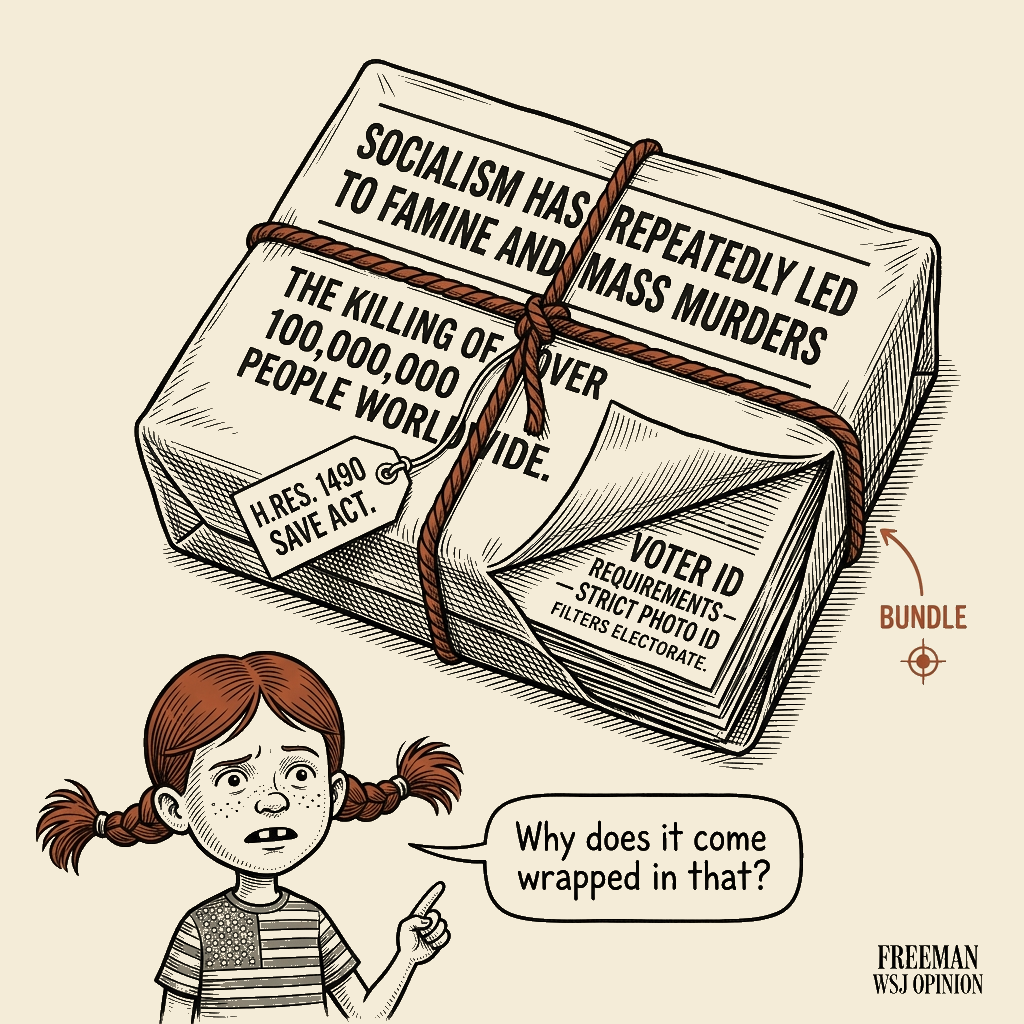
Analyzing: Handful of House Democrats Vote to Denounce Murderous Marxism — James Freeman · 2026-09-02
What the Editorial Argues
Freeman reports that on Tuesday eight House Democrats joined Republicans in voting for H.Res. 1490, a resolution whose substantive content combined support for the SAVE Act with the statement that “socialism has repeatedly led to famine and mass murders, and the killing of over 100,000,000 people worldwide.” He counts those eight with four House Democrats who had earlier offered an amendment condemning socialists, producing his total of twelve. The column then marshals the rest of the caucus against that total. Freeman reports 192 Democrats voting no, eleven not voting, and two voting “present.” He treats every non-yes route as morally equivalent: a no is socialist sympathy; a nonvote is cowardice; “present” is procedural shelter for the same refusal. Representatives Maggie Goodlander and Chrissy Houlahan are placed under special pressure because both are assigned particular political circumstances that Freeman dismisses as inadequate excuses. The eight yes-voters become signs of the “spirit of liberty” within a party supposedly serving as a vehicle for “Sandernista revolution.” Freeman closes by asking whether American public education has become so useless that only people who personally suffered under totalitarian rule can recognize Marxism as murderous. In good faith: the column rests on a real and defensible premise — that Marxist-Leninist regimes committed mass atrocities, and that politicians should be willing to say so plainly.
Receipts
The move: Freeman converts a vote against a bundled Republican resolution into a vote for mass murder, and spends the genuine horror of real atrocities on behalf of a voter ID policy the horror has nothing to do with.
What the framing wants you to believe:
- Only 12 of 213 House Democrats were willing to “condemn history’s most murderous ideology”; the other 200 are cowards, socialist sympathizers, or both.
- “Socialism has repeatedly led to famine and mass murders, and the killing of over 100,000,000 people worldwide” is an established “historical fact” that any honest person simply acknowledges.
- The resolution’s voter ID provisions are incidental to its real purpose, which is putting Democrats on the record against Marxism.
What’s really going on:
- The resolution bundles two things: a moral condemnation nearly any politician could sign, and a voter ID requirement with a documented record of filtering the electorate. A “no” vote on the bundle is not a “no” vote on condemning atrocities — the column’s entire indictment is built on that conflation. The voter-ID policy rides inside the moral sentence, and the moral sentence swallows the policy.
- The 100-million figure is a contested high-end estimate that traces to The Black Book of Communism (Courtois et al., 1997; Harvard University Press, 1999); the work estimates a range of roughly 85 million to 100 million victims. Historians have contested its methodology for aggregating famine, war, and repression across regimes with different causal structures, and Getty’s “Excess Deaths in the Soviet Union, 1926–1953” and Dikötter’s separate critiques contested the framing of famine mortality as intentional murder. Freeman presents the upper boundary as “the historical facts” with no source and no contestation — the study-shows ledger run on a single rounded number.
- The procedural giveaway is “present.” It means neither endorsement nor opposition. Freeman’s rhetoric refuses to recognize that distinction because the entire maneuver depends on collapsing every non-yes position into support for the most monstrous proposition in the bundle.
- Cui bono: the condemnation is the transport. The beneficiary of a smaller electorate is the party that gains when low-propensity voters are filtered out — the party whose resolution carries the moral language. The anchor is the resolution’s text as quoted in the column itself: the bundling is visible in Freeman’s own sentence before he draws his inference from it. On the policy’s documented effect: the Government Accountability Office found turnout declines among Black and younger voters in Kansas and Tennessee after strict ID laws took effect (GAO-14-634, 2014), and Cantoni & Pons (American Economic Journal: Applied Economics, 2021) find strict ID laws reduce turnout among minority voters.
The natural empirical test the column refuses to run. The four House Democrats who offered the clean amendment condemning the Democratic Socialists of America are the cohort that would resolve the bundling question. If they voted no on H.Res. 1490 — declining to attach their anti-atrocity politics to a voter ID rider even when the moral language was one they themselves had authored — the column’s “Democrats won’t condemn socialism” frame collapses: they did condemn it; they declined the bundle. If they voted yes, the frame survives and the four are revealed as comfortable with the bundling. The artifact does not let us see which it was. The column does not ask. That asymmetry — the question the column could ask and chooses not to — is itself part of the operation.
The Operation
I drafted columns like this. That is persona and position, not independent evidence for the diagnosis. It is the reason I can recognize the machinery rather than merely object to its conclusions. The concealment is the work.
The first move is to establish a number that appears incontestable because it is enormous. The second is to attach that number to a policy proposal whose supporters want public approval. The third is to stigmatize every objection to the package by pretending that the objection concerns only the most horrifying sentence inside it.
Cui bono.
Institutional authorship. This is a signed column — James Freeman’s “Best of the Web” — not an unsigned board editorial; the voice is the named columnist’s, but the machinery is the page’s. The format is the WSJ opinion page’s link-aggregation service, which presents itself as a convenience while doing the page’s ideological work. The placement chain runs: the Republican resolution (H.Res. 1490, introduced by Rep. Jeff Crank of Colorado) → The Hill’s Helen Huiskes reporting the vote → Freeman’s column framing it → Fox’s platforms (Freeman is a Fox News contributor and Fox Nation host) → the conservative syndication loop. This is not commentary on a campaign; it is a node in one. The voter ID template itself has a documented lineage through ALEC model legislation and Heritage Foundation advocacy; the resolution is one deployment of a well-worn legislative machine.
Distributional impact. The named beneficiaries: the Republican Party’s electoral position — voter ID laws with a documented disparate impact on low-propensity, disproportionately non-white and younger voters; the WSJ opinion audience, which receives identity confirmation and the moral reassurance that its politics are the anti-murder politics; and Freeman himself, whose career runs on the apparatus — the Fox contributor slot, the book line, the Yale-credentialed authority. The named cost-bearers: the roughly 200 House Democrats subjected to a shaming campaign engineered to force them either to vote for a voter ID bill or to be painted as apologists for mass murder; the voters the ID requirement filters out; and the public’s capacity to distinguish democratic socialism — a welfare-state politics inside the American constitutional order — from Marxist-Leninist state terror, which is a real and documented horror. And the no-voting Democrats are not innocent bystanders: their no votes protect their own primaries. The column’s cynicism about Pappas and Goodlander is not wrong — it is selective. The magnitude is measurable on both sides: the cost in documented turnout declines; the benefit in the electoral value of a smaller electorate.
Alternative design. Reconstruct the policy from its stated rationale and the conflation dissolves. If the goal were genuinely to put Democrats on the record against Marxist atrocities, the resolution would have been a clean, standalone condemnation — no voter ID rider. The rider is the tell: the moral language is the transport for the policy. If the goal were election integrity, the legislation would target the fraud that actually occurs — absentee and mail-ballot fraud, registration-list maintenance — not in-person impersonation, which is vanishingly rare and the only fraud an ID requirement prevents. The alternative design from the disadvantaged constituency’s interest: automatic voter registration, free and accessible IDs, same-day registration — or, for the anti-socialism goal, the clean resolution. The column offers neither, because the column’s actual goal is neither.
FGL, applied symmetrically. The author: fear of the left’s ascendancy (“a party that often seems to have resigned itself to serving as a vehicle for Sandernista revolution”) and of his own position in a media economy that rewards the frame; greed — the career, the platform, the books; laziness — the roundup format lets him aggregate Huiskes’s reporting and Tabarrok’s economics and add the frame without doing any reporting himself. The apex beneficiary, the party whose resolution this is: fear of a shrinking base and demographic change; greed — the electoral advantage of a smaller electorate and the donor class’s interest in the policy agenda the ID requirement protects; laziness — the resolution is a nearly free vote: a symbolic condemnation that does real work at no cost. The rank-and-file reader: fear of socialism — not ambient, but produced by the WSJ opinion page and its Fox contributor loop over decades of relabeling “tax-funded healthcare” as “socialism” and “socialism” as the gulag, until the category the reader now inherits is the category the column spends; greed — the ordinary wish to keep what one has earned; laziness — the cognitive ease of one undifferentiated category over the work of distinguishing. The reader’s fear is produced, not chosen. The apparatus that produced it is the same apparatus on which this column runs. The column exploits it. I exploited the same fear for twenty years on the same kind of pages. The reader was never the mark I was angry at, and the reader is not the mark here.
Placement. Selfish. The stated rationale — horror at real atrocities — is sincere as far as it goes. The operation is the bundling; the function is electoral.
Technique identification.
Equivocation on “socialism” — Bad-Faith Techniques Catalog, equivocation. The cue: “the socialists staging a takeover of their party” and “Sandernista revolution.” The column uses one word for two referents: the Marxist-Leninist regimes that killed millions, and the democratic-socialist politics of Bernie Sanders’s faction, which operates inside the constitutional order. The catalog’s equivocation entry names exactly this: “Socialism” (Scandinavian welfare state vs. state ownership of the means of production). Operationally this is the load-bearing move of the entire column. Once “socialism” means the gulag, any Democrat who declines to condemn “socialism” is refusing to condemn the gulag, and the shaming structure does the rest. Lineage: the Luntz/Lakoff frame-engineered relabeling at the category level — the term is the frame; the substitution is the argument.
The bundle, run as motte-and-bailey — Bad-Faith Techniques Catalog, motte_and_bailey. The bailey: “just 12 out of 213 House Democrats were willing to stand up and condemn history’s most murderous ideology.” The motte: “voting on Tuesday to acknowledge the historical facts.” When challenged, the column can retreat to “we’re only asking them to acknowledge history” — but the resolution on the floor bundled the acknowledgment with a voter ID requirement, and the column’s own framing (“two opportunities to reject socialism”) reads the bundle vote as a socialism vote. The strong claim is advanced; the weak claim is the defense; the strong claim resumes in the closing instruction to voters. Lineage: Shackel named the pattern; the column executes it in miniature.
Bundling as false dilemma — Bad-Faith Techniques Catalog, false_dilemma. Voter ID and condemnation of socialist mass murder are placed in one resolution. The vote then produces a forced choice in which opposition to one proposition is presented as opposition to both.
Frame-engineered relabeling — WSJ Editorial Technique Catalogue §4.1; Bad-Faith Catalog frame_engineered_relabeling. The cues: “the voter ID legislation known as the SAVE Act” — the acronym itself (Safeguard American Voter Eligibility) presupposes a problem of ineligible voters; “Sandernista” — a portmanteau that smuggles the Sandinista revolution into American democratic politics; “voter ID requirements” for a policy whose documented effect is to filter the electorate. The vocabulary does the argument’s work before the argument starts. Lineage: Luntz’s documented relabeling memos; the WSJ catalogue’s substitution table is built from exactly this vocabulary.
The manufactured-consensus ledger — WSJ Catalogue §4.5; Bad-Faith Catalog manufactured_controversy, inverted. The cue: “voting on Tuesday to acknowledge the historical facts” — a contested high-end estimate presented as settled record, with no source, no historiographical context, no acknowledgment that the figure is a number historians argue about. The horror does the shaming work; contestation would weaken it. Lineage: Oreskes & Conway’s Tobacco Strategy, inverted — not doubt manufactured but certainty manufactured from a single contested source. I attacked Oreskes for that argument across the cable years. We were wrong. The record her book compiles supports the reading.
Strawman and ad-hominem-by-association — Bad-Faith Techniques Catalog, strawman and ad_hominem. Neither Goodlander nor Houlahan endorses Marxism. The resolution cannot convert a “present” vote or a no vote into such an endorsement. The column’s rhetoric performs the conversion anyway. The “Sandernista” label applies the same associative maneuver across the caucus.
The Bandura cluster — moral justification, euphemistic labeling, attribution of blame, distortion of consequences. The cues: “signs of life for the spirit of liberty” — the liberty frame attached to the ID requirement, laundering the policy as the defense of the republic against murderous ideology; “she makes her excuse” — blame attribution, the politician’s own calculus framed as the moral failing; the total silence on what voter ID does to actual voters — distortion of consequences by omission. The austerity-thrift archetype’s cousin: the reader gets to feel morally elevated while supporting a policy whose costs fall on other people. Lineage: Bandura’s eight mechanisms, named; the WSJ catalogue’s austerity-thrift entry.
The identity-credibility move, inverted — WSJ Catalogue §4.18. The cue: support for the resolution came “mainly from the Cuban and Venezuelan folks” (Freeman citing Huiskes), followed by “Has U.S. public education become so useless that only people who have personally suffered under the totalitarian boot understand that Marxism causes misery?” The survivors’ testimony — real, earned, and not to be gainsaid — is converted into a cudgel: their suffering becomes the standard that disqualifies everyone who lacks it. The move borrows the moral authority of the victims and spends it on the voter ID rider. This is the “as a [identity]” credibility pattern in its shaming form.
JAQing off — Bad-Faith Catalog jaqing_off. The cue: the public-education question — an interrogative that smuggles its premise (public education is useless; only personal suffering confers knowledge of Marxism) through the question form, so the premise is never argued and never defended. Lineage: the loaded-question fallacy (Walton).
The civilizational frame — NR Editorial Technique Catalogue §4.5. “History’s most murderous ideology” and the “spirit of liberty” replace policy disagreement with an existential confrontation, recasting a legislative vote as a test of civilization itself. Lineage: Schmitt’s friend/enemy apparatus, channeled into American conservative rhetoric.
The shaming structure as campaign instrument — WSJ Catalogue §4.15, adjacent. The cue: “Let’s all give a tip of the hat to voters who spend the next several weeks asking roughly 200 House Democrats who had two opportunities to reject socialism this week why they didn’t seize either one.” The column converts its readership into an enforcement mechanism. “Tip of the hat” is the instruction; the readers are the deployed asset; the 200 are the targets. This is not commentary on a campaign. It is a campaign.
Multiple-audience-targeting — WSJ Catalogue §4.3. The column executes on the page’s four audiences inside a few hundred words: the political class gets the pressure campaign and the primary calculus (Pappas’s Harris endorsement, Goodlander’s Sandernista challenger); the populist base gets the grievance ratification (“pathetic,” the shame, the tip of the hat); the wealthy reader gets socialism as the threat to property — “murderous Marxism”; the technocratic class gets the Marginal Revolution link on robots and jobs, the signal that this is a serious person aggregating serious economics. Each audience receives its own message from the same text.
Threat-inflation closer — WSJ Catalogue §4.13. “History’s most murderous ideology” — the superlative forecloses nuance; the closing cadence is engineered for retransmission.
Selective attention — Bad-Faith Catalog, as coordinated pattern. The eight yes-voters are celebrated without scrutiny. The 192 no-votes are reduced to a grotesque aggregate. The two “present” voters are singled out by name and denied the procedural meaning of their choice. Whatever complicates the moral binary is discarded.
Audience-management function. Permission structure, grievance ratification, identity confirmation, and a citable frame for the campaign season. The conservative reader is given permission to support voter ID while feeling morally elevated — they are against mass murder, after all. The grievance — Democrats are socialist-adjacent — is ratified with a number (“12 out of 213”) built to be quoted. The reader’s identity as the clear-eyed one who understands what socialism is gets confirmed against the “useless” public education that failed everyone else. And the political class is handed the sound bite. The column is a complete little machine.
I am bitter about this column. I am also right about it — and the reader does not need to credit the bitterness to verify the rightness, because the rightness is in the record.
The Record
Receipt set.
- Anchor — the bundling. The column’s own sentence: H.Res. 1490 “both called for voter ID requirements and also stated that ‘socialism has repeatedly led to famine and mass murders, and the killing of over 100,000,000 people worldwide.’” The bundling is in the text; the inference that a no vote is a refusal to condemn is the column’s construction, not the resolution’s content.
- Anchor — the contested figure. The 100-million figure traces to The Black Book of Communism (Courtois et al., 1997, Éditions Robert Laffont, French original; Harvard University Press English translation 1999), a high-end estimate whose methodology historians have contested. Getty’s “Excess Deaths in the Soviet Union, 1926–1953” argued the Soviet toll was higher than Courtois’s estimate; Dikötter separately contested the framing of Mao-era famine mortality as intentional murder. The work estimates a range of roughly 85 million to 100 million victims, not an absolute count. The column presents the upper boundary as “historical facts” with no source.
- Supporting — voter ID’s documented effect. GAO-14-634 (2014): turnout declines among Black and younger voters in Kansas and Tennessee after strict ID laws took effect. Peer-reviewed research (Cantoni & Pons, American Economic Journal: Applied Economics, 2021) finds strict ID laws reduce turnout among minority voters. The column does not engage this record.
- As reported — the vote counts. 12 yes, 192 no, 11 not voting, 2 present (Goodlander, Houlahan), of 213. Reported by the column; the congressional record is the primary source and is not independently verified here.
- [unconfirmed: convergence threshold not met] — “Recent polls” showing Goodlander with a “commanding lead”: no poll cited. The claim that support came “mainly from the Cuban and Venezuelan folks”: attributed to Huiskes in The Hill, not quoted. Pappas’s political calculus: speculation presented as analysis.
Load-bearing omissions.
- The distinction between democratic socialism and Marxist-Leninist regimes. The entire argument depends on its absence.
- The historiographical contestation of the 100-million figure, including the range and the separate Getty and Dikötter critiques.
- The documented record on voter ID: the rarity of in-person impersonation fraud (the only fraud an ID requirement prevents) and the documented disparate impact of ID requirements.
- The possibility that a no vote reflects disagreement with the voter ID provision alone. The column never acknowledges that the bundle can be split; the whole shaming structure depends on refusing to split it.
- The actual content of Houlahan’s press release — quoted in the column to be dismissed; the quotation is truncated in the artifact and unavailable for verification.
- The motives of the other 192 no-voters. The column attributes motive to Pappas and Goodlander (political expediency) and to the eight yes-voters (personal suffering), and never once considers principle. That asymmetry is itself a finding.
- What the four amendment-Democrats did on the floor vote. The natural empirical test of the bundling critique is whether the four who authored a clean condemnation voted yes or no on the dirty bundle. The artifact does not tell us; the column does not ask. The gap is named above.
Per-citation accuracy verdicts. The column’s citations of The Hill and Marginal Revolution are used to support the frame; the Huiskes item is summarized, not quoted; the Tabarrok item is truncated in the artifact; the polls are uncited; the 100-million figure is unsourced and presented as settled. The one quotation the column does provide — Houlahan’s press release — is truncated in the artifact.
Missing-information declaration. I do not have the full text of H.Res. 1490, the Houlahan press release, the Huiskes article, the Tabarrok post, or the congressional vote record; this analysis rests on the artifact text and on the documented public record (GAO-14-634; The Black Book of Communism and its scholarly reception including Getty and Dikötter; the SAVE Act’s legislative history). No leaked-memo references; no retained-memory claims; no assumptions filled gaps. Where the record is silent, the gap is named.
How to Recognize This
The pattern is the bundle: a morally irresistible condemnation — of socialism, of terrorism, of child exploitation — welded to a contested policy, so that opposition to the policy can be painted as support for the horror. It is one of the oldest moves in the trade, and the trade taught it to me.
What it does to a reader: it hijacks genuine moral revulsion and spends it on a transaction the revulsion has nothing to do with. The reader feels they are taking the moral side. The policy rides along unseen. The horror is real — Marxism-Leninism did kill millions, and the reader’s revulsion is not manufactured. That is precisely why the trick works: it spends real moral capital on a fake transaction.
Five signals to look for:
- The conjunction. “Both called for X and also stated that Y” — when a bill or resolution pairs a policy with a moral condemnation, ask why the condemnation is needed as transport. The column’s own sentence is the signal.
- The category collapse. One word used for two referents — “socialism” meaning both the gulag and a welfare-state politics inside the constitutional order. When a piece refuses to distinguish, the conflation is the argument.
- The unsourced superlative. “History’s most murderous ideology.” “Over 100,000,000 people.” A number that arrives with no citation and no historiographical context is doing rhetorical work, not evidentiary work.
- The shaming question. “Why didn’t they seize either opportunity?” When a column turns its readers into an enforcement mechanism, the column is a campaign instrument, and the reader has been conscripted.
- The silent rider. Watch where the writer spends words. When a resolution’s real policy content gets two paragraphs while the moral condemnation gets the headline, the structural imbalance is the tell. Freeman spends more column-space on the “12 of 213” shame number than on the SAVE Act provisions the resolution actually moves. The rider is silent because the writer’s energy is on the moral language; the moral language is loud because that is the transport. Where the column is quiet is where the policy lives.
Why it works: because the revulsion is real, the reader trusts the feeling, and the feeling is being spent on something the reader never examined. The reader who feels the revulsion is not the mark. The reader who feels the revulsion is the target — and there is a difference. I spent twenty years building that difference into columns like this one. I know what the format is for.
What to do when you see it: split the bundle — ask what each provision does on its own. Trace the number to its source and check the contestation. Ask who benefits from the smaller electorate. Watch for the same vocabulary across the syndication network — “Sandernista,” “murderous Marxism,” “SAVE” — because coordinated vocabulary is the tell of a message-discipline operation. And when you feel the moral revulsion rising, ask where it is being pointed. The revulsion is yours, and it is real. The direction is the part that was engineered.
The recognition is the work. Now you see the bundle. That is the whole difference, and it is not a small one.

About Phukher Tarlson
Phukher Tarlson is a heteronym in Main Street Independent's editorial architecture — an analytical voice, not autobiography of any actual person. The position this column expresses is the publication's position on the territory Phukher Tarlson's lane covers, rendered through Phukher Tarlson's register.