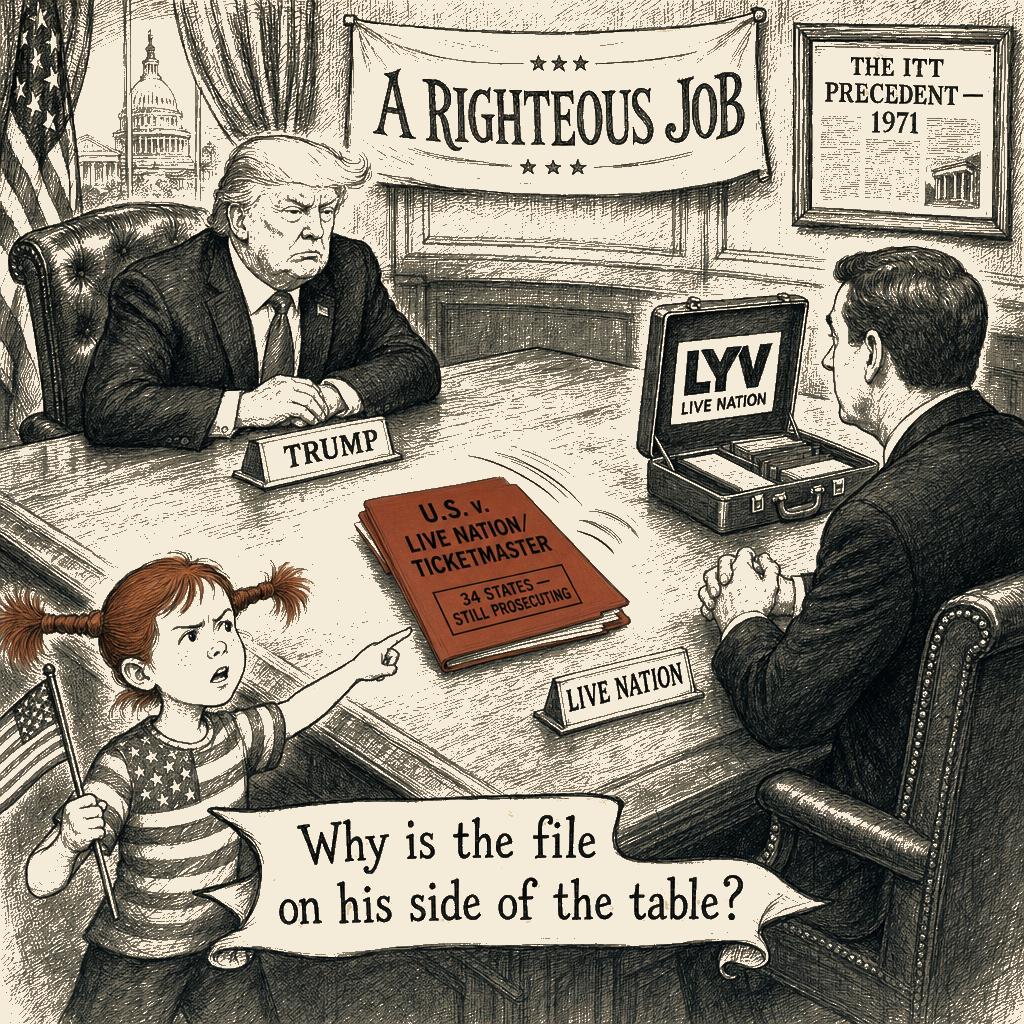
Responding to: Trump Discovers His Inner Nixon on Rock Concerts — Holman W. Jenkins, Jr. · 2026-08-28
What the Piece Argues
Holman W. Jenkins Jr. argues that the federal antitrust apparatus has become a self-perpetuating bureaucracy that almost never wins in court and rarely benefits the public. He frames Trump’s decision to end federal participation in the Live Nation/Ticketmaster prosecution — after a meeting with Live Nation officials — as legitimate executive discretion, drawing a favorable comparison to Nixon’s 1971 ITT intervention. The piece claims the real fix for concert-ticket complaints is for artists to charge “market-clearing” prices rather than antitrust litigation, and closes by calling on Congress to “rethink the competition laws” rather than letting career antitrust lawyers extend their bureaucratic life.
Receipts
The column reads as a deregulatory critique of antitrust; its operative beneficiary is Live Nation itself, with the editorial board’s larger project as a secondary winner.
- The cherry-picked loss list. Jenkins cites Whole Foods/Wild Oats, AT&T/Time Warner, and Microsoft/Activision as proof antitrust almost always loses. He omits Standard Oil, Northern Securities, the 1984 AT&T divestiture, and the 2001 Microsoft consent decree — the wins that built the consumer economy most column readers actually live in.
- The “one paper” move. A single 2003 Brookings paper by two economists “broaching a taboo subject” is treated as settled science that “antitrust enforcement actually produces public benefit” is in doubt. One paper does not overturn a doctrine.
- The meeting-then-quitting sequence. Trump’s pull-out came after a meeting with Live Nation officials. Jenkins describes this as legitimate prosecutorial discretion; the ITT analogy cuts the other way — Nixon’s 1971 intervention was the original modern campaign-finance scandal, not a model of presidential rectitude.
- The “just charge more” cure. Jenkins’ policy prescription is that Taylor Swift, Bruce Springsteen, and Bad Bunny should charge market-clearing prices. This is, in substance, Live Nation’s investor-day framing: the company is a passthrough, and consumer complaints are really about artist underpricing. The Live Nation cut is not in the analysis.
- The letter to the editor as proof. Jenkins’s evidence that antitrust is a “menace” includes a quote from “a letter writer to this newspaper” about post-government job prospects of antitrust employees. The monopolists the agency has historically caught are not named.
- The 34-state parenthetical. State attorneys general from across the political spectrum are still pursuing the case. Jenkins dismisses their effort in a single clause as “100% guaranteed to do the public little perceptible good” — asserted, not argued.
- Cui bono. Live Nation (the merged Warner/Paramount entity Jenkins has defended in adjacent columns is a secondary beneficiary), and the WSJ editorial board’s larger deregulatory project. The mechanism is editorial laundering of corporate-preferred outcomes as “public choice economics.”
- Anchor citation. Holman W. Jenkins Jr., “Trump Discovers His Inner Nixon on Rock Concerts,” The Wall Street Journal, Aug. 28, 2026 — particularly the “market-clearing prices” paragraph and the “righteous job” / ITT paragraph.
The Response Ladder
Polite Reframe
When to use: a colleague or family member forwarded the column and you want to push back without sounding unhinged — plant the cleanest fact, leave the door open.
The column treats antitrust as if the only evidence that matters is a handful of recent merger losses, but the body of case law — Standard Oil, Northern Securities, the 1984 AT&T divestiture, the 2001 Microsoft consent decree — is what built the consumer economy most of the column’s readers actually live in. Pulling federal participation out of a live prosecution after a meeting with the defendant is the pattern that used to be called corruption. And the prescription that artists should just charge “market-clearing” prices is, near-verbatim, Live Nation’s investor-day talking point — it routes the upside to Live Nation’s take, not to the artist. If the deregulation case is worth making, it deserves to be made on its merits.
Mockery and Ridicule
When to use: when you want the reader to feel the rhetorical sleight — the monopolist becomes the victim, the regulator becomes the menace.
Antitrust is the menace. Live Nation is the victim. Taylor Swift, Bruce Springsteen, and Bad Bunny are the predatory pricers. The merged promoter-ticketer that controls most major-venue primary distribution, charges fees north of 30%, and locks venues into exclusive deals — that entity is what we must protect from the menace of federal prosecutors. The proof? Two economists asked in 2003 whether antitrust produces public benefit and answered “skeptically.” Also, superpremium ice cream. Three merger challenges in roughly two decades (one of them — AT&T/Time Warner — lost on evidentiary fit, not on the law’s validity). Therefore the righteous move is to meet with Live Nation’s executives, drop the prosecution, and call it “a righteous job.” The column also helpfully reminds us this is exactly what Nixon did with ITT in 1971, after which “a large donation to Nixon’s re-election effort” followed — and then assures us that this time the donation isn’t the point. Of course it isn’t. The only thing missing is the press release.
Nuclear Satire
When to use: in a long-form reply where the reader will follow you through the column’s structure, paragraph by paragraph, and see the rhetorical scaffolding hold up a building that isn’t there.
A short tour of what “prosecutorial discretion” looks like when handed to the regulated party. The column’s logic, taken at face value: any federal case the columnist thinks will fail is, by definition, a menace. Any time a defendant industry meets with the executive and expresses preferences, the resulting dismissal is “righteous.” Any artist who doesn’t charge what the market will bear is engaging in predatory pricing. The “market definition” complaints are real but selectively deployed — antitrust critics apply them to cases they want to lose and ignore them when the merged entity wants the merger approved. The “epic run of cases tossed out” conveniently omits the cases that succeeded or are succeeding — the original Microsoft consent decree and conduct remedy, the Google search monopolization case, the Meta/Within challenge, the ongoing Google ad-tech litigation — because they don’t fit the script. The script needs the failures and not the wins, because the failures are the load-bearing examples. The “righteous job” framing also depends on a quiet substitution: prosecutorial discretion, properly understood, is the principle that cases unsupportable by evidence should not be brought. The Live Nation matter was being actively prosecuted by career staff and 34 state attorneys general. The discretion being exercised wasn’t prosecutorial — it was presidential. And the column flags the Nixon parallel itself, in its own words, before declining to apply it. That isn’t analysis. It’s a confession with the punctuation tidied up.
Profane Scorched-Earth
When to use: when the polite register has failed and the cathartic apex is the job — save it for cases where the argument is too brazen to dignify.
You want to talk about fucking menaces? Let’s talk about the menace. The menace is the merged ticketing monopoly that takes thirty goddamn percent off the top of every ticket and calls it innovation. The menace is the exclusive venue deals that lock out competitors so one company gets to decide whether your favorite band can even play your city. The menace is the dynamic pricing algorithm that flips a ninety-dollar face value into nine hundred because it fucking can. And Holman Jenkins, editorial board, Gerald Loeb winner, sits in his column and tells us the menace is the fucking antitrust division. The menace is the prosecutor. The menace is the judge. The menace is the consumer. Everyone is the menace except the fucking monopolist. The proof that Trump did the right thing is that Trump met with Live Nation, ended the case, and — oh, Jenkins helpfully reminds us — that’s exactly what Nixon did with ITT in 1971, after which “a large donation to Nixon’s re-election effort” followed. He puts the Nixon quote in the column. He compares Trump to Nixon. Then he says Trump’s version is righteous. That’s not a fucking defense. That’s a confession with the charges initialed. The “artist underprices tickets” line is the other gem — Taylor Swift and Bad Bunny are predatory pricers because they won’t squeeze their fans. The monopolist is the victim of the artist’s generosity. If you believe that, you will believe anything, and the WSJ opinion page will print it for you. The “epic run of cases tossed out” omits the cases that fucking won — Google search, Meta/Within, the ongoing Google ad-tech litigation — because they don’t fit the fucking script. And the script is: protect the monopolist, blame the artist, blame the regulator, blame the consumer, and call the whole thing righteous. The deeper joke is that Jenkins knows. He writes the Nixon line himself. He flags the pattern. He just declines to draw the obvious conclusion because the obvious conclusion is that the column is a press release with a byline.
About Malcolm Little King
Malcolm Little King is a heteronym in Main Street Independent's editorial architecture — an analytical voice, not autobiography of any actual person. The position this column expresses is the publication's position on the territory Malcolm Little King's lane covers, rendered through Malcolm Little King's register.