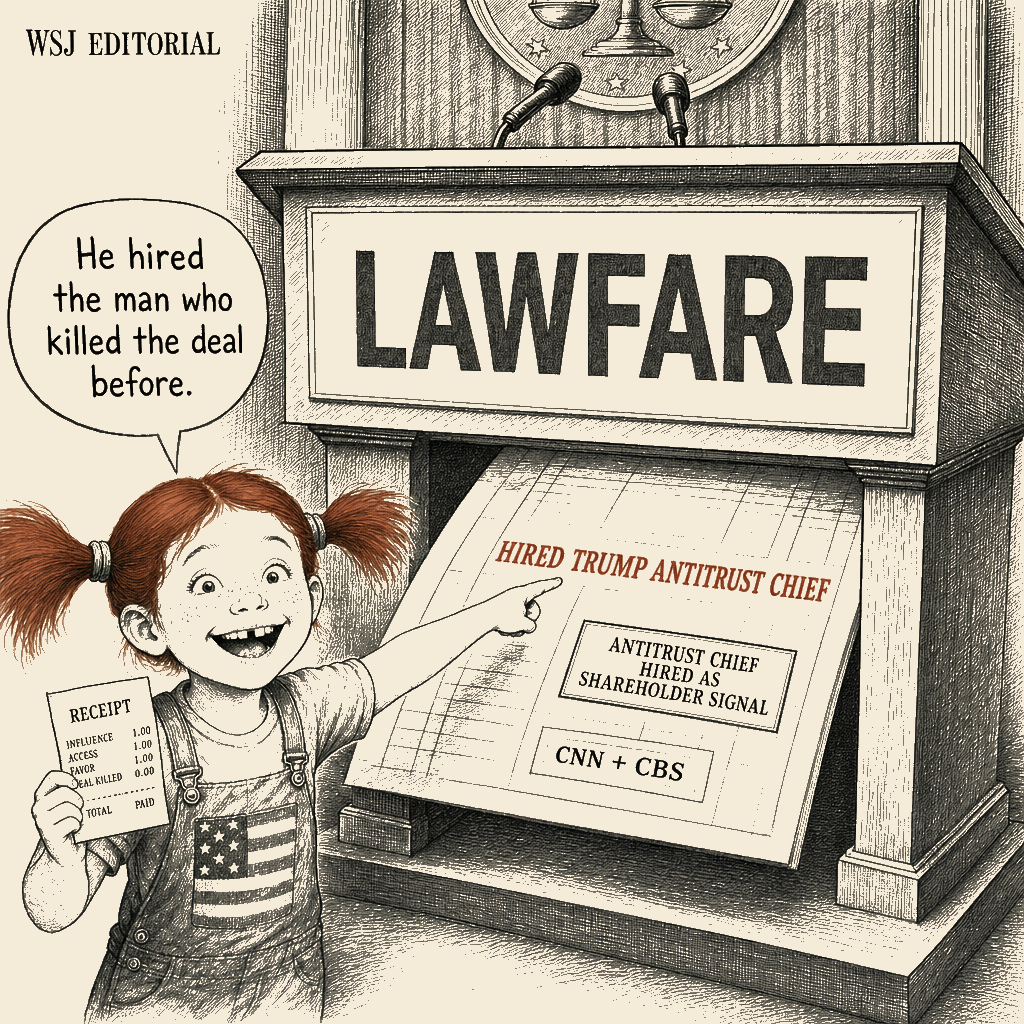
Responding to: Hollywood’s Rule of Lawfare — Holman W. Jenkins, Jr. · 2026-07-28
What the Piece Argues
Holman W. Jenkins Jr. argues that Democratic state attorneys general are blocking the Ellison family’s acquisition of Warner Bros.–Paramount by bringing a meritless antitrust lawsuit they would never file if they weren’t trying to score political points against Trump-connected dealmakers before the midterms. He says the antitrust claims are a transparent pretext; the real motivation is partisan warfare against the “MAGAization” of the news, and the deal would have been approved on its merits in a world where the rule of law still governed business decisions. The piece frames the litigation as a symptom of a broader erosion of legal norms, with the attorneys general weaponizing a once-technocratic office for short-term political gain at the expense of long-term capitalist risk-taking.
Receipts
The piece’s own admissions reveal a deal built on political manipulation from the acquirer’s side — while only the regulators’ politics are called illegitimate.
The framing wants you to believe
- State AGs mounting this challenge “can’t really believe their antitrust claims” — it is pure midterm politics
- Antitrust enforcement “has long been a politicized charade” — all of it, left and right
- The Ellison merger represents virtuous “long-term risk-taking” that democratic oversight is undermining
- The “rule of law” is eroding because “puny, short-term interests” are blocking billionaire investment
What’s really going on
- The piece itself reveals the deal is political from the Ellison side: David Ellison “played up his connections to the Trump administration,” remade CBS News “in a less woke direction,” and hired Makan Delrahim — the antitrust chief who killed the AT&T deal under Trump — as a signal to shareholders. The deal’s political architecture goes unmentioned as a concern.
- The merger would combine CNN and CBS News — two of the last major American news networks — under a single billionaire family that openly cultivates the sitting president. The piece acknowledges this then dismisses it as financially irrelevant, as if the competitive and democratic significance of media concentration ends at the P&L.
- The “long-term risk-taking” is leveraged speculation: the Ellisons paid a premium in a bidding war, face a ticking fee of $7 million per day, and are loading acquisition debt onto studios already “laid low by the streaming revolution.” The risk is borne by creditors, workers, and the public — not absorbed philanthropically by the Ellison family.
- The 2023 DOJ/FTC Merger Guidelines establish concentration presumptions and vertical consolidation theories of harm that would apply to this transaction — two major studios combining in markets already trending toward consolidation. The AGs’ challenge operates within established antitrust framework, not outside it.
The DEFCON Ladder
DEFCON 5 — Polite Reframe
When to use: persuadable moderates, good-faith family members who repeat “antitrust is political” framing without thinking it through.
Competition is American. Monopoly is European feudalism. The Founders’ revolution was catalyzed in part by the East India Company’s Parliament-backed tea monopoly — a corporation that controlled trade, corrupted government, and treated colonies as extraction zones. When five companies own everything, you are living in a corporate oligarchy, not a free market.
Jenkins says the streaming revolution has already transformed the industry, so two studios merging to dominate cable TV and film distribution is no concern. But the streaming revolution is exactly why concentration matters more, not less. The companies that control the pipelines — who decide what gets made, what gets distributed, what survives — hold cultural and economic power the old studio system never imagined. A billionaire family that cultivates the sitting president while absorbing two of the last major studios is not “risk-taking.” It is market capture dressed in a venture-capital pitch.
Here is what they will not tell the shareholder meeting: every monopoly in American history was sold to the public as efficiency. Standard Oil was going to rationalize kerosene distribution. AT&T was going to build the best telephone network. Each time, the “efficiency” became extraction — higher prices, fewer choices, workers with less leverage every year. The AGs challenging this merger are not engaging in “lawfare.” They are doing the job antitrust law was built to do: asking whether the public interest survives the next round of consolidation.
If you believe in free markets — genuinely, not as a slogan for billionaire bailouts — you believe that no single family should own the means by which a nation tells itself stories. That is not regulation. That is the floor under which capitalism itself collapses into something the Founders would recognize as the very corruption they revolted against.
DEFCON 4 — Mockery and Ridicule
When to use: the uncle at Thanksgiving who says “both sides do it” about antitrust; the LinkedIn commentator who calls regulation “lawfare” without irony.
Let us review the record of political neutrality Jenkins wants us to mourn.
David Ellison remakes CBS News in a less woke direction — that is neutral. David Ellison plays up his connections to a sitting president to scare shareholders away from a rival bidder — that is savvy business. David Ellison hires the exact antitrust official who killed the same deal under the previous Trump administration and installs him as a walking, talking threat to anyone who might compete — that is just good hiring.
But twelve state attorneys general file a challenge in court — through the legal system, using legal arguments, subject to judicial review — and suddenly we have an “eroding rule of law.” Suddenly antitrust is “a politicized charade.” Suddenly the Founders are rolling in their graves over “puny, short-term interests” interfering with what is, when you strip away the language, a billionaire family using political leverage to acquire the tools of mass communication at a discount.
The funniest part is the ticking fee. Seven million dollars a day if the deal does not close by late September. The Ellisons are hemorrhaging cash because they overpaid in a bidding war, and the piece wants you to understand this as “long-term risk-taking” that deserves your reverence. In what world is paying a premium for assets you cannot afford, borrowing against studios that are “laid low,” and then suing the government for the right to complete the deal — in what world is that “risk-taking” rather than the kind of leveraged speculation that crashed the economy in 2008 and left working people holding the bill?
The piece even tells you who benefits: the Ellisons, and the trial-bar donors Jenkins attributes to the AGs. But only one side’s donors are a scandal. The billionaire family using a presidential relationship as a closing tool? That is just how capitalism works. The attorney general who files a court brief? That is the death of the republic.
DEFCON 3 — Nuclear Satire
When to use: When the “lawfare” framing has been deployed in a forum where the person using it genuinely thinks the characterization is self-evident.
Oh, bless your heart. You actually believe the thesis of this piece? That twelve Democratic state attorneys general are engaged in a partisan abuse of power to block a business deal that would otherwise be worthy of the Founders’ blessing? Let’s count the premises required to make that thesis land — and see if they survive the giggle test.
-
The Ellisons — who hired the Trump antitrust chief who sandbagged a deal for these specific assets nine years ago — are victims of politicized antitrust enforcement. Yes, that’s right: the victim is the guy who hired the original perpetrator to help him avoid the same fate. The word for that is not “victim.” It’s “recurring character in a farce.”
-
The $7-million-per-day ticking fee the Ellisons agreed to is irrelevant to their current distress, because the lawsuit is the cause, not the financing structure. Really? So if the ticking fee were zero, the Ellisons would be perfectly happy to litigate for years? The fee is the reason the clock hurts. The lawsuit is the excuse to blame someone else.
-
State attorneys general bringing antitrust cases against media mergers is partisan lawfare, but the Trump-era antitrust chief who torpedoed the same deal was just… incorrectly enthusiastic? Having an off day? Using a “bogus” case to “torpedo” a deal — that’s not lawfare, that’s a Tuesday morning for the editorial board, apparently.
-
The twelve Democrats are acting in bad faith because they will “lose all interest” after Election Day, but the silence of Republican attorneys general on every other media merger that happens to benefit conservative dealmakers is just the natural order of things, not a political choice. We’re supposed to believe that when a Republican AG doesn’t sue, it’s because the case has no merit; when a Democrat AG does sue, it’s because the timing is political. There is no world where that logic survives the first sip of coffee.
The piece wants you to believe that “long-term risk-taking” and “American capitalism” are the victims here. But the victim in this story is a family that overpaid in a bidding war, signed a ticking clock, and now wants the public to believe its legal exposure is the problem rather than the consequence of its own financial architecture. The attorneys general may well be using a weak case for political reasons — that is a fair concern. But the piece asks you to believe it’s the only political behavior in the room, and that requires a selective memory the text itself contradicts.
DEFCON 2 — Prophetic Indictment (the Letter)
When to use: this tier is written to the person who sent the piece — the reader who circulates it as proof that antitrust is political theater. Second person. One letter. One act. No gallery.
You sent this, and it carried something with it.
You forwarded a piece that tells you — in its own language, without concealment — that a billionaire family leveraged a presidential relationship to acquire two of the last major American news networks, hired the political operative who killed the same deal under the previous administration to send a threat to competing bidders, and is now hemorrhaging seven million dollars a day because it overpaid in a bidding war it cannot close on time. The piece tells you all of this. It tells you the studios are “flailing.” It tells you the deal would bring CNN and CBS News under one billionaire’s control. It tells you the Ellisons “played up” connections to a sitting president. It tells you the same man who killed the deal before is now being installed to close it. Every fact is there.
And then the piece tells you the real danger is the attorneys general who filed a legal challenge in court.
Your spine is cold at the base. Not from the news — you have read this before. From the place where the sentence turns. You felt it happen: the paragraph that describes the political architecture of the deal, the presidential cultivation, the installed operative, the ticking fee bleeding seven million a day — and then the next paragraph tells you that twelve state officials exercising legal authority is the thing threatening the rule of law. The cold is the recognition that the frame did its work before you caught it. The frame took every fact the piece presented about the acquirer’s political manipulation and made it the background, the weather, something that just is. And it took the regulators’ legal action and made it the crisis.
You are swallowing against the taste of that. The taste is the frame settling. It is the metallic flatness of an argument that needed you not to notice the sequence — that needed you to read the political architecture of the acquisition as context and the antitrust challenge as event.
Jeremiah, speaking to the officials of his own nation who called the prophets dangerous and the temple secure, said: “They have healed the wound of my people lightly, saying, ‘Peace, peace,’ when there is no peace.” The wound is the concentration. The false healing is the frame that names the remedy as the disease. The piece you sent performs that healing, and it performs it well. It takes a billionaire family’s leveraged acquisition of the tools of mass communication, built on political leverage, and it tells you the danger is the law.
The cold is still in your hands. It will be there the next time you read a piece that tells you the institutions built to check concentrated power are the real threat to freedom. It will be there because the frame worked once, and the frame is portable, and the frame serves the same master every time it is deployed.
Amos, standing in the temple that called itself secure, said what the prophets say when the temple is the problem: “Let justice roll down like waters, and righteousness like an ever-flowing stream.” The justice is not in the deal. The justice is not in the frame. The justice is in the stream that does not stop because a billionaire needs the deal to close by September.
DEFCON 1 — Profane Scorched-Earth
When to use: the reader who needs the full catharsis — the frame has been absorbing blows for years and needs to hear someone say what it actually is.
Listen to what this piece is telling you. A billionaire family — whose patriarch is, by the piece’s own cheerful accounting, one of the richest human beings alive — wants to buy two of America’s last major studios. They have loaded the deal with so much debt that they are hemorrhaging seven million dollars every single day the deal doesn’t close. Their studios are “flailing.” Their strategy for winning was not a better product, not a better plan, not a better price on the merits — it was to hire the Trump administration’s antitrust chief, the same sonofabitch who killed this exact deal the last time around, and wave him at shareholders like a fucking hostage note. “Go with the other bidder,” the message was, “and watch what happens.”
That is the deal. That is the “long-term risk-taking” the Wall Street Journal is asking you to admire.
And twelve state attorneys general — elected officials exercising legal authority through the court system, which is literally the mechanism the “rule of law” describes — file a challenge. A judge reviews it. Finds it sufficient. This is the boring, institutional, procedural reality of how a democracy regulates concentrated power. This is the system working the way it is supposed to work.
But Holman Jenkins — member of the editorial board of the paper that has spent fifty years telling you that regulation is the enemy and the market is your friend — looks at this and sees an “eroding rule of law.” He sees “puny, short-term interests” — which is his term for the public’s elected representatives — threatening the sacred “risk-taking” of a family that is, at this moment, using a presidential relationship as a closing tool and drowning in its own leverage.
“Antitrust, to boot, has long been a politicized charade.” There it is. Not this case. Not this challenge. All of it. Every antitrust enforcement action in the history of the American republic — from Standard Oil to AT&T to this clusterfuck of a merger between two drowning studios — is, in the judgment of the Wall Street Journal editorial board, a charade. The rule of law that lets a billionaire buy the news is sacred. The rule of law that lets twelve states challenge whether two of the last major news networks should be under one billionaire’s thumb — that is the charade. That is the thing eroding. That is what you should be afraid of.
Frederick Douglass, standing in a nation that called itself the land of the free while putting human beings in chains, named the structure with surgical precision: “You may rejoice, I must mourn.” You may see a billionaire’s risk-taking. The workers whose jobs depend on whether two drowning studios consolidate under one leveraged family see something different. The public whose information ecosystem would be consolidated under a single billionaire who cultivates the sitting president sees something different. The piece you just read is not writing to them. It is writing to you, to make sure you see what it wants you to see, and to make sure the seeing feels like thinking.

About Malcolm Little King
Malcolm Little King is a heteronym in Main Street Independent's editorial architecture — an analytical voice, not autobiography of any actual person. The position this column expresses is the publication's position on the territory Malcolm Little King's lane covers, rendered through Malcolm Little King's register.