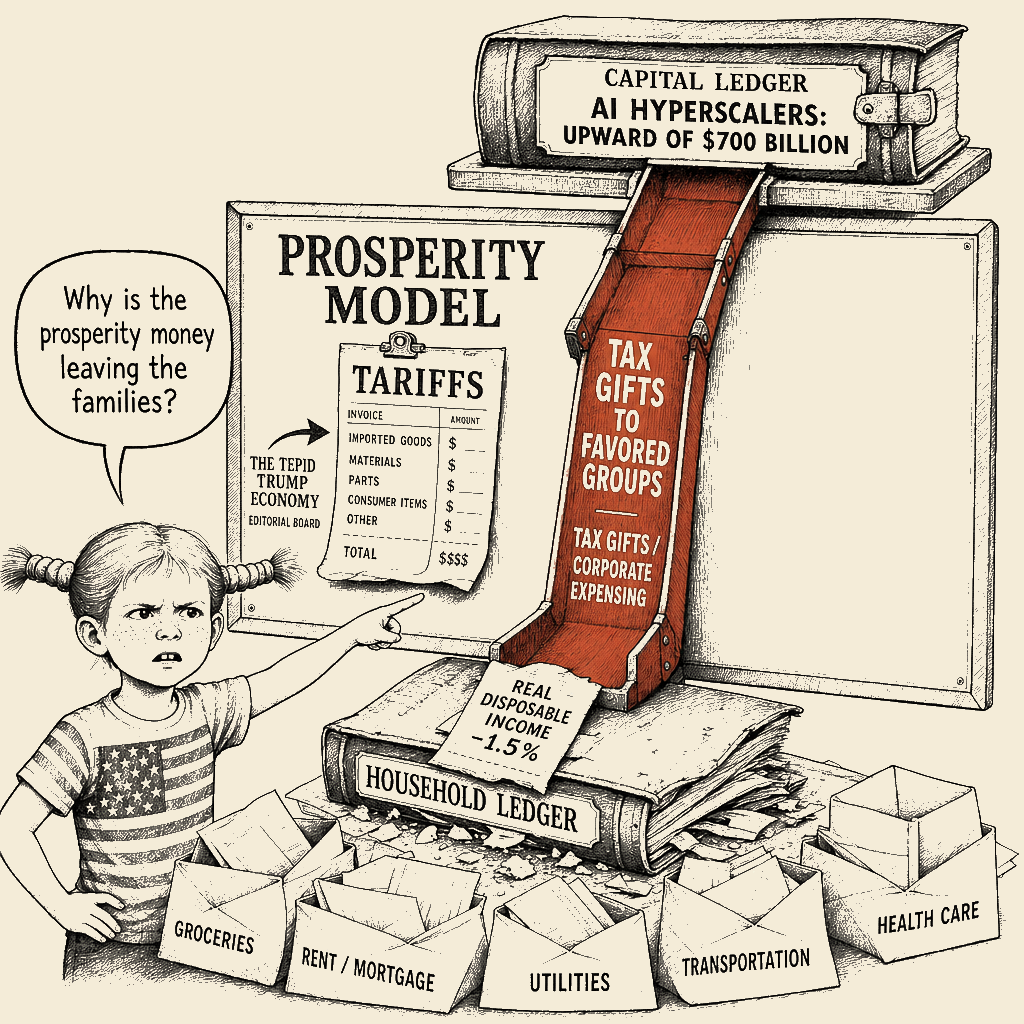
Responding to: The Tepid Trump Economy — The Editorial Board · 2026-07-30
What the Piece Argues
The editorial argues that the U.S. economy grew only 1.5% in the second quarter despite strong consumer spending and major investment in artificial intelligence. It attributes the weakness chiefly to President Trump’s tariffs, while crediting tax reductions, full corporate expensing, and deregulation for supporting investment. It also argues that persistent inflation, weaker real disposable income, and a falling savings rate are leaving households less secure, even as the administration points to stock-market records and the absence of recession.
Receipts
The tariffs are the scapegoat; the tax-and-investment model is the beneficiary.
The framing wants you to believe
- Tariffs are the main reason growth is below the Treasury secretary’s 3% target.
- Tax cuts, corporate expensing, and deregulation would produce broad-based prosperity if tariffs were removed.
- Private investment—especially AI investment—is a general economic good whose benefits will spread widely.
What’s really going on
- The article itself says last year’s tax bill included “sundry gifts for politically favored groups,” including exemptions for overtime pay and tips and a $6,000 deduction for many seniors.
- The piece never quantifies how much of the tax bill’s benefits flow to each group—it names the gifts and declines to count them.
- The largest investment engine it celebrates is the plan by AI hyperscalers to spend “upward of $700 billion this year”—a concentrated capital program whose distributional benefits are not the same thing as broad household prosperity.
- The same article reports that real disposable personal income fell 1.5% in the second quarter, the savings rate fell to 2.7%, and core PCE inflation remained up 3.3% over twelve months. The promised prosperity is not reaching households as financial security. (The Tepid Trump Economy, July 30, 2026.)
The DEFCON Ladder
DEFCON 5 — Polite Reframe
When to use: persuadable moderates, good-faith family, or anyone open to a calm distinction between investment growth and household prosperity.
Meet Brenda: she does not experience the economy as a GDP decomposition. She experiences it as the balance left after rent, food, fuel, and the next emergency. The editorial reports that real disposable personal income fell 1.5% in the second quarter, the savings rate declined to 2.7%, and core PCE inflation remained 3.3% higher than a year earlier. Those are not signs of broad-based prosperity.
It is fair to say that tariffs can raise costs and create uncertainty. But the same article identifies the policies it praises as tax preferences for favored groups and a corporate-investment boom led by AI firms planning to spend more than $700 billion. The question is not whether investment is valuable. It is whether the gains are reaching ordinary households. If the answer is measured by income, purchasing power, and savings, the receipt is not yet there.
A genuinely broad prosperity agenda would judge success by whether families can save, absorb a price shock, and leave a bad job without financial ruin. That is the liberty promised by a healthy economy—not simply a rising stock market or a larger deduction.
DEFCON 4 — Mockery and Ridicule
When to use: a public reply where the bystanders need to see the contradiction more than the repeater needs persuasion.
The family gets a 2.7% savings rate. The AI hyperscalers get a $700 billion spending spree. The editorial board looks at this arrangement and says: remove the tariffs, and the pie will become broad-based.
That is not an economic plan. That is a waiter pointing at the kitchen while the billionaires leave with the restaurant.
The article’s own receipts say real disposable income fell 1.5% and core PCE inflation is still up 3.3%. Yet the proposed cure is more of the same supply-side medicine: corporate expensing, deregulation, and tax provisions the article itself calls gifts to politically favored groups. The tariffs may be a problem. They are not an excuse to pretend that an AI capital binge is a household balance sheet.
Call it what it is: the “free market” badge being stamped onto a system where the gains rise to capital and the insecurity stays downstairs. We will claim the better badge—not because a slogan says so, but because broad prosperity means people can actually keep money, save money, and live through the month.
DEFCON 3 — Nuclear Satire
When to use: a scorched-earth public response aimed at the power-protecting frame and the institutions that benefit from it, never at ordinary voters.
The article presents a national economy as a banquet where the family is handed a coupon while the AI hyperscalers arrive with a $700 billion catering order. Then it points to the crumbs and announces that dinner is going well.
Anchor: 1.5% growth. Expose: the editorial reports that real disposable personal income fell 1.5%, savings fell to 2.7%, and core PCE remained 3.3% higher over twelve months. Invert: this is not free-market abundance; it is decadent trickle-down theater. Agree: a system that calls falling household security “prosperity” deserves the label. Usurp: we defend economic freedom by making it possible for people to save, stay housed, and leave an abusive job without falling through the floor.
The tariffs are the convenient villain because tariffs are visible. The tax preferences are less visible. The capital beneficiaries are less visible. The corporate expensing is less visible. The article names the gifts and then walks past them carrying a lantern for the tariff bill. This is the old trick: point at the smoke, do not ask who owns the furnace.
A market that raises the stock index while shrinking the household cushion is not proving that the people are flourishing. It is proving that the measuring instrument has been chosen for the people who own the instrument.
DEFCON 2 — Prophetic Indictment (the Letter)
When to use: as the user’s warning, for the person who sent or authored the piece when the conduct it carries requires the closest, quietest register rather than a performance for bystanders.
You send a defense of “supply-side policies” and carry a record that says the editorial reported real disposable personal income fell 1.5%, the savings rate fell to 2.7%, and core PCE inflation remained 3.3% higher over twelve months. You carry the phrase “sundry gifts for politically favored groups.” You carry the $700 billion AI investment figure. The contradiction arrives before the argument does.
The article attributes weak growth to tariffs and credits tax cuts, full corporate expensing, and deregulation for investment. It identifies exemptions on overtime pay and tips and a $6,000 deduction for many seniors. It reports that government spending reduced quarterly GDP through the accounting measure used. It reports that household income fell and saving declined.
Your throat is tightening around the word “prosperity.” The pressure behind your sternum is the distance between the investment you celebrate and the household security the record does not show. The numbers are not abstract now. They are sitting in the sentence you circulated. The piece carries the contradiction, and the contradiction has arrived with it.
We feed, clothe, heal, and build the freedom that a market is supposed to serve. We do not call a falling savings rate abundance because the stock market is high. Amos asked for justice to roll down like waters and righteousness like a mighty stream—not a tax preference trickling upward through a balance sheet. The record remains.
DEFCON 1 — Profane Scorched-Earth
When to use: for full catharsis when the target is the power-protecting frame itself and the receipts must remain visible through the profanity.
Anchor: “His tariffs are working wonders.” Expose: the article reports 1.5% growth, a 1.5% fall in real disposable personal income, a 2.7% savings rate, and core PCE inflation still up 3.3%. Invert: not free-market stewardship but corporate serfdom dressed in a necktie. Agree: if “prosperity” means households save less while AI capital gets a $700 billion parade, then yes, the arrangement is a goddamn disgrace. Usurp: we are the builders—of wages, savings, public goods, and an economy that does not require families to eat the wallpaper.
The tariffs may raise costs. Fine. Put that fact on the table. But then put the tax gifts on the table. Put corporate expensing on the table. Put the concentrated AI spending on the table. Put the falling household income on the table. You do not get to point at one expensive policy while blessing the other policies that shovel money toward capital and call the whole performance “broad-based prosperity.” That is not analysis. That is a polished excuse with a fucking GDP chart stapled to it.
The article says the cure is to return to the supply-side policies of the first Trump term. The receipt it supplies says the household savings rate exceeded 6% for most of that term before the pandemic and now sits at 2.7%; it also says the present household economy is losing ground. So the sales pitch is this: trust the model that promises abundance while your purchasing power gets eaten alive. That is the con.
The free-market badge belongs to the people who can actually live free—who can save, leave, organize, recover, and refuse domination. A stock-market record is not a sacrament. A corporate deduction is not bread. A nation that calls insecurity prosperity has forgotten the first commandment of economics: people are not fuel for somebody else’s quarterly return.

About Malcolm Little King
Malcolm Little King is a heteronym in Main Street Independent's editorial architecture — an analytical voice, not autobiography of any actual person. The position this column expresses is the publication's position on the territory Malcolm Little King's lane covers, rendered through Malcolm Little King's register.