Responding to: JD Vance ‘Fixes’ Capitalism — William McGurn · 2026-08-03
What the Piece Argues
The piece argues that competitive markets, despite their imperfections, generally serve consumers better than government intervention or attempts to redesign capitalism from above. It presents Amazon’s displacement of Borders as an example in which the customer ultimately benefits through greater choice and lower prices, and it warns that the opposite of competition is not cooperation but collusion. It further argues that JD Vance’s skepticism toward free-market thinkers such as Milton Friedman risks replacing imperfect private decision-making with supposedly wiser bureaucratic control.
Receipts
The framing weaponizes a defense of competition to shield concentrated private power from accountability.
The framing wants you to believe
- When Amazon defeats brick-and-mortar retailers, “the real winner is the customer,” because competition automatically produces better prices, greater choice, and higher-quality goods.
- Government intervention is the greater danger because markets are already designed to limit the harm caused by imperfect people.
- The opposite of competition is collusion, so criticism of market power is treated as an invitation to bureaucratic control.
What’s really going on
- Competition is not the same thing as a market remaining competitive. A firm can win customers and still acquire enough power to disadvantage suppliers, workers, publishers, and future competitors.
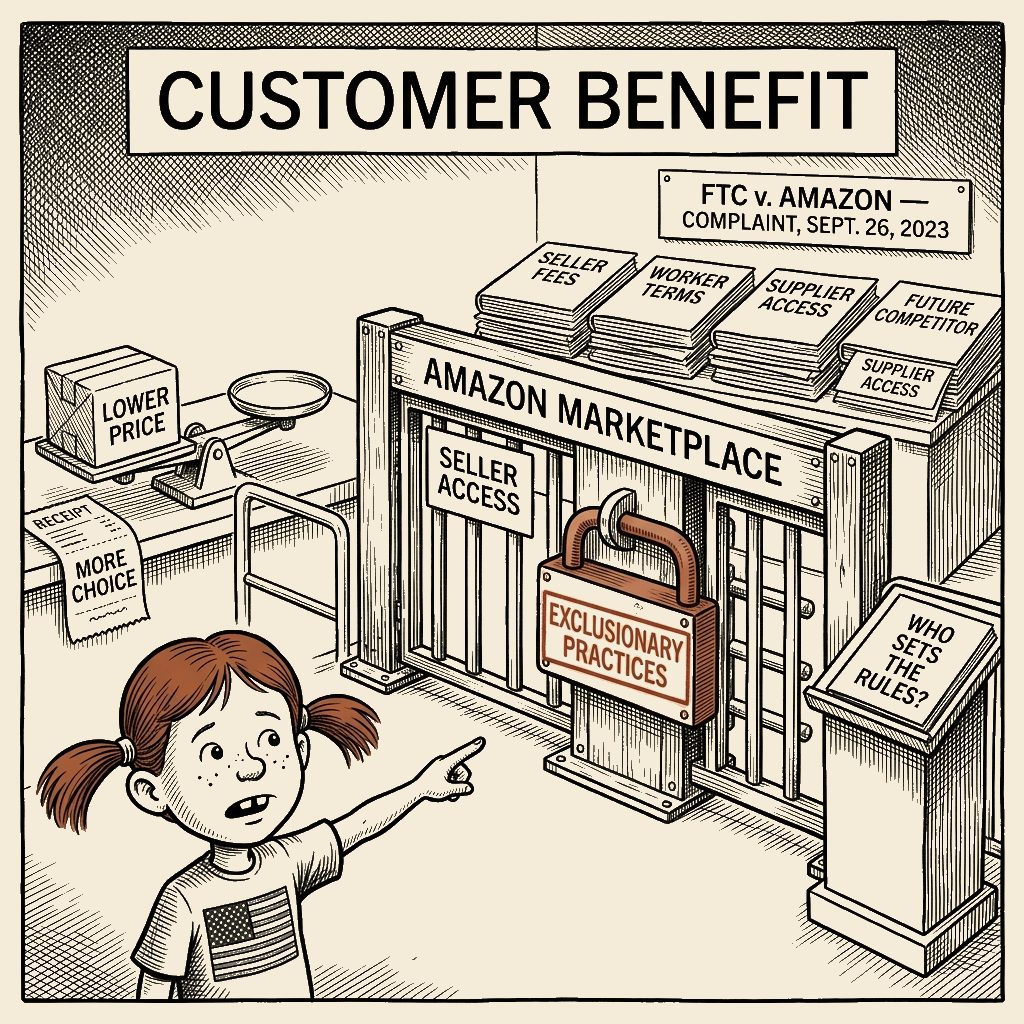
- The Federal Trade Commission’s 2023 antitrust complaint against Amazon alleged that the company used exclusionary strategies to maintain monopoly power and raise costs for sellers and consumers. Those allegations remain allegations, not a final adjudication—but they are enough to disprove the article’s larger assumption that customer benefit ends the inquiry. (FTC v. Amazon, complaint filed Sept. 26, 2023.)
- The omitted question is cui bono: who gains when “competition” becomes a shield against antitrust enforcement, labor standards, or public oversight? The immediate customer may receive convenience and low prices while concentrated owners capture durable control over the platform, the suppliers, and the rules of access.
The DEFCON Ladder
DEFCON 5 — Polite Reframe
When to use: With a persuadable moderate, a good-faith family member, or anyone who still believes the customer question is the whole question.
Brenda likes the lower price. That part is real. When a large retailer gives her more choices at less money, competition has served her, and nobody gains wisdom by pretending otherwise.
But the customer is not the only person in the market. The seller, the worker, the supplier, and the would-be competitor are there too. The Federal Trade Commission’s 2023 complaint against Amazon alleged that Amazon used exclusionary practices to maintain monopoly power and raise costs for sellers and consumers. That is not proof that every allegation will prevail in court. It is proof that “the customer wins” is not a complete economic analysis.
The question is not whether competition can benefit people. It plainly can. The question is whether the market remains open after one company gains enough power to write the terms by which everyone else must compete.
A free economy should defend competition, not confuse the victory of one corporation with the existence of competition. We can protect lower prices, innovation, and customer choice while also preventing a platform from becoming the gatekeeper, landlord, referee, and toll collector of its own marketplace. That is not government replacing the customer. It is public power keeping the customer from being trapped inside one private system.
DEFCON 4 — Mockery and Ridicule
When to use: For the bystander who can see the joke once the article’s logic is made literal, while the ordinary voter is treated as someone being handed the bill—not as the target.
Picture the customer entering the marketplace and receiving a gold medal, a coupon, and sole custody of the word “competition.” Behind the curtain, Amazon gets the platform, the data, the seller fees, the search ranking, and—according to the FTC’s 2023 complaint—the alleged machinery for making rivals pay more to reach the customers they supposedly defeated.
What a marvelous system: one company wins the race, buys the stadium, sets the rules, charges the runners, and then publishes a column explaining that the spectators are the real winners.
The article says the market is “designed for imperfect people.” Fine. But the design has to include limits on the person who acquires the power to close the market behind himself. Otherwise “imperfect people” is doing the work of “owners with leverage,” while “competition” is doing the work of a protective screen.
The customer deserves low prices. The bookstore, the warehouse worker, the independent seller, and the next competitor deserve an open field. We are not defending collusion; we are defending the actual competition that concentrated power eventually eats.
DEFCON 3 — Nuclear Satire
When to use: For a public exchange where the argument has stopped persuading and needs to be exposed as a baroque defense of private gatekeeping.
The article’s economic theology is simple: if the customer gets a cheaper package, the corporation has been baptized. The corporation may own the road, the tollbooth, the map, and the police force, but behold—the customer received free shipping, so the kingdom of competition has arrived.
The Federal Trade Commission’s 2023 Amazon complaint is inconvenient because it describes the machinery behind the miracle: a platform accused of using its power to control sellers, police prices, and preserve its position. The case is not a conviction, and truth does not require pretending it is one. It requires admitting that a customer’s short-term benefit does not erase a platform’s structural power.
That is the trick: reduce political economy to the checkout screen. Do not ask who owns the warehouse. Do not ask who sets the seller’s terms. Do not ask what happens when every road to the customer runs through one gate. Ask only whether the box arrived cheaper.
The article invokes Friedman against a caricature, then offers a caricature of its own: government as the only alternative to corporate impunity. That is not serious economics. That is a false choice wearing a necktie. The real alternatives include antitrust, labor power, public enforcement, open standards, and rules that prevent the winner from converting victory into permanent rule.
The customer is not the enemy. The customer is the person being used as the corporation’s moral alibi.
DEFCON 2 — Prophetic Indictment (the Letter)
When to use: For the person who sent the piece; write to the sender, not about the sender. This is the closest tier: second person, present tense, dry record first, then the sensation in the body; no jokes, no gallery, no barrage.
William,
You send a piece that says, “The real winner is the customer,” and it carries a market verdict: if the price is lower and the selection is wider, the inquiry is finished.
The piece identifies Amazon’s defeat of Borders as a case in which competition benefits consumers. It presents competition as a restraint on imperfect people and describes collusion—private or political—as the opposite of a free economy. The Federal Trade Commission filed an antitrust complaint against Amazon on September 26, 2023, alleging that Amazon used exclusionary strategies to maintain monopoly power and raise costs for sellers and consumers. The allegations have not become a final judgment.
Your throat is tightening around the word “competition,” and the next swallow is narrower than the last. The record is not asking you to deny that customers can benefit from Amazon. It is asking whether customer benefit is the whole record. You are holding a sentence that names the buyer and leaves the seller, the worker, the supplier, and the future competitor outside the frame.
The pressure behind your sternum is the omitted question: who owns the gate after the race is over? The article says the market disciplines imperfect people. The complaint describes a claim that one company used its position to discipline the people who needed access to that market. The claim may be defeated in court. It cannot be defeated by refusing to name it—and damn well not by pretending the customer is the whole market.
The word “collusion” is in your hands. So is the possibility that private power can close a market without calling itself a government. We defend competition by defending the conditions that let competitors exist. We defend the customer by refusing to make the customer the witness for every concentrated power that sells him something cheaply.
Amos asked for justice to move through public life like water, not for the ledger to be read only from the purchaser’s side. Matthew 25 makes the test plainer: the measure is what is done to the least protected, not merely what is placed in the prosperous person’s hand. The record remains. The gate remains. The question remains.
DEFCON 1 — Profane Scorched-Earth
When to use: For full catharsis against the power-protecting argument, when the reader wants the receipts and the gloves off—while the ordinary customer remains part of the public being defended.
“The customer wins” is the kind of sentence you get when an entire economic argument has been shoved into a shopping cart and sent down the conveyor belt.
Amazon beats Borders, therefore capitalism is vindicated. A customer gets a cheaper package, therefore the platform can do whatever the hell it wants. The Federal Trade Commission files a 2023 complaint alleging Amazon used exclusionary tactics to preserve monopoly power and raise costs for sellers and consumers, and the response is basically: shut up, the box arrived.
That is not economics. That is corporate public relations with a scripture verse stapled to it.
The customer can benefit from Amazon. The customer can also be used as the corporation’s human shield. Those facts fit together just fine, which is why the article has to pretend they do not. The seller pays the fee. The worker absorbs the pressure. The supplier accepts the terms. The competitor faces the gate. The owner collects the rent. Then somebody points at a discount and screams, “Behold, liberty!”
No. A market is not free because the merchandise is cheap. A market is free when people can enter it, work in it, sell through it, and challenge the incumbent without begging the incumbent for permission. If one corporation becomes the platform, referee, toll collector, and executioner of competition, calling that “openness” is goddamn bullshit with a balance sheet.
And the voter who wants affordable goods is not stupid for wanting affordable goods. The voter is being handed a rigged choice: corporate domination or government control. That is the con. The real choice is whether public power will keep private power from swallowing the field.
We are not against competition. We are against the corporate graveyard that gets renamed competition after the competitors have been buried. We are not against customers. We are against using customers to bless a system that makes everyone else kneel.
Amos did not ask whether the palace had obtained a favorable price. Matthew did not say the judgment would be based on how efficient the marketplace looked from the throne. The measure is what the powerful do with power—and whether the people beneath it can still stand.

About Malcolm Little King
Malcolm Little King is a heteronym in Main Street Independent's editorial architecture — an analytical voice, not autobiography of any actual person. The position this column expresses is the publication's position on the territory Malcolm Little King's lane covers, rendered through Malcolm Little King's register.