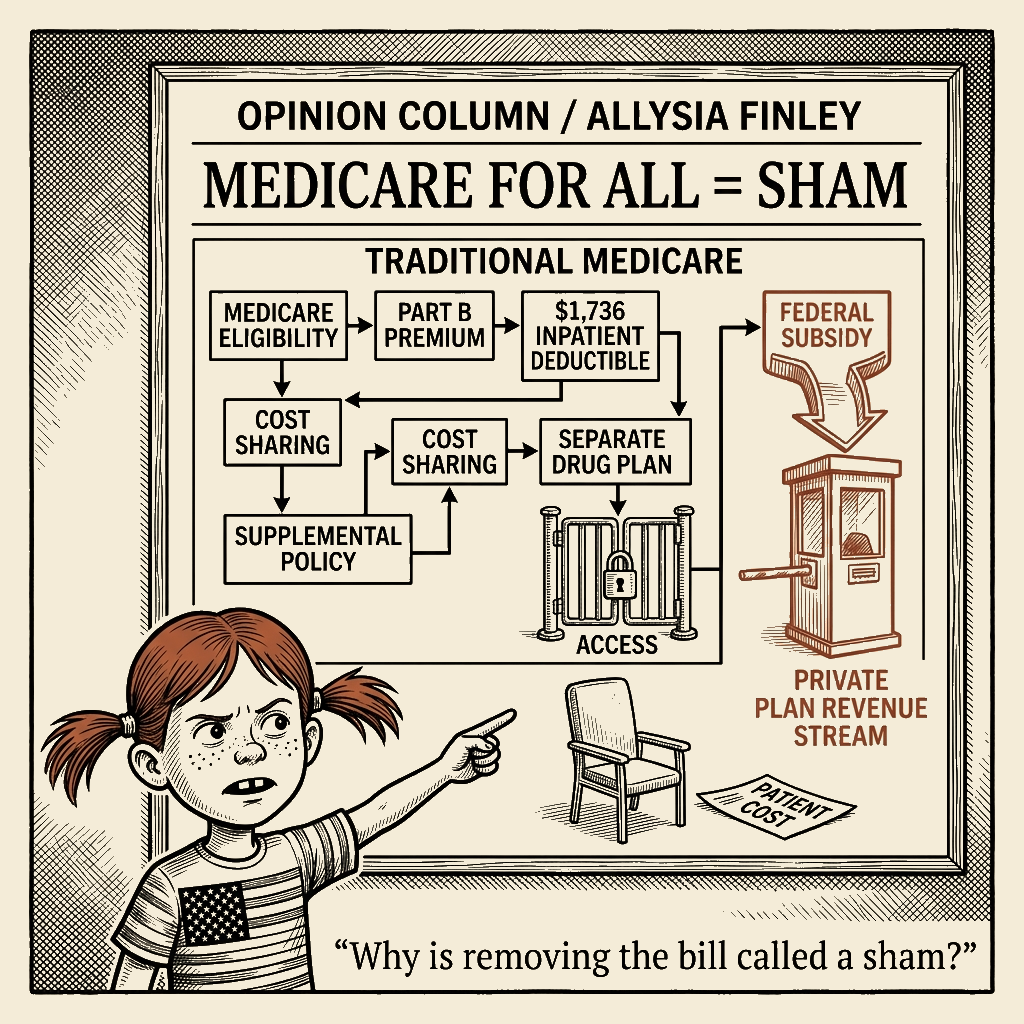
Responding to: Socialist Chic and the ‘Medicare for All’ Sham — Allysia Finley · 2026-08-02
What the Piece Argues
The column argues that Abdul El-Sayed presents himself as an advocate for ordinary people while enjoying substantial household income and assets and proposing an expansive government role in health care. It contends that “Medicare for All” is an inaccurate label for his single-payer plan because traditional Medicare includes premiums, deductibles, cost sharing, prescription-drug expenses, and private-plan alternatives. The column further argues that government reimbursement policies already restrict access for lower-income patients and that single-payer systems would worsen inequality by rationing care through waiting lists while wealthy people purchase faster service privately.
Receipts
The framing turns a legitimate question about how to design universal coverage into a character attack on the idea of universal coverage, then calls the existing patchwork “freedom” because its costs are scattered.
The framing wants you to believe
- El-Sayed’s income, rental properties, and family wealth disqualify him from advocating broader access to health care.
- Because traditional Medicare includes premiums and deductibles, a publicly financed system using the name “Medicare for All” is inherently deceptive.
- Government involvement is the source of unequal access, while private insurance and private payment are treated as the neutral baseline.
What’s really going on
- The column’s own evidence shows that traditional Medicare leaves seniors exposed to premiums, deductibles, prescription-drug costs, supplemental-insurance costs, and uncapped out-of-pocket spending; that is an argument for repairing coverage, not proof that universal coverage is fraudulent. The cited figures come from Medicare’s published benefit structure and the column’s own account.
- The concentrated beneficiaries of the current arrangement are private insurers, including Medicare Advantage plans that receive federal subsidies, while patients bear the fragmentation, billing exposure, and uneven access.
- The piece attacks a plan that would remove premiums, deductibles, and cost sharing while quietly treating those very costs as evidence that public coverage is a “sham.” That is not exposure. That is camouflage.
The DEFCON Ladder
DEFCON 5 — Polite Reframe
When to use: persuadable moderates, good-faith family, or anyone who may be open to a calm moral and factual reminder.
Brenda works two jobs and still postpones care because the deductible comes before the insurance becomes useful. That is the policy question—not whether the person proposing reform has ever earned a comfortable income.
The column is right about one narrow point: “Medicare for All” would not simply duplicate traditional Medicare. Traditional Medicare includes a Part B premium, a hospital deductible, cost sharing, prescription-drug expenses, and no ordinary annual ceiling on out-of-pocket spending; many seniors also buy supplemental coverage. The column documents those features itself.
That receipt doesn’t prove universal coverage is a sham; it proves traditional Medicare is incomplete—which is exactly why the plan would replace it. If the proposed reform eliminates premiums, deductibles, and cost sharing, then calling it a single-payer plan is more accurate than calling it traditional Medicare—and the relevant question is whether that design would provide comprehensive care fairly.
The real choice is not between “government” and freedom. It is between a system that makes people navigate premiums, deductibles, supplemental policies, and insurer networks and a system that pools those costs so people can receive care without facing financial ruin. We should defend the value the column claims to care about—access, choice, and timely treatment—by designing public coverage that actually delivers them.
DEFCON 4 — Mockery and Ridicule
When to use: the bystander is the audience, the repeater has stopped persuading, and the mockery can land upward at insurers and the wealthy rather than downward at patients.
Picture the con artist’s menu: “Medicare for All” is dishonest because Medicare has a premium, so the answer must be a system with a premium, deductible, drug plan, supplemental policy, and private insurer—otherwise the government is meddling. The rack is not hidden. It is sitting in the waiting room with a clipboard.
The column’s receipt is that traditional Medicare charges a Part B premium beginning at $202.90 a month, includes a $1,736 inpatient deductible, requires separate drug coverage, and leaves beneficiaries exposed to cost sharing. Fine. That is what the record says. It also means the current program is not a complete model of universal coverage.
Then comes the magic trick: costs paid by seniors are presented as evidence against a proposal designed to remove those costs. A system that asks people to buy supplemental insurance is called ordinary; a system that would make dental, vision, and catastrophic protection part of the public guarantee is called deceptive.
And who gets to keep the business? Private Medicare Advantage plans—federally subsidized, selected by roughly half of Medicare beneficiaries according to the column—while the patient is instructed to admire the variety of paperwork. We are told this is market freedom. We call it what it is: a revenue stream with a deductible attached.
We are the ones defending choice: the choice to see a doctor without first consulting a balance sheet, the choice to leave a bad job without losing medical care, the choice to treat a sick body before it becomes a financial event.
DEFCON 3 — Nuclear Satire
When to use: a hostile public exchange where the argument needs to be made impossible to miss and the target is the insurance structure, not the ordinary voter.
The column arrives wearing Carhartt as camouflage and carrying a deductible as a moral argument. It points at Abdul El-Sayed’s income and says: “Aha! He owns property, therefore no one should question a health system that can make a working family choose between treatment and rent.” This is not economic analysis. It is a magician waving a candidate’s tax return while the insurance industry walks out the back door with the cash register.
The receipt is printed in the column: traditional Medicare has premiums, a $1,736 hospital deductible, cost sharing, separate drug plans, supplemental policies, and no ordinary out-of-pocket ceiling. That is not a defense of the present system. That is the indictment. The program sold as security still leaves people assembling a private barricade around the public benefit.
Then the column stamps the reform “socialist” and “sham,” as though naming the financing mechanism were more important than asking who gets treated. The inversion is plain: a politics that protects fragmented coverage while denouncing comprehensive coverage as dishonest is not defending independence. It is preserving dependency—dependency on employers, insurers, formularies, networks, and whatever price the billing department invents next.
The piece invokes inequality and then offers the wealthy a fast lane as proof that public systems are unequal. Of course the wealthy can buy their way around a queue when the rich are allowed to purchase a second system. That is not a refutation of universal care. It is the business model the column is protecting.
Call it what it is: not a defense of patients, but a polished brochure for the tollbooth. We are the ones defending health care that feeds the sick, treats the poor, and does not require a person to become rich before becoming safe.
DEFCON 2 — Prophetic Indictment (the Letter)
When to use: the reader who sent the bylined piece; write to that reader in second person, present tense, as a cold, documented letter with no jokes, no gallery, and no barrage.
Allysia, you send a column that calls “Medicare for All” a “sham.” It carries the claim that a public guarantee is fraudulent because traditional Medicare has premiums, deductibles, cost sharing, drug-plan costs, supplemental policies, and private alternatives. The first sensation is small: a dryness at the back of your throat, the kind that arrives before the record has finished speaking.
Your column identifies traditional Medicare’s Part B premium as $202.90 a month and its inpatient deductible as $1,736. It states that traditional Medicare has no ordinary limit on out-of-pocket spending, that many beneficiaries purchase supplemental insurance, and that about half of Medicare beneficiaries enroll in Medicare Advantage. It then describes a proposed single-payer system that would remove premiums, deductibles, and cost sharing as a deception because it would not reproduce those features.
The contradiction is set down plainly. The costs you list are not evidence that comprehensive coverage is fraudulent. They are evidence that the existing public program leaves patients exposed. The word “sham” is the thing in your hands now. It is a label placed over the gap between what people need and what the system guarantees.
Your throat is tightening around the sentence that calls the reform dishonest, and the next sentence tightens it further: the people who cannot afford the deductible are made into evidence against removing the deductible. The column says wealthy people can purchase faster care where public systems ration care. The record you carry therefore describes a two-tier reality and presents the existence of the upper tier as an argument against closing the lower one.
The thing is as bad as the word says. The piece protects the arrangement that makes medical security conditional, then calls the proposal to make it universal a fraud. We feed, clothe, heal, and build public guarantees because care is not a prize reserved for the person who can clear the billing office.
The prophet Jeremiah recorded a people who had lost the capacity to blush. Amos asked for justice to run like water, not for the ledger to be arranged so the wealthy could drink first. Matthew 25 sets the test in the body of the hungry, the sick, the imprisoned, and the stranger. The judgment is not whether the brochure sounded respectable. It is whether the least protected were left exposed. That record remains open.
DEFCON 1 — Profane Scorched-Earth
When to use: the reader who needs catharsis after the argument has been repeated as a public defense of insurer power; profanity is aimed upward, never at the person who is being persuaded.
The column’s con is beautifully dressed: call a public health guarantee “Medicare for All,” discover that old Medicare has premiums and deductibles, then scream “sham” while private insurers collect federal money and patients keep paying through the nose. That is not a gotcha. That is a goddamn business plan.
The receipt is right there: traditional Medicare charges a Part B premium, imposes a $1,736 inpatient deductible, demands cost sharing, requires separate drug coverage, and leaves people exposed to uncapped costs. The column thinks it has found the crime. It has found the body. The crime is a public program that still makes sick people buy extra armor before the hospital bill can finish bleeding them.
Then the piece performs its little identity swap. The reformers are called frauds because their plan would not preserve every defect of traditional Medicare. Fine—then the people defending premiums, supplemental policies, formularies, and private-plan toll collectors are the ones preserving the racket. They carry the badge of “choice” while the patient chooses between delayed care and debt.
And the wealthy escape route? The column admits that rich people can buy faster service where public systems ration care. That is the whole fucking point of unequal systems: the people with money leave the queue while everyone else is told the queue proves public care is impossible. If the elevator is reserved for billionaires, the answer is not to set the building on fire. The answer is to stop calling the elevator a health system.
We are not ashamed to say what the record says. The rich do not need another sermon about their right to keep every private advantage. Patients need care. Workers need the freedom to change jobs without surrendering their doctors. Families need protection from the bill that arrives after the illness has already taken everything else.
The column calls universal care a sham. The sham is pretending that a fragmented, subsidized, insurer-dependent system is neutral while any attempt to remove its tollbooths is branded extremism. We feed, clothe, heal, and organize the public power to do it. The billion-dollar health-care machine can keep its polished language. The patient has already seen the invoice.

About Malcolm Little King
Malcolm Little King is a heteronym in Main Street Independent's editorial architecture — an analytical voice, not autobiography of any actual person. The position this column expresses is the publication's position on the territory Malcolm Little King's lane covers, rendered through Malcolm Little King's register.