Responding to: ‘Abolish Capitalism. Viva Free Enterprise!’ — James Freeman · 2026-08-07
What the Piece Argues
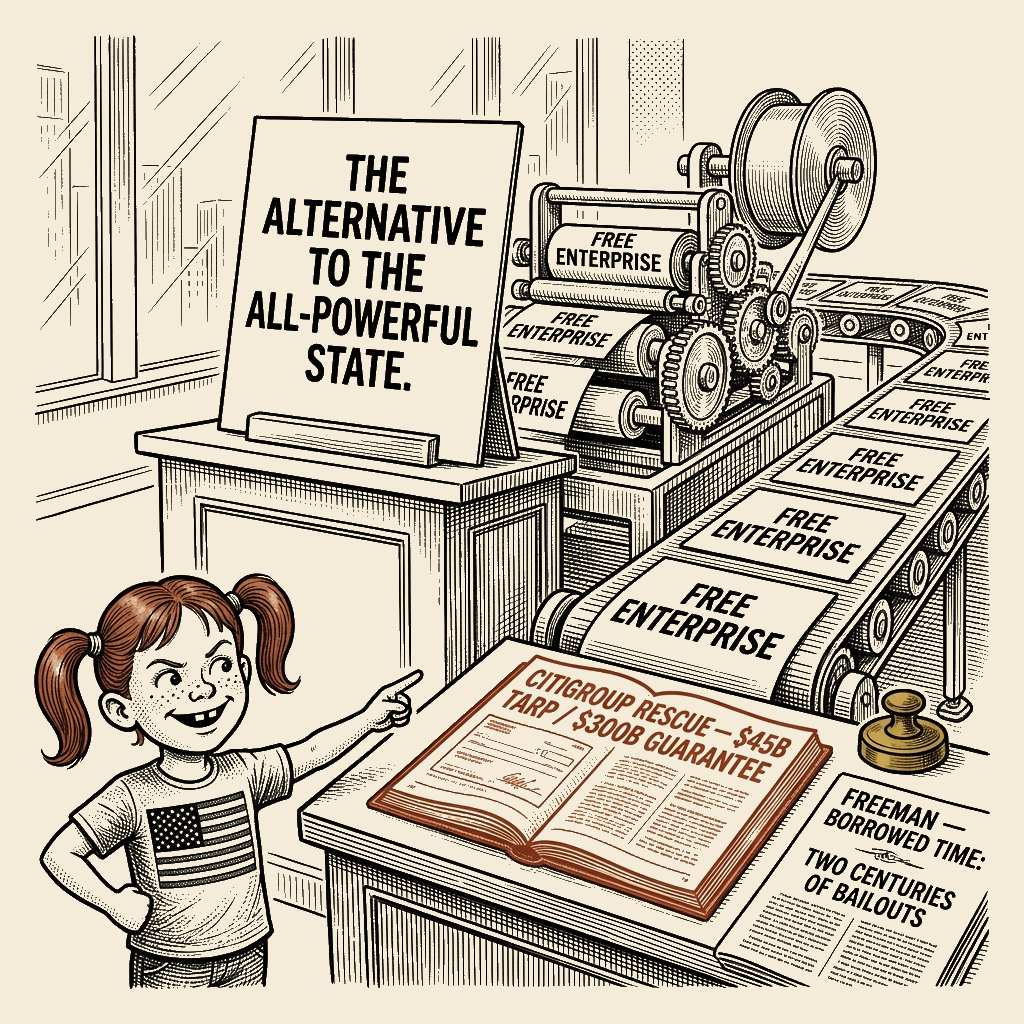
The column opens by arguing that it’s important to make clear what the alternative to an all-powerful state really is, given what it calls the progress of a Marxist takeover of the Democratic Party. It cites polling results showing that “free enterprise” is much more popular than either “capitalism” or “socialism,” and treats that word’s popularity as proof that Americans endorse the existing system. A reader’s reply is invoked to press the case that free enterprise — not the state — is the alternative, and that criticism of concentrated corporate power is a step toward Marxism.
Receipts
The framing wants you to believe that mainstream Democratic policy positions — healthcare access, labor protections, public investment — are steps toward a Marxist takeover, and that the “free-enterprise” alternative means freedom from government overreach.
What’s really going on
- “Free enterprise” as the WSJ editorial page wields it is not the corner store’s freedom — it’s the conglomerate’s immunity. When the label opposes antitrust enforcement, universal healthcare, environmental regulation, and union organizing, it protects monopoly power, not the entrepreneur. The beneficiary is concentrated capital; the cost falls on workers, consumers, and communities.
- The author co-wrote a history of Citigroup — the largest single bank rescue in American financial history. Citigroup took $45 billion in TARP funds and a $300 billion-plus federal asset guarantee; the government was exposed to roughly $476 billion in total cash and guarantees to keep Citi afloat. The free-enterprise alternative to the all-powerful state, it turns out, depends on the state when the bets go bad.
- The “misery” of the past century is attributed to socialism, not to the deregulation that produced the Great Depression, the 2008 crisis, and the opioid epidemic. The ideas that have actually produced mass American misery — unregulated finance, monopolistic consolidation, wage suppression — are the ones the WSJ editorial page has championed.
- The polling finding is genuine but the inference is rigged. Americans who prefer “free enterprise” are expressing a desire for opportunity and fairness, not endorsing the deregulatory agenda sold under that label. The same Americans, when polled on actual policies — minimum wage increases, expanded healthcare, taxing the wealthy — support those policies by double-digit margins.
Anchor: The 2017 Tax Cuts and Jobs Act’s corporate-rate cut (35%→21%) was the law’s single most expensive provision — roughly $1.35 trillion in lost revenue over 2018–2027 (Joint Committee on Taxation); the act as a whole added about $1.9 trillion to deficits over the decade (Congressional Budget Office). Corporations deployed the savings overwhelmingly in stock buybacks — a record $800 billion-plus in 2018 (S&P Dow Jones Indices) — not in wages or investment.
The DEFCON Ladder
DEFCON 5 — Polite Reframe
When to use: Good-faith moderate, family member, or colleague who shared the piece thinking it made a fair point about government overreach.
Tom runs a machine shop in Greenville. Twelve employees, three CNC lathes, a defense subcontractor contract that keeps the lights on. Tom’s not a Marxist. He also knows the road his delivery trucks use was built with tax money, his employees’ kids go to public schools, and the health-insurance pool he buys into works because regulation prevents insurers from dropping anyone who actually gets sick.
When someone at the Rotary says government is the problem, Tom thinks about the SBA loan that kept his shop open in 2009 — the downturn caused by the very deregulation the “free enterprise” crowd championed. Tom’s enterprise is free. Tom’s enterprise depends on public investment, rule of law, and a workforce healthy enough to show up.
The label “free enterprise” was not designed for people like Tom. It was designed for the people who need Tom’s taxes to bail them out when their own bets fail. We don’t have to choose between freedom and tyranny. The real choice is between an economy where Tom’s small business can compete and one where Citigroup’s losses are Tom’s tax bill. That’s not Marxism. That’s the economy Tom actually lives in — and it’s the one the column’s author wrote a whole book about needing government to save.
DEFCON 4 — Mockery and Ridicule
When to use: A Twitter reply, group chat, or Substack comment — bystanders watching the argument, not the sharer.
James Freeman, assistant editor of the Wall Street Journal’s editorial page and co-author of a book about Citibank’s two centuries of government bailouts, is warning you that the real threat to American freedom is your neighbor wanting health insurance she can afford.
The man who literally wrote the bailout book is telling you the problem is too much government.
That’s like the guy who burned down his kitchen writing a column about the dangers of cooking — except the fire department showed up with $45 billion to rebuild it and now the guy says the real problem is that your local diner wants a fire extinguisher. The free-enterprise alternative to the all-powerful state, as documented in the author’s own bibliography, includes the state showing up with a check when the free-enterprise decisions stop being profitable. But your nurse wanting a living wage — that’s the Marxism we need to worry about.
The poll says Americans prefer “free enterprise” over “socialism.” Of course they do. Americans also prefer pizza over “dinner” — one is a specific thing that sounds delicious, and the other is a category that includes vegetables. The term was chosen to sound like freedom while meaning deregulation. That’s not analysis. That’s branding.
And the branding works, because every reader who nods along has just agreed that the woman at the town hall asking for insulin she can afford is a Marxist threat to the republic. She’s not. She’s the customer the free-enterprise system was supposed to serve.
DEFCON 3 — Nuclear Satire
When to use: Your own platform, your newsletter, your thread — your people, full force, receipts cumulative.
Marxists. Taking. Over.
Let me get this straight. The Marxists who are taking over the Democratic Party are the people who want — checks notes — insulin priced below a monthly car payment, bridges that don’t collapse, and schools where the ceiling tiles stay on the ceiling. This is the takeover. This is what the Wall Street Journal editorial page is marshaling its credibility to fight against.
Meanwhile, the free-enterprise patriots — the ones defending America from the Marxist menace of affordable childcare — spent the last decade lobbying for a $1.9 trillion tax cut that produced $800 billion in stock buybacks in a single year and not a damn dollar in median wage growth. Free enterprise! The stock price goes up, the factory closes, the town dies, and the editorial page writes a column about how the real threat to Tom’s machine shop is the teacher who wants a functioning classroom.
You want to know what’s actually Marxist? Forty-five billion dollars of taxpayer money handed to Citigroup because Citigroup’s free-enterprise decisions were catastrophic. That is the government owning the means of — no wait, that’s just socialism for the rich and rugged individualism for the poor. King said that in the mid-1960s and it hasn’t aged into nostalgia.
The column cites a poll showing Americans prefer “free enterprise.” It does not cite the polls showing those same Americans support raising the minimum wage, expanding healthcare, strengthening unions, and taxing the wealthy — by double-digit margins, consistently, year after year. Americans love “free enterprise” in the abstract and hate everything the free-enterprise lobby actually does with the label. The poll measures brand recognition, not policy preference. The WSJ editorial page knows this, which is why it prints the brand name and not the policies.
The Marxist takeover, it turns out, is this: people want the government to work for them instead of for Citigroup. And the free-enterprise response is: that’s Marxism, and also we’re going to need another bailout.
DEFCON 2 — Prophetic Indictment (the Letter)
When to use: Written privately to the named author, about one act and the harm it carries — no audience, no performance.
Dear Mr. Freeman,
You wrote this week that “Marxists have been making lately” progress in “an attempted takeover of the Democratic Party,” and that the alternative to “an all-powerful state” is free enterprise. You cited a poll showing people prefer the term. The column carries a label — “Marxist” — and it lands somewhere in a reader’s morning as a replacement for what their neighbor meant when she said she wanted her kids to have healthcare.
The column ran on the Wall Street Journal’s opinion page, where you serve as assistant editor. The piece cites Associated Press reporting on a poll in which respondents favored “free enterprise” over “capitalism” and “socialism.” You framed the choice as binary: free enterprise or an all-powerful state. You are the co-author of “Borrowed Time: Two Centuries of Booms, Busts and Bailouts at Citi.” In 2008, Citigroup received $45 billion in TARP funds and a $300 billion federal guarantee on its assets — the largest bank rescue in American history. The column does not mention this.
Something is drawing tight along the hinge of your jaw, and the swallow that follows is one you have to decide to do, because what your column carries — the thing it is doing right now in the hands of every reader who shared it — is replace a person’s meaning with a label. The woman at the school board meeting said she wanted her children’s classrooms to have working heat. Your column has taught the reader to hear her as a Marxist. The man at the town hall said he wanted to see a doctor without going bankrupt. Your column has given the reader a word for that: takeover.
The word works. That is the problem. It works because it forecloses the question that would follow if the label were not there — the question of what the woman actually said and what the man actually meant. Your column replaces the question with the label, and the label is the column, and the column is the thing the reader will carry for the rest of the day: not the woman’s words, but your word for her. The sound of what she said is sealed off now, replaced by the sound of what you called it, and the room where her sentence might have landed has gone quiet.
You wrote about free enterprise. Your own book documents two centuries of Citigroup’s booms, busts, and government bailouts. The enterprise was not free when the losses arrived. The state you warn against was the goddamn state that saved the institution you wrote about. This is a contradiction you did not mention, and the omission is not incidental — it is the column.
The taste gathering at the back of your throat is the thing your reader will feel when the label stops holding — when someone asks, plainly, what “free enterprise” means in practice, and the answer is: it means the tax cut went to buybacks, and the factory closed, and the town is dying, and the editorial page wrote a column about Marxism. The prophet Amos told the comfortable that God rejected their festivals, their songs, their solemn assemblies — that what God required was justice, rolling down like waters. The song your column sings is well-crafted. The justice it drowns is the thing the people you wrote about were asking for.
DEFCON 1 — Profane Scorched-Earth
When to use: The reader who needs full catharsis. Your platform. Gloves off. Receipts spine intact.
Marxists are taking over the Democratic Party. That’s the claim James Freeman, assistant editor of the Wall Street Journal editorial page, is making this week. His evidence: a poll showing people like the words “free enterprise” better than “socialism.” His urgency: fighting “the ideas that have caused so much misery over the past century.” His credibility: he co-wrote a book about Citibank — the bank that took $45 billion in taxpayer bailout money, the bank that needed the goddamn government to survive its own free-enterprise decisions. That’s his credibility. That’s who’s warning you about Marxism.
The Marxist takeover, for those keeping score, consists of: people wanting to see a doctor without going fucking bankrupt. People wanting their kids’ schools to have roofs that don’t leak. People wanting a wage that covers rent in the zip code where they work. These are the Marxists. This is the takeover. This is what the Wall Street Journal editorial page is spending its credibility to fight — your nurse, your teacher, your neighbor who said she wanted the bridge repaired before it kills somebody. These are the people James Freeman needs you to be afraid of.
And the free-enterprise alternative? Let’s talk about the free-enterprise alternative. The Tax Cuts and Jobs Act of 2017 — the signature free-enterprise achievement — cost $1.9 trillion. Corporations took the savings and bought back $800 billion in stock in a single year. That’s not investment. That’s not a wage. That’s not a goddamn job. That’s a stock price going up while the factory goes dark, while the town center empties out, while the editorial page publishes a column about how the real threat is your neighbor wanting insulin she can afford. The free-enterprise dividend went to the shareholders. You got nothing. You will get less than nothing when they cut the services to pay for it.
This is the game, and it is the oldest con in American politics: rebrand the demands of the many as existential threat, and rebrand the privileges of the few as universal principle. “Free enterprise” is the brand name for an economy where Citigroup socializes its losses and privatizes its gains, where the corporate tax rate drops by a third and the buybacks hit records, where workers are told to be grateful for the opportunity to go bankrupt when they get sick. And if you object — if you say, wait, this isn’t freedom, this is a rigged-ass system — then you’re a Marxist. That’s the move. The whole move. That’s it.
James Freeman wrote a book about two centuries of Citibank’s booms, busts, and bailouts. He has documented, in book-length detail, that the free-enterprise system he’s defending has been socializing its losses since before his great-grandfather was born. He knows the government he warns you about is the government that saves the institutions he writes about. He wrote it down. In a book. With page numbers. And then he wrote a column telling you the real threat is your neighbor wanting healthcare. The man needs to read his own goddamn book.
As King argued at Riverside in April of 1967, a nation that spends more on weapons than on the welfare of its people is dying of a spiritual sickness. Freeman’s version is worse: a nation that spends its public trust defending a brand name while its citizens go bankrupt from medical debt and its bridges crumble around them has confused its advertisements for its values. The column this week is an advertisement. The values it drowns are the ones the people were actually asking for. And the people who needed forty-five billion goddamn dollars from the government to survive their own decisions are the ones telling you that government is the problem — that your nurse’s paycheck is the Marxist takeover, that your neighbor’s insulin is the tyranny. If that doesn’t make you want to flip the whole fucking table and set the goddamn thing on fire, you haven’t been paying attention.

About Malcolm Little King
Malcolm Little King is a heteronym in Main Street Independent's editorial architecture — an analytical voice, not autobiography of any actual person. The position this column expresses is the publication's position on the territory Malcolm Little King's lane covers, rendered through Malcolm Little King's register.