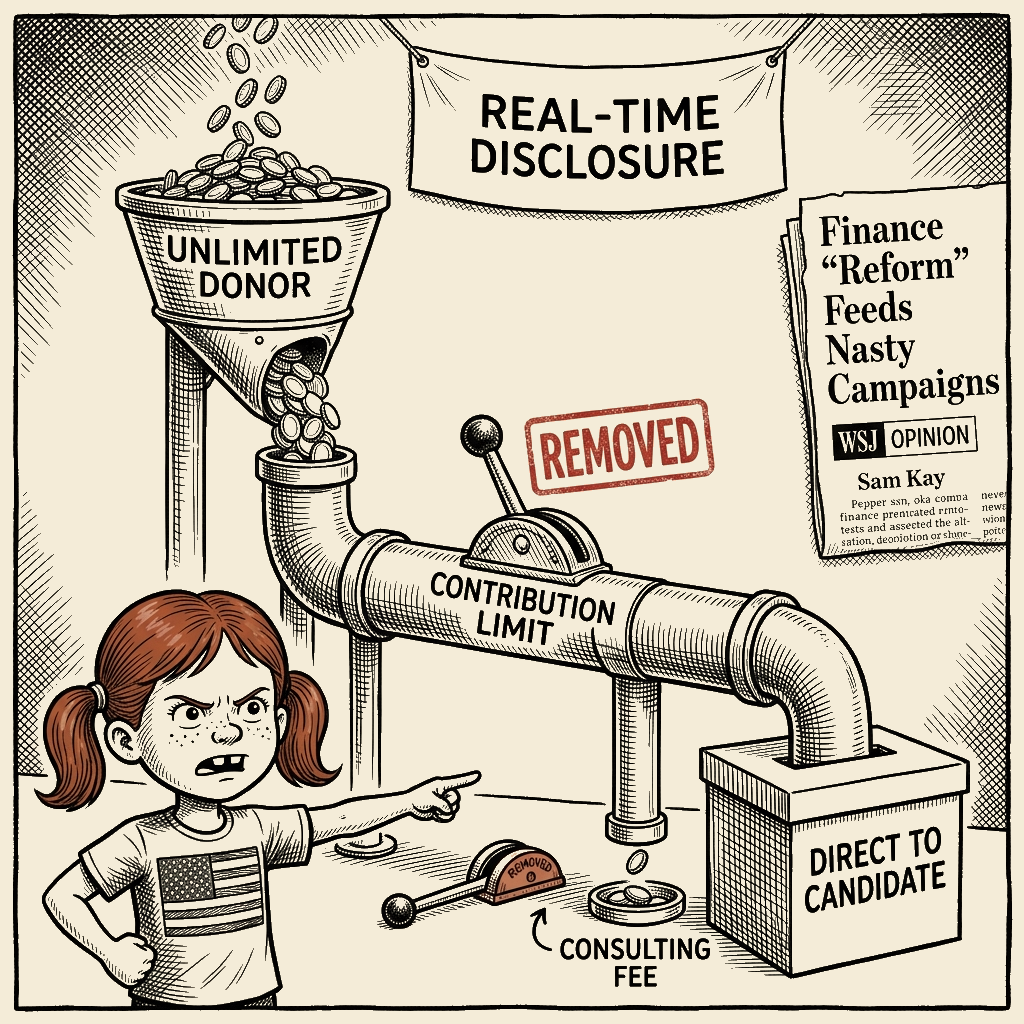
Responding to: Finance ‘Reform’ Feeds Nasty Campaigns — Sam Kay · 2026-08-05
What the Piece Argues
Sam Kay, a Republican pollster, argues that post-Watergate campaign-finance limits backfired: by capping direct giving, they drove political money into unaccountable outside groups, produced the negative and fragmented advertising voters despise, and diluted accountability. He welcomes the Supreme Court’s decision in NRSC v. FEC striking down coordination bans, and proposes going further — letting individuals, corporations, unions, and other organizations give unlimited amounts directly to candidates, with real-time disclosure, on the theory that direct and visible funding makes campaigns more honest than the current indirect system does.
Receipts
The move the framing makes is to convert the genuine failure of one reform — limits pushed money into opaque outside groups — into a license to abolish the limit itself, conceding that donor influence persists and proposing to hand it a direct line to the candidate.
The framing wants you to believe
- Contribution limits caused the negative, unaccountable campaigns voters hate; unlimited direct giving would be cleaner and more transparent.
- “Real-time disclosures” would let voters judge who funds whom and hold candidates directly responsible.
- The NRSC decision is a “welcome correction” that restores positive, honest advertising.
What’s really going on
- The author concedes the key fact himself: limits “haven’t eliminated the influence of wealthy donors or corporations. They have simply changed how that influence is exercised” — then proposes removing the only brake on the direct purchase of candidates, rather than strengthening disclosure or public financing.
- Cui bono: the concentrated beneficiary is the donor class buying direct access, plus the political-consulting industry the author works in (OnMessage, a Republican firm whose revenue scales with ad spend); the diffuse cost falls on every voter whose election is bought.
- “Real-time disclosure” is the time-tested deregulatory fig leaf: it tells you who bought the senator; it does not stop the senator from being bought.
Anchor citation — the piece’s own admission: “Those concerns are legitimate. But contribution limits haven’t eliminated the influence of wealthy donors or corporations. They have simply changed how that influence is exercised.”
The DEFCON Ladder
DEFCON 5 — Polite Reframe
When to use: for the persuadable moderate and the good-faith relative — the person who reads the headline and thinks, “well, if the billionaire’s going to spend the money anyway, shouldn’t it just go to the candidate openly?” This is the tier that changes a mind in a kitchen conversation.
Darla runs the diner on the corner, and she watches the ads the way the rest of us do — thirty seconds of somebody yelling, paid for by an organization she’s never heard of, and she turns to me and says, “At least if the money went straight to the candidate, we’d know who was behind it.” Here’s the thing: Darla is right about the problem and wrong about the cure. The outside groups are unaccountable, the ads are awful, and the money is everywhere. I don’t dispute any of it.
But the answer to unaccountable money is not to hand the money directly to the candidate. The answer is to get the money out. The piece you sent proposes that individuals, corporations, and unions “should be free to contribute as much as they want directly to candidates’ campaigns.” That is the one change that makes every problem on the page worse. It removes the limit on how much of your elected official one person can buy — and it calls the removal transparency.
The author concedes the point himself: contribution limits haven’t stopped wealthy donors from influencing politics; “they have simply changed how that influence is exercised.” That is an argument for closing the loopholes, strengthening disclosure, and funding campaigns publicly — not for declaring the purchase legal. A senator who takes a foreign lobbyist’s money and votes that lobbyist’s bill isn’t a reformer’s problem; he’s a foreign agent. Get the money out, or stop pretending we have a republic.
DEFCON 4 — Mockery and Ridicule
When to use: sharp, satirical; stops persuading the repeater and performs for the bystander. Open funny-before-devastating — the literalized image.
Picture the campaign ad: the candidate stands in front of a podium, reads a $10 million check aloud, thanks the donor by name, and then says, “And that’s how you get transparency.” The audience laughs. The donor gets his money’s worth.
That’s the world Sam Kay is building. He’s a pollster at a Republican consulting firm, and he wants the rich to write bigger checks directly to candidates. He says contribution limits have backfired — that they’ve pushed spending to outside groups and made campaigns more negative. He’s right about the problem. But his solution is to let the rich buy the ballot outright.
“Contribution limits haven’t eliminated the influence of wealthy donors or corporations. They have simply changed how that influence is exercised.” The piece acknowledges the corruption concern — “Critics will argue that larger direct contributions invite corruption and pay-to-play politics. Those concerns are legitimate.” — but dismisses it by arguing that limits haven’t eliminated the influence anyway.
The piece claims to be a reform proposal, but it’s actually a corruption preserver. It claims to be about transparency, but it’s actually about letting the rich hide in plain sight. It claims to be about democracy, but it’s actually about letting the rich buy the ballot.
We are the builders. We build a system that protects democracy by limiting the influence of wealthy donors. We don’t let the rich buy the ballot.
DEFCON 3 — Nuclear Satire
When to use: scorched-earth, grotesque metaphor, absolute villainization of ideas, institutions, and named apex-of-power figures. Open funny-before-devastating, now baroque; receipts deployed with cumulative force; full identity inversion; hyperbolic criminal/medical/hellfire comparisons.
Imagine the ad: the donor’s name in 72-point font, the check read aloud in full — not the amount, just the name — and a voiceover: “Paid for by the future.” That’s the world Sam Kay is building at his Republican consulting firm, and he’s not selling reform. He’s selling a scalpel that performs the lobotomy on campaign finance and calls the blood transparency. He’s a pollster at OnMessage Inc. — a fixer in a lab coat — declaring the cure for a money-sick system is to inject it with more money, straight into the patient’s veins, no filter, no waiting room.
He’s right that the limits backfired. He’s wrong about the cure, and the wrongness is the point. “Critics will argue that larger direct contributions invite corruption and pay-to-play politics. Those concerns are legitimate.” Legitimate — and then he shrugs with the thinnest dodge in the playbook: “Contribution limits haven’t eliminated the influence of wealthy donors or corporations. They have simply changed how that influence is exercised.” That’s not an argument. That’s the arsonist noting that fires still happen and suggesting we deregulate matches. The cause of the disease is the concentration of wealth; his prescription is to concentrate it faster and call the aneurysm a partnership.
“Individuals, corporations, unions and other organizations should be free to contribute as much as they want directly to candidates’ campaigns.” No cap. No firewall. Direct line from the treasury to the throne. He names the corruption concern and then excises it from the record like a surgeon burying the biopsy. Reframe, reframe, reframe: the rich aren’t buying influence, they’re “exercising influence.” The ballot isn’t for sale; it’s just in plain view. The bribe is printed, so it must be a receipt. Whatever you call it, the direction is the same — money down, democracy up on the slab.
And the consulting firm’s meter is running. Every un-capped dollar that flows to a candidate flows through people like Sam Kay. This isn’t a reform platform; it’s a toll booth dressed as a temple. We are the builders. We built the limits to keep the few from buying the many. We don’t let the rich buy the ballot.
As King said at Riverside in 1967, a society that treats machines, profits, and property rights as more important than persons breeds the giant triplets of racism, extreme materialism, and militarism. Add a fourth evil to King’s triplets, being born right now: the purchase of the republic, made lawful, itemized, and called transparency.
DEFCON 2 — Prophetic Indictment (the Letter)
When to use: the letter written to the piece’s named author — cold, close, unhurried; second person, present tense, no jokes, no gallery.
Sam Kay,
Your piece argues that contribution limits “haven’t eliminated the influence of wealthy donors or corporations” and that “individuals, corporations, unions and other organizations should be free to contribute as much as they want directly to candidates’ campaigns.” That is what it carries — the removal of the limit on buying an office, wrapped in the word “transparency.” Heat is climbing your neck into your face, and you cannot will it back down.
The record, in the piece’s own terms. You call the Supreme Court’s decision in National Republican Senatorial Committee v. Federal Election Commission (2026) — striking down the ban on coordination between party committees and candidates — “a welcome correction.” You write that limiting direct contributions “simply changed how that influence is exercised,” and you propose removing the limit. You name the objection yourself: critics “will argue that larger direct contributions invite corruption and pay-to-play politics,” and you call those concerns “legitimate.” The piece closes by disclosing that you are a pollster at the Republican consulting firm OnMessage Inc. That is the record, and no motive is asserted in it.
The act is publication. The words left the opinion page under your name, and they are in the world now, in the hands of people who vote and the people who buy. What they carry does not change because the delivery is called “disclosure.” Your throat is tightening around the swallow you have just taken, and it will be tighter around the next one. The paragraph that calls pay-to-play “legitimate” is where the piece names the corruption and waves it through in the same breath — that is not an argument, it is a shrug with a citation. What does the receipt change? The pressure behind your sternum is a flat hand, pressing steadily inward, and it does not lift while the page stands, and the page is still moving. You have proposed the one thing that makes the receipt and the bribe the same document, and you ask the voter to sign it. It is not a reform proposal. It is a business plan, and the disclosure at the bottom of the page names the firm the plan feeds. The heat has climbed as high as your jaw, and it will not go back down while this piece is being read anywhere.
Amos did not measure Israel by its temples or its treasuries. He measured it by what it did to its poor, and the justice he demanded ran through a system that could not dam it — “let justice roll down like waters, and righteousness like an ever-flowing stream” (Amos 5:24). The water will not run clean through the system your piece proposes. It runs gold, already weighed, already spent, already signed for. The judgment stands, and it does not need your consent.
DEFCON 1 — Profane Scorched-Earth
When to use: the cathartic apex — for the reader who needs every glove off and every word of it, the release valve after the whole ladder.
Let’s stop goddamn pretending. This piece was honest for exactly one fucking sentence, and that sentence is the whole game. “Contribution limits haven’t eliminated the influence of wealthy donors,” it confesses — “they have simply changed how that influence is exercised.” Read it again, because that is the entire confession: the brake works. It holds the money back. And the “reform” on sale here is to rip the goddamn brake out — not fix it, not replace it with public funding, not close the loopholes — but yank it out of the car and call the wreck sunshine. That’s like saying locks don’t stop every burglar, so mail the thieves the keys.
This is not reform, you absolute fool. This is a fence getting the law rewritten so the stolen goods move in the open and get called legitimate commerce. “Real-time disclosure”? That’s the receipt for the bribe — the little paper that tells you which billionaire bought the senator while the senator stands on the floor pretending to be unbought. “Candidate control”? That’s the buyer controlling the bought. And every dollar the scheme frees flows through firms like OnMessage — the consulting house the author works for, the house that eats ad spend for breakfast. He wrote the op-ed that feeds his own goddamn payroll, and he dressed the feeding as civic virtue. He’s not a reformer; he’s a toll collector who wants to raise the toll and call the road transparent. Hell of a coincidence.
Stop calling it sunlight. It’s a bribe wearing a fucking sign. The moneychangers got their table turned over for less — for selling doves in the temple, a little profit laid over the sacred. Christ’s one act of force was that table, and here is the modern upgrade: unlimited, disclosed, lawful, and still a goddamn bribe. The only thing that’s changed is the nerve it takes to say so. It’s a bribe. It was always a fucking bribe. This piece just wants you to sign the receipt, thank the man, and hand over the office you were supposed to hold. The builders built limits so the few couldn’t buy the many. The fixer wants to burn the limits down and charge a management fee on the ashes — and call the invoice enlightenment.
Amos did not measure a nation by its temples or its treasuries; he measured it by what it did to its poor. “Let justice roll down like waters, and righteousness like an ever-flowing stream” — Amos 5:24. That water won’t run clean. In the America this piece would build, it runs gold: molten, already counted, already spent.
The Prophecy
When to use: Prophetic register with restrained profanity — not as loud as the scorched-earth, but with enough fire to make the target uncomfortable. The force is proximity plus edge.
You sent me a piece that wants the rich to buy the ballot directly and calls it reform. That’s what it carries. Sam Kay, a pollster at the Republican consulting firm OnMessage Inc., tells you the contribution limits backfired, that the money just “migrated” to outside groups, that voters can’t follow it. Maybe he’s right about that. But the fix he’s selling is to let the money flow straight to the candidate — no cap, no firewall, just “real-time disclosures” and a hope that nobody blinks.
“Contribution limits haven’t eliminated the influence of wealthy donors or corporations. They have simply changed how that influence is exercised.” That’s the piece’s own receipt, and it’s the whole damn argument in a thimble: limits didn’t stop the influence, so hand the influence a direct line. “Critics will argue that larger direct contributions invite corruption and pay-to-play politics. Those concerns are legitimate.” Legitimate — and then waved off like a fly. That’s not a rebuttal. That’s a goddamn shrug dressed in a suit.
And read the byline. “Mr. Kay is a pollster at the Republican consulting firm OnMessage Inc.” More money flowing to candidates means more money flowing through people like him. He’s not a reformer. He’s a toll collector who wants to raise the toll and call the road “transparent.” Hell of a coincidence, that.
The heat is climbing your neck as you read this, and it should be. This piece is a business plan wearing reform’s clothes. We are the builders, and we don’t let the rich buy the ballot. Not this cycle. Not ever.
Amos spoke to a nation that offered sacrifices while destroying the poor. “Let justice roll down like waters, and righteousness like an ever-flowing stream.” The water will not run clean. It will run gold.
The Reckoning
When to use: The all-out, no-holds-barred, maximal-expletive apex — the cathartic end of the ladder. Every paragraph carries a quote, receipt, or named technique. Gloves all the way off.
This absolute motherfucking sham of a “reform” wants the rich to buy the ballot outright and calls it democracy. Sam Kay — a pollster at the Republican consulting firm OnMessage Inc., writing on the Wall Street Journal opinion page — tells you the contribution limits “backfired,” pushed spending to outside groups, made campaigns nastier. He’s right about the problem and dead fucking wrong about the cure. His answer isn’t reform. It’s a goddamn invoice with a business plan stapled to the back.
“Contribution limits haven’t eliminated the influence of wealthy donors or corporations. They have simply changed how that influence is exercised.” That’s his own receipt, and he reads it wrong on purpose. The cure for too much money in politics is not more money in politics, you absolute tool — it’s not handing the gold a direct line to the candidate’s throat. But here’s his actual proposal: “If donors spend millions, that money should flow directly to candidates.” Millions. Directly. No cap, no firewall, no pretense. That’s the whole shit-stained point of the piece.
“Critics will argue that larger direct contributions invite corruption and pay-to-play politics. Those concerns are legitimate.” Legitimate — then dismissed with the flattest fucking dodge in the racket: limits “haven’t eliminated the influence,” so let’s just hand the influence a direct line. That’s like saying locks don’t stop every burglar, so mail the thieves the keys. Transparency, my ass. What he’s selling is the rich hiding in plain sight — buying the ballot and calling the receipt “disclosure.”
And who’s the motherfucking toll collector on this bridge? OnMessage Inc. — his own firm. More money flowing to candidates means more fees flowing to the consultants who build the ads. He isn’t proposing reform; he’s proposing deregulation of his own revenue stream and calling the invoice enlightenment. The builders built limits to keep the few from buying the many. The fixer wants to burn it down and charge a management fee on the ashes. Fuck that noise. We don’t let the rich buy the ballot. We don’t let the rich buy the fucking ballot. Not today. Not ever.
Amos saw a nation burning incense over a broken people. “Let justice roll down like waters, and righteousness like an ever-flowing stream.” That water won’t run clean. In Sam Kay’s America it runs gold — molten, already counted, already spent.

About Malcolm Little King
Malcolm Little King is a heteronym in Main Street Independent's editorial architecture — an analytical voice, not autobiography of any actual person. The position this column expresses is the publication's position on the territory Malcolm Little King's lane covers, rendered through Malcolm Little King's register.