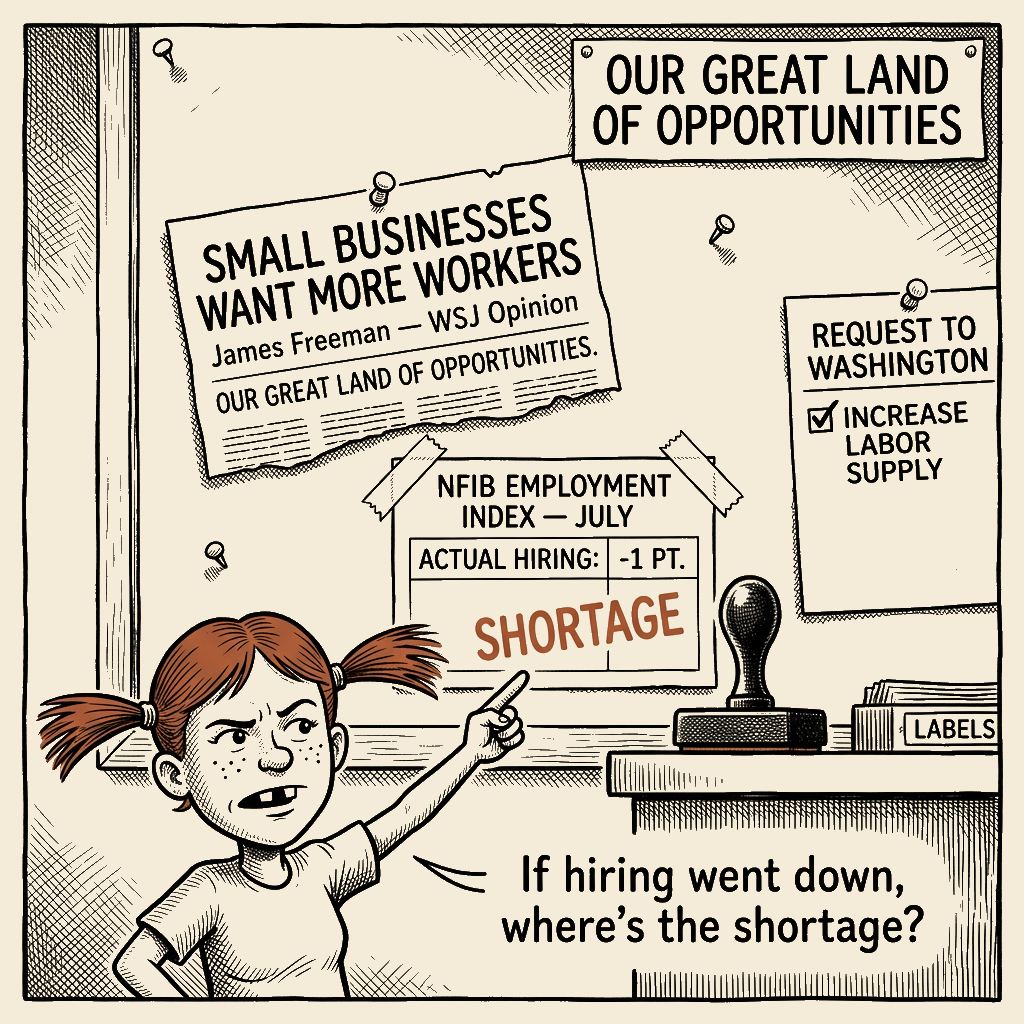
Responding to: Small Businesses Want More Workers — James Freeman · 2026-08-06
What the Piece Argues
The piece reads the July NFIB small-business data as a sign of a rising economy: owners report strong demand for workers and rising pay plans, while the actual problem, in its telling, is that not enough workers can be found. It concludes the U.S. economy suffers a worker shortage and calls on Washington to enable more legal migration — vetted, so newcomers come to work — so that “our great land of opportunities” can get the workers it needs. The argument treats the hiring gap as a supply problem rather than a pricing problem.
Receipts
The framing converts a wage problem into a worker problem, then sells expanded low-wage migration as the fix.
The framing wants you to believe
- The U.S. economy is rising and small-business owners are eager to hire.
- The problem is a shortage of workers — there simply aren’t enough people to take the jobs.
- The solution is more legal migration, vetted, so our “great land of opportunities” can get more people “ready to seize them.”
What’s really going on
- The piece’s own data contradicts it: “actual July hiring activity declined 1 point from June” (NFIB, quoted in the piece) — hiring fell while owners reported wanting to hire, the signature of a wage problem, not a body-count problem.
- Workers are not missing; they are underpaid. A record 47.8 million Americans quit their jobs in 2021 alone (BLS JOLTS) — the same workers “vanish” whenever the offered wage stops covering childcare, rent, and the ride to work.
- The call for more migration serves employers who want a larger labor pool to hold wages down, while U.S. taxpayers backfill sub-living wages through Medicaid, SNAP, and the EITC — the “cheap” labor the framing celebrates is partly paid for by everyone else (U.C. Berkeley, Fast Food, Poverty Wages, 2013).
Anchor: NFIB Small Business Employment Index, July (as quoted in the piece): hiring declined 1 point from June.
The DEFCON Ladder
DEFCON 5 — Polite Reframe
When to use: A good-faith small-business owner or a family member who genuinely repeats the “nobody wants to work” story and is persuadable — the patient, fact-first conversation.
Let me tell you about Joe. He worked a warehouse shift for three years. His daughter’s childcare cost more than his take-home for the hours it covered, so the math never closed — he was paying for the privilege of going to work. When a plant twenty miles away posted a wage that closed the gap, Joe went. The warehouse Joe left has been “short” ever since.
The July NFIB report this piece is built on says owners want to hire and are “ready and willing to pay up” — and then, in the same breath, admits actual hiring declined one point from June. That is not a shortage of human beings. That is a shortage of wages. The workers you say are missing are not missing; they are deciding whether the wage on the sign will cover the rent.
There is no shame in wanting a healthy business. But we don’t desert our own when they’re down — the neighbor who lost his job, the veteran with PTSD, the mother working three jobs and still short. These are our people. A nation that stops pretending its workers don’t exist, and starts paying them what the work is worth, is a nation that doesn’t have a labor shortage at all. Pay the wage, and the worker you’re searching for will be standing at the door — because she was never gone. She was waiting to be worth it.
DEFCON 4 — Mockery and Ridicule
When to use: The “worker shortage” line repeated at a table or on social media with bystanders watching — the response that performs for the audience, not the repeater.
I have found the worker shortage, and it is beautiful. It is living in the wage column, where it has always lived.
The July report says owners are “ready and willing to pay up” for workers — and then, in the very next sentence, admits hiring fell one point from June. You are paying up so much that you hired fewer people than last month. That is not a shortage of workers. That is a shortage of honesty, and it is the only shortage in this story.
They will tell you nobody wants to work. Ask them what it pays. The answer is always the punchline. The worker who “doesn’t exist” is the worker who did the math at the kitchen table and found your wage is an insult with a W-2 attached. She’s not a shortage. She’s a decision. You’re the one who hasn’t decided to pay her.
So here’s the deal, friend — the “shortage” ends the day the wage stops being a joke. Until then, stop blaming the people who won’t starve for your refusal to pay them. The workers are not missing. Your nerve is.
DEFCON 3 — Nuclear Satire
When to use: The full-scorched-earth reply to the “shortage” myth and its caliphate dog-whistle — cumulative receipts, baroque metaphor, absolute villainization of the framing.
Let us solve the great mystery of our time: the worker who does not exist. The NFIB has searched for her. The editorial has searched for her. They have determined, with the gravity of a papal conclave, that there are simply not enough Americans willing to accept a wage that cannot cover the rent.
The shortage is so acute that actual hiring declined one point in July. This is the shortage of a man who announces he cannot find water while standing in the ocean, because he refuses to open his eyes. The data is not hiding from them. It is in the piece they wrote.
And note the dog-whistle that closes the plea for more bodies: vet the newcomers so they come to work and not “to create a caliphate.” The bosses who cannot find American workers at a wage that won’t feed a family have found, in the same sentence, the Muslim who will take less. The shortage is not of workers. The shortage is of shame. Bring the workers, pay them nothing, blame the ones who won’t starve, and smear the ones who will — that is not a labor policy. That is a scavenger’s prayer, said over a wage you know is too low to feed a child.
The “great land of opportunities” is great, it turns out, for one thing only: the opportunity is yours and the labor is cheap. Call the worker a shortage so you never have to call the wage a theft. The economy is not rising. The lie is rising. And it is rising on the backs of people the piece has decided do not count.
DEFCON 2 — Prophetic Indictment (the Letter)
When to use: You sent this piece to someone, or someone sent it to you. This tier is written to the person who now holds it. It is not for debate and not for the crowd. It is one letter, cold and close, about one act — what moved through your hands and where it landed. Use it when you want the person who circulated the piece to sit with what it actually carries, without the distance of a screen. It does not argue. It witnesses.
You sent me a piece that tells you the economy is rising and the problem is that there aren’t enough workers. To hell with that. Receive what it carries.
The July report the piece is built on says owners want to hire and are ready to pay up, and actual hiring fell one point from June. The piece does not stop to wonder why. It names the problem a shortage of workers and asks the government for more of them — vetted, in its words, so they come to work and not “to create a caliphate.”
There is a woman who lives near you, or works where you shop, who stands at the counter of a business that says now hiring and knows the wage on the sign will not cover the rent. She is not a shortage. She is a fact the piece looked at and chose not to see. The piece did not call her by name. It did not need to. It called her a shortage, and that is the same violence, done twice.
Something is closing in your throat, and you know what it is. It is the sound of a person erased by a statistic — told, in the morning paper, that she does not exist. You carried that to her. You did not mean to; you meant to forward good news about the economy. But the economy the piece describes is the one where the employer gets more bodies and she gets the same wage, and the taxpayer — you, among them — backfills the rest. The cold is in your hands now. It is the cold of being counted out of your own country’s story.
The letter of James saw you coming. It says in the fifth chapter: the hire of the labourers who have reaped down your fields, which is of you kept back by fraud, crieth — and the cries of the harvesters have entered the ears of the Lord of hosts. The Lord of hosts is not confused by a labor shortage. He is not confused by a caliphate. He is listening to the wage. So are you, now. That is the only thing this letter needed to put in your hands.
DEFCON 1 — Profane Scorched-Earth
When to use: The reader who needs full catharsis — the worker told for the thousandth time she doesn’t exist, or the ally who needs the gloves off.
There is no worker shortage, you absolute frauds. There is a wage shortage. There is a shortage of employers willing to pay a human being enough to cover the rent, and a shortage of editorialists with the spine to say it out loud.
July hiring fell one point. One goddamn point. Owners are “ready and willing to pay up” and they hired fewer people than June. That is not a shortage of Americans. That is a shortage of the truth, and it is the only shortage in this piece that has ever been real.
And the caliphate line. You cannot find workers at the wage you’re offering, so you ask for more bodies and smear the Muslims who might take the job — in the same goddamn sentence. That is not economics. That is a scavenger’s prayer over a wage you know is too low to feed a family. You have the nerve to call yourself the land of opportunity while you’re out here trying to import a labor pool to keep wages down and blaming the worker for your own cheapness.
The workers you say are missing are not missing. They are at the childcare center doing the math, at the bus stop doing the math, at the kitchen table doing the math, and the math says your wage is a fucking insult. They will come back the day the wage stops being a lie. Picard said it almost thirty years ago, and it is the only honest sentence in this whole sorry genre: build a class of people you treat as disposable, and you have built “a race of disposable people.” That is what the “shortage” is — you have decided to count your own neighbors as disposable, and now you’re shocked they declined the role.
Stop blaming the people who won’t starve for your refusal to pay them. The “great land of opportunities” you’re pining for is one where the opportunity is yours and the labor is cheap — a plantation with a spreadsheet. We are done being counted as a shortage. We are not the shortage. Your wage is. Your nerve is. Your shame is. By any means necessary that operate through the ballot and the wage, we are done.

About Malcolm Little King
Malcolm Little King is a heteronym in Main Street Independent's editorial architecture — an analytical voice, not autobiography of any actual person. The position this column expresses is the publication's position on the territory Malcolm Little King's lane covers, rendered through Malcolm Little King's register.