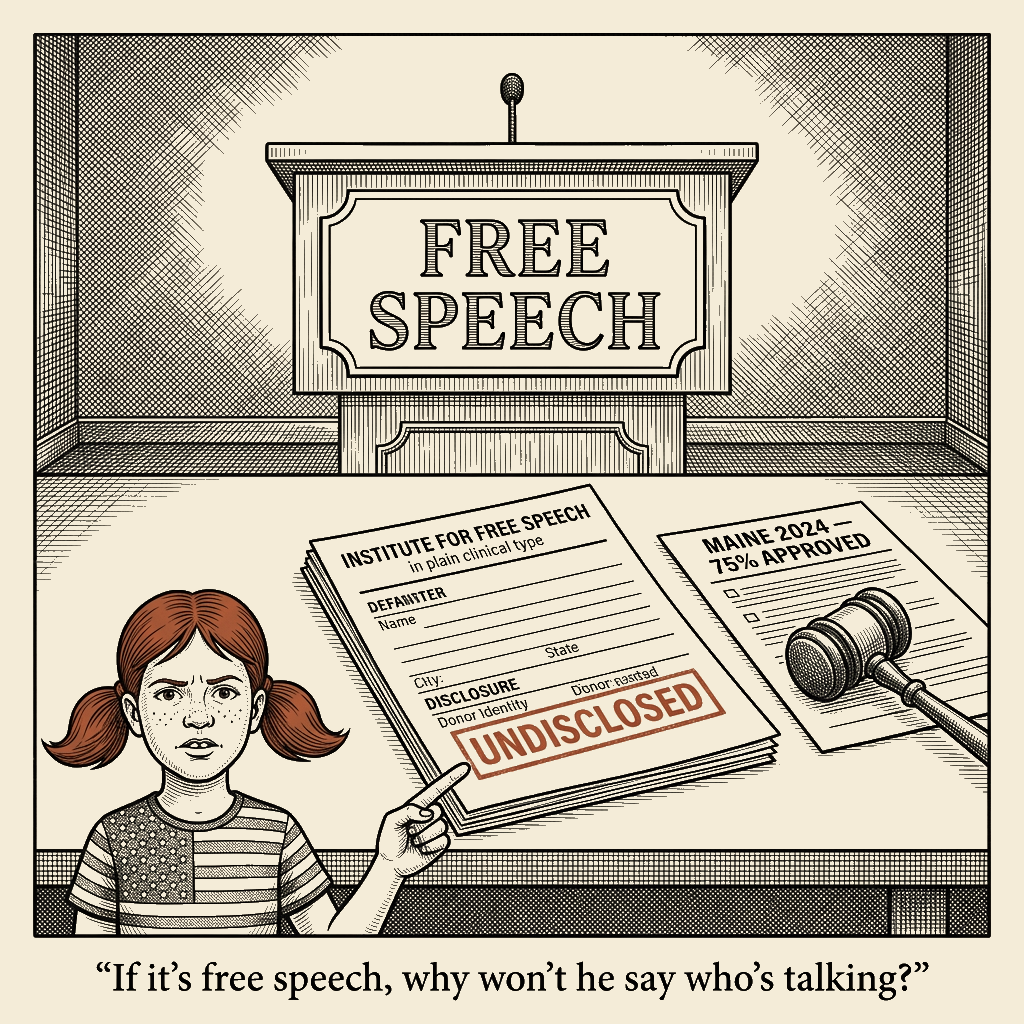
Responding to: Campaign Speech Lies at the Heart of the First Amendment — Bradley A. Smith · 2026-08-09
What the Piece Argues
Bradley A. Smith, writing on behalf of his Institute for Free Speech, argues that Maine’s 2024 ballot measure capping super PAC contributions at $5,000 per year and imposing donor disclosure violates the First Amendment. He contends that campaign spending is speech, that the Supreme Court settled the unconstitutionality of independent spending caps in Buckley v. Valeo (1976), and that the measure’s 75 percent voter approval cannot override a constitutional right — comparing such voters to supporters of warrantless searches and calling majoritarian overreach the precise thing the Bill of Rights exists to check. He also argues that the institutional press supports campaign-finance limits only because the press itself is exempt from them, and that defending organized, well-funded, persuasive political speech is the true test of free-speech seriousness.
Receipts
The move is the “money is speech” frame: a rule that limits how much one donor can dole into a super PAC is presented not as a rule about elections but as a constitutionally protected-speech violation, and the people who voted against concentrated money are recast as would-be tyrants.
The framing wants you to believe
- Capping contributions to a super PAC is, “functionally,” capping what the donor may say — an assault on the First Amendment itself.
- A three-quarters popular vote for the cap proves “majoritarian overreach,” the same species as authorizing warrantless searches.
- Campaign-finance regulation is elite “good government”/“dark money” rhetoric that thins out everyone’s speech, and only the press backs it because the press is exempt.
- Real free-speech seriousness means defending the “organized, often well-funded” speech that can persuade an electorate.
What’s really going on
- The piece itself concedes the decisive fact: donors remain “free to spend whatever they please independently of candidates” — so the $5,000 cap stops no one from speaking. What it stops is pooling — the concentration of a few fortunes into a megaphone that drowns out everyone else’s voice. A cap on flooding the public square is not a cap on speech; it is a cap on one voice out-shouting the town.
- The “speech” frame launders a concentrated-power position: the few who can spend millions are the beneficiaries; the many whose votes are diluted by that spending are the cost-bearers. Treating the 75 percent of Mainers who voted against being drowned out as “authoritarians in waiting” inverts who is silencing whom.
- Buckley v. Valeo (1976) is real, but a Supreme Court doctrine is not a reason the position serves the many — it is the legal high-water mark of a deregulation project. (Anchor.) And the piece’s own admission that the Maine law leaves party committees uncapped shows a targeted distinction between untraceable independent pools and other channels — not a blanket gag on speech.
- The institutional authorship is the piece’s own: Bradley A. Smith’s Institute for Free Speech, a named litigant-advocacy organization built to strike down campaign-finance limits. An interest group suing to deregulate the money it is organized around is not an innocent bystander discovering the First Amendment.
The DEFCON Ladder
DEFCON 5 — Polite Reframe
When to use: good-faith family member, persuadable moderate, anyone who sincerely believes campaign finance limits are censorship — you’re not fighting them, you’re giving them a better frame.
Let me tell you about Gary. Gary runs a hardware store in Bangor, Maine. He donates fifty bucks to a local group that advocates for clean water. Next to him in the donations ledger is a hedge fund manager who just wrote a five-million-dollar check to a super PAC that will run ads telling Gary who to vote for.
Under Maine’s law — the law Smith wants struck down — both Gary and the hedge fund manager face the same $5,000 cap on what they can give to that super PAC. Under Smith’s preferred rule, there is no cap. The hedge fund manager writes five-million-dollar checks. Gary still has fifty bucks.
Smith calls this “free speech.” But Gary’s voice doesn’t get louder because the hedge fund manager’s does. It gets quieter. Every dollar above Gary’s capacity is a dollar spent telling his neighbors what to think, and Gary can’t answer.
Smith will tell you that Buckley v. Valeo — the landmark case he cites — supports his position. He’s half right. Buckley did strike down expenditure caps. But Buckley also upheld contribution limits for exactly one reason: corruption, or the appearance of corruption. Smith will tell you that Buckley’s contribution holding applies only to candidates, not to super PACs, because SpeechNow v. FEC extended Citizens United to independent-expenditure organizations. He’s right that the doctrine has narrowed. But the corruption rationale doesn’t evaporate because you routed the money through a different vehicle. A five-million-dollar check to a super PAC running a candidate’s ads creates the same appearance of corruption as a five-million-dollar check to the candidate. Smith presents this as settled law. It is the exact question before the First Circuit — and nearly three-quarters of Maine voters already gave their answer.
Real free speech isn’t about who can write the biggest check. It’s about whether the check you write actually counts. If your candidate can only win by outspending the other side a thousand to one, your message isn’t winning on its merits — it’s buying the megaphone. Nearly three-quarters of Maine knew that. We should trust their judgment over a lawyer who didn’t disclose who was paying him to disagree.
DEFCON 4 — Mockery and Ridicule
When to use: a Twitter exchange, a Substack reply, anywhere the audience can see the performance — you’re not persuading Smith, you’re showing everyone watching what his argument looks like when you hold it up to the light.
So here’s the pitch: a hedge fund manager wants to write a $5 million check to a super PAC that will run a hundred thousand ads telling Maine voters who to hate this November. A Maine voter — let’s call her Diane, she teaches third grade — thinks maybe, just maybe, there should be a $5,000 cap on how much any one person can dump into that operation. And along comes Bradley A. Smith, lawyer for the Institute for Free Speech, to tell Diane that capping the hedge fund’s check is censorship. That it is Diane who is silencing the billionaire.
Read that again. A third-grade teacher in Bangor is silencing a hedge fund manager because she thinks five million dollars is too much money for one person to spend telling her neighbors what to think. The billionaire’s speech is being suppressed — by the radical notion that Diane’s fifty bucks should count for something.
Smith’s proof that this is censorship? Buckley v. Valeo — a case from 1976 that struck down expenditure caps while upholding contribution limits. What he didn’t mention: Buckley’s contribution holding authorized anti-corruption regulation of exactly the type Maine enacted. He’ll tell you that SpeechNow v. FEC narrowed Buckley’s contribution holding to candidates only. He’s right — but the corruption rationale doesn’t change because you funneled the money through a super PAC instead of the candidate’s campaign. The part of the legal landscape he needs you not to think about: a five-million-dollar check to a super PAC running a candidate’s ads creates the same appearance of corruption as a five-million-dollar check to the candidate. That’s the question before the First Circuit. Smith presented it as settled law because he needs you not to notice it’s contested.
Nearly 75 percent of Maine voters approved this law. Smith’s response: popularity doesn’t make something constitutional. Fair enough. But when nearly three-quarters of people vote for “don’t let one person buy more speech than everyone else combined,” and the person arguing it’s unconstitutional is a lawyer paid by people who want to buy exactly that — at some point you have to ask whether the Constitution is really the thing he’s defending, or whether it’s the costume his clients’ money rented for the evening.
DEFCON 3 — Nuclear Satire
When to use: the audience is already on your side and needs the catharsis; the piece has been widely shared and you want to make sharing the response feel like a complete act; the argument is too far gone for polite correction and needs to be dismantled at volume.
Bradley A. Smith has discovered something extraordinary. A hedge fund manager who writes a $5 million check to a super PAC is not exercising financial power — he is exercising free speech. A third-grade teacher in Bangor who thinks that’s too much is not exercising democratic self-governance — she is committing censorship. The First Amendment, which was written to prevent the government from jailing you for what you say, actually exists to prevent the public from limiting how much money you can spend telling them what to think. The Founders fought a revolution against concentrated power so that concentrated power could buy unlimited access to every election in the country, and anyone who objects is an authoritarian in waiting.
Smith is a lawyer. He represents the Institute for Free Speech — an organization whose name does what the best propaganda always does: it tells you the opposite of what it does. His clients want to pour unlimited money into super PACs. His argument is that this money is speech. His proof is Buckley v. Valeo — a case from 1976 that, in the very opinion he cites, explicitly upheld contribution limits as constitutional. He quoted the expenditure side. He left out the contribution side. And when you point out that SpeechNow v. FEC narrowed Buckley’s contribution holding to candidates, he’ll say you’re right — but the corruption rationale that justified those limits doesn’t disappear because you routed the money through a super PAC instead of the candidate’s campaign. It just means the legal question is genuinely contested, which is why it’s in front of the First Circuit right now — a fact Smith presents as though the answer were already in.
Nearly three-quarters of Maine voters approved this law — the ones Smith dismisses as wanting “less speech.” They were doing what the First Amendment actually exists for: governing themselves. They looked at the robocalls, the attack ads, the ten mailers a week funded by people they’d never met, and they said: we want rules. Smith’s response: wanting rules on political speech is the same as wanting less speech, and wanting less speech is the same as censorship. The man compared a $5,000 cap on super PAC contributions to the government raiding your house and the state suppressing your religion. He did it with a straight face in a national publication. He also neglected to mention that he founded the institute bringing the lawsuit, or that the institute does not disclose the people who fund it.
But the real trick — the prestidigitator’s flourish — is the bit about media bias. Smith says newspapers support campaign finance limits because media organizations are exempt from those limits, so thinning out the competition makes their voice louder. The man who runs an institute that doesn’t disclose its donors and exists to fight campaign finance regulation is accusing newspapers of having a vested interest in the debate. The pot calling the kettle black would need a telescope to see the kettle from where the pot is standing. Smith’s undisclosed funders benefit directly from unlimited political spending. His institute exists to make sure they can keep doing it. And he’s worried about the newspapers’ objectivity. Power doesn’t panic — but it does project.
DEFCON 2 — Prophetic Indictment (the Letter)
When to use: the author is named and you want the closest register — the conduct set down dry, then felt in the body. No gallery. For the author.
You wrote a piece arguing that a $5,000 cap on contributions to super PACs is “functionally, a law that caps how much you may say.” It was published by a national outlet. It was written by a lawyer for the Institute for Free Speech, which was founded by that lawyer, and which represents the plaintiffs in the case the piece discusses. The Institute’s donors were not disclosed.
Heat is climbing into your face, and you cannot will it back down.
Your piece cites Buckley v. Valeo (1976) for the proposition that spending limits violate the First Amendment. Buckley did hold that. Buckley also held — in the same opinion — that limits on contributions to candidates are constitutional, because the government has a compelling interest in preventing corruption or its appearance. You quoted the expenditure holding. You did not mention the contribution holding. You will say the contribution holding doesn’t extend to super PACs because SpeechNow v. FEC narrowed it. You’ll be right about the doctrine. But the corruption rationale doesn’t change because you funneled the money through a different vehicle — and that’s the question the First Circuit is deciding right now, in the case your organization brought, funded by the people who benefit from the answer you’re arguing for.
Your throat is tightening around this swallow, and it will be tighter around the next one.
Your piece compares a campaign-finance limit to a warrantless search of a home. It compares it to the state banning a Bible. A cap on how much one person can give to a political spending vehicle is, in your framing, the moral equivalent of the government breaking down your door. You presented a contested legal question as settled law — because if your readers understand that the constitutionality of super PAC contribution limits is genuinely at issue, the rhetorical force of your analogy collapses.
Nearly three-quarters of Maine voters decided they did not want unlimited money in their elections. Your piece calls this “emotionally appealing” and then irrelevant. The voters spoke. The voters were overruled — by a judge, at the request of a lawyer whose organization is funded by the people the voters were trying to regulate. The air in the room is thinning, and the room is getting smaller, and the voice that cast one of those votes does not carry through the walls of it.
You wrote a piece of advocacy. The advocacy was not disclosed. The funding was not disclosed. The precedent cited contradicts half the argument. And the democratic majority that voted for the law you oppose is reframed as having voted for “less speech” — as though the problem with American democracy is that there is not enough political advertising, not too much money in it.
There is a line from Amos that runs underneath all of this. The prophet told the rulers of his day that they trampled on the poor and took from them levies of grain (Amos 5:11, NRSV). The mechanism you defend is the modern form: the wealthy buy the political system; the lawyers argue that buying it is protected by the Constitution that was written to prevent it; and the people who voted to stop it are told they were committing censorship. The First Amendment was written to protect the citizen from the state. You have inverted it to protect the donor from the citizen. The real free speech is nearly three-quarters of Maine voters telling you they’ve had enough — and your clients are spending millions to make sure that speech doesn’t count.
DEFCON 1 — Profane Scorched-Earth
When to use: For the reader who needs the catharsis — the profane apex, gloves off, every paragraph still anchored to the receipts. The profanity lands hard and earns its place; the money-is-speech con gets the full evisceration. Kick up at the apparatus and the named institute; never at the voters it insults.
The absolute fucking nerve of it. The bad-faith ballet disguised as a brief: “Money isn’t speech” — and their answer is that a cap on a super PAC gift is a gag order. Let’s do the math they’re praying you don’t. The donor can still publish his own pamphlet, buy his own goddamn ads, shout from his own rooftop until the neighbors call the cops. Nobody on earth is silencing one syllable. The ONLY thing the $5,000 cap touches is the part where three fortunes team up to buy the election so the rest of us can’t be heard over the roar.
That’s the con, and they think you’re too fucking stupid to see it: take the act of a few rich men pooling millions to drown out three million citizens, and rebrand it “free speech.” Then take the seventy-five percent who voted against being drowned — and call them “authoritarians in waiting.” The people voting for their own democratic voice are the tyrants, and the bought megaphone is the First Amendment. That’s not irony, that’s an insult dressed in a robe, and the judge is the Institute for Free Speech’s own client.
“Congress shall make no law” — that’s the text. You want the whole goddamn doctrine built on it to be: Congress shall make no law, except that money is speech, and the speech of the richest shall drown the speech of the rest, and the source shall be hidden, and anyone who votes to stop it is a dictator. Fuck that. Real free speech is the nurse’s one vote being worth the banker’s one vote. That’s the amendment. That’s the Republic. The rest is the wealthy explaining, in the language of liberty, why liberty is for whoever can afford the biggest goddamn megaphone — and why the rest of us should be grateful they’ve let us listen.

About Malcolm Little King
Malcolm Little King is a heteronym in Main Street Independent's editorial architecture — an analytical voice, not autobiography of any actual person. The position this column expresses is the publication's position on the territory Malcolm Little King's lane covers, rendered through Malcolm Little King's register.