Responding to: The Big Midterm Question: Money — Karl Rove · 2026-08-05
What the Piece Argues
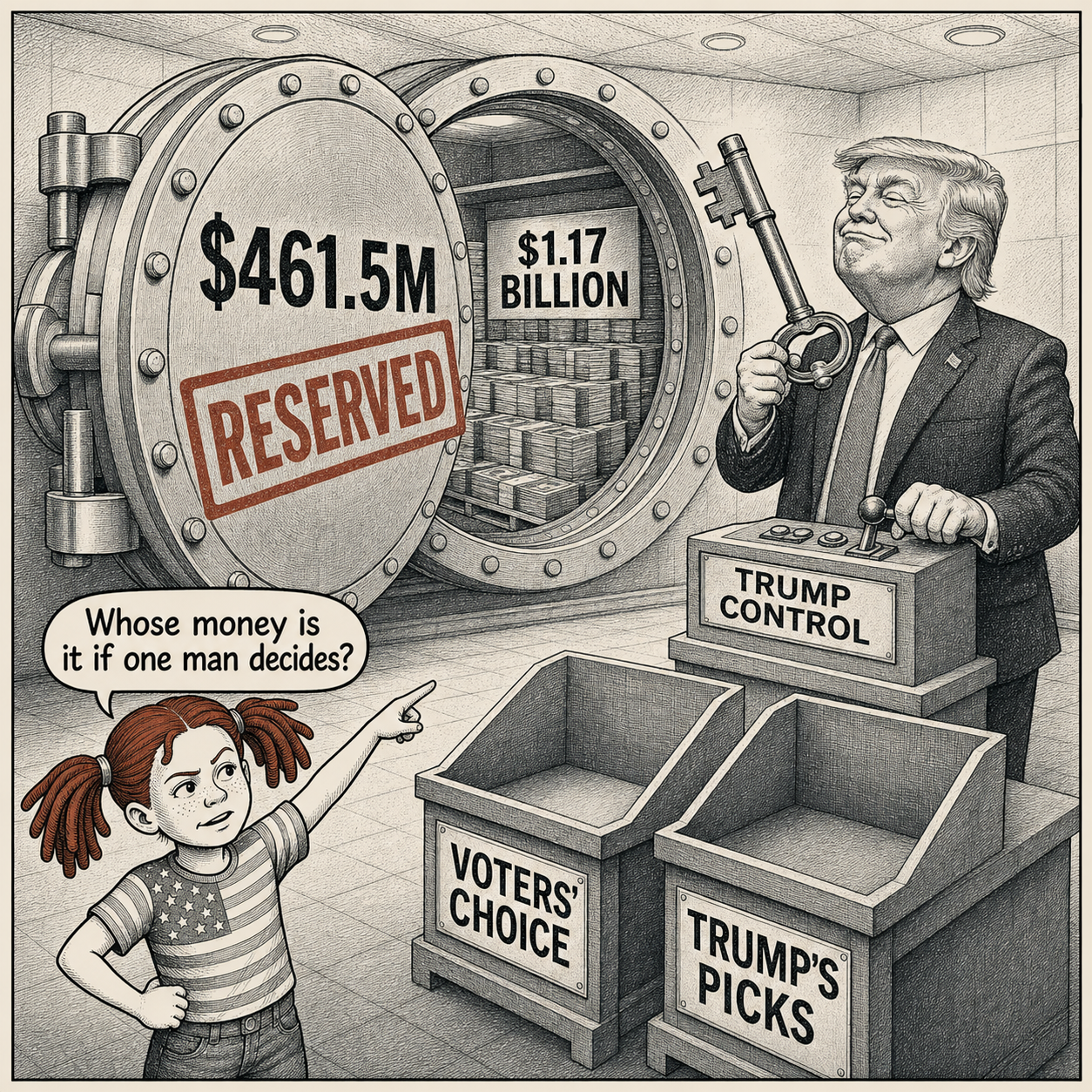
Rove’s piece argues that while Democratic Senate and House candidates hold a meaningful hard-money fundraising advantage heading into the fall midterms, the GOP’s vastly larger super PAC, party-committee, and outside-group war chest — approximately $1.17 billion to Democrats’ $494 million — could erase that edge. He notes that $461.5 million of the GOP advantage sits in Trump-controlled PACs (MAGA Inc. and Never Surrender), and that whether and how the president deploys it will matter, especially in Texas and Georgia, where Trump’s endorsed Senate nominees are struggling badly as fundraisers. The piece closes by suggesting the president’s low approval makes it strategically preferable to keep his name off ad campaigns.
Receipts
The piece wants you to believe this is a strategic money race where both sides have strengths and the bigger war chest tilts the outcome.
- The framing wants you to believe the GOP’s outside-money advantage is a natural consequence of stronger Republican support, that it neutralizes Democratic candidate-level fundraising, and that Trump’s reserve is just another chess piece in a competent strategic game.
- What’s really going on is that the $1.17 billion GOP outside advantage represents concentrated mega-donor wealth deployed through unlimited super PAC spending — a structural asymmetry the piece celebrates without once asking who writes those checks or what they get in return. Rove’s own numbers tell the real story: Trump’s endorsed candidates in Texas raised $9.2 million; their Democratic opponents raised $68.6 million. In Georgia, $7.4 million versus $98 million. The outside money exists not because voters prefer Republican candidates but because the candidates themselves cannot earn voter support at scale. And the $461.5 million in Trump-controlled PACs is being reserved — not deployed — while those candidates drown, a fact Rove reports without examining whose interests it serves to sit on cash while colleagues flounder. (FEC filings, cited throughout; Cook Political Report race ratings, cited for House toss-ups.)
The DEFCON Ladder
DEFCON 5 — Polite Reframe
When to use: persuadable moderates, good-faith family members, anyone who genuinely cares about fair elections and might not have considered the money-in-politics angle.
Down in Georgia, the Democratic Senate candidate raised ninety-eight million dollars. The Republican opponent — picked by Donald Trump because loyalty mattered more than competence — raised seven million. Not seventy. Seven.
That’s not a fundraising gap. That’s a verdict from actual voters putting their actual money behind a candidate they believe in.
So the question Karl Rove doesn’t want you to ask is simple: if you need a billion dollars in outside money to overcome a seventy-million-dollar deficit in voter support, who are you really serving — the voters, or the people writing the eight- and nine-figure checks?
A nation that lets its elections be determined by a handful of concentrated donors rather than the broad support of its citizens isn’t a democracy with a finance problem. It’s a marketplace where the richest bidder picks the clerk. If you believe every citizen’s voice should carry equal weight, then the answer isn’t picking a side in this money race — it’s asking why the race is run on terms that drown out the people it’s supposed to be about.
DEFCON 4 — Mockery and Ridicule
When to use: the person who shared this with you thinks GOP financial dominance is just smart politics, or thinks “both sides do it” and the piece is just reporting facts.
Here’s the hoard Karl Rove wants you to admire: a billion one hundred and seventy million dollars in Republican outside-group cash — more than double the Democrats’ war chest — and the entire strategic question is whether one man will let any of it touch the ground. Four hundred and sixty-one-point-five million sits in Trump’s personal PACs, not in the races, not in the air, not on a single screen. It just sits there. The biggest pile of campaign cash in the history of the republic, and its owner is weighing whether to spend it on candidates or on a building with his name on it. That’s not strategy. That’s a man choosing a monument over his own party.
And the candidates he chose — the ones voters were told to support because the president said so — are raising money the way a bake sale raises money. Nine-point-two million in Texas. Seven-point-four million in Georgia. Their opponents pulled sixty-eight million and ninety-eight million. The voters said no so hard these candidates can’t afford a mailer, and Rove’s response is not “maybe pick better candidates” but “write a column begging the boss to open the wallet.” The man who built the Iraq War on bad intelligence is now building a financial analysis on the premise that a billionaire sitting on four hundred million dollars of party money while his own nominees drown is a problem to be managed rather than a scandal to be named.
And the final flourish — the punchline Rove delivers with a straight face — is that Trump’s low approval rating hurts GOP candidates, so maybe keep his name off the ads. The president’s candidates are underwater because of him, his money is hoarded because of him, and the solution to both problems is to make him invisible while spending his cash. Karl Rove calls this analysis. The rest of us call it a hostage note written by a man who helped take the building.
DEFCON 3 — Nuclear Satire
When to use: the audience is already frustrated, already sees the system as rigged, and needs language that matches what they’re feeling.
Karl Rove — the man who sold the country a war on fabricated intelligence and calls it policy analysis — wants you to know the GOP has more money than God. A billion one hundred and seventy million dollars in outside-group cash, dwarfing the Democrats’ four hundred and ninety-four million, and this is presented as the normal machinery of democratic competition rather than the most expensive auction in human history where the lot is your government.
Here’s the joke Rove doesn’t know he’s telling: Trump’s endorsed candidates in Texas and Georgia are raising money the way a lemonade stand raises money — nine-point-two million and seven-point-four million against opponents pulling sixty-eight-point-six million and ninety-eight million. The voters said no so hard the candidates couldn’t even afford to keep the lights on. And the solution isn’t fielding better candidates; it’s airlifting in a billion dollars of mega-donor cash to carpet-bomb the electorate into submission, because when voters won’t choose you, the Republican Party’s answer has always been to buy the answer it wants. The four hundred and sixty-one-point-five million sitting in Trump’s personal PACs — money he may prefer to spend on a library bearing his name rather than on the candidates bearing his endorsements — is not a strategic reserve. It’s the admission ticket price for a democracy where the richest bidder gets to overrule the actual vote. And Rove is writing this in the Wall Street Journal, to the donor class, not to you — because you were never the audience. You were the merchandise.
DEFCON 2 — Prophetic Indictment (the Letter)
When to use: you received this piece forwarded to you — a link pasted in a text, a link dropped in a group chat, a post shared with a note. The letter is written to the person who sent it.
You sent a piece written by Karl Rove — the man who helped build the case for a war that killed over four thousand American service members and hundreds of thousands of civilians on intelligence he knew was fraudulent — and the piece is about money, specifically about how a billion-dollar outside-spending advantage will carry candidates that voters, by their own wallets, rejected.
The piece tells you that Trump’s endorsed candidates in Texas and Georgia raised nine million and seven million dollars while their opponents raised sixty-eight million and ninety-eight million. It tells you that four hundred and sixty-one million dollars sits in Trump’s personal PACs, reserved, while those candidates drown. It tells you that the president may prefer to keep the cash for his presidential library. It tells you this in the Wall Street Journal, to people who write the checks.
You are holding, right now, a document that describes — in plain figures, in Rove’s own careful prose — a system in which concentrated wealth overrides the expressed preference of voters, and you sent it as though it were information. It is a manual. The paper is thin between your fingers and the weight in it is not the weight of journalism; it is the weight of a price tag on something that was supposed to be yours and was sold to someone who could afford the bid.
The cold is not in your hands. It is in the recognition that the piece’s audience is not you — that it was written to the people who decide whether four hundred and sixty-one million dollars goes to saving candidates voters rejected or to a building with one man’s name on it — and that you forwarded it to someone as though it affected you equally. The indifference in the prose is structural: your participation in the democracy this piece describes is the participation of inventory, not customer, damn it — and it does not carry your name.
Amos, the prophet, told the powerful in Israel: “You who trample on the needy and bring ruin to the land’s poor” — and the text records that they bought the righteous with silver and the needy for a pair of sandals. Rove is telling you the exchange rate. The prophet’s question still holds: does the money buy the policy, or does it buy the silence of the people the policy is meant to serve?
DEFCON 1 — Profane Scorched-Earth
When to use: the cathartic tier. The reader who needs the full fire. The system described is exactly as ugly as it looks and softer language is a courtesy the piece didn’t extend to the voters it’s drowning.
Karl Rove wants you to understand the money.
A billion dollars. The Republican outside groups have a billion dollars — a billion one hundred and seventy million, if you want the exact figure, and Rove gives you the exact figure because he’s writing to the people who paid it, not to you. The Democrats have four hundred and ninety-four million. That’s the game. That’s the democracy. That’s the auction where your vote is the item being sold and you are not invited to the bidding.
Trump’s endorsed candidates — the ones he handpicked, the ones who won primaries because he told voters to support them — raised nine-point-two million in Texas and seven-point-four million in Georgia. Nine million. Seven million. Their opponents — the candidates actual human beings chose with actual human dollars, one donation at a time — raised sixty-eight-point-six million and ninety-eight million. The voters said no so loudly the candidates couldn’t buy a billboard, and Karl Rove’s prescription is not “maybe pick candidates people want” but “airlift in the billion-dollar war chest and drown the verdict.”
And here’s the part that should make your fucking skin crawl: four hundred and sixty-one-point-five million of that billion — almost half — sits in MAGA Inc. and Never Surrender PACs, and both are controlled by Trump, and the piece tells you, with the calm of an accountant reading a quarterly report, that the president may decide to keep the cash for his presidential library. His candidates are drowning. The money to save them exists. And the question isn’t whether he’ll spend it — it’s whether he’ll spend it on them or on himself. The president of the United States is holding four hundred million dollars of his own party’s survival in his hands and weighing it against a building with his name on it, and Karl Rove frames this as a strategic calculation rather than what it actually is — a man sitting on his party’s throat and asking whether the price of letting them breathe is worth it when he could spend the same money on a goddamn monument to himself.
This is what it looks like. Not in theory. Not in some abstract warning about money in politics. Right here, in these numbers, in this piece, in this newspaper: a former senior White House adviser — the architect of a war built on lies — writing to the donor class about how their billion dollars will override the people’s seventy million and calling it analysis. He’s not talking to you. He never was. You’re the shit being purchased. The voters in Texas and Georgia who chose different — they’re the merchandise being overruled. And the four hundred and sixty-one million dollars sitting in Trump’s personal accounts, not being spent on the candidates who need it because the son of a bitch would rather have a library — that is not a strategic reserve. That is the price of admission to a country where your vote counts for exactly what the next check can’t override, and Karl Rove wants you to understand that this is normal, this is fine, this is just how the goddamn game works.
It isn’t how the game works. It’s how the game is fucked. And the only thing more obscene than a billion-dollar advantage drowning out the voters is the calm, careful prose in which it’s explained — as though describing the weather, as though there’s nothing to be done, as though the correct response to a democracy sold for parts is to nod at the financial analysis and move on.
About Malcolm Little King
Malcolm Little King is a heteronym in Main Street Independent's editorial architecture — an analytical voice, not autobiography of any actual person. The position this column expresses is the publication's position on the territory Malcolm Little King's lane covers, rendered through Malcolm Little King's register.