Responding to: The Crypto Lobby Objects on the Clarity Act — The Editorial Board · 2026-08-06
What the Piece Argues
The Wall Street Journal’s editorial board argues that the Senate’s Clarity Act rightly closes a loophole in last year’s Genius Act: while stablecoin issuers can no longer pay interest on user balances, crypto exchanges and wallets still can, through “rewards,” cash back, and perks that are structured so they are not based solely on a user’s stablecoin holdings. The board contends these arrangements amount to unregulated deposit-taking — a backdoor way for crypto firms to act like banks without bank regulations — and that small banks, which rely on interest to attract deposits, are the principal losers from the arbitrage. It acknowledges that the biggest banks benefit from the government’s too-big-to-fail guarantee, but presents that as a reason for caution about crypto-entanglement rather than as a defense of banking privilege. It closes open to accommodating crypto with language changes, provided the industry accepts regulation comparable to what banks face.
Receipts
The move is to dress a government-subsidized deposit monopoly in the costume of consumer safety — and then ask the state to make the competitor’s price illegal.
The framing wants you to believe
- Crypto “rewards” are a loophole that lets exchanges act like banks without bank rules — “quasi-banks” demanding an exemption from “the same regulations.”
- Stablecoin interest invites a 10%-style blowup, and when it fails, politicians will force taxpayers to the rescue — FTX and Silicon Valley Bank are the warnings.
- Wall Street opposes the Clarity Act’s loophole to protect consumers and small banks, not its own turf. The crypto lobby’s $40 million gift to Sen. Moreno is proof of crypto’s undue power.
What’s really going on
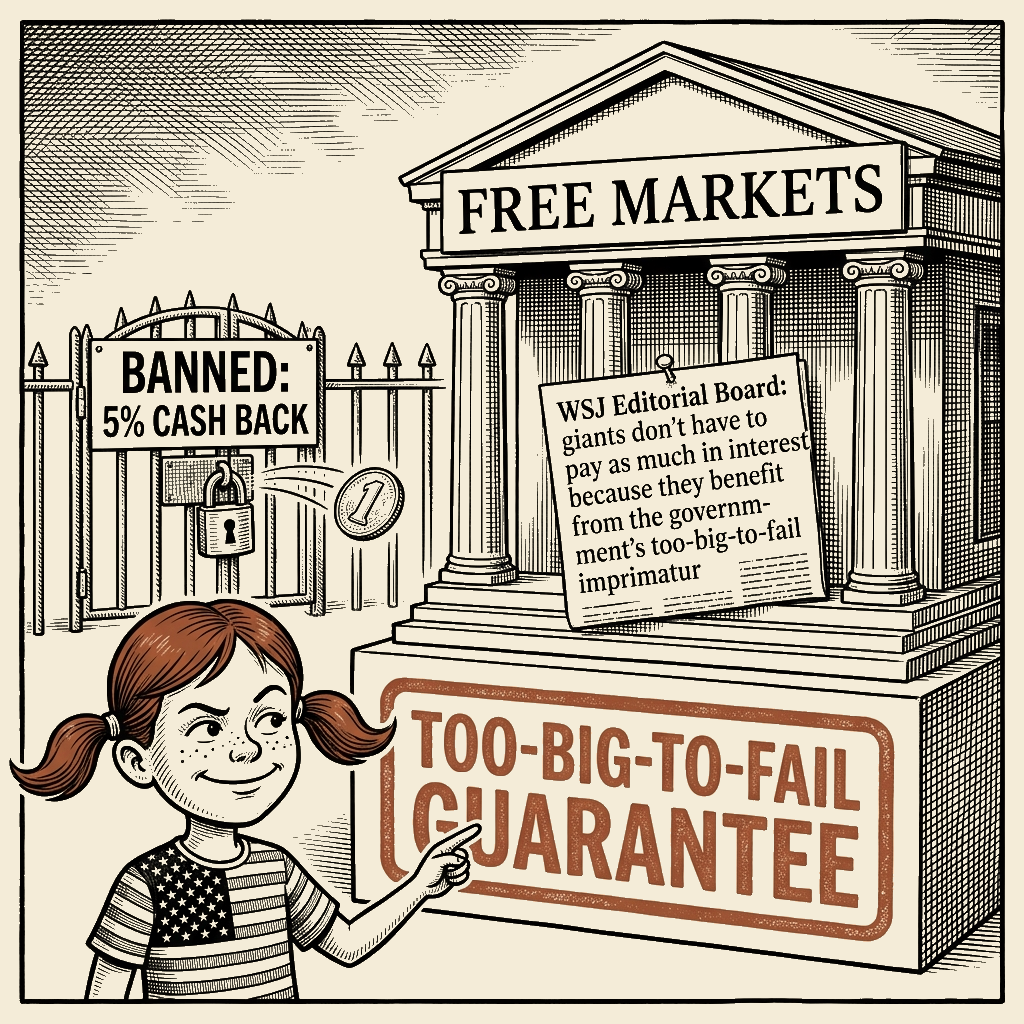
- The editorial hands over the smoking gun itself: Wall Street giants “don’t have to pay as much in interest because they benefit from the government’s too-big-to-fail imprimatur” — the board’s own words. The banks’ competitive advantage is a taxpayer-backed guarantee; the free market is the thing being protected from.
- The Clarity Act’s ban on “any form of interest or yield” is a state-enforced price control on the return of ordinary people’s own money — the same logic as Regulation Q (1933–2011), the Depression-era ban on banks paying depositors interest, which this same free-market page would have cheered in its day.
- The bailout lecture cuts backward: the rescue machine already ran for both sides — the government guaranteed uninsured deposits, Circle’s $3.3 billion included, when Silicon Valley Bank failed and the stablecoin broke to 87 cents; and FTX’s Sam Bankman-Fried went to prison for fraud and stolen customer funds, not for paying interest.
- The $40 million crypto super PAC donation the board waves at Moreno is small change next to the finance sector’s permanent lead in Washington — per OpenSecrets’ tallies, finance/insurance/real estate is routinely among the top-spending lobbying sectors in the country.
The Response Ladder
Polite Reframe
When to use: For the good-faith reader — the relative who read the editorial and nodded along, the community banker with a genuine worry, the friend who hears “crypto” and stops listening because the industry has burned so many people. You are not fighting the reader; you are handing them the half of the story the Board left on the cutting-room floor.
Start with someone I’ll call LaTonya. Her savings sit in the credit union her mother joined in 1982. She has never owned a stablecoin and never will. When she hears “crypto yield,” she hears “scam” — and she has earned that suspicion. The industry has torched enough ordinary people that no one should be asked to be naive about it. On FTX, the editorial is right: Sam Bankman-Fried ran a fraud, and calling it a fraud is not a favor to anyone. That part of the record stands.
Here is the part the editorial does not tell you. The giants it defends do not win LaTonya’s deposits by offering her a better rate. They win by borrowing on the government’s good name — the “too-big-to-fail” backing the Board itself names in its own column. When Silicon Valley Bank failed, the government guaranteed every uninsured deposit, including the $3.3 billion Circle had parked there. That is the state taking sides in the market, and the editorial calls it the natural order of things.
Ask the question the piece avoids. If a 10% yield is unsustainable, the market correction is to let it fail in the market — that is what a market is for. What is not a market correction is having the state decide, in advance, which institutions may compete for a dollar and which may not, then blessing the decision with a Jefferson quote. The Board says it speaks for free markets and free people. A free market is not a list of permitted competitors. It is a field with the state’s thumb off the scale — and a government that backs the biggest banks to the hilt while banning a newcomer’s 5% cash back has already picked its side. Martin Luther King, speaking in his last years, named the system this page runs defense for: socialism for the rich, rugged individualism for the poor.
So here is our side of the argument, stated plainly. We are the ones actually defending free markets — the kind where the guarantee is priced, the subsidy is disclosed, and the honest competitor is allowed to make an honest offer. If you care about your grandmother’s community bank, the answer is not to make her would-be competitor a crime. The answer is to make the giants pay for the guarantee that lets them steal her deposits at a price she cannot match. End the subsidy and everyone competes on the merits. That is the conservative position, properly kept: it conserves the market itself, not the balance sheet of the people who run it.
Mockery and Ridicule
When to use: For the bystander watching the kerfuffle — the reader who knows both industries are grifting but hasn’t noticed that one of them owns the referee. All the mockery goes up the power ladder, at the Board and the giants, never down at the reader.
Allow me to make sure I understand the free market as practiced by the Journal’s editorial page. The Giant borrows with an invisible government co-signer, pays you 0.01% on your savings, and when the co-signer is finally needed — Silicon Valley Bank, March 2023 — the government makes every uninsured depositor whole, including a crypto company’s $3.3 billion. That, the Board declares, is “free markets and free people.” The Newcomer offers 5% cash back on a stablecoin, and the Board declares a national emergency. The difference between the welfare recipient and the welfare aristocrat is that the aristocrat writes the editorial.
The Board scoffs at the airline-miles analogy because miles are earned by flying. Fair. But the giants’ deposits are earned by existing — the state’s guarantee does the earning for them. And here is the beautiful part: the Board printed the admission itself. “Wall Street giants don’t have to pay as much in interest because they benefit from the government’s too-big-to-fail imprimatur.” Read that sentence again, the way you’d read a letter from your bank. The state is already picking the winners of the deposit contest. Then these gentlemen mock Coinbase for calling it a “regulatory moat.” Gentlemen, a moat is a moat. You may call it an “imprimatur” if it makes you feel better about the taxpayers who dug it, but it is still a moat, and you are still on the inside of it.
The Board also concedes the bill carves out an escape hatch: 5% cash back to anyone who signs up for a loyalty program and keeps a dollar in the account. One dollar. One form. Five percent on a balance you can withdraw any time. The bill itself bans any return “economically or functionally equivalent” to interest on a bank deposit — and the Board’s own example is the textbook case. The hole in the bill isn’t the crypto lobby’s doing. It is the bill the Board is out here defending.
Senator Moreno’s crack that the Journal has descended into “a Wall Street special interest group superPAC” is the one true sentence in this entire exchange — coming, deliciously, from a senator whose 2024 victory was financed by a crypto super PAC’s $40 million, after which the PAC boasted, “Crypto’s big bet pays off.” Everybody in this story is bought. The only question is which buyer owns the ink.
To be clear about the one honest paragraph in the editorial: FTX was a felony in a business suit, and the crypto lobby’s whining does not change that. But there is a difference between a grifter at the casino table and a grifter at the board table. The board-table grifter has the regulator on the payroll and the op-ed page on the speed dial. The Journal is not opposing this bill because the bill is wrong. It is opposing it because the bill is one small step from making the giants compete like everybody else — and in the free market the masthead actually defends, that is the one thing that cannot be allowed to happen.
Nuclear Satire
When to use: For the reader who already knows the score and wants the full indictment stacked, receipt on receipt, with the mask off and the grotesque made visible.
Picture the church. The pews are polished brass, the altar is a consolidated balance sheet, and the congregation sings hymns to the credit rating. On the wall hangs the charter: “The Editorial Board speaks for free markets and free people, the principles, if you will, marked in the watershed year of 1776.” In the confessional sits Adam Smith. Nobody has been in to confess in two hundred years, because in this church, the bankers are the priests.
The gospel of this church, as preached last week: “The crypto industry and its friends in Washington portray themselves as defenders of free markets. What they really want is to be quasi-banks without abiding by the same regulations.” Now, brothers and sisters, let us compare the sin to the saint. The saint borrows on the sovereign’s signature. The saint pays depositors less than the price of a stamp. When the saint’s house of cards wobbled, the government performed a miracle: uninsured deposits rose from the dead, Circle’s $3.3 billion among them. And the Board calls that system the free market — while the digital competitor that offers five dollars back per hundred is declared a plague out of Revelation.
Stack the receipts, because they deserve their own liturgy. One: the TBTF sentence, straight from the pulpit — giants pay less because of the “government’s too-big-to-fail imprimatur.” Two: the Board concedes the giants “may even benefit from growth in stablecoin holdings” — the very growth it wants to ban, helping the very people it claims to police. Three: USDC broke its peg and fell to about 87 cents; the government guaranteed the deposits; the peg survived. Four: FTX — genuine fraud, genuinely named, and genuinely the only honest paragraph in the piece. Five: $40 million, one super PAC, one senator, one boast: “Crypto’s big bet pays off.”
Here is the tell buried in the sermon. The giants are not afraid of a 5% cash-back offer. Cassian Andor, in the series that bears his name, put it with more honesty than this editorial page: power doesn’t panic. Power pays. It pays for the super PAC, it pays for the commentary, it pays for the editorial that performs perfect free-market piety while executing perfect cartel discipline. And the grotesque truth is that the banking system and the crypto system are already the same patient, and the Board is a doctor pointing at a hangnail on a man the state just gave a full blood transfusion.
So let us name the inversion properly. You call crypto “quasi-banks.” But look at the giants: private when the bonuses are paid, public when the guarantee is needed, regulated like an industry, bailed like a religion. That is not a bank. That is a quasi-governmental enterprise with a private jet. The moat you defend is not “the free market.” The moat is the state’s signature on the giants’ debt — and the editorial page is the moat’s chaplain. We are the free-marketeers now. You are the ministry of moats. And the market you actually fear is the one where the state stops taking sides — because in that market, when the giants finally have to earn their deposits, the moat will look exactly like what it has always been: a welfare program with a wine list.
Profane Scorched-Earth
When to use: For the reader who has watched the same con for forty years and needs the release valve. Full catharsis now — receipts still in hand, gloves off, careful aim kept upward.
You want to know what a motherfucking stablecoin is? Wall Street. That’s the real stablecoin. It’s backed by the full faith, credit, and future tax revenue of the United States of America, it pays its custodians in bonuses, and when the underlying asset wobbles, the federal government steps in and makes everyone whole. Silicon Valley Bank went tits up in March 2023 and the government guaranteed every uninsured dollar — including Circle’s $3.3 billion — and the editorial page that now shits itself over 5% cash back called that what the fuck, exactly? I don’t recall the column headlined “Let the Big Banks Fail and Eat Their Own Risk.” I recall the column headlined “The Crypto Lobby Objects.” That’s what you write when the moat has to look like a principle.
Adam Smith — your boy, the one your masthead has been dragging out of the grave since 1776 — wrote that people of the same trade seldom meet together, even for merriment and diversion, but the conversation ends “in a conspiracy against the public.” He wasn’t writing about a bunch of exchange nerds with a yield bug. He was writing about you. The banking industry is the conspiracy the free market needs protection from, and the editorial page is its organ. You are not the defenders of free markets and free people. You are the defenders of a protection racket with a wine list, and the “free” in your masthead is doing the same work the word “free” does in “free-range”: it’s a marketing claim, not a description.
And do not hand me this small-bank shit. The Board says it’s shielding community banks from the crypto drain. Bullshit. Community bankers are the casualties of the same too-big-to-fail discount the giants enjoy; they are the ones getting their deposits stolen by a subsidy they can’t match. If the Board actually cared about the community bank in Selma, the fix would be to end the giants’ subsidy or make them pay for it — not to make a would-be competitor into a regulation violation. But you don’t fix the subsidy, do you? You ban the competition. That’s not conservatism. That’s a cartel with an editorial budget.
And the loyalty-program fig leaf? Sign up, keep a dollar, collect 5% — that’s a reward, not interest, because the bill says so? The bill’s own test bans returns “economically or functionally equivalent” to a bank deposit. A five-percent yield on a withdrawable balance is the definition of economically equivalent to a bank deposit. The exemption you flag is the hole you’re defending. Even your own editorial can’t tell the difference between a loyalty program and a savings account — because there isn’t one.
And spare me the dignity of your “ad hominem” complaint about Senator Moreno. You printed the receipt yourself: forty million dollars, crypto super PAC, “Crypto’s big bet pays off.” Everybody in this story is bought, including the senator, including the PAC, including — especially — the page that counts the angels on the head of a stablecoin while the giants borrow on the state’s name. The question was never whether someone is bought. The question is whose purchase order you are filling today.
Martin Luther King, in the last years of his life, named the operating system your page runs defense for: socialism for the rich, rugged individualism for the poor. Say it out loud and see if it doesn’t fit like a bespoke suit. When the giants fail, the state makes them whole — that’s socialism, and it’s beautiful, as long as it’s for them. When a newcomer offers a return, the state bans it on sight — that’s rugged individualism, and it’s brutal, as long as it’s for everybody else. Your entire economic religion is a well-pressed version of that sentence, and the only difference between you and the grifters you lecture is that your grift is lawful, insured, and written in the style of Thomas Jefferson.
Price the guarantee. End the goddamn subsidy. Let every unsustainable yield die in the open market where unstable things go to die. And when the giants finally have to compete for a deposit without the state’s co-signature, ask the Editorial Board how free their free market looks then. Don’t bother. You already know.

About Malcolm Little King
Malcolm Little King is a heteronym in Main Street Independent's editorial architecture — an analytical voice, not autobiography of any actual person. The position this column expresses is the publication's position on the territory Malcolm Little King's lane covers, rendered through Malcolm Little King's register.