Responding to: Democrats no longer have the No. 1 weapon to keep their socialist wing in line · 2026-08-10
What the Piece Argues
The piece’s primary talking point is stated plainly: “The plain truth, however, is that the Democrat Party has no control over the DSA and, more importantly, cannot stop it from claiming its members are ‘Democrats’ and redefining the Democrat Party.” It argues that the Democratic Socialists of America are reshaping the Democratic Party from within, with Zohran Mamdani’s New York mayoral victory as its leading example. The piece attributes the Democratic establishment’s loss of control to the rise of super PACs after Citizens United, which weakened the parties’ traditional power over fundraising, endorsements, and candidate selection. Its warning is that independent money now allows an ideological faction to bypass party gatekeepers and transform the party’s identity.
Receipts
The framing wants you to mistake the loss of a party establishment’s monopoly for the loss of democracy.
The framing wants you to believe
- The Democratic Party once controlled candidate selection through fundraising, endorsements, and campaign spending, but that power has largely disappeared.
- The DSA is an outside force hijacking the Democratic label and redefining the party against its will.
- Super PACs have made the formal party establishment powerless to stop candidates it dislikes.
What’s really going on
- Citizens United v. FEC removed restrictions on certain independent corporate and union spending and helped establish the legal environment in which super PACs operate. It did not give party officials a veto over who may run as a Democrat.
- Independent expenditures must remain legally uncoordinated with candidates, campaigns, and party committees. The mechanism expands outside spending; it does not turn party control into a constitutional entitlement. Anchor citation: Citizens United v. FEC, 558 U.S. 310 (2010); FEC guidance on independent expenditures.
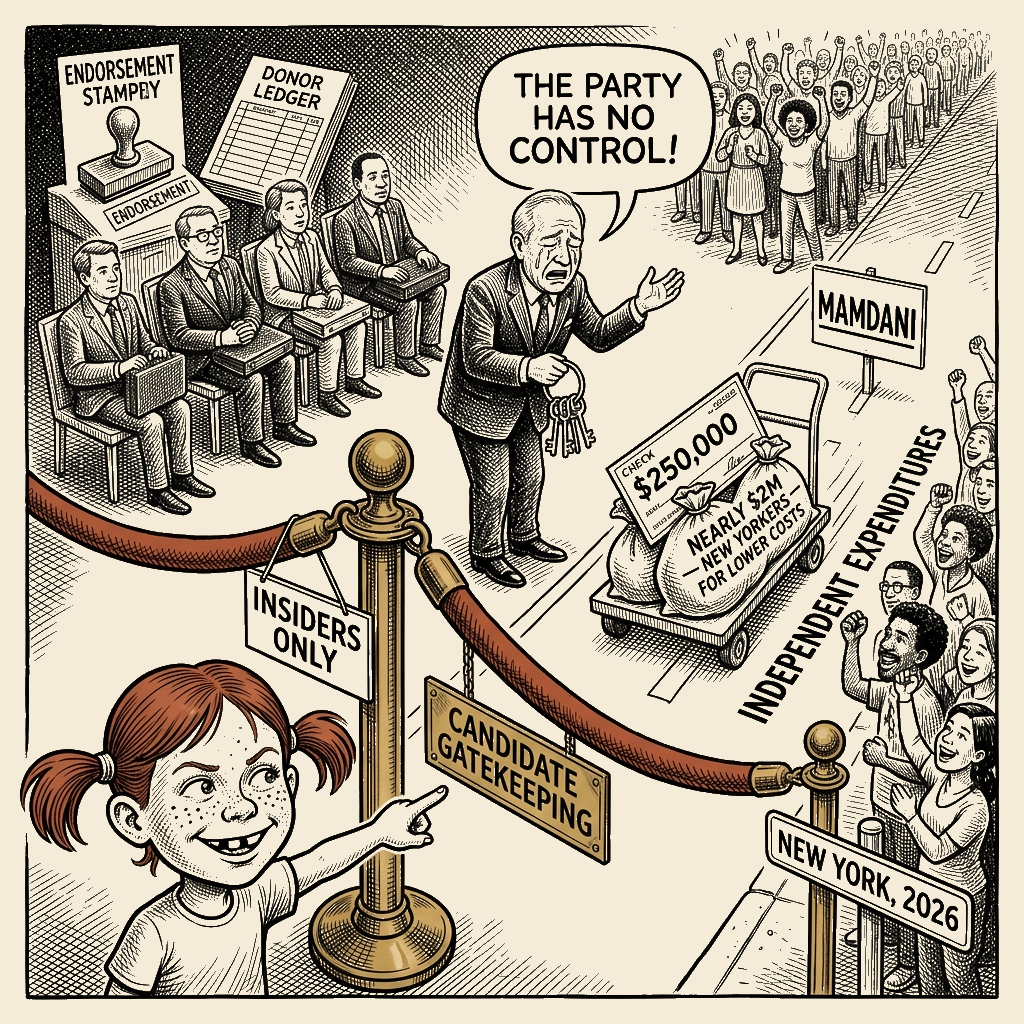
- The same article reports that Elizabeth Simons gave $250,000 to New Yorkers for Lower Costs, which reported nearly $2 million supporting Zohran Mamdani.
- The beneficiaries are wealthy donors, independent political committees, campaign consultants, and candidates capable of attracting a parallel funding network.
- The omitted fact is that the old gatekeeping system was itself concentrated power: party officials, major donors, consultants, endorsements, and institutional access deciding which candidates deserved a real chance.
- The complaint is not that money entered politics. The complaint is that money can now support candidates outside the preferred chain of command.
The Response Ladder
Polite Reframe
When to use: For a persuadable moderate or a good-faith conversation about parties, money, and candidate selection.
The source’s own sentence gives away the argument: “The plain truth, however, is that the Democrat Party has no control over the DSA.” But a party’s inability to veto candidates whom voters may support is not the same thing as voters losing control.
The legal and financial shift is real. Citizens United v. FEC removed restrictions on certain independent political spending and helped create the legal environment in which super PACs operate, while federal law still requires such spending to remain independent of candidates and campaigns. The article itself reports that Elizabeth Simons gave $250,000 to New Yorkers for Lower Costs, which reported nearly $2 million supporting Zohran Mamdani.
That receipt proves that concentrated wealth remains powerful. It does not prove that party officials deserve exclusive control over who may run under the Democratic label. The old system gave party organizations, donors, consultants, and institutional insiders enormous influence; the newer system lets some of that money move through independent groups instead.
The honest reform is not restoring one gatekeeper’s monopoly. It is confronting the money on every side: disclose the $250,000 checks, expose the nearly $2 million networks, and stop pretending that party control is the same thing as public control.
Mockery and Ridicule
When to use: For a public reply that exposes the contradiction to bystanders without mocking ordinary voters.
The old party machine is standing outside the voting booth, clutching its clipboard, shouting, “You cannot call yourself a Democrat unless I approve your paperwork.”
Then the super PAC walks in carrying a $250,000 check.
The argument says the Democratic Party is powerless because an independent group reportedly spent nearly $2 million supporting Zohran Mamdani. That is a strange definition of powerlessness. The party machine is not powerless because voters can choose a candidate it dislikes. It is powerless because wealthy donors and consultants can build a parallel political highway around it.
Citizens United v. FEC did not create a constitutional right for party officials to quarantine inconvenient candidates. It helped protect independent political spending, subject to the rule that it cannot coordinate with the candidate. The result is not “socialism” defeating democracy. It is plutocracy renting a second building next door.
And here is the part the argument drops behind the curtain: the same money system it condemns when an insurgent benefits from it becomes acceptable when it serves the establishment. The article’s own receipt — Elizabeth Simons’s $250,000 contribution to a pro-Mamdani group — shows the issue clearly.
The complaint is not that money rules politics. The complaint is that the wrong people are getting to use the money.
Nuclear Satire
When to use: For a sharp public takedown when the argument’s contradiction is too large for ordinary prose to carry.
The party establishment wants you to believe it is a helpless little orphan, wandering through the rain while the Democratic Socialists of America seize the mansion.
Please.
The argument says party officials once controlled candidate selection through fundraising, endorsements, and expenditures. Then Citizens United v. FEC removed restrictions on certain independent political spending and helped establish the legal environment in which super PACs operate. The source reports a $250,000 contribution from Elizabeth Simons and nearly $2 million spent by New Yorkers for Lower Costs in support of Mamdani.
That is not the death of power. That is power changing hands, changing addresses, and hiring a new accountant.
The old machine wants the public to mourn the loss of its monopoly while ignoring who owns the replacement machinery. The donor with the check is still there. The consultant is still there. The independent group is still there. The only missing character is the party boss who used to believe every dollar had to pass through his own pocket before it could become political speech.
This is the con: call an insurgent candidate an invader, call voters’ support a hostile takeover, and avoid asking why billionaires can spend millions building the political world in the first place. The public gets a morality play about “socialists.” The concentrated donor gets the receipt. The consultant gets the contract. The gatekeeper gets to pose as the victim.
The money did not disappear. The nearly $2 million did not disappear. The $250,000 check did not disappear. The old party monopoly simply discovered that concentrated power can operate without asking the old landlord for a key.
Profane Scorched-Earth
When to use: For the reader who has watched donor money, consultant power, and party gatekeeping get renamed “democratic stability” and needs the whole con answered without anesthesia.
“The Democrat Party has no control over the DSA” is not a defense of democracy. It is a fucking confession.
The source says the old parties once controlled candidates through fundraising, endorsements, and spending. Then Citizens United v. FEC (2010) and SpeechNow.org v. FEC (2010) helped expand independent political spending beyond formal party control. Fine. That is a real legal and institutional change. But the piece does not expose the rule; it mourns the loss of the people who used to hold the fucking keys.
For years, party organizations and their consultant class treated candidate selection like a velvet-rope nightclub: donors at the door, insiders on the list, voters waiting outside while somebody explained that democracy was complicated. Now an independent group helps a candidate the establishment dislikes, and suddenly the same money system becomes an existential threat. When the money serves the old machine, it is governance. When it escapes the old machine, it is socialist subversion. That is not principle. That is political property law written by people who think the property belongs to them.
The source reports a $250,000 contribution and nearly $2 million for a pro-Mamdani group. Outside reporting supports the contribution; the larger total remains unverified in the evidence available here. The claim that Mamdani could not have won without the money is not analysis. It is a fucking hunch with a necktie.
And the voter is not the enemy. The voter who wants a candidate outside the consultant-approved corridor is not stupid, treasonous, or captured. The voter is being told that the only legitimate reform is one that leaves the old power arrangement untouched. The real enemy is the structure that makes every public choice pass through private money—whether that money flows through a party committee, a super PAC, a billionaire family, or a consultant who calls himself neutral while billing the machine.
The honest indictment is larger than the source’s preferred target: concentrated money has too much power, and party insiders have too much power over who gets to compete. If you want democracy, break both monopolies. If you want only the first monopoly restored, say so plainly. Stop calling the fucking cage “stability.”

About Malcolm Little King
Malcolm Little King is a heteronym in Main Street Independent's editorial architecture — an analytical voice, not autobiography of any actual person. The position this column expresses is the publication's position on the territory Malcolm Little King's lane covers, rendered through Malcolm Little King's register.