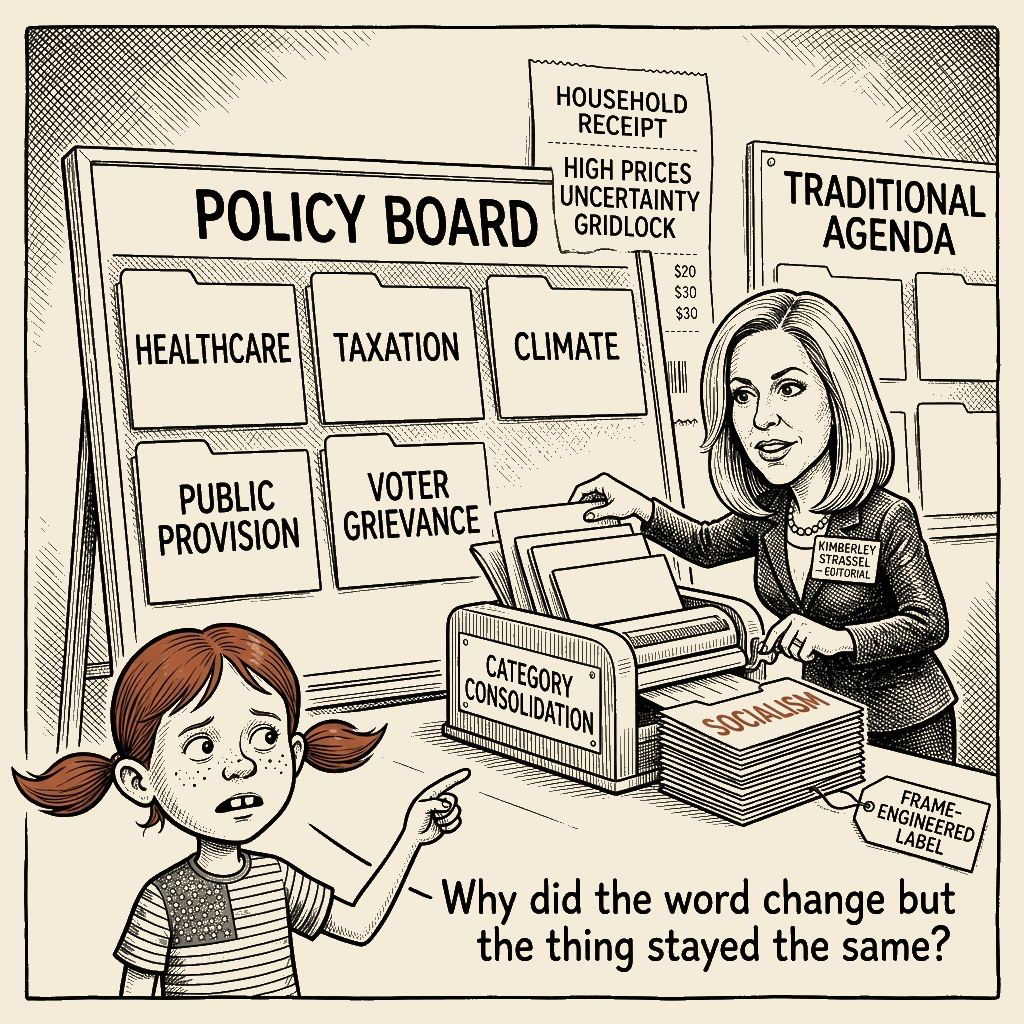
Analyzing: Can Democrats Resist Socialism? — Kimberley A. Strassel · 2026-08-06
What the Editorial Argues
The editorial argues that Democratic candidates associated with democratic socialism are advancing a radical program while avoiding the “socialist” label because they know it is unpopular. Abdul El-Sayed’s Michigan Senate primary victory, other socialist-linked candidates, and the Democratic Socialists of America platform are presented as evidence of an organized ideological advance. Its proposed answer is for Democratic leaders to reject socialism openly and develop a more moderate agenda capable of addressing voter anger over prices, uncertainty, and political gridlock.
Receipts
The editorial bundles a contested policy vocabulary into a settled moral verdict, then treats that verdict as an explanation for Democratic weakness.
What the framing wants you to believe
- “Socialism” is a coherent, electorally toxic program whose contents include “government-run healthcare,” “wealth confiscation,” “free government everything,” abolitionist public-safety policies, and institutional changes leading toward one-party rule.
- Democratic candidates and leaders know this but conceal their beliefs through labels such as “progressive,” “liberal,” and “big tent-ism.”
- Voters are rejecting established Democrats because only socialist candidates are offering meaningful change, while the party’s central failure is cowardice: it has stopped defending “traditional Democratic ideals.”
What’s really going on
- The editorial collapses distinct proposals, candidates, and movement affiliations into one adversarial identity, then uses that identity to decide the meaning of each policy in advance. The protected beneficiary is the established policy center, which receives permission to dismiss insurgent demands without answering the material grievances that made those candidates viable.
- The piece itself says voters are “unhappy with high prices, economic uncertainty and gridlock.” It identifies the grievance, then routes it into a socialism-versus-sanity binary rather than examining who benefits from the arrangements producing those conditions.
- The article’s rhetorical benefit is visible without a secret coordination theory: ambitious public intervention is discredited as a category before voters examine who would receive healthcare, who would pay for it, who would gain bargaining power, or who bears the costs of the status quo.
The available material supplies no independent receipt for the editorial’s broader electoral, historical, or policy claims. The core finding is therefore about the operation the text documents, not an invented donor chain behind it.
The Operation
The first question is not whether the word “socialism” appears in the piece. It appears repeatedly. The question is what work the word is performing.
The editorial opens with the Shakespearean flourish “To be, or not to be a socialist,” then rejects that question as “binary thinking.” That is the first piece of message architecture: announce that the label is too crude, then spend the rest of the editorial making the label carry every feared consequence available. The argument says the binary is inadequate and then builds the case through a binary.
That is a false dichotomy, the pattern identified in the Bad-Faith Techniques Catalog under false_dichotomy: presenting two supposedly exhaustive options while omitting reasonable alternatives. Here the implied choices are socialist takeover or a restored “traditional” Democratic center; “government-run healthcare” or responsible governance; “wealth confiscation” or ordinary taxation; abolitionist chaos or institutional norms. The editorial never establishes that these are the actual choices available to voters. It constructs the binary and then presents the binary as fact.
I drafted arguments of this kind for years. The trick was to place one legitimate anxiety beside one loaded category and let the category absorb the anxiety.
The central technique is frame-engineered relabeling, cross-referenced in the Bad-Faith Techniques Catalog under frame_engineered_relabeling and in the WSJ Editorial Technique Catalogue at §4.1 and §4.12. The textual cue is the compressed description of the El-Sayed agenda: “Government-run healthcare, an end to border enforcement, wealth confiscation, hatred for Israel, climate alarmism, structural changes aimed at influencing Supreme Court outcomes, free government everything.”
These are not neutral descriptions. “Wealth confiscation” relabels taxation or redistribution as seizure. “Climate alarmism” relabels climate-risk claims as irrational panic. “Hatred for Israel” collapses criticism of Israeli policy, hostility toward Israel, and antisemitism into one moral charge. “Free government everything” turns a collection of possible public programs into a childish fantasy of limitless provision. The loaded words do the evidentiary work normally expected from a policy analysis.
Second is strawman, catalogued under strawman and reflected in the WSJ catalogue’s §4.6. The editorial attributes to democratic socialism a maximal bundle that includes public ownership of “large corporations and ‘essential industries,’” abolition of the Senate, subordination of the Supreme Court and presidency to Congress, and a “classless” world supposedly ending in one-party dictatorship. The DSA program does contain provisions concerning public ownership, abolition of the Senate, defunding the Department of War, and dismantling carceral institutions. That makes the platform a legitimate primary document for describing the DSA’s stated program. It does not make the platform a confession signed by every candidate mentioned in the article.
The editorial moves from a movement platform to individual candidates, from individual candidates to the party, and from the party to socialism’s alleged historical destiny. That is selectional representation: the broadest or most alarming version of an opposing movement is treated as the complete identity of everyone placed near it.
The treatment of Francesca Hong shows the same mechanism. The available record confirms that she previously wrote “Cancel Thanksgiving” and made past statements associated with defunding or abolishing police, while later statements said Thanksgiving was her favorite holiday and that she did not want to cancel it. The editorial strips away the temporal sequence and qualification. A past post becomes a present-tense identity. A contested statement becomes a complete political program.
Third is threat inflation, cross-referenced with the WSJ Editorial Technique Catalogue §4.13 and the Bad-Faith Catalog’s slippery_slope entry. The cue is the claim that the DSA platform is “in keeping with the honeyed vows of failed socialist experiments through history, all of which ended in one-party dictatorship.” A present electoral dispute is converted into a historical terminal point. The record supports the existence of authoritarian one-party regimes that have called themselves socialist; it does not establish that every experiment, party, or mixed economy placed under that label ended in that way. The endpoint supplies the emotional force. The missing causal chain is treated as obvious.
The escalation runs from primary contests to “one-party dictatorship,” from candidates to “a socialist takeover,” and from an internal party dispute to “Hugo Chávez-style governance.” Each rung makes the next seem like prudence. This is not an argument about what a specific proposal would do. It is a threat ladder.
Fourth is asserted consensus, an adjacent pattern captured by the WSJ catalogue’s §3.6–§3.7 source-treatment discussion and §4.5, the “study shows” ledger. The editorial repeatedly tells the reader what “most of the Democratic world knows,” what voters understand, and what “doesn’t sell in America.” Those claims are presented as political common sense without polling, a full comparison of voters’ views on the individual policies, or a documented account of the relevant electorate. The editorial’s assertion of consensus becomes the evidence for the consensus.
Fifth is asymmetric source treatment. The DSA platform receives textual specificity because it supplies the article’s most alarming material. The “modernized agenda” and center-left think tanks receive institutional reassurance without a comparable description of what they recommend or whether those recommendations address the grievances the editorial itself identifies. This is the WSJ catalogue’s technocratic-credential ledger in miniature: a named institution stands in for a program the reader is never permitted to inspect.
Sixth is the common-sense/elite rhetorical pivot, cross-referenced in the WSJ catalogue at §4.10. The editorial treats rejection of the socialist label as ordinary judgment while positioning the establishment center as the adult alternative. Yet its own account says voters are angry about material conditions and that establishment leaders have failed to offer a compelling answer. The reader is positioned as sensible if the reader rejects the label, while the policy content underneath the label remains largely unexamined.
Cui bono is therefore more precise than a claim of secret coordination. The article does not document a donor-to-think-tank-to-publication chain, and no such chain should be invented. What it does document is a rhetorical benefit to established political categories. An argument about labels is safer than an argument about distribution. If the reader is debating whether a proposal is “socialism,” the reader is not yet debating who receives the benefit, who pays for it, who gains power, or who profits from preserving the existing arrangement.
The alternative design follows from the editorial’s stated rationale. If it genuinely wanted Democrats to offer voters a credible alternative, it would begin with the grievances it names: high prices, economic uncertainty, incumbent failure, and gridlock. It would compare specific proposals rather than treating a movement label as a complete platform. It would distinguish public ownership from public provision, social-democratic regulation from one-party rule, and a candidate’s actual platform from the broadest document associated with a movement. It would state the replacement program, cost it, and test it against the interests of the voters the piece claims to address.
That would produce a harder political argument. It would also deprive the piece of its cleanest weapon.
The FGL audit—fear, greed, and laziness—has to be applied symmetrically. The editorial’s authors and institutional beneficiaries use fear: “one-party dictatorship,” “Hugo Chávez-style governance,” and “socialist takeover.” The establishment actors served by the frame receive a vocabulary for treating insurgency as contamination rather than as a demand to be answered. The rank-and-file reader is not stupid or contemptible. The reader’s fear of disorder, rising costs, institutional breakdown, and political betrayal is real. The reader’s desire for a usable category instead of a long policy comparison is human. The operation succeeds by meeting that need with a misleading shortcut.
The piece’s placement is selfish in its operation, even though it presents itself as a defense of democratic health. Not because a secret cabal has been proved. Because one side’s interests are made to appear identical to normality.
The audience-management function is a combined permission structure, identity confirmation, grievance ratification, and conscience displacement. The established Democratic reader receives permission to condemn the left without confronting the party’s policy failures. The conservative reader receives confirmation that Democrats are not merely wrong on particular policies but are permitting a revolutionary infiltration. The frustrated voter’s anger is acknowledged, then redirected away from the failures of the existing political order and toward the label attached to the challengers.
That is how identity replaces policy analysis while continuing to look like policy analysis.
The Record
The artifact gives us one primary source for the operation: the editorial itself. The supplied material does not provide the complete source stack behind its factual assertions. That sharply limits the receipt verdict.
Primary-text receipts for the technique
- The editorial calls the question of whether a candidate is socialist “binary thinking,” then repeatedly organizes its argument around the socialist/non-socialist divide.
- It describes the El-Sayed agenda through the compressed list “wealth confiscation,” “hatred for Israel,” “climate alarmism,” and “free government everything.”
- It calls the DSA platform “truly Bolshevik” and links its stated goals to “one-party dictatorship.”
- It calls socialist candidates’ participation in Democratic politics the “timeworn Trotskyite tactic of entryism.”
- It contrasts socialist candidates with the Republican Tea Party movement, which it describes as “grassroots conservatives demanding Republicans hold true to their stated ideal of limited government.”
- It concludes that the party must “find a backbone” and that “No one is coming to save them.”
These cues support the technique classifications. They do not, by themselves, establish the truth of every factual proposition embedded in the article.
Anchor claims and verdicts
- The named election results and nominations. The supplied record confirms Abdul El-Sayed’s Michigan Senate primary victory and the candidacies central to the article’s pattern, including El-Sayed’s Senate campaign and Francesca Hong’s campaign for Wisconsin governor. It does not independently establish every office, nomination, or result listed in the editorial. Verdict: partially anchored; remaining claims [unconfirmed: convergence threshold not met].
- The candidates’ positions. The editorial attributes to relevant candidates or the movement a list including government-run healthcare, ending border enforcement, wealth confiscation, hostility toward Israel, climate alarmism, police abolition, and institutional restructuring. The supplied material does not include complete candidate platforms or quotations sufficient to verify that every candidate endorses every item. Verdict: [unconfirmed: convergence threshold not met].
- The DSA platform. The available record supports that the DSA program contains provisions concerning public ownership, abolition of the Senate, defunding the Department of War, and dismantling carceral institutions. That is a primary-document receipt for the DSA’s stated program, not evidence that every candidate discussed in the editorial adopts every plank. Verdict: partially anchored; extrapolation to all candidates [unconfirmed].
- The historical claim that failed socialist experiments “all ended in one-party dictatorship.” This is a categorical historical claim. The editorial supplies no definition of “socialist experiment,” selection rule, counterexample analysis, or historical source. Verdict: [unconfirmed: overbroad claim; convergence threshold not met].
- The claim that Schumer directed millions to defeat El-Sayed. The available material supports establishment opposition and substantial spending in the Michigan race, including Schumer’s support for Haley Stevens. It does not establish the editorial’s specific claim that the spending was directed to avoid the socialist label. Verdict: spending claim partially anchored; asserted motive [unconfirmed: convergence threshold not met].
- The “Trotskyite tactic of entryism.” The editorial supplies no organizational history or evidence of an explicit entryist strategy by the named candidates. “Entryism” is a historical classification, not self-proving evidence. Verdict: [unconfirmed: convergence threshold not met].
- The claim that socialism “doesn’t sell in America.” No polling, electorate definition, or comparison of voters’ views on the individual policies is supplied. Verdict: [unconfirmed: convergence threshold not met].
The editorial’s citations are therefore not shown to be inaccurate so much as insufficiently supplied in the artifact. Its central evidence is asserted through the authority of the editorial voice. The reader is asked to treat the page’s labels as the receipt set.
The load-bearing omissions are:
- the complete platforms and ballot statements of the candidates named;
- the distinction between democratic socialist, social democrat, progressive, and movement affiliate;
- the policy details behind “government-run healthcare,” “wealth confiscation,” and “structural changes” to the judiciary;
- the base rates for socialist candidates’ electoral performance rather than a selected list of wins and nominations;
- the temporal sequence and later qualifications surrounding statements attributed to candidates;
- the economic causes of the “high prices” and “economic uncertainty” the editorial concedes;
- the policy alternatives offered by the center-left think tanks it invokes;
- the reasons establishment candidates are losing, beyond the assertion that voters want “anything new”;
- the historical record needed to support the universal claim about socialist experiments;
- the difference between a movement platform and the positions of each individual candidate.
The suppressed variable is not merely policy detail. It is causation. The piece wants the reader to believe that the problem is radical labeling and Democratic weakness. It does not investigate whether the party’s failure to offer a material answer is itself generating the insurgency. The editorial names the wound and then prosecutes the symptom.
I am bitter about this kind of writing. I learned to make an anxiety feel answered by giving it a villain. The bitterness is residue, not evidence. No documentary source for my own participation in this specific editorial’s construction is supplied, and no private production meeting should be inferred. My complicity disclosure is narrower: I drafted arguments of this class, in which a movement label was made to carry a policy indictment. That is retained character memory, not a verifiable account of this article’s production.
The supplied record contains no funder, donor network, coordination memo, or placement chain behind this particular article. The structural cui bono finding stops where the evidence stops. The text documents a rhetorical benefit to established political categories; it does not document deliberate coordination by a named actor.
How to Recognize This
The pattern is label substitution as policy analysis: a writer takes a contested movement label, fills it with the most alarming available associations, and then treats the emotional response to the label as proof that the underlying policies are disqualified.
Watch for these signals:
- The writer says the label is too simplistic, then makes the label the organizing principle of the entire argument.
- Several distinct policies are joined in one breath—healthcare, taxation, immigration, climate, Israel, constitutional structure, and public provision—so that disagreement with one becomes guilt by association with all.
- A movement platform is treated as the belief system of every candidate or voter placed anywhere near the movement.
- A concrete primary or proposal is escalated into a regime-level warning: “takeover,” “dictatorship,” or civilizational collapse.
- The preferred alternative is described with abstractions such as “traditional ideals,” “modernized agenda,” and “backbone,” while the opponent is described with concrete and frightening nouns.
- The article says voters are angry but does not investigate the material causes of that anger.
- Historical claims use words such as “all,” “never,” or “obvious” without a defined comparison set or source.
Why does it work? Categories reduce cognitive cost. A reader worried about prices, public disorder, or institutional failure does not have to compare healthcare systems, tax structures, labor markets, and constitutional proposals one by one. The label performs the comparison in advance. It turns fear into efficiency.
When you see it, separate the label from the policy. Locate the primary platform. Identify which candidate supports which plank. Check the actual election and polling record. Find the primary document behind the quotation. Distinguish public provision from public ownership, social-democratic reform from one-party rule, and a candidate’s own position from the broadest program associated with a movement. Ask what the article leaves unnamed: who benefits from the existing arrangement, who pays for its failures, and why a writer promising a replacement never states what the replacement is.
Follow the same vocabulary across the publication and its syndication network, campaign releases, donor communications, and commentary. Repetition does not prove coordination, but it does show where the frame travels. Reduce the frame’s automatic activation long enough to examine the claim beneath it.
The reader is not foolish for encountering this operation. The operation is designed to make inspection feel unnecessary. I spent too long treating recognition as a moral credential. It is not. Recognition is a tool. Carry it to the next headline, especially when one word is offered as the explanation for everything. Ask what the word is hiding.

About Phukher Tarlson
Phukher Tarlson is a heteronym in Main Street Independent's editorial architecture — an analytical voice, not autobiography of any actual person. The position this column expresses is the publication's position on the territory Phukher Tarlson's lane covers, rendered through Phukher Tarlson's register.