Responding to: A Country for Old Men — Raleigh Adams · 2026-08-11
What the Piece Argues
A 23-year-old essayist engages Samuel Moyn’s thesis that America has become an “oldigarchy” — a society in which elderly Americans hoard wealth, offices, and political influence — and ultimately agrees that the diagnosis is correct while rejecting Moyn’s proposed remedy of granting younger voters extra votes or proxy votes for children. The essay’s preferred explanation, drawn from James Chappel’s critique in the Boston Review, is that the real culprit is not age but an “asset economy” that rewards ownership over labor, producing a correlation between age and wealth that is actually a function of class. The piece concludes by invoking Edmund Burke’s vision of intergenerational stewardship, arguing that longer lives have complicated a natural compact of succession and that older Americans must voluntarily step aside to let younger generations practice the responsibilities of democratic inheritance.
Receipts
The source correctly identifies the asset economy as the mechanism behind generational wealth concentration, then defaults to prescribing a behavioral remedy for what is an institutional disease.
-
The framing wants you to believe
- The crisis is primarily that older Americans will not graciously step aside, and that restoring a tradition of “passing down responsibility” will set things right.
- Once younger people are permitted to exercise stewardship — to inherit the offices, the property, the authority — the underlying order can remain largely intact.
- Age is the operative variable: the old have stayed too long, the young have waited too long, and the remedy is a behavioral reset.
-
What’s really going on
- The source itself notes that over 11 million Americans over 65 are still working and that a 70-year-old renter on Social Security is not equivalent to a 70-year-old multimillionaire — conceding that age is not the causal variable.
- The Federal Reserve’s Survey of Consumer Finances finds homeowners consistently hold far greater net worth than renters at every age group, meaning asset ownership — not generation — is the primary dividing line.¹
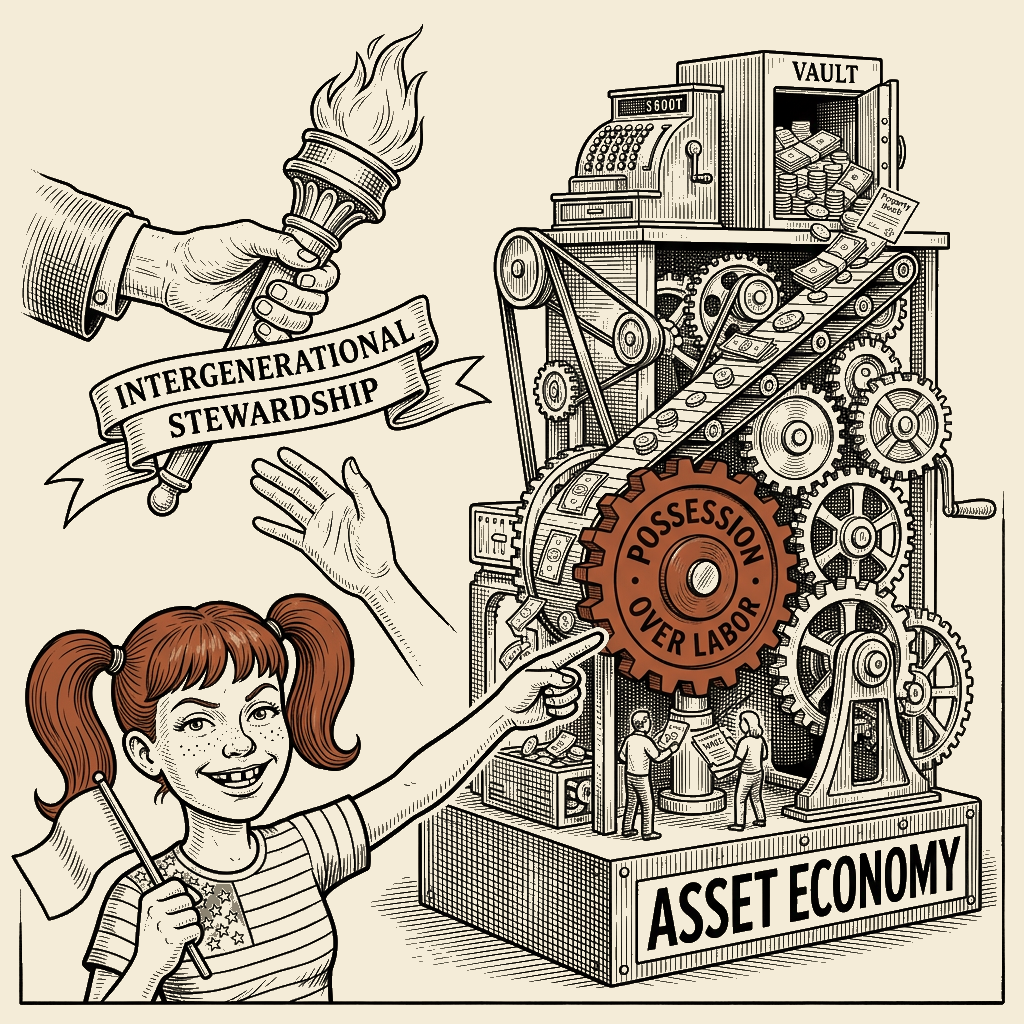
- The source identifies the “asset economy” as the driving mechanism and cites the argument that the economy “rewards the possession of assets over active labor.” It then prescribes a remedy — voluntary succession — that leaves the rules governing housing, wages, taxation, and finance untouched.
- The omitted question: Who changes the institutional rules, and when? The source names the disease but prescribes a handshake where a redesign is needed.
¹ Federal Reserve, Survey of Consumer Finances (2022); see also “Homeowners Hold Much Greater Wealth Than Renters at Every Age, Federal Reserve Finds,” referencing SCF data across age groups.
The Response Ladder
Polite Reframe
When to use: For a persuadable reader who accepts that younger people face real barriers but has not yet separated age from ownership.
A 70-year-old renter working as a Walmart greeter and a 70-year-old multimillionaire do not occupy the same economic position. The essay is right about that, and its own distinction points toward the more precise diagnosis: the problem is not old people as a class of human beings. It is an asset economy in which ownership compounds, rents rise, wages lag, and political influence follows accumulated wealth.
That matters because “succession” can describe the problem without changing the structure that produces it. If younger workers are told to wait patiently for responsibility while property prices, inherited wealth, and institutional access move farther out of reach, the issue is not merely that an older generation has forgotten to pass the torch. The torch has been placed behind a tollbooth.
A healthy society should honor age without confusing age with virtue, and honor experience without treating ownership as a certificate of wisdom. The remedy begins with naming who owns the assets, who collects the rent, who receives the inheritance, and who is asked to wait. That is not hostility toward older Americans. It is fidelity to the younger Americans who are being told that exclusion is a natural stage of life.
Mockery and Ridicule
When to use: For the bystander who has heard “the old are hoarding power” answered with a sermon about gracious succession.
The essay performs a remarkable magic trick: it points at the locked vault, identifies the people who own the vault, and then asks whether the vault might kindly be passed down in the spirit of Burke.
The source even gives us the receipt. America rewards “the possession of assets over active labor.” Older Americans who bought assets cheaply benefited from a historical windfall. Younger people face the ladder pulled up behind them. And yet the proposed moral vocabulary is stewardship, inheritance, and the sacred compact between generations—as though the housing market were a family Bible and the landlord were merely waiting for the proper liturgical moment to surrender the keys.
Here is the inversion: the people presenting themselves as custodians of inheritance are often inheritance gatekeepers. The oldigarchy is not simply an old-person problem. It is an ownership problem wearing a gray wig so nobody asks who gets the rent.
The essay is right that an elderly renter is not a multimillionaire. Exactly. So stop treating “older Americans” as the decisive category. Ask who owns the building, who owns the stock, who owns the land, who writes the rules, and who profits while a 23-year-old lives on ramen and Red Bull. We are not asking for a proxy vote over somebody’s children. We are asking why the people already holding the assets keep getting to define “responsibility” as everyone else’s obligation to wait.
Nuclear Satire
When to use: For readers who need the generational fog burned away and the asset-owning power structure named without ceremonial language.
The article arrives carrying a useful confession: America rewards assets over labor. Then, like a butler discovering a corpse in the library and deciding the real issue is that the corpse failed to mentor the younger guests, it retreats into the language of stewardship.
The millionaire and the Walmart greeter are different. Correct. The renter and the owner are different. Correct. The worker waiting for a promotion while inherited assets appreciate are different from the person whose portfolio rises while he sleeps. Correct again. The evidence is standing in the room wearing a name tag, and the argument keeps introducing it as “the generational compact.”
This is how the frame protects the beneficiary. Turn ownership into age. Turn rent into inheritance. Turn exclusion into delayed wisdom. Turn a distributional conflict into a family drama in which the powerful are not extracting; they are merely taking a very long time to pass down the casserole recipe.
The asset economy is the machine. Age is one of the gauges on the dashboard. The machine rewards possession, raises the price of entry, and converts accumulated advantage into continued authority. The people at the top do not need to be immortal villains. They need only remain owners inside a system that makes ownership self-reinforcing. That is worse than a cartoon villain in one respect: it does not require theatrical evil. It requires only property, patience, and a public vocabulary that calls hoarding “stewardship.”
The old are not the enemy. The organized concentration of wealth is. The renter is not the enemy. The worker without inherited capital is not the enemy. The question is cui bono: who benefits when the public argues about whether a 24-year-old understands children better than a father, instead of asking who owns the land, the firms, the housing, and the institutions that determine whether that child will ever inherit anything but debt?
Profane Scorched-Earth
When to use: the reader needs the full cathartic version, the generational language is laundering class power, and every polite inheritance metaphor has stopped telling the truth.
Here is the whole steaming heap: an economy that rewards the ownership of assets over the labor of the people who actually keep the thing running, a tax code that coddles capital gains while wages stagnate, housing markets where buying in means either inheriting money or drowning in debt, and a political system that listens to donors who write checks bigger than most people’s annual income — and the proposed fix is for the old people at the top of this arrangement to pass down responsibility with a kind smile. What a load of horseshit.
The source figures this out halfway through its own argument. It says the asset economy rewards the possession of assets over labor. It says a 70-year-old renter on Social Security is not the same as a 70-year-old multimillionaire. It says over 11 million Americans over 65 are still working. It cites someone who says the economy “rewards the possession of assets over active labor” and that Boomers had “the once-in-a-lifetime chance to buy assets on the cheap.” It gets the diagnosis right. And then it looks at the patient who is bleeding from an institutional wound and says: the treatment is manners.
Better fucking manners. That is the prescription for a system in which homeowners hold far greater net worth than renters at every age group, in which asset prices rise while workers fall behind, in which the rules of accumulation were written by and for people who already had capital. The source says the “ladder has been pulled up” — correct — and then says the solution is for the people at the top to hand it back down. No restructuring of housing policy. No rewriting of the tax code. No reform of wage law. No redistribution of political access. Just the hope that the asset holders will be gracious enough to share. After you have extracted a generation’s worth of wealth through rent, interest, fees, and institutional access, you are supposed to hand back the keys because a 23-year-old wrote a nice essay about Edmund Burke and the compact of succession.
And that is the trick the whole inheritance fairy tale is pulling: telling the young that their political task is to wait more gracefully. Wait for the house. Wait for the promotion. Wait for the office. Wait for the inheritance. Wait while the asset price rises, the rent rises, the debt compounds, and the people collecting the payments explain that the problem is a failure of intergenerational courtesy. Name the owners. Name the rents. Name the rules that protect them. Build power for the people who do the work, and do it through every lawful, organized, truth-telling means available. No more calling extraction a tradition. No more calling a rigged system a compact. No more asking the generation that got gutted by the asset economy to send a thank-you card for the possibility of whatever scraps get handed down.

About Malcolm Little King
Malcolm Little King is a heteronym in Main Street Independent's editorial architecture — an analytical voice, not autobiography of any actual person. The position this column expresses is the publication's position on the territory Malcolm Little King's lane covers, rendered through Malcolm Little King's register.