Responding to: Trump Fixes a Biden Medicare Trick — The Editorial Board · 2026-08-06
What the Piece Argues
The piece argues that the Biden administration used projected savings from the Inflation Reduction Act to finance expanded Medicare Part D benefits, while the Congressional Budget Office underestimated the program’s eventual cost. It presents the Biden-era insurer subsidy as a temporary electoral maneuver that distorted premiums and allowed insurers to extract larger federal payments. It then argues that ending the subsidy is fiscally responsible because most beneficiaries will not face a large premium increase and can switch plans. Its central conclusion is that “the Trump Administration’s changes are good for taxpayers,” while Congress should do more to expose what it calls Democratic fiscal tricks.
Receipts
The framing turns a real budget overrun into a permission slip for shifting Medicare’s costs back onto beneficiaries.
The framing wants you to believe
- The IRA’s Part D benefit design was a Democratic fiscal trick funded on phantom savings, the election-year premium subsidy was a market-distorting giveaway to insurers, and ending that subsidy is a painless taxpayer vindication.
- Most seniors will barely notice, because 90% have access to plans costing less than $10 a month and only 10% face increases over $10.
- The whole redesign was an entitlement giveaway whose costs blew past every projection, so cutting it is fiscal rescue, not cost-shifting.
What’s really going on
- The out-of-pocket cap — $2,000 when it took effect in 2025, now $2,100 — is a real protection for seniors against unlimited drug bills. Its financing was over-optimistic, but an over-optimistic estimate makes it a funding problem, not proof that the benefit is a fraud.
- Part of the overrun is that seniors finally used medicines the old design rationed: more GLP-1 utilization and slower substitution to cheaper generics and biosimilars. That is care actually delivered — which is what the benefit was for.
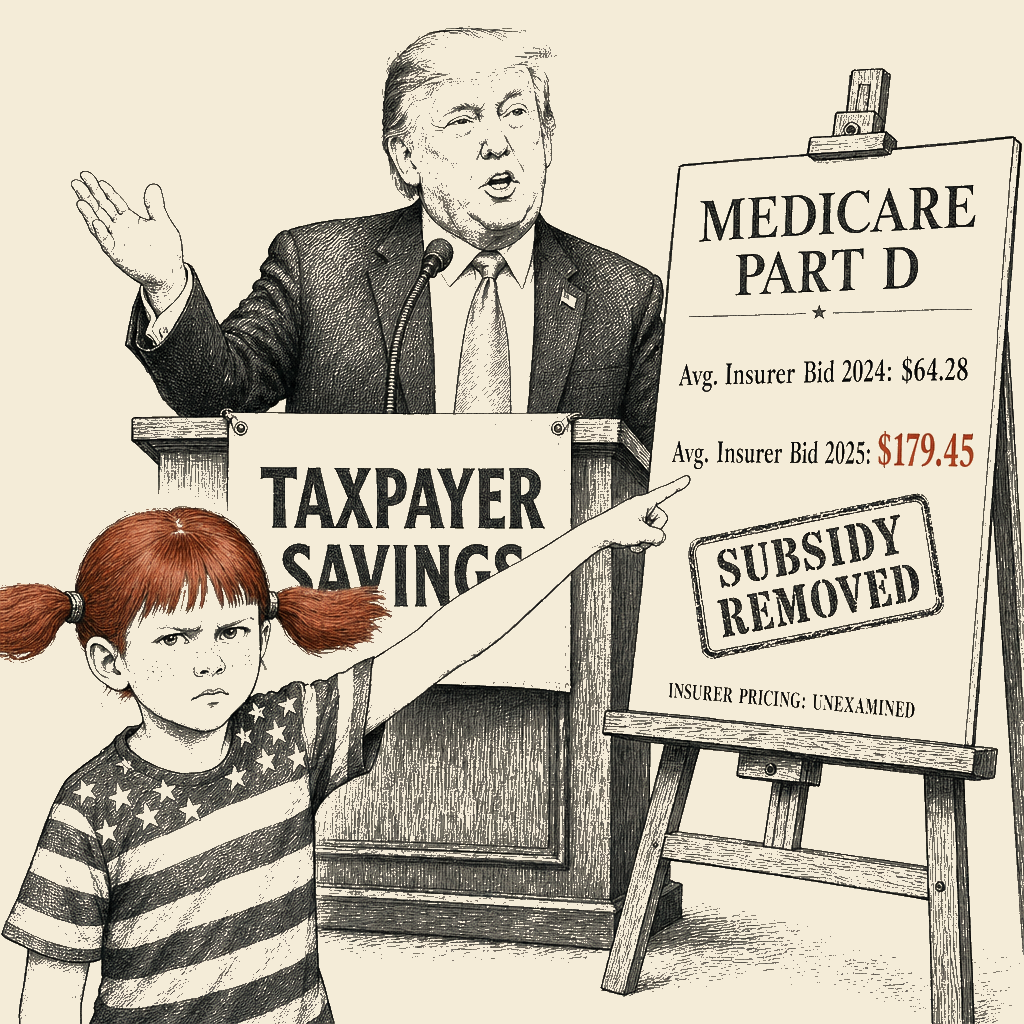
- The subsidy existed because insurer bids for basic Part D coverage jumped from $64.28 a month in 2024 to $179.45 in 2025 under the new rules. Ending it removes a federal buffer between that cost and beneficiaries’ premiums; it does not repair the underlying design. And the 90% figure measures plan availability, not whether a senior’s drugs, pharmacy, or doctor survive the switch — access is not continuity.
- The true beneficiaries of the “taxpayer savings” frame: insurers gain leverage to raise premiums or narrow offerings, while seniors who cannot easily shop or absorb higher costs carry the risk. Some taxpayer savings, yes — and the rest of the bill lands on the people least able to move. Congressional Budget Office, “Estimated Budgetary Effects of H.R. 5376,” August 2022.
The Response Ladder
Polite Reframe
When to use: With a persuadable moderate, a good-faith family member, or anyone who wants to discuss Medicare costs without turning seniors into a budget line.
Brenda is 74, takes several prescriptions, and does not experience Medicare as a spreadsheet. She experiences it as the difference between filling a prescription and postponing it.
The Part D changes did create a valuable protection: an annual ceiling on what many beneficiaries pay out of pocket. The financing behind that change was too optimistic — the Congressional Budget Office has revised its estimates, partly because seniors finally used the medicines the old design rationed. That deserves an honest fix.
But ending a premium subsidy is not fixing the underlying design. It means removing a federal cushion after insurer bids rose sharply under the new rules. Some beneficiaries will find cheaper plans, and the 90% figure sounds reassuring — but it measures plan availability, not whether a senior’s drugs, pharmacy, or doctor survive the switch. Shopping is not costless, and switching can mean changing formularies and physicians.
If the goal is responsible Medicare policy, Congress should show exactly who saves, who pays, and what happens to people who cannot move easily between plans. Taxpayer protection and senior protection are not enemies. A sound reform should provide both.
Mockery and Ridicule
When to use: For the bystander who has watched powerful institutions call a cost shift a reform.
The argument’s picture is wonderfully tidy: Washington removes a subsidy, seniors open a spreadsheet, discover a cheaper plan, and every taxpayer rides home on a white horse.
The actual Part D redesign is less enchanted. Congress added an out-of-pocket cap, insurer bids rose from $64.28 to $179.45 under the new structure, and the administration answered with a temporary subsidy to keep premiums from detonating before an election. Now the subsidy is being removed and the bill is being presented as a taxpayer victory.
That is not a cure. That is moving the furniture while insisting the house stopped leaking.
And the reassurance is doing heavy lifting. Ninety percent have access to cheaper plans — great, if your drugs, your pharmacy, and your doctor all ride along to the cheaper plan, which is exactly what the statistic does not promise. The people with the least flexibility are expected to shop harder, compare formularies, change pharmacies, and absorb the risk. The insurers get the market. The seniors get the homework. The taxpayers get a press release announcing that the money saved from one pocket proves the whole coat is cheaper.
Nuclear Satire
When to use: When the argument is being performed as fiscal heroism rather than examined as a transfer of risk.
Here is the grotesque little theater: Congress promises seniors a prescription-drug ceiling, the insurers submit bids that rise under the new design, the government builds a temporary scaffold to keep premiums from alarming voters, and then the scaffold is kicked away with a trumpet blast about “taxpayer savings.”
The source’s own figures describe the trap. Average bids for basic Part D coverage rose from $64.28 in 2024 to $179.45 in 2025. The response is not to repair the machinery, examine insurer pricing, or guarantee that seniors are not stranded by formulary changes. The response is to declare that the people beneath the machinery can shop around.
That is the governing theology of the spreadsheet: the beneficiary is efficient if he can navigate twelve plans, three formularies, changing pharmacies, and a new premium while sick. The institution with lawyers, actuaries, and negotiating power is merely responding to incentives. Brenda is told to comparison-shop. The insurer is told to submit another bid.
Then comes the 90% comfort blanket: most seniors have access to plans under $10 a month. Access is not continuity. A plan that exists on paper is not a plan that covers your medicine, sees your doctor, or keeps your pharmacy. The number measures shelf space, not the person holding the prescription.
The argument treats the CBO’s revised estimate as proof that the benefit was a fraud, while treating the subsidy’s removal as proof that the correction is painless. That is not fiscal clarity. It is selective accounting wearing a flag pin.
Profane Scorched-Earth
When to use: For full catharsis when the argument has turned budget arithmetic into a sermon about deserving seniors and innocent taxpayers.
Here is the damn con: the piece takes a real Medicare failure, wraps it in a flag made of deficit projections, and then calls the bill sent to sick people a victory for taxpayers.
The receipts are right there. The source says CBO raised the Part D baseline by roughly $700 billion through 2035 after earlier projections claimed the law would reduce the deficit. It says the promised rebates produced $136 million instead of the projected $2.3 billion for 2023 and 2024. It says insurer bids jumped to $179.45 a month from $64.28 in 2024 and $34.71 in 2023. It says insurers gamed the rules. That is not a clean program. That is a busted machine with money running through every available crack.
So audit the insurers. Rewrite the rules. Stop pretending a drug-price bargain exists when the bargain is mostly vapor. But do not stand there with a goddamn pair of scissors, cut support for patients, and call the blood on the floor “taxpayer savings.”
The source says 90% of beneficiaries can access a plan costing less than $10 a month. Wonderful. The remaining people are not decorative extras in a slideshow. The source also says 10% are in plans expected to rise by more than $10 a month, while plan offerings have fallen by more than half. People with serious medical needs do not shop for coverage like they are comparing sandwich prices. They need the drug their doctor prescribed, from a plan that covers it, at a price their household can survive.
And the people who get to call this “good for taxpayers” are not the ones being asked to choose between medicine and the electric bill. They are not the ones navigating formularies, changing networks, prior authorization, and the bureaucratic obstacle course built by a system that treats human illness as a revenue opportunity. The same government that found $6 billion for the insurers who gamed the bids now tells an exposed senior to go shopping. Matthew 25:31–46 does not measure righteousness in premium dollars; it asks what we did for the sick.
The honest conclusion is uglier and more useful: the subsidy may have been badly designed, insurers may have exploited it, and the benefit expansion may have been underpriced. But ending support is not automatically reform. If the fix protects the federal balance sheet by making selected seniors pay more, then say that plainly. Do not smear the transfer with the holy word “taxpayer” and pretend the money evaporated.
A government that can find billions for an insurer and then lecture a senior about shopping harder is not practicing fiscal virtue. It is laundering responsibility. The trick is not that Medicare costs money. The trick is making the public fight over which sick person should carry the damn cost while the institutions that designed the mess remain safely above the argument.

About Malcolm Little King
Malcolm Little King is a heteronym in Main Street Independent's editorial architecture — an analytical voice, not autobiography of any actual person. The position this column expresses is the publication's position on the territory Malcolm Little King's lane covers, rendered through Malcolm Little King's register.