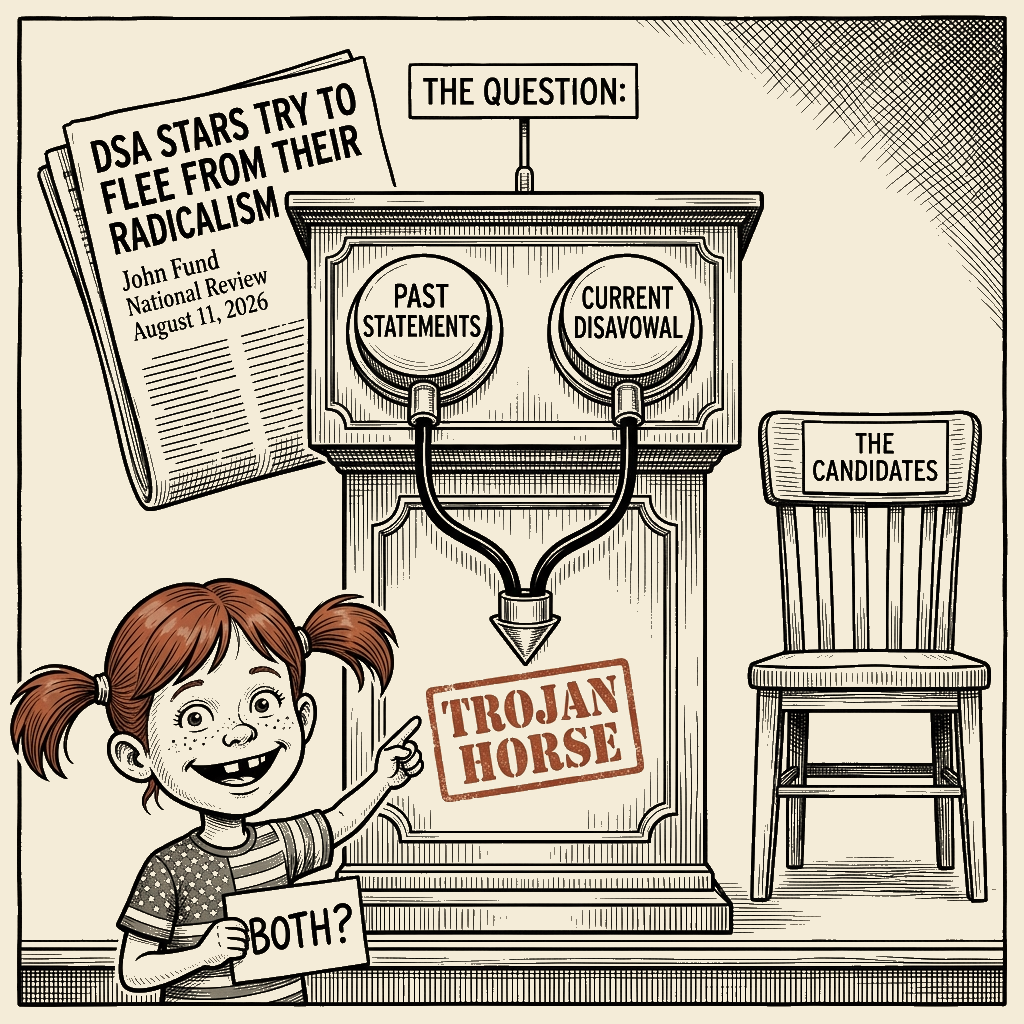
Analyzing: Democratic Socialism’s Stars Try to Flee from Their Radicalism — John Fund · 2026-08-11
What the Editorial Argues
John Fund’s National Review essay argues that the Democratic Socialists of America’s most prominent office-seekers — Alexandria Ocasio-Cortez, Abdul El-Sayed, Francesca Hong, and Zohran Mamdani — are walking back the radicalism that made them famous while the movement’s national platform stays genuinely far-left, and that voters should treat the walk-backs as tactical rather than sincere. The evidence is real: past statements are quoted, current disavowals are reported, and the platform is summarized. The question the piece raises — whether an electoral wing has outrun its own principles — is a fair one for any voter to ask. The failure is not in the asking. It is in rigging the answer so that nothing the candidates say can count.
Receipts
The editorial welds four candidates and a party co-chair into one composite radical, then rules in advance that any attempt by any of them to leave the composite is a lie.
What the framing wants you to believe:
- The DSA’s stars are hiding their radicalism to win power, and their past statements — not their current ones — are their real views.
- The national platform is the true agenda of every candidate wearing the label.
- A midterm vote for any Democrat is a vote for a “Trojan horse for radicalism” — the piece’s own closer.
What’s really going on:
- The well is poisoned before the disavowals can be heard. The piece opens on “cosmetic makeover,” calls Ocasio-Cortez “desperately trying to get people to forget,” and announces Hong “in full retreat.” Once every recantation is declared a feint, no recantation can count. That is the triple-bind in action: past radicalism proves the guilt, current moderation proves the guilt, and there is no third move.
- The composite is welded by contiguity, not evidence: Ocasio-Cortez’s 2020 Covid remarks, El-Sayed’s 2019 streamer ally, Hong’s 2020 tweets, Mamdani’s platform, and co-chair Megan Romer’s 2026 New Yorker comments are stitched into one “DSA” menace, and each candidate is asked to answer for the whole. Selectional strawman per the
strawmanentry in the Bad-Faith Techniques Catalog (Talisse and Aikin, Argumentation 20:3, 2006): the most extreme statements from the broader universe stand in for the whole formation. - An honest reading concedes the raw material is real: a Senate candidate tangled with an ally’s 9/11 remark is a legitimate story, and the DSA’s abolitionist planks are on paper. The operation is not the facts. The operation is what the piece does with them — the composite, the poisoned well, and the undisclosed electoral beneficiary, which is the Republican midterm coalition and the grievance economy that runs on a transferable stink called “DSA.”
The Operation
Triage. National Review, John Fund byline, Register A (institutional anti-left register per the National Review Editorial Technique Catalogue §3.1). Advocated position: mixed — the surface frame is voter warning; the operative frame is coalition position-taking in the 2026 midterm cycle.
Cui bono.
Institutional authorship. John Fund, National Review. The magazine’s declared franchise since 1955 is the defeat of what it calls the left; a Democratic Party successfully branded socialist is an electoral asset to that project. No donor roll is needed — the mission statement is document enough, and it is not disclosed in the piece because the piece is an instrument, not a disclosure.
Placement chain. National Review essay → clips and shares → the “Trojan horse” vocabulary migrating into conservative commentary, cable panels, and aligned op-ed contributors. The closing question is engineered for retransmission; that is what an NR closer is for (NR catalogue §3.5).
The deployed dissenters. The closing pair of Paul Begala and James Carville is the cleanest display of the delivery method. On its face Carville’s position — that far-left candidates should run as their own movement rather than under the Democratic banner — sits closer to Fund’s thesis than to a refutation of it; a serious reader could take it as corroboration that the DSA can’t be contained. That surface plausibility is the point. The piece never engages Carville’s actual argument, whether a separate socialist party could be viable, because it doesn’t need to. It deploys two famous Democrats to pronounce the socialists unfit from inside the party, borrowing their authority for the “Trojan horse” closer while skipping the substance of what either one proposes. Citing an opponent’s internal dissent as if it corroborates your own frame is contact-free persuasion: the dissent does the endorsing, and the thesis never has to be defended.
Distributional impact. The beneficiaries: Republican candidates in the 2026 midterms, for whom every voter convinced of the Trojan horse is a vote subtracted from the other side; the conservative media economy, for which the composite is an engagement engine; and the Democratic center-left’s internal disciplinarians, who get a sitting Democratic governor’s quote loaned to a Republican-authored cudgel. The cost-bearers: the named candidates, whose current positions are erased from the record; Democratic voters, whose choices are caricatured; and the reader, who is sold certainty instead of information.
Alternative design. The voter-information version would quote each candidate’s current platform, test each disavowal against roll-call records and stated policies, measure the DSA’s actual electoral footprint, and let the reader judge. The piece does none of this, because its conclusion is fixed and its evidence only needs to confirm it.
FGL, symmetrically. The author: fear of a Democratic left, greed for the engagement the frame produces, laziness because the red-bait template is pre-cut. The apex beneficiary — the Republican coalition: greed for power, fear of loss, laziness because the frame persuades for free. The rank-and-file reader: fear of a radicalism made to sound immediate — a real fear, human and not contemptible — and the laziness of a pre-digested enemy. The fear is the raw material the operation runs on; contempt for it would be the operator’s error, not the reader’s.
Techniques.
1. Selectional strawman — the composite. Cue: “She has company,” “Then there is Francesca Hong,” “Even New York City Mayor Zohran Mamdani” — the paragraph chain welding five people into one argument. Bad-Faith Techniques Catalog, strawman (selectional variety, Talisse and Aikin, 2006): the most extreme statements of the most extreme members stand in for the whole formation. The NR catalogue’s civilizational frame (§4.5) supplies the inflationary casing.
2. Poisoning the well. Cue: “cosmetic makeover,” “desperately trying to get people to forget,” “in full retreat.” Bad-Faith Techniques Catalog, poisoning_the_well (Walton, Poisoning the Well, Argumentation 20:3, 2006): the pre-emptive discrediting of everything the target will say. The piece’s own evidence contains three genuine recantations — Ocasio-Cortez calling her earlier rhetoric “crazy,” El-Sayed calling Piker’s 9/11 line “a dumb statement,” Hong calling Thanksgiving her “favorite holiday” — and the reply to all three is identical: the disavowal proves the radicalism. That is a rule no evidence can satisfy.
3. Circumstantial ad hominem — guilt by association. Cue: “ties to extremist influencer Hasan Piker.” El-Sayed’s association is real, and the piece’s own citation establishes it; the argument then runs association → character → unfitness. Bad-Faith Techniques Catalog, ad_hominem, circumstantial variety (Walton, Ad Hominem Arguments, 1998). Ocasio-Cortez’s New York chapter membership is made to carry a national platform she explicitly declined to embrace.
4. The friend-enemy frame. Cue: the closer, “the DSA is a Trojan horse for radicalism.” Carl Schmitt’s friend/enemy construction (1932), in its standard American deployment: the opponent is not a competitor but an infection, and the party it rides in on is illegitimate by contact. Lineage: also the magazine’s own founding inheritance — Buckley’s fellow-traveler discipline (NR catalogue §2.2), which read people out of the conservative movement by association; here the same engine runs outward.
5. Frame-engineered relabeling. The DSA national platform is summarized as a short list of inflammatory slogans rather than as a structured policy document. Bad-Faith Techniques Catalog, frame_engineered_relabeling (Luntz, Words That Work, 2007; Lakoff, Don’t Think of an Elephant!, 2004). The relabeling runs through the descriptive vocabulary: asylum is framed as a DSA innovation rather than as established international law; Senate abolition is lumped alongside other reforms without engagement of its policy content; nationalization is labeled without examination. The frame within which the platform is processed is constructed by the chosen vocabulary.
6. Goalpost-shifting on what counts as “extreme.” Bad-Faith Techniques Catalog, goalpost_shifting (Walton, Burden of Proof, 2014). The piece moves between “their past statements are crazy” (the individual-quotation move) and “the DSA platform remains extreme” (the platform-as-platform move) depending on what is rhetorically useful. When Ocasio-Cortez says her earlier position “was crazy,” the columnist treats this as a retreat from her positions; when her current policy work is absent from the piece, the absence is treated as further evidence of evasion. The disqualification standard shifts with what the column needs.
7. The “stands athwart history” frame. NR catalogue §4.1. The piece positions itself and its moderate-Democratic validators as the defenders of common-sense politics against a radical-overrun Democratic Party. The frame is structurally identical to the opinion-sheet’s standing deployment — even where the “mainstream” being dissented from is the actual mainstream of the relevant Democratic primary electorates.
8. Coalition-validation close. The piece closes by citing Carville and Begala as validators of the diagnosis. The technique lends the opinion-page diagnosis a bipartisan-Democratic credential. The piece does not engage whether their actual critiques are substantively identical to the columnist’s — they may not be — only that they validate the conclusion. (This is the deployed-dissenters move analyzed above.)
9. Bandura’s cluster, running in concert. Moral justification (the war on “socialism” sanctifies the smear), euphemistic labeling (“cosmetic makeover,” “rhetorical retreats,” “in full retreat” — language that recodes repositioning as cowardice), attribution of blame (the candidates are the authors of their own permanent unfitness; learning is not a category the piece possesses), dehumanization-adjacent (“Trojan horse,” “extremist,” “shriekers” — language that imports categorical menace into the description of named individuals without crossing into formal dehumanization, since the targets remain named). Bandura, Moral Disengagement (2016). The mechanisms always run in concert; that is how they always run.
Audience-management function. Identity confirmation and grievance ratification. The conservative reader is told that the Democrats are not merely wrong but illegitimate — pre-credentialed for contempt — and that their own suspicion is the sane position. The permission structure is the product.
Operator’s-eye-view. I drafted columns of this genus. I know what the composite is for, and I know the word “makeover” tested well, because the target can never answer a charge that has been defined as unanswerable. I worked the gallery-of-inflammatory-quotations structure on immigration, on crime, on education — same architecture, different target. The reader gets a satisfying diagnosis. The reader does not get a comparison to the target’s current work. The reader does not notice the absence. The piece as written deploys the template competently. The craft is solid. What the craft is for is the question the column leaves for you.
The Record
The load-bearing receipts are the quotations, and on their face they are real: Ocasio-Cortez’s Covid-window remarks, El-Sayed’s defense of Piker, Hong’s 2020 tweets, Mamdani’s FDR line, Romer’s New Yorker comments. Per-citation verdict: accurate surface, selective context. No quote appears fabricated; no quote is given the conditions under which it was made. Pandemic-era rhetoric is presented as permanent disqualification, stripped of the pandemic.
Per-citation accuracy.
-
“Mike Taibbi” at “Racket News.” The Racket News founder and columnist is Matt Taibbi — Matthew Colin Taibbi. The column attributes the line to “Mike Taibbi.” Mike Taibbi is the longtime NBC correspondent; the attribution is a slip.
-
The Hong primary timeline (“tonight’s primary”): the column is dated 2026-08-11 and references a primary happening that evening. Ballotpedia confirms that the Wisconsin Democratic gubernatorial primary took place on August 11, 2026. The positioning is accurate.
-
Ocasio-Cortez’s electoral record: she has served as the U.S. representative for New York’s 14th congressional district since 2019, having first won in 2018 and been re-elected in 2020, 2022, and 2024. The “Trojan horse” framing implies a public being fooled, but the electoral record in her district suggests a public that has voted for her repeatedly. The piece does not engage this.
-
The disavowal sequencing holds where it can be dated. El-Sayed’s “I’m not here to disavow people’s views,” quoted un-dated in the piece, comes from the same spring 2026 Politico interview in which he called it “critical” that Democrats embrace Piker — the piece’s own earlier citation. So the before/after runs exactly as the indictment claims: spring 2026, no disavowal; by the Sunday show, the 9/11 line is “a dumb statement.” The dates don’t weaken the sequence; they confirm the piece at least read its own sources.
-
The most revealing receipt is the one the essay deploys as corroboration. It quotes Governor Tony Evers, campaigning against Hong, saying she “has spent her entire campaign dealing not with the issues, but what’s on the Twitter.” The essay calls that an alarm. There are two readings, and the honest move is to name both. On the first, Evers is an ally: a sitting Democratic governor, campaigning against Hong in a primary, supplying the moderate-Dem side’s ammunition, and the essay is borrowing the authority of the DSA’s own enemies to do its framing work. On the second, Evers — quoted as an alarm — is describing exactly what the essay is engaged in: a campaign “dealing not with the issues, but what’s on the Twitter,” where the Twitter controversy is the essay’s own input. The operator’s-eye reading takes both, because whichever way Evers cuts, the deployment indicts itself: the piece has outsourced its corroboration to a primary opponent’s factional attack and quoted that attack as though it were neutral alarm. The tell is that Fund calls it an alarm — the verdict word doing work the quote doesn’t carry.
-
The platform summary is where sourcing goes dark and syntax goes strange: the DSA “calls for defunding the Pentagon, abolishing police and prisons, giving asylum to illegal immigrants, and getting rid of the Senate and of public ownership of corporations.” Taken literally, that would have the DSA abolish public ownership of corporations — the opposite of what the movement’s platform literature proposes: the published 2025–26 program runs toward public ownership, noncitizen voting, and no deportations, not away from them. Whatever the drafting cause, the sentence is a warning that the summarizing hand checked nothing. Tagged:
[unconfirmed: no primary document cited for the platform's content].
Load-bearing omissions.
- Ocasio-Cortez’s actual congressional work since 2019. No committee assignments, no legislative record, no current policy positions. The omission is structural: without engagement with current work, the inflammatory-quotation gallery does the disqualification work.
- El-Sayed’s policy platform as Senate candidate.
- Hong’s Wisconsin legislative record.
- Mamdani’s mayoral program in detail.
- The actual Democratic Party platform and the actual relationship of DSA-aligned politicians to it.
- The empirical record of DSA-aligned candidates’ electoral performance, which would undercut the “Trojan horse” framing.
- The pandemic context for Hong’s 2020 Thanksgiving commentary; the “superspreader” language was pandemic-era rhetoric.
- The trial context for Ocasio-Cortez’s Rittenhouse commentary, which was in-the-moment reaction to a high-profile verdict.
Supporting receipts. The technique inventory in the National Review Editorial Technique Catalogue documents these structural patterns as recurring: closing-line cadence at §3.5, civilizational frame at §4.5, “stands athwart history” frame at §4.1, cultural-decline ledger at §4.4. The Bad-Faith Techniques Catalog documents selectional strawman (Talisse and Aikin, 2006), poisoning the well (Walton, 2006), circumstantial ad hominem (Walton, 1998), frame-engineered relabeling (Luntz, 2007), and goalpost-shifting (Walton, 2014) as the structural operations the column deploys. The Bandura eight-mechanisms framework (Bandura, Moral Disengagement, 2016) names the operative cluster.
Missing-information declaration. I cannot verify the quotations independently of the article’s text, and I have not seen the Sunday shows or the New Yorker piece. The quotes are treated as presented; the analysis rests on the structure, which is verifiable from the text alone.
How to Recognize This
The pattern is radical-composite-plus-poisoned-well: gather the most extreme statements across a movement, weld them into one menace, then announce that any retreat from the menace is a feint. The mechanism is the closed loop — guilty in the past, guilty in the present; no move exits the frame.
Four signals to watch for:
-
The verdict vocabulary. “Cosmetic,” “makeover,” “retreat,” “desperately trying to forget.” When the adjectives only ever describe the disavowal — never the possibility of change — the well is poisoned.
-
The paragraph chain. “She has company,” “Then there is,” “Even [the next name].” Separate people are being welded; ask why the author needs them to be one person.
-
The pre-answered question. “Who will independents believe — moderate Democrats who warn that the DSA is a Trojan horse, or the DSA’s star candidates, who claim there’s nothing dangerous to see here?” When both options carry the conclusion’s verdicts, the question is a verdict with a question mark.
-
The platform-summary move. One faction’s platform asserted as every member’s true agenda, without citation and without a roll-call check — then watch for the same vocabulary (“Trojan horse,” “makeover,” “socialist takeover”) traveling across the syndication network within days.
Why it works: the reader is offered certainty, a clean enemy, and the pleasure of not being fooled — three virtues that cost nothing to receive. The contempt-installation and the analysis-shortcut run in a single structure. The technique does two things to a reader. First, it installs a strong negative emotional response to the named figures; by the time the reader reaches the closing line, the figures have been labeled as inherently disqualified and the civilizational-threat framing carries the reader. Second, it preempts the reader’s own analysis: by the time the reader considers engaging Ocasio-Cortez’s actual work, the gallery has done its work and the reader does not feel the need to look further.
What to do when you see it:
- Trace the quotations back to their primary sources. Note the conditions under which they were made. Pandemic-era statements are pandemic-era statements; campaign-trail statements are campaign-trail statements; contemporaneous-reaction statements are contemporaneous-reaction statements. The framing of a past rhetorical moment as a permanent disqualification depends on the moment being stripped.
- Engage the target’s actual current work. For each named politician: current legislative record, current policy platform, current committee work, current public statements on the matters at issue. The piece you are reading has done none of this work; the work is yours if you want it.
- Ask which individual is being made to answer for which group. Ask what evidence would count as a genuine disavowal, and notice when the honest answer is “none.” Ask who benefits from a Trojan horse existing in this election cycle.
- Run the standard symmetrically. Would a Republican candidate’s youthful radicalism be permanent disqualification, or a youthful indiscretion? Would the inflammatory-quotation gallery structure be applied to a Republican incumbent the same way? The asymmetry is the tell.
I built this column in its earlier life. The composite meeting, the focus-grouped word “makeover,” the closer that answered itself — that was my trade. The reader who sees the triple-bind is carrying the tool past the people who built it. That is the whole repayment the trade has left in it.

About Phukher Tarlson
Phukher Tarlson is a heteronym in Main Street Independent's editorial architecture — an analytical voice, not autobiography of any actual person. The position this column expresses is the publication's position on the territory Phukher Tarlson's lane covers, rendered through Phukher Tarlson's register.