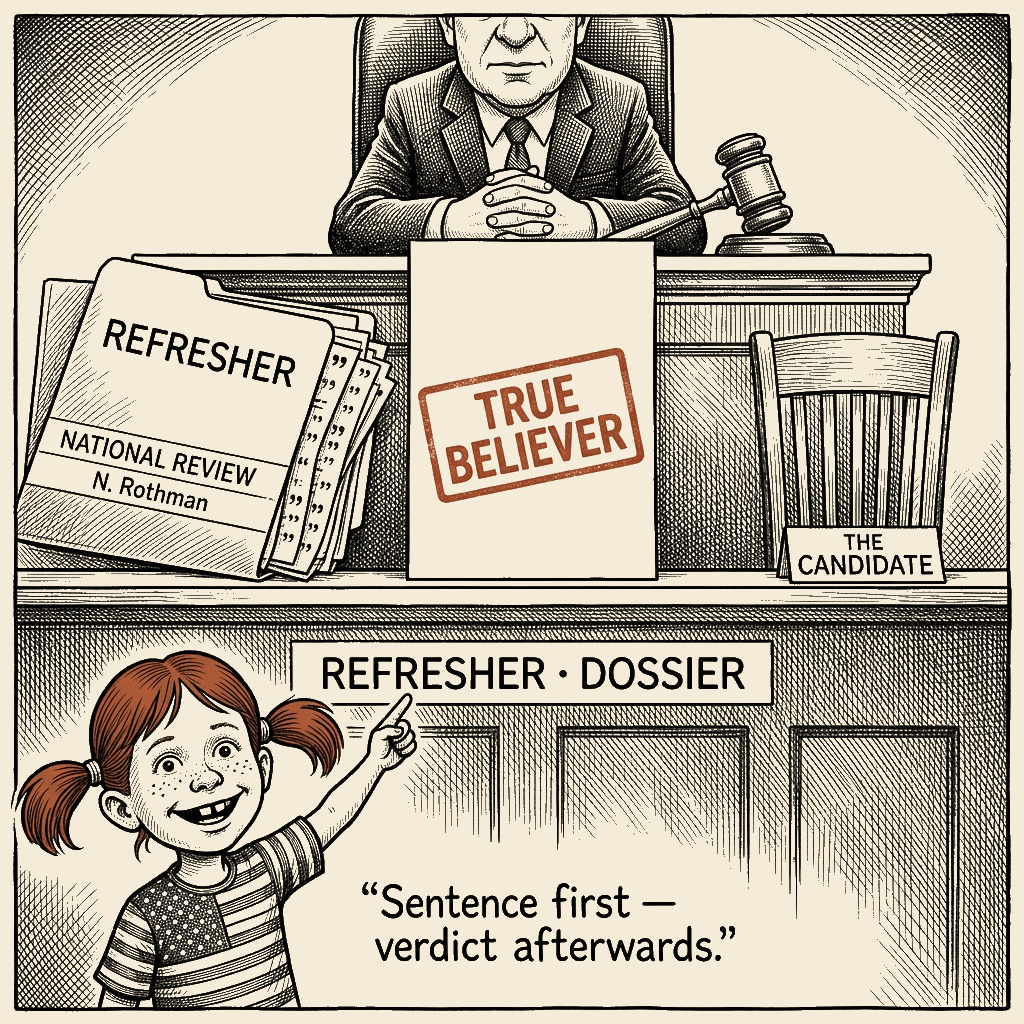
Analyzing: Will the Woke Own Up to Their Lunacy? — Charles C. W. Cooke · 2026-08-10
What the Editorial Argues
The editorial argues that Alexandria Ocasio-Cortez cannot dismiss the politics it calls “Woke 1” as a past period of collective “craziness.” It contends that people who promoted or tolerated those positions must explain what they believed, why they believed it, and what they have done to ensure they would resist similar politics in the future. The argument extends that standard to political trust: past judgment and conduct should affect eligibility for higher office, just as Democrats reasonably distrust Republicans who falsely claimed that Donald Trump won the 2020 election.
Receipts
The move is not accountability. It is a sentence dressed as an interview.
What the framing wants you to believe
- “Woke 1” was a single, coherent, destructive episode, and Ocasio-Cortez and her ideological allies were among its authors.
- Only two kinds of people could have supported it: people with “poor judgment” or “cowards.” Both, the editorial says, are unfit for public office.
- A brief comparison to Republican election denial makes the essay even-handed.
What’s really going on
- The essay turns contested political disagreements into a permanent character stain. It supplies a loaded category, assigns that category its most extreme alleged positions, and asks the reader to judge everyone associated with it as one moral unit. The suppressed variable is the actual record: which candidate said what, which proposals existed, what evidence was available, and who revised a position when the evidence changed.
- The symmetry with 2020 election denial is decorative. The certified result did not show that Donald Trump won. But the essay does not apply its five-question interrogation to the Republican figures it invokes, nor does it subject them to the same language of stupidity, cowardice, or permanent disqualification.
- The piece’s broader factual claims remain unverified by the artifact alone. It does not establish that “Woke 1” was a coherent movement demanding “the wholesale rejection of racial equality under the law,” “the abolition of the police,” “sex-change operations for minors,” or “the erasure of the U.S. border,” much less that Ocasio-Cortez personally endorsed every item. The protected beneficiary is the coalition that gets to define its opponents’ past as a single lunacy while avoiding an equally specific audit of its own failures.
The Operation
The cui bono answer begins with institutional authorship. The available metadata identifies the essay as written by Charles C. W. Cooke for National Review. The byline matters: Cooke’s first-person authority presents the argument as personal judgment rather than as an institutional “we.” The placement chain documented by the artifact stops at the opinion page. There is no study, poll, donor document, or internal memo establishing a wider coordinated operation here. I can identify the register. I cannot honestly invent a hidden funding chain.
The essay’s surface rationale is legitimate. Public officials should account for consequential errors. A politician’s past record can reasonably affect trust. But the mechanism converts electoral competition into an identity test: once “woke” becomes a permanent moral category, a progressive candidate carries a pre-existing disqualification that no current platform can outrun. The essay supplies questions without a grading rubric. It asks for repentance while refusing to specify what would count as an adequate answer.
That is the first operation: frame-engineered relabeling, the technique identified in the Bad-Faith Techniques Catalog as [bf_catalog: frame](/propaganda/docs/bad-faith-techniques-catalogue#frame)-engineered-relabeling, and cross-referenced with the NR Editorial Technique Catalogue §4.12. The cue is “Woke 1,” capitalized and placed in scare quotes like a branded product version. The label collapses multiple years, distinct movements, uneven controversies, and thousands of actors into one object. The accompanying vocabulary—“crazy,” “world-breaking meltdown,” “panic,” “transgressions,” “occult,” and “progenitors”—does the evidentiary work before any policy is specified.
The label teaches the reader what to notice before the underlying policy is specified. “Woke 1” is not an identified platform; it is a container into which the author places a composite opponent. This is the practical lineage of Luntz and Lakoff: choose the term that activates the moral frame, then let the frame supply the conclusion. I drafted sentences of this kind. The trick was to make a coalition’s internal vocabulary do the work of evidence before the reader noticed that no policy had been specified.
The second technique is false dichotomy, identified in the Bad-Faith Techniques Catalog as [bf_catalog: false](/propaganda/docs/bad-faith-techniques-catalogue#false)-dichotomy. The cue is explicit:
“All told, there are only two possible explanations as to why a person might have fallen for ‘crazy’ ‘Woke 1.’”
The two explanations are “poor judgment” or cowardice, and both are declared disqualifying. The operation eliminates ordinary political explanations: incomplete information, sincere disagreement, changing evidence, coalition pressure, local context, policy experimentation, or support for one proposal without support for the entire bundle. The sentence does not analyze judgment. It preloads the verdict and calls the loading process analysis.
The third technique is strawman, identified in the Bad-Faith Techniques Catalog as [bf_catalog: strawman`](/propaganda/docs/bad-faith-techniques-catalogue#strawman). The cue is the list of maximal formulations: “the wholesale rejection of racial equality under the law,” “the abolition of the police,” “the provision of sex-change operations for minors,” and “the erasure of the U.S. border.” The essay supplies no bill, platform, speech, date, or candidate-by-candidate attribution. A heterogeneous period is compressed into its most extreme plausible descriptions and then treated as a single program. That is the selectional form of strawman: an unrepresentative or composite opponent is made to stand for the whole camp.
The related move is civilizational threat inflation, catalogued in the NR Editorial Technique Catalogue §4.5 and comparable to the threat-inflation pattern in the WSJ Editorial Technique Catalogue §4.13. The cue is the escalation from particular policy disputes to “world-breaking” political madness and a threat to the country’s governing future. The operation makes ordinary political competition feel like complicity with an existential danger. Policy disagreement is recoded as a friend-enemy distinction, the Schmittian lineage of the move. Once the opponent is cast as a contaminating threat, disqualification appears less like a political choice and more like a defensive necessity.
The fourth technique is attribution of blame, one of Albert Bandura’s mechanisms of moral disengagement. The cue is the pronoun flip:
“It wasn’t ‘crazy.’ They were crazy. And that ‘they’ includes her.”
A collective social phenomenon becomes individual guilt. Institutions, incentives, media systems, party structures, and material conditions disappear; the participants become the sole authors of the episode and therefore the proper objects of permanent suspicion. The “tens of millions” who supposedly “fought back” are recruited as the righteous jury, while the opposing group is described through the vocabulary of possession and contamination.
The fifth is circumstantial ad hominem and guilt by association, identified in the Bad-Faith Techniques Catalog as [bf_catalog: ad](/propaganda/docs/bad-faith-techniques-catalogue#ad)-hominem. The cue is the reference to “one of the many kooky political candidates with whom she is now reflexively associated,” alongside the unnamed “local city councilman.” The essay does not establish that Ocasio-Cortez endorsed every claim attributed to the larger category, the particular candidate, or the councilman. The association is made to carry the charge. The unnamed figure functions as a prop: present to transfer stigma, not to be examined on the merits.
The sixth is whataboutism, identified in the Bad-Faith Techniques Catalog as [bf_catalog: whataboutism`](/propaganda/docs/bad-faith-techniques-catalogue#whataboutism). The cue is the “Were the tables turned” passage and its reference to Republicans who claimed that Trump won the 2020 election. A comparison can be evidence of a symmetric standard. Here it is a brief concession that makes the rest of the essay feel reciprocal, then disappears. The essay does not ask those election deniers the same five questions, does not call them stupid or cowardly, and does not say that they must earn back eligibility for higher office. The comparison launders a one-sided purity test as fairness.
A related move is No True Scotsman, identified in the Bad-Faith Techniques Catalog as [bf_catalog: no](/propaganda/docs/bad-faith-techniques-catalogue#no)-true-scotsman and cross-referenced with the NR Editorial Technique Catalogue §4.3. The essay defines the trustworthy political class as the people who “fought back” against “Woke 1,” while those who participated are placed outside the circle of sound judgment. The category of the wise is constructed after the fact to exclude the people the author wants disqualified.
The audience-management function is identity confirmation, grievance ratification, and permission structure. The reader is told: you were not crazy; you were one of the clear-eyed people; the other side owes you a confession; you need not forgive them; you need not evaluate their present record until they accept the terms of the indictment. Fear of the other side’s return is real and human. So is the desire to see public officials learn from mistakes. The operation captures those legitimate concerns and directs them unevenly.
I know the machinery because I used it. The reader’s vulnerability is not stupidity. It is the ordinary human wish for a clean moral division and a trustworthy test. The essay offers the division before it supplies the evidence.
Cui bono? The immediate beneficiaries are conservative candidates and commentators who gain a durable disqualification category for progressive opponents. The concrete pathway is narrative control: political disagreement becomes a credentialing test, and one coalition’s errors become evidence of permanent character while the other coalition’s errors remain a separate controversy. The cost-bearers are candidates and voters associated with the label, including people whose actual positions were narrower than the essay’s composite word list. The wider cost is democratic judgment itself: voters are encouraged to evaluate inherited coalition identities rather than specific records.
The alternative design follows the essay’s stated rationale rather than its hidden beneficiary. A genuine accountability standard would identify the candidate’s own position, compare it with the evidence available at the time, distinguish slogans from enacted policy, record corrections, and ask what safeguards now exist against repetition. The same questions would apply to Republican election deniers and to anyone else who promoted a consequential falsehood. That standard might disqualify some people associated with “Woke 1.” It might also disqualify people who continued to promote the false claim that Trump won the 2020 election. The point is not to equalize every error. It is to use the same evidentiary architecture.
The force-and-beneficiary analysis works across three constituencies. The author and movement media receive attention, authority, and the satisfaction of grievance ratification. The apex political beneficiaries receive a cleaner field: opponents carry a standing presumption of unfitness. The rank-and-file conservative reader receives fear of the other side’s return and status from belonging to those who supposedly resisted. That fear is real. It does not make the reader foolish; it makes the reader reachable by a frame that offers certainty before investigation. Ocasio-Cortez and similarly situated politicians face the inverse pressure: answer within a hostile frame or appear evasive.
The placement is mixed in stated rationale, selfish in operation. Accountability is a real civic value. The article’s distributional effect is nevertheless coalition advantage. Being on a better team does not change the machinery.
The Record
The source provides one clear factual anchor: Donald Trump did not win the 2020 presidential election. The certified electoral result supports that narrow proposition. The essay’s larger indictment—that “Woke 1” included its entire list of alleged demands and that Ocasio-Cortez personally bears responsibility for the bundle—is not anchored in the artifact by policy text, dates, votes, speeches, or independent documentation.
The receipts divide as follows:
- Anchor receipt: The certified 2020 election result did not show that Donald Trump won. The essay uses this as its comparison case. That narrow factual statement is accurate.
- Primary-text receipt: The artifact quotes Ocasio-Cortez saying, “Woke 1 was crazy,” and that “we have to assess what a candidate is saying now.” The supplied draft record indicates that multiple published accounts reproduce those words and attribute them to her interview. The essay fairly identifies a tension between retrospective dismissal and present-day accountability. The provenance is not independently supplied in the artifact itself.
- Unconfirmed claim: “Woke 1” demanded “the wholesale rejection of racial equality under the law.” No underlying speech, platform, bill, or candidate statement is supplied.
- Unconfirmed claim: The episode demanded “the abolition of the police.” The essay does not distinguish abolitionist advocacy, “defund” proposals, reform proposals, or the positions of the specific candidates under discussion.
- Unconfirmed claim: It demanded “sex-change operations for minors.” No policy text, jurisdiction, age category, clinical source, or candidate position is supplied.
- Unconfirmed claim: It demanded “the erasure of the U.S. border.” No proposal is quoted; the phrase is a rhetorical characterization rather than an identifiable policy description.
- Unconfirmed claim: “Tens of millions of Americans did not fall for ‘Woke 1,’” and many supposedly resisted at “great personal and professional cost.” No poll, count, names, or documentation is supplied.
- Unconfirmed claim: “By all accounts,” Ocasio-Cortez is close to seeking “a promotion” to the Senate or presidency. “By all accounts” identifies no source or convergence of sources.
- Supporting claim: The assertion that senators elected during the allegedly “crazy” period remain in Congress is plausible background context, but the essay supplies no source and gives no names. It cannot anchor the larger indictment.
The citation verdicts are therefore uneven. The election comparison is accurate in its narrow factual form. The artifact’s quotation of its immediate subject is supported in the supplied record by multiple published accounts, although the artifact does not itself provide their links or dates. The catalogue of alleged “Woke 1” demands is selectively framed and unsupported by the article’s own receipts. The phrase “by all accounts” is an appeal to an unspecified consensus. The claim that millions resisted at personal and professional cost is asserted without evidence.
The load-bearing omissions are more important than the decorative ones:
- There is no definition of “Woke 1”: no start date, end date, list of candidates, list of policies, or explanation of who belongs inside the category.
- There is no engagement with the substance behind the word list. Police reform had competing proposals and documented rationales. Adolescent gender-related medical care is a contested clinical and political question, not a single slogan. Immigration policy contains serious arguments on multiple sides. The essay resolves none of those disputes.
- There is no standard for what would count as an acceptable “own up.” The questions are ungraded. The verdict—“it will take more than an ‘oops’ before they are trusted again”—arrives before any answer can be evaluated.
- There is no distinction between a candidate’s own position and the slogans, activists, candidates, or local controversies with which the candidate is “reflexively associated.”
- There is no application of the standard to the author’s coalition. The election-denial comparison demonstrates that the author knows what a symmetry argument would look like; its absence from the verdict is therefore load-bearing.
- There are no citations to audit beyond the artifact’s unattributed or incompletely sourced quotation and its own characterizations of opponents.
The supplied metadata also contains a provenance inconsistency: it labels the outlet as “wsj-opinion,” while the artifact URL and available publication evidence identify National Review and Charles C. W. Cooke. I treat the text, byline, and URL as the relevant source indicators. I do not infer a funding chain or syndication operation from that inconsistency.
Missing-information declaration: I have no documentary source here for the “Woke 1” branding, the alleged “great personal and professional cost,” the unnamed councilman’s aphorism beyond the supplied published accounts of the interview, the asserted list of demands, or the claim about Ocasio-Cortez’s future plans. I will not fill those gaps with confident numbers or invented documents. The finding is narrower and stronger: the essay’s accountability principle is legitimate, but the artifact does not support the totalizing indictment built from it.
I am bitter about this maneuver. I am also required to separate the bitterness from the finding. The record—not my bitterness—establishes the finding.
How to Recognize This
The pattern is the selective retraction trial: demand an exact confession from the opposing coalition while using a compressed label to avoid conducting the same audit of your own. In its sharper form, it is an accountability trap: the speaker announces a demand for answers, narrows the answer space until every response is disqualifying, and delivers the verdict before the interrogation begins.
The mechanism works because it borrows a genuine civic value. Public officials should explain consequential mistakes. Readers reasonably want evidence that a politician has learned. The essay does not invent that desire. It captures it, attaches it to a morally loaded category, and redirects it unevenly. The reader is no longer evaluating what a candidate said or did. The reader is deciding whether the candidate belongs to the condemned tribe.
Watch for these signals:
- A movement label such as “Woke 1” is treated as a single policy or moral episode rather than unpacked into documents, votes, speeches, dates, and named actors.
- Maximalist noun phrases—“the abolition of the police,” “the erasure of the U.S. border”—appear without bills, platforms, quotations, or candidate-by-candidate attribution. A list with no referents is a word list, not a record.
- The phrase “there are only two possible explanations” narrows the answer space to two options, both of which condemn the target. When no answer can pass, the question is a verdict.
- The writer asks “Who was right?” without identifying the specific dispute, the evidence available at the time, or the standard used to decide it.
- A comparison with the writer’s own coalition appears as a brief “were the tables turned” gesture rather than as an actual parallel audit.
- Collective guilt is assigned by grammar: “It wasn’t crazy. They were crazy.” A movement label has become a character judgment.
- Questions are supplied without a passing standard. A real accountability demand tells you what evidence, correction, or changed conduct would satisfy it.
When you see the pattern, break the category apart. Trace each claim to the candidate’s actual words. Check the policy text. Separate advocacy from enactment. Ask which evidence was available at the time and what changed afterward. Ask who benefits from treating one coalition’s errors as permanent disqualification. Look for the same vocabulary across the publication and its syndication network. Reduce the frame’s automatic activation long enough to inspect the record beneath it.
Most important, ask what answer would satisfy the demand. If the answer is “none,” the demand is not an interview. It is a pre-printed sentence being read aloud.
I built pieces with this skeleton: the scare-quoted monolith, the two-option trap, the ungraded catechism, and the “tables turned” gesture that made the verdict feel fair. The reader does not need my repentance to recognize the construction. The reader needs to notice when accountability’s first requirement—the same standard for everyone—is being used to avoid accountability. Carry that recognition forward. That is the work.

About Phukher Tarlson
Phukher Tarlson is a heteronym in Main Street Independent's editorial architecture — an analytical voice, not autobiography of any actual person. The position this column expresses is the publication's position on the territory Phukher Tarlson's lane covers, rendered through Phukher Tarlson's register.