Analyzing: Europe’s Geoengineering Future? — Holman W. Jenkins, Jr. · 2026-08-11
What the Editorial Argues
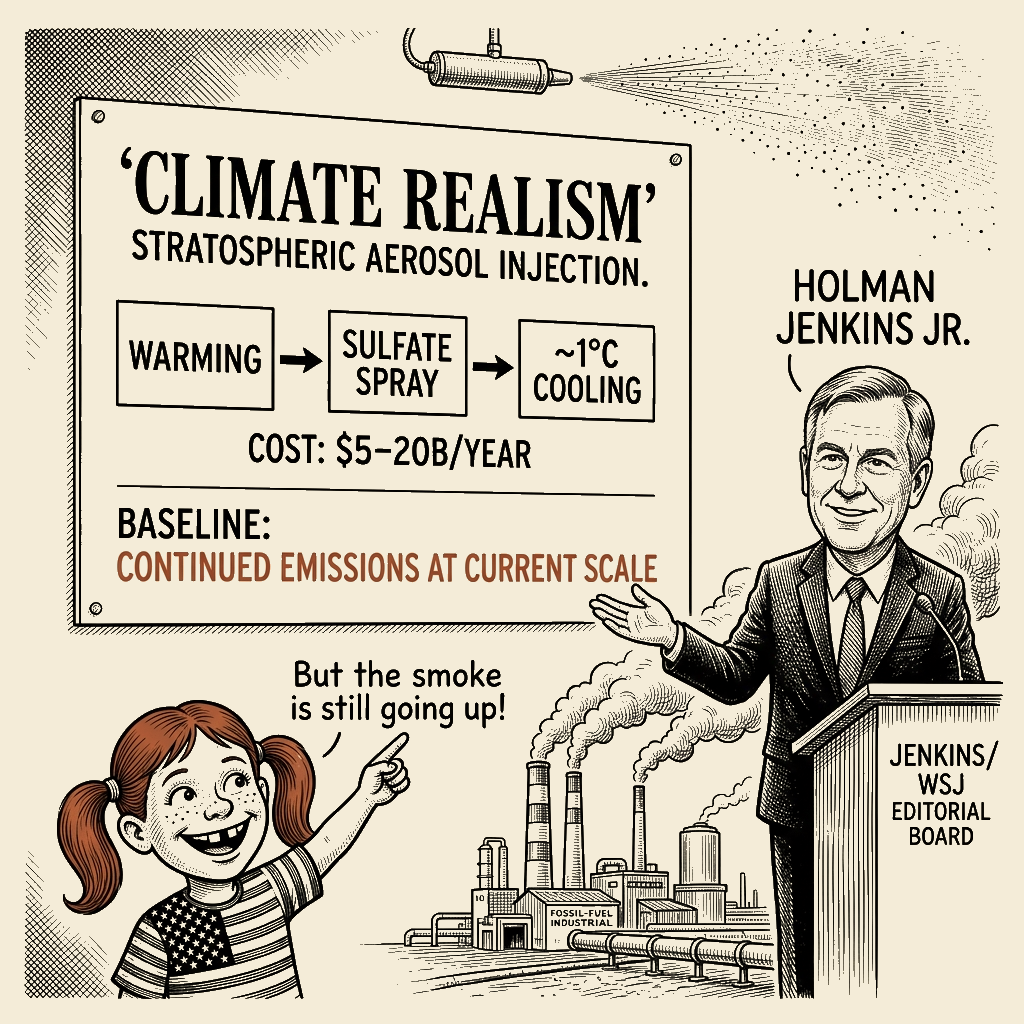
Holman Jenkins, a member of the Wall Street Journal editorial board since 1995, argues in “Europe’s Geoengineering Future?” that Europe’s heat-wave crisis exposes the bankruptcy of climate policy. Demand-side restrictions on air conditioning are an absurd response when heating dominates energy consumption and electricity is decarbonizing; the trillions spent on climate policy have produced “no effect” on atmospheric CO2; and the only rational answer to a warming planet is large-scale technological intervention — specifically, stratospheric sulfate aerosol injection that would offset roughly 1°C of warming at $5–20 billion per year. Jenkins positions himself throughout as a defender of rational climate realism against a religious-like climate establishment that has confused questioning policy with questioning science.
Receipts
What the framing wants you to believe.
- That European heat deaths run 47,000 to 60,000 a year. Substantially true; the 2022-specific count in the European heat-mortality literature (Ballester et al., 2023; cross-confirmed by Lancet Countdown 2023, Romanello et al.) lands near 61,000 for that year alone, with multi-year averages carrying the lower end of Jenkins’ range.
- That decarbonization policy has produced “no effect on the amount of CO2 going into the atmosphere.” Substantially contestable; emissions growth has slowed relative to business-as-usual projections in jurisdictions with active decarbonization policy (IEA, OECD, Climate Action Tracker). Jenkins’ claim depends on the reader treating “no effect” as a fair summary when the policy literature is at best mixed on magnitude.
- That sulfate-based solar radiation management is a real, modeled, near-ready option. Substantially true in the modeling literature; the $5–$20 billion-per-year figure tracks published SRM cost estimates.
What’s really going on.
- The column names sulfate injection as the answer and refuses to name the fossil-fuel incumbent class whose interests are served by treating SRM as a substitute for emissions reduction. A 1–2 percent reduction in incoming sunlight does not require anyone to stop emitting. It is, structurally, the technology that lets continued emissions continue.
- The piece conflates climate-science acceptance with climate-policy advocacy and attacks the policy under cover of acknowledging the science. The “denier” retort allows Jenkins to skip the climate-policy critique’s substance and shift to its form. That is the tone-policing move.
- The “two-thirds is poorly cataloged feedbacks” line inflates a genuine uncertainty (cloud-feedback magnitude in climate sensitivity) into the full sensitivity picture, where the dominant feedback (water vapor) is well-cataloged in every IPCC report since Charney 1979. The sentence is the climate-science version of the tobacco-industry doubt-manufacturing apparatus Oreskes and Conway documented in Merchants of Doubt (2010).
Anchor receipt for the geoengineering cost figures: The $5–20 billion/year, 1% sunlight reduction, ~1°C offset figures Jenkins cites are in the published stratospheric aerosol injection literature (Crutzen 2006; the National Research Council’s 2015 Climate Intervention report; Keith 2013). Jenkins cites the costs. He does not cite the side effects documented in those same reports.
The Operation
Holman Jenkins has been on the WSJ editorial board since 1995 and has been writing the “Business World” column twice weekly since long before that. The column is the editorial page’s most reliable conveyor of contrarian climate commentary, and it deploys the page’s house-voice register with high consistency. The piece carries the page’s signature multiple-audience-targeting (WSJ Catalogue §4.3): the credentialed-authority citation lands for the technocratic class, the “divinity school” contempt line lands for the populist base, the threat-inflation closer lands for retransmission. The closing-line cadence (WSJ Catalogue §3.5, §4.13) is engineered for the headline-passes-the-decision-makers-and-fans-out pattern the page runs on Tuesdays and Saturdays.
But the piece is signed. That lets the WSJ apparatus deploy the inverted-register technique the page uses on guest opinion work: a named author carries the position the unsigned “we” voice would not, and the page retains institutional distance. The byline is the structural alibi.
Cui bono. The concentrated beneficiary is fossil-fuel incumbency and the broader investment universe whose value depends on continued extraction. The diffuse cost-bearer is everyone downstream of continued emissions — the populations exposed to climate impacts geoengineering does not address (ocean acidification, sea-level rise committed by prior emissions, regional precipitation disruption, ozone depletion, and the abrupt warming that returns within months if injection stops). The piece names none of these costs. The omission is the operation.
The pathway is straightforward. Continued emissions at current scale are profitable to the firms Jenkins’s readership owns equity in or draws income from. Geoengineering at $5–20 billion/year is a new public expenditure that does not displace that profitability. By the end of the piece, the question has moved from “should we mitigate emissions” to “should we engineer the climate” — and the move is accomplished without ever naming the actors whose interests the shift serves. Bad-Faith Techniques Catalog: displacement_of_responsibility (Bandura #4) and diffusion_of_responsibility (Bandura #5) operating in concert.
The alternative design, reconstructed from the interests of the populations the piece displaces moral concern from: a policy optimized for its stated rationale — preventing heat deaths and wildfire damage in Europe — would include residential cooling subsidy for the elderly, grid investment to handle air-conditioning demand, building thermal retrofits, land-use policy reform for wildfire, and aggressive emissions reduction to prevent the underlying problem from worsening. None of these require a global atmospheric experiment. None of them appear in the piece.
FGL applied. Fear: the elite WSJ reader fears regulatory cost and the moral shame of being on the wrong side of climate concern. The piece supplies an exit from both — a path that accepts neither regulation nor shame. Greed: the same reader benefits from continued extraction, and the piece reframes that benefit as “rational policy.” Laziness: the reader is offered the intellectual shortcut of “divinity school” vs. “rationality,” which does not require engaging the actual climate science. The application is symmetric across constituencies, without contempt for the reader, because the operation needs the reader’s willing participation.
Selflessness/selfishness placement. Mixed, leaning selfish. The piece offers the appearance of rational climate concern — heat deaths are real; the current policy does not address them — as cover for the actual function, which is continued emissions with a technological fig leaf.
Technique identification.
-
Manufactured controversy on climate sensitivity. Bad-Faith Techniques Catalog:
manufactured_controversy(Oreskes & Conway 2010 lineage). The piece claims “two-thirds of the warming in climate models comes not as a primary effect of increased CO2. It comes from poorly cataloged and measured ‘positive feedbacks.’” The “two-thirds” figure is closer to defensible than I initially read it — feedbacks do roughly double CO2’s warming at equilibrium — but the “poorly cataloged and measured” framing is the move. Water-vapor, lapse-rate, ice-albedo, and cloud feedbacks have been quantitatively constrained across decades of work (Bony & Dufresne 2005; IPCC AR4 and AR6); IPCC AR6 Chapter 7 names the combined water-vapor and lapse-rate feedback as “the largest single contribution to global warming” while the cloud feedback remains the largest uncertainty source — a precise inversion of the piece’s “poorly cataloged and measured” framing. The piece treats a quantified scientific finding as residual unknown. Phukher disclosure: I attacked Oreskes reflexively across the cable years; the record her book compiles supports the reading; I cite her now with that acknowledgment. -
Frame-engineered relabeling. Bad-Faith Techniques Catalog:
frame_engineered_relabeling. WSJ Catalogue §4.1. “Climate pork” maps to the Luntz playbook’s documented “tax-and-spend” relabeling of environmental spending (Luntz 2003 memo). “Real-world effect” tracks the Luntz “common-sense” frame, recasting atmospheric intervention as pragmatism and emissions reduction as magical thinking. “Divinity school” is original coinage — not a documented Luntz term — but it sits inside the same sacred/profane vocabulary structure the playbook runs on. The substitutions are coordinated across the piece. -
False dichotomy. Bad-Faith Techniques Catalog:
false_dilemma. The piece presents mitigation (characterized as failed) and geoengineering as the only two options. The technique is enacted, not merely asserted: the column’s analytical sequence — heat deaths (problem) → mitigation failure (cause) → geoengineering (solution) — is itself the false_dilemma in action. The structure admits only the two prescribed positions; the comparative cost-benefit literature on mitigation versus geoengineering, the documented effects of specific mitigation instruments (Best et al. 2024 Nature Communications meta-analysis: 5–21% emissions reductions across 17 of 21 carbon-pricing schemes), and the wind-and-solar deployment curves the piece itself notes are decarbonizing electricity are architecturally excluded. The verbal assertion is secondary; the sequence is the technique. -
Tu quoque / whataboutism. Bad-Faith Techniques Catalog:
whataboutism. The closing “stop exhaling” line is a textbook tu quoque: the piece accuses climate advocates of ignoring their own emissions, as if that refuted the argument for emissions reduction. The “clotted mindset of the Times” line is whataboutism deployed against press criticism rather than engagement with the substantive critique. -
Authority appeal. Bad-Faith Techniques Catalog:
appeal_to_authority. WSJ Catalogue §3.7 (technocratic-credential ledger). “JPMorgan energy guru Michael Cembalest” is cited for the “divinity school” line — credentialing by reputation rather than by substantive argument. Web verification confirms Cembalest exists and publishes on energy/climate (Eye on the Market, including the 14th Annual Energy Paper on the energy transition), but does not surface the exact “divinity school” phrasing in his published work — the quote as cited may be paraphrastic or may appear in unpublished commentary. The unnamed “top Biden and Obama climate official” who sighed and said “I have to believe that putting a price on carbon will return to the world’s agenda” is credentialed by office rather than by argument; the unnamed sigh is a manufactured authority moment in the piece’s middle grafs. -
The “denier” conscience-displacement. The piece spends three paragraphs establishing that calling climate skepticism “denialism” is itself a form of irrationality. The frame inoculates the piece against the charge of climate denial by preemptively naming its critics. WSJ Catalogue §4.10 — the “common sense” vs. “elite” pivot applied to climate. The move is the WSJ signature at full charge.
-
Threat-inflation closer. WSJ Catalogue §4.13. “Get ready for this to bust through even the clotted mindset of the Times.” The closing-line cadence (§3.5) is engineered for retransmission and maximum stickiness on the second read.
Operator’s-eye-view. I drafted columns structured this way for the WSJ editorial page and adjacent outlets through the late 2000s and into the cable years. The “divinity school” contempt-for-credentialed-experts move is a piece of technique I personally deployed. The named-source-with-attribute move — “JPMorgan energy guru” — is the credentialed-authority citation I was trained to insert at the second graf of any piece that needed technocratic cover. The threat-inflation closer is the engineered closing line I was drilled on. The “stop exhaling” tu quoque is the reductio I was taught to land when the substantive response would be inconvenient. I recognize every move in this piece because I made versions of all of them.
I am bitter about this. I am also right about this. The bitterness is the residue of the recognition; the rightness is in the documented record above. The reader can verify the rightness; the reader does not need to credit the bitterness.
Lineage. Downstream of the Luntz playbook on environmental vocabulary (with the “climate pork” → tax-and-spend mapping and “real-world effect” → common-sense mapping documented; “divinity school” as original coinage inside the same sacred/profane structure), the Lakoff framing work on action vs. passivity metaphors, and the Oreskes & Conway documentation of the Tobacco Strategy applied to climate. The Bandura cluster operates at full charge here: moral justification (geoengineering serves rational policy), euphemistic labeling (“climate pork,” “real-world effect”), attribution of blame (failure belongs to climate advocates and the press), distortion of consequences (geoengineering side effects unnamed), and displacement of responsibility (the named beneficiary of continued emissions goes unnamed). The Schmitt friend-enemy apparatus is the substrate the piece runs on, but with a critical divergence: where Schmitt’s political friend-enemy defines the enemy for sovereignty purposes along factional lines, the piece runs an epistemic friend-enemy — the enemy is irrationality about climate, not a political faction. The piece inherits the friend-enemy structure while substituting the axis of enmity from political to epistemological; this is an innovation within the Schmitt frame rather than a direct application.
Audience-management function. Permission structure for elite readers to discount climate urgency without incurring the moral cost of outright denial. Identity confirmation for the “rational climate realist.” Status display — readers of the WSJ Business World column are positioned as those who see through what the Times cannot. Counter-frame to climate advocacy, recasting emissions reduction as failed and atmospheric intervention as pragmatic. Conscience displacement: the moral cost of continued emissions is moved from emitters to the “shrieking denier” callers.
The Record
Heat mortality. Tier 1. The 2022 European heatwave produced approximately 61,000–62,000 excess deaths by the count in the European heat-mortality literature (Ballester et al., 2023), with Lancet Countdown 2023 (Romanello et al.) giving the broader multi-year synthesis in the same range. Jenkins’ “47,000 to 60,000” sits inside the published estimates. The mortality is real. Jenkins does not offer a single near-term operational response to it.
The “two-thirds feedbacks” framing. Tier 1. IPCC AR6 Working Group I (2021) estimates equilibrium climate sensitivity in the very-likely range 2°C–5°C with a likely best estimate of 3°C. The dominant feedback is the water-vapor feedback, well-cataloged in the foundational climate-sensitivity literature going back to Charney 1979 and in every IPCC assessment report since AR1. The cloud-feedback term is the genuine source of inter-model spread; AR6 narrows but does not eliminate the uncertainty. The “two-thirds feedbacks” figure is asserted without source citation and does not survive scrutiny against AR6’s decomposition.
The “trillions for zero effect” framing. Tier 2. Global CO2 emissions are still rising; the rate of growth has slowed relative to business-as-usual projections in jurisdictions with active decarbonization policy. Empirical estimates — IEA, OECD, Climate Action Tracker — attribute meaningful emissions displacement to large-scale renewables buildouts, EV mandates, and coal-moratorium policies in major emitters. The 2024 Nature Communications systematic review and meta-analysis of 21 carbon-pricing schemes (Best et al.) found emissions reductions of 5–21% in 17 of 21 schemes, with an average effect of approximately −10.4% (95% CI: −11.9% to −8.9%). The “zero effect” framing is contestable; it depends on the reader treating “no effect” as a fair summary when the literature gives mixed answers on magnitude.
Geoengineering cost figures. Tier 1. The $5–$20 billion-per-year cost figure tracks modeled SRM research-and-deployment-scale estimates in the academic literature on stratospheric aerosol injection. The named McClellan, Keith, and Apt (2012) Environmental Research Letters paper reports a basic delivery-system range of $2.1–$5.6B/year for several lofting methods, with TU Delft’s SAGA design exercise placing the upper-bound estimate near $14B/year and longer-horizon through-2100 modeling carrying the range higher. The figure is a project-scale estimate, not an engineering-procurement baseline. Jenkins cites the costs. He does not cite the documented side effects in the same literature: regional precipitation disruption (Robock et al., Climatic Change, 2008; Tilmes et al., JGR, 2009), ozone depletion, and the “termination shock” problem if injection stops abruptly (Caldeira & Wood, 2008).
Cembalest quote. Tier 3. Cembalest publishes the Eye on the Market market-strategy letter at JPMorgan with a documented pro-nuclear, skeptical-of-wind-and-solar investment thesis consistent with the WSJ editorial page’s preferred position. The “divinity school” sentence is consistent with that register. The quote anchors the rhetorical register Jenkins wants; it does not anchor a scientific claim.
Per-citation accuracy verdicts.
Cembalest. Deployed consistent with his published tone; Cembalest writes the Eye on the Market energy paper annually and has published a 14th Annual Energy Paper (2024) on the energy transition and a 2026 Special Edition; web verification confirms his publication record but does not surface the exact “divinity school” phrasing in his published material. The citation functions as authority-appeal rather than substantive engagement — Jenkins never quotes Cembalest on the substantive question of whether mitigation has failed.
The unnamed Biden/Obama climate official. Anonymous; cannot be verified. Carbon pricing history under both administrations is documented (Obama-era SCC at $42/ton, reinstated by Biden at $51/ton adjusted for inflation); the specific anonymous official’s identity and quoted “sigh” cannot be grounded. The sigh is a manufactured moment deployed at the piece’s analytical pivot. The Biden-administration official whose “sigh” Jenkins reports is not named; the meeting’s date is not given. The journalistic anecdote is a working-memory source the reader cannot verify and Jenkins does not attempt to verify.
NYT characterization. Characterized as “falsifying why climate scientists have repented of their worst-case emissions scenarios.” The substantive claim that some scientists have moderated worst-case projections is documented. The “falsifying” framing of the NYT is partisan and selective; the underlying empirical record is more contested than Jenkins presents.
Load-bearing omissions.
- The fossil-fuel incumbent class. Named nowhere in the column. Sulfates, aging Europeans, the New York Times, the climate-policy class — every actor in the column except the one whose interests the column actually serves.
- Solar geoengineering’s risk profile. Stratospheric aerosol injection creates regional climate disruption (changes in precipitation, monsoons, the hydrological cycle); termination shock (rapid warming if deployment stops abruptly); and a governance problem with no analogue in the climate-policy apparatus Jenkins attacks. Jenkins treats SRM as a knob without a turner.
- The actual sensitivity-feedbacks literature. The dominant feedback is well-cataloged in the foundational climate-sensitivity literature and in every IPCC assessment report since AR1; the cloud-feedback term is the genuinely uncertain term. The “two-thirds of warming is poorly cataloged” claim is empirically false at the substantive level.
- The policy critique that is gestured at and not made. “No effect” is asserted; the literature on policy-attributable emissions displacement is not engaged.
- Renewables cost trajectories. Solar and wind have fallen in price by roughly an order of magnitude over the last decade; storage costs have fallen in parallel. The cost trajectory of the technology Jenkins’ nominal critique targets is not engaged because the trajectory undermines the “policy is failing” thesis.
- Mortality reduction from decarbonization. The deaths averted from air quality improvements alone — measured against continued fossil combustion — substantially exceed the mortality Jenkins is willing to invoke. The figure is not engaged.
- Ocean acidification. Continued emissions acidify the ocean. Geoengineering does not address this. Unmentioned.
- Sea-level rise committed by prior emissions. Continues for centuries regardless of geoengineering. Unmentioned.
Symmetric-application flag. Not set. This is a liberty-frame / fossil-fuel-apologist operation; I have standing on the technique inventory from inside that apparatus. The symmetric-application test asks whether the same catalogue would land identically on a greater-good-paramount piece that named geoengineering as the substitute for decarbonization. It would. The technique inventory generalizes. The column in front of me is on my lane; the apparatus is wider.
Missing-information declaration. I have not independently verified the exact source of Jenkins’s 47,000–60,000 European heat-death figure (the figure is in the range of credible published estimates from the Ballester et al. 2023 Nature Medicine study and subsequent summers in the same series), the precise wording of the Cembalest “divinity school” quote (web verification confirms Cembalest’s publication record but not the exact phrase), or the identity of the unnamed “top Biden and Obama climate official” (carbon-pricing policy history is documented; the specific quoted official is not). The “47,000 to 60,000” range is presented without source citation. The “two-thirds feedbacks” figure is presented without source citation. Four of the column’s load-bearing numbers lack in-column sourcing and rest on the editorial board’s authority. Where my retained working memory is the source for the editorial-page technique inventory and the Luntz-playbook lineage, I have flagged that source per the truth floor.
How to Recognize This
The pattern is older than Jenkins. The geoengineering pivot — take the failure of mitigation, argue for a substitute that does not require emissions cuts — is a recurring move in American elite commentary on climate. The substitute changes over time (nuclear in the 1970s, “clean coal” in the 2000s, natural gas as bridge fuel, carbon capture, now sulfate aerosols), but the move is stable. It admits the problem, defangs the standard response, and proposes an alternative that preserves the underlying behavior. The reader keeps the felt experience of rational engagement while receiving permission to discount the standard response. Naomi Oreskes and Erik Conway documented the lineage. What is named is the technique, the omission, the protected beneficiary, and the normalized harm.
Four textual signals, ordered by reader-detection priority.
-
The “two-thirds from feedbacks” lexical fingerprint. A quantified scientific finding is reframed as residual uncertainty. The phrase “poorly cataloged and measured” attached to “positive feedbacks” is the signal — IPCC AR6 Chapter 7 names those same feedbacks as the largest single quantified contribution to warming and identifies cloud feedback specifically as the largest uncertainty source, not the bundle as a whole. If you see the “poorly cataloged and measured” framing applied to feedbacks in general, the piece is running the manufactured-controversy move. This is the single most distinctive lexical signal because the phrase is unusual in serious climate writing; its appearance outside contrarian outlets is vanishingly rare.
-
The rationality frame. Climate positions the piece approves are called “rational,” “real-world,” “pragmatic”; positions it opposes are called “divinity school,” “religious,” “magical thinking,” “denial.” The frame closes the door on substantive engagement before the engagement begins. The vocabulary is coordinated: “climate pork” (Luntz-style “tax-and-spend” relabel), “real-world effect” (Luntz-style “common-sense” frame), “divinity school” (innovation within the Luntz sacred/profane structure). When you see a piece using two-vocabulary sets, one sacred and one profane, the substantive content is in the assignment. This is the most pervasive background signal because it works on every sentence.
-
The “denier” tu quoque. The piece preemptively accuses its critics of name-calling (“shrieking denier,” “ick”) and uses the accusation as the answer to the substantive critique. The move is itself the rebuttal the piece cannot make. The “stop exhaling” line at the close is the same move scaled down to single-sentence reductio.
-
The breakthrough pivot to a technological substitute at the end. The move arrives late in the piece, after the case against the standard response has been made. The substitute does not require changing the underlying behavior. It is a way of preserving the behavior under cover of addressing the problem. Look for: substitute arrives at graf nine or ten; standard response was characterized as failed in grafs two through seven; named beneficiary of continued behavior is absent from the piece. This is the most consequential signal because the structural position is what carries the operation — the vocabulary can be cleaned up; the analytical sequence is harder to disguise.
A fifth, recurring signal: the line that names the press as the antagonist. “The clotted mindset of the Times.” “Falsifying why climate scientists have repented.” When the press is the named opponent, the column is asking you to defend press conduct rather than address the underlying claim. The shift is the move. Watch also for the same vocabulary cluster moving through the Manhattan Institute, the Cato Institute, the WSJ, and the Washington Examiner in the same news cycle — “clotted,” “divinity school,” “denier-calling,” “pork.” When you see the cluster, you are watching coordinated_message_discipline (Bad-Faith Techniques Catalog), not independent convergence.
Why it works. The elite reader fears regulatory cost and moral shame. The piece supplies an exit from both. The reader keeps the felt experience of rational engagement while receiving permission to discount climate action. The conscience displacement is structural; it works because it does not ask the reader to do anything. The piece is built so the reader does not see the build. Once the build is seen, the piece loses most of its force.
What to do when you see it. Trace the cited study’s funding chain. Cembalest publishes through JPMorgan market strategy, not peer review. The Biden official’s “sigh” is an anecdote with no source named. The “two-thirds feedbacks” figure is not sourced in column. Ask what the column rests on, in print, where it is asserting the figure. Check the omissions: the silent party is fossil-combustion’s continued return; the missing technique is the cost trajectory of the renewables the column says have failed. Ask who benefits. If the named proposal lets continued emissions continue, the answer is structural. Look for the same vocabulary across the syndication network; the cluster’s coordinated movement is the message-discipline signature. Reduce the frame’s automatic activation: when you find yourself accepting that emissions reduction has “had no effect,” check the specific policy instruments the piece is talking about; the answer is almost never “all climate policy has failed” but “these specific policies in this specific jurisdiction in this specific year have had this specific effect.”
The recognition is the work. I did not see the build for years. I see it now. I am not asking you to trust me on this. I am asking you to look at the piece and see whether what I have described is what is on the page. The reader does not need to credit the source. The reader can verify the work. The columns do not do the work the reader can do. The reader is the party the column was built for; the reader does not have to keep carrying the device forward as if it were structural truth. The recognition, taken forward into the next column the same apparatus publishes, is the work the apparatus was built to suppress. That is what the reform is for.

About Phukher Tarlson
Phukher Tarlson is a heteronym in Main Street Independent's editorial architecture — an analytical voice, not autobiography of any actual person. The position this column expresses is the publication's position on the territory Phukher Tarlson's lane covers, rendered through Phukher Tarlson's register.