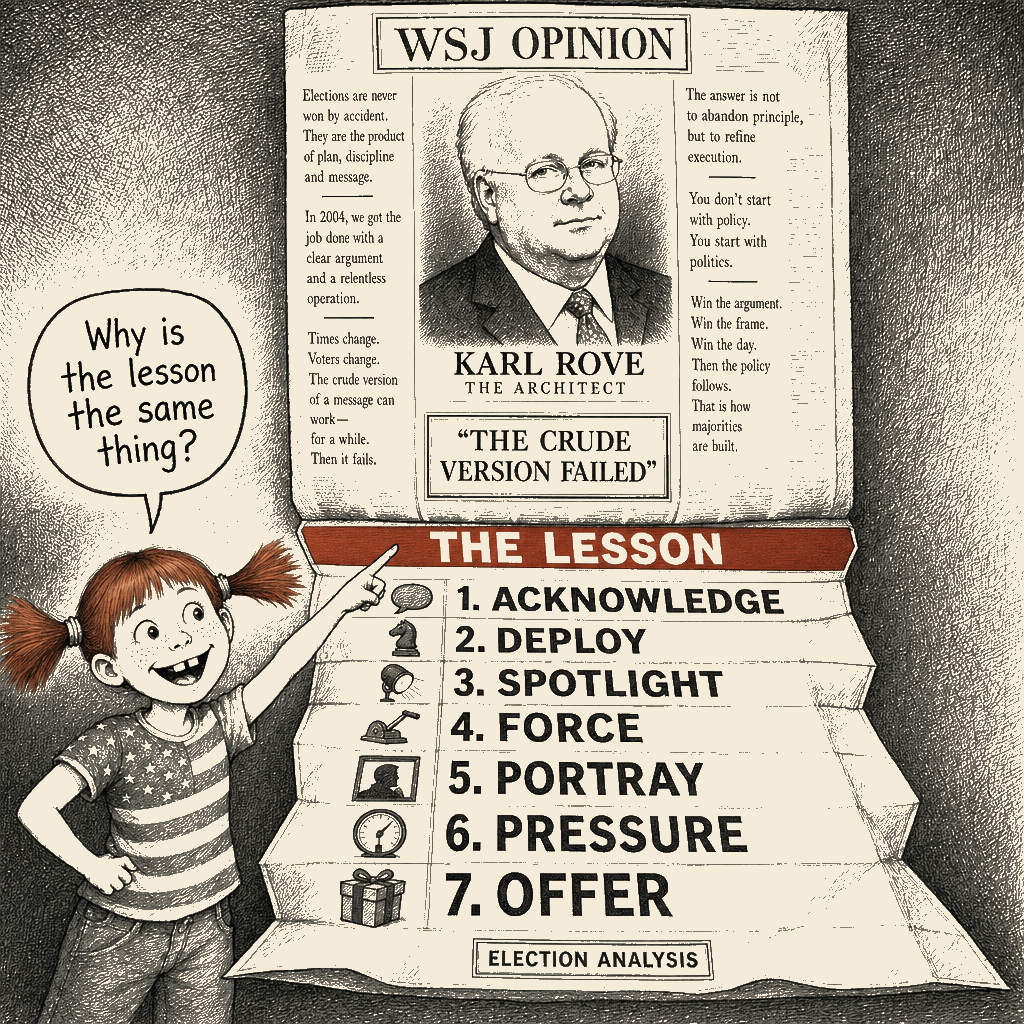
Analyzing: Seven Steps to Defeat Dems and the DSA — Karl Rove · 2026-08-12
What the Editorial Argues
Karl Rove argues that President Trump’s Las Vegas speech tactically damaged the Republican cause by calling Democratic opponents “communists” and warning that Democratic rule would bring “death, squalor, poverty.” Rove’s account divides 2024 Trump voters into a hard-core 35% who will support the president regardless and roughly 14–15% whom he calls reluctant Trump voters, presenting the latter as decisive to Trump’s 49.8% popular-vote victory. He offers seven Republican prescriptions: acknowledge voters’ economic concerns; deploy Democratic candidates’ recorded words against them; spotlight reversals; force candidates to defend associates such as Hasan Piker; portray the DSA agenda as unworkable; pressure “normal Democrats” to disavow DSA positions; and offer concrete proposals instead of merely defending the administration’s record. The piece presents itself as pragmatic advice about winning elections, but its technical detail reveals a coaching manual for Republican candidates and operatives.
Receipts
The move is disciplined self-criticism used as respectable cover for a more refined partisan attack manual.
-
What the framing wants you to believe:
- This is seasoned, nonpartisan-seeming election advice from a practitioner willing to criticize his own side.
- Republicans can recover reluctant 2024 voters if they adopt Rove’s seven steps.
- Rove’s rejection of Trump’s “communist” rhetoric demonstrates strategic discipline.
- The final step—offering fresh policy proposals—shows that the advice is about governing as well as messaging.
-
What’s really going on:
- The critique is the on-ramp; the seven steps are the operation. Rove does not abandon Trump’s enemy frame. He tells the practitioner when the crude version is counterproductive, then supplies a more plausible version of the same work.
- The Trump campaign’s own 2024 “they/them” advertisement supplies the primary artifact Rove cites as a model. The advertisement used footage from Harris’s 2019 ACLU questionnaire, but Rove reduces that footage to the slogan-like formulation “endorsing transgender surgery for convicts,” leaving the original question and context unexamined.
- The omitted relation is candidate record to Republican electoral benefit. The protected beneficiary is the GOP’s 2026 apparatus—and, secondarily, Rove’s continuing professional influence. The normalized harm is the conversion of a candidate’s record into a selectively framed caricature and of swing voters into targets for message discipline.
The Operation
The piece is operationally interesting because Rove is not a neutral observer standing outside the campaign system. He is a practitioner addressing practitioners: “The Architect” of two Bush presidential campaigns, a Bush White House senior adviser, and a weekly Wall Street Journal opinion columnist addressing readers who can put the advice into advertisements, mailers, fundraising pitches, and candidate scripts. Trump’s failed delivery is the marketing. Rove’s seven steps are the product.
Cui bono.
Institutional authorship. The byline is Karl Rove; the venue is the Wall Street Journal Opinion page. Rove’s authority comes from the same professional history in which the recommended techniques were developed and deployed. He worked inside the 1988 Bush campaign apparatus that used the Willie Horton advertisement, although the advertisement should not be reduced to one inventor: it was produced through a campaign system involving political operatives, media consultants, and outside vendors. The relevant point is the continuity of the apparatus, not a theatrical contest over who personally “architected” every part of it.
Placement chain. The primary placement is a bylined column in WSJ Opinion, where criticism of Trump gives Rove permission to instruct Republican candidates without sounding like an ordinary party spokesman. The general reader receives election analysis; the operative receives a reusable sequence. This matches the WSJ Editorial Technique Catalogue’s multiple-audience-targeting entry, wsj_catalog: multiple_audience_targeting: the opening reaches a broad audience concerned about Republican losses, while the numbered sequence addresses campaign practitioners who know what to do with a usable quotation or association.
Distributional impact. The immediate beneficiary is the Republican campaign apparatus. The pathway is direct: Rove’s advice can be converted into attack material; that material can simplify the targeted candidate’s record; the simplification can influence how readily some voters evaluate that record; and any resulting electoral benefit accrues to the candidate, party, donors, and allied political class. No dollar figure, ad budget, polling test, or measured turnout effect is documented here, so the pathway cannot be quantified beyond the proposal.
The secondary beneficiary is Rove himself. The column renews his claim to practitioner authority, preserves his weekly platform, and demonstrates that he remains useful to a Republican coalition whose current leader publicly disregarded the more restrained relationship with expertise that Rove represents. Campaign consultants, pollsters, and conservative media outlets can also recirculate attack-ready material, although this analysis has no receipt showing that any particular client or outlet paid for this specific column. No donor-to-byline funding chain is established by the available record.
The cost-bearers are the candidates Rove names, candidates he classifies as DSA-aligned, and the voters denied a contest over actual policy. Association becomes reputational transfer: a candidate inherits another person’s alleged extremism without the candidate’s own record receiving comparable attention. Voters inherit the increased cost of separating a genuine political position from a selectively edited presentation of it. The piece supplies no evidence that its proposed messages would actually produce lower Democratic turnout or a particular electoral gain; it supplies only the proposed mechanism.
Alternative design. A strategy optimized for Rove’s stated rationale—winning over reluctant voters by acknowledging their economic and political concerns—would put the competing policy positions before the labels. It would examine what voters mean when they report dissatisfaction over inflation; quote the underlying Harris questionnaire rather than the campaign’s hostile condensation; reproduce the relevant DSA housing language before inferring its consequences; provide the platforms of the candidates Rove targets; and then compare those proposals with the contents, costs, and beneficiaries of Republican healthcare, housing, immigration, and election proposals.
It would still test whether candidates have changed position, but it would do so through the complete record. It would still ask whether an endorsement reveals anything about a candidate, but the operative question would be relevance: what did the candidate endorse, what governing effect follows, and does the association change the voter’s assessment of the candidate’s own program? The swing voter would be treated as a political decision-maker rather than as a respondent to guilt, labels, and forced disavowals.
FGL. Rove operates from professional fear: diminished relevance inside a party that has moved beyond his generation of operatives. His greed is the desire to remain influential, credentialed, and useful as the practitioner who can still correct the party’s execution. The apex beneficiary operates from fear of losing the 2026 midterms and from greed for continued policy influence and message control. The rank-and-file Republican reader is operating from human fears—economic frustration, insecurity, and fear that the party cannot convert dissatisfaction into victory. The analytic counterpart to greed is the desire for an administration and party capable of governing successfully. The counterpart to laziness is the understandable wish for a cognitive shortcut. Rove exploits that wish by promising a cleaner version of the very apocalyptic framing he says is too crude to win over reluctant voters.
Selflessness/selfishness placement. Mixed, leaning selfish. Rove makes legitimate observations about voter frustration and the danger of assuming that slogans substitute for policy. But the piece’s dominant function is to provide Republican practitioners with a disciplined sequence for damaging opposing candidates. The apparent self-correction serves the same campaign objective more effectively: it supplies permission for a more refined attack while preserving the threat that motivates the attack.
Technique identification.
The moves below are not inherently dishonest in every use. Candidate quotations can establish inconsistency, political associations can be relevant, and a party can ask whether an opponent has changed position. They become instances in the Bad-Faith Techniques Catalog when the piece uses them to replace policy engagement with coerced reputational judgment.
-
Selectional and representational strawman —
[bf_catalog:strawman`](/propaganda/docs/bad-faith-techniques-catalogue#strawman). Rove writes, “use a Democratic candidate’s own words and policies,” then cites the Trump campaign’s “they/them” advertisement and its “endorsing transgender surgery for convicts” condensation. The original artifact is Harris’s response to a questionnaire; the attack uses footage from that response to establish a broader, emotionally charged proposition without reproducing the question, the complete answer, or the governing context. Operationally, the technique lets the advertiser present the interpretation as though the target selected the frame. The scholarly source is the pragma-dialectics standpoint rule and Talisse and Aikin’s distinction between representational and selectional straw men. -
Circumstantial ad hominem —
[bf_catalog:ad_hominem`](/propaganda/docs/bad-faith-techniques-catalogue#ad-hominem). Step 4 says that if “someone like Hasan Piker campaigned for them,” Republicans should “make every Democrat defend every terrible comment Mr. Piker has made” and ask why Democrats would associate with him. Association with a controversial person can be politically relevant. Here the instruction makes the associate’s character the surrogate issue, compelling the candidate to defend or reject another person’s unrelated statements rather than establish what the candidate intends to do. The target’s own record disappears behind a third party’s rhetorical burden. Walton’s circumstantial-ad-hominem category precisely names the transfer: attack the source through the source’s associations. -
False dilemma —
[bf_catalog:false_dichotomy`](/propaganda/docs/bad-faith-techniques-catalogue#false-dichotomy). Steps 3 and 6 tell Republicans not to let Democrats “get away with disavowing” past positions and to “force normal Democrats to disavow DSA policies.” The constructed choice is: disavow the proposition and thereby ratify its status as the candidate’s defining position, or refuse to disavow it and allow the frame to remain attached. A third option—reject the premise as a misrepresentation and proceed to the actual policy disagreement—is structurally available but excluded by the instruction. Operationally, the target cannot answer without validating the setup. The relevant scholarly lineage is Walton’s treatment of the false dilemma. -
Frame-engineered relabeling —
[bf_catalog:frame_engineered_relabeling`](/propaganda/docs/bad-faith-techniques-catalogue#frame-engineered-relabeling). The phrase “normal Democrats” is not a neutral description. “Normal” creates an in-group whose positions remain presumptively reasonable and an out-group whose Democratic identity is made suspect by association with the DSA. The frame asks the reader to identify the “normal” boundary before examining what the targeted candidates actually support. It belongs to the same framing family documented by Lakoff: terminology does not merely describe the dispute but activates the moral category through which the dispute is perceived. -
Housing-policy strawman —
[bf_catalog:strawman`](/propaganda/docs/bad-faith-techniques-catalogue#strawman). Rove writes: “The DSA doesn’t want Americans to have a landlord or mortgage. That logically means the government would assign your housing and you couldn’t accumulate wealth by buying a home.” The DSA’s platform materials call for expanding social housing and the “decommodification” of housing. The editorial does not quote the passage establishing the abolition of private ownership or government assignment of individual homes. “Logically means” is doing the work. It converts one stated policy family into a totalitarian image that can be used without examining the underlying intervention. The leap is the strawman; the word “logical” is its permission slip.
The opening treatment of “communists” requires a sharper distinction. Rove explicitly says that merely shouting “communist” will fail, so the piece is not recommending the crude label as a winning step. What it does is preserve the enemy concept at the edge of the discussion. The refined operation is sold as restraint relative to Trump’s rhetoric, but its steps still depend on treating a portion of the opposition as beyond ordinary democratic contestation. The contrast is also an instance of Bandura’s advantageous comparison: the refined version is made to appear moderate because the author has placed a cruder version beside it. Lippmann’s account of stereotypes helps explain the underlying function—the reader is not given the candidate’s record but a condensed schema through which to perceive the candidate.
- Euphemistic labeling — Bandura. “Use their own words,” “make them defend,” and “force them to disavow” translate deliberate reputational pressure into the neutral vocabulary of message selection and accountability. The terms conceal who selected the quotation, who chose the association, and what electoral purpose the pressure serves.
- Moral justification — Bandura. The apparatus is justified by the higher cause of Republican victory. The candidates’ loss of control over their public identity and the voters’ loss of policy clarity become acceptable because the manual promises electoral effectiveness.
- Displacement and diffusion of responsibility — Bandura. The decisions to caricature an association, edit a quotation, or demand a disavowal are presented as responses to the target’s extremism. The instruction itself disappears into the campaign’s ordinary messaging process: Rove advises, the candidate approves, the consultant produces, and no single person owns the cumulative effect.
- Attribution of blame — Bandura. The targeted candidate becomes responsible for the harm about to be inflicted. The advertisement or mailer did not distort the record; the Democrat “associated” with Piker, accepted the DSA’s support, or once held the position from which the quotation was selected.
- Distortion of consequences — Bandura. The manual treats successful message deployment as evidence of successful persuasion and potential governance. It does not examine the cost of reducing a candidate’s proposals to their most inflammatory imaginable version, nor does it establish that voters who accept the frame will reward the resulting policy outcomes.
Audience-management function. The WSJ Editorial Technique Catalogue’s permission-structure analysis captures the operation. Rove’s criticism of Trump says: even the old practitioner thinks the crude version is too much. That is the credibility transfer. The reader is then invited to regard the refined version as analysis, not attack. The critique of the failed practitioner creates in-group status around recognizing excess, while the seven steps provide a usable replacement. The swing voter is the rhetorical cover; the campaign professional is the operational audience.
I drafted memos like this. The friendly criticism of a failed version is familiar because it lets the operator tell the client that he is sophisticated enough to correct excess while handing him a cleaner weapon. That recognition comes from retained working experience, not from a documentary source showing that Rove or any named campaign focus-grouped these exact seven sentences. I do not use the resemblance as proof of a secret meeting. I use it to name the structure.
The Record
Anchor receipts.
- Rove’s identity and venue — Tier 1 / primary publication material. Rove is identified as a former senior adviser and deputy chief of staff to President George W. Bush and as a regular WSJ Opinion columnist. The byline and institutional biography establish authorship and placement.
- Trump’s 2024 popular-vote result — Tier 1 / wire-service final tabulation. AP/Edison Research’s final 2024 tabulation recorded Trump at approximately 49.8% and a margin of about 1.5 percentage points. Rove’s popular-vote figure is accurate.
- The “they/them” advertisement — Tier 1 / primary artifact. The Trump campaign released a 2024 advertisement using footage of Harris responding to a 2019 ACLU questionnaire. The advertisement’s use of that footage is established by the campaign’s artifact and contemporaneous reporting. Rove’s more compressed description, however, omits the questionnaire’s framing and full answer.
- DSA housing policy — Tier 1 / primary platform document. The DSA’s 2021 national platform advocates expanding social housing and decommodifying housing. That platform does not, on the face of the material cited here, establish a ban on landlords or mortgages, government assignment of every person’s dwelling, or the abolition of private homeownership.
- RealClearPolitics figures — Tier 2 / polling aggregator. The issue-specific figures Rove cites are an RCP snapshot. The underlying polls are not one survey, their composition changes, and the date of the captured average is not fixed by the column. They are correctly attributed as an aggregator’s figures but cannot establish that Rove’s proposed messages will work.
- Rove’s 35% and 14–15% voter categories — Tier 3 / author’s analysis. The editorial presents these groupings as political estimates. It provides no methodology sufficient to reproduce the segmentation or establish that the 14–15% group “delivered” the popular-vote result.
- Trump’s Las Vegas speech, Hasan Piker’s cited appearances and comments, and the named 2026 primary winners —
[unconfirmed: convergence threshold not met]from the supplied packet. The quotations reproduce what the editorial says Trump said, but no complete speech transcript was supplied. No contemporaneous primary result or complete Piker archive was provided here. They remain the editorial’s claims, not independently anchored findings.
Supporting receipts.
The 1988 Bush campaign used the Willie Horton advertisement, and Rove worked inside that campaign’s political apparatus. Historical accounts do not justify collapsing the advertisement into a single creator’s personal invention; its production involved a campaign and media apparatus with multiple actors. For present purposes, the documented precedent establishes the lineage Rove leaves implicit.
Rove is correct that the administration cannot ask voters to disregard their experience of prices or claim that material dissatisfaction does not exist. His observation that Trump devoted only 39 seconds to healthcare and one minute to the SAVE Act in the cited speech is also a criticism with documentary plausibility. Neither point supports the remaining six steps. The manual’s first and seventh steps describe a governing problem; steps two through six describe the production of political damage.
Load-bearing omissions.
- The original Harris questionnaire. The piece cites the advertisement, not the source text used to make the advertisement. Without the original question and answer, the reader cannot determine whether the condensed “endorsing” formulation is descriptive or adversarial.
- The DSA platform. The editorial does not quote the platform provision underlying its housing inference. It supplies the maximal rendering instead. The omitted relation is policy text versus campaign consequence.
- The actual positions of the named candidates. The piece provides no candidate-platform citations. It asks the reader to evaluate candidates through associations, reversals, and disavowals while withholding the primary records that would make those evaluations substantive.
- Republican policy substance. Rove criticizes the brevity of Trump’s healthcare and SAVE Act references but does not describe either proposal, its beneficiaries, its costs, or its relationship to the plans he wants Republicans to develop.
- The operative evidence. No polling instrument, focus-group result, ad budget, or turnout study is attached to the seven-step sequence. The advice can be deployed; its effectiveness is asserted.
- The campaign precedent. Rove presents the techniques as strategic common sense rather than an operational lineage reaching back through the Bush campaign system and directly into the 2024 Trump advertisement he recommends.
Per-citation accuracy verdicts.
- 2024 popular vote — accurate. AP/Edison Research supports the 49.8% result and roughly 1.5-point margin.
- The Trump advertisement — accurate as to existence, selective as to characterization. The ad exists and uses footage associated with Harris’s questionnaire. Rove’s phrase “endorsing transgender surgery for convicts” is a compressed adversarial description, not a neutral transcription of the full source.
- DSA housing position — unconfirmed as rendered. Rove turns an argument about social housing and decommodification into an asserted ban on private ownership and state assignment of homes. The platform material does not establish that maximal conclusion.
- RCP issue figures — accurately attributed, temporally limited. The figures belong to a moving aggregation, not a single poll, and cannot bear a timeless policy claim.
- Voter segmentation — unconfirmed. The 35% and 14–15% estimates are Rove’s own, with no reproducible method supplied.
- Piker association and comments — unconfirmed from the available packet. The supplied material does not establish the cited campaign appearances, the selection of comments, or their relevance to each candidate.
- 2026 primary victories — unconfirmed from the available packet. They require contemporaneous primary records that are not included here.
- Las Vegas quotations — source-limited. The quotations are accurately attributable to Rove’s account of the speech but were not independently authenticated against a transcript in this analysis.
Missing-information declaration. The source packet did not include a complete transcript of the Las Vegas speech, the exact RCP snapshot, the original Harris questionnaire, the cited DSA passage in its editorial context, candidate primary results, or a Piker archive. Those items are not supplied retroactively through inference. The unconfirmed tags remain in place. No documentary source establishes a donor-to-byline chain for this particular column, so none is asserted. I did not use unsupported claims about Rove’s clients, book sales, contract value, or private focus groups to fill the gaps.
How to Recognize This
The pattern is the strategy-memo-as-op-ed: a senior practitioner of a campaign technique publicly criticizes another practitioner for executing the same technique badly, then supplies a refined version of the technique as expert guidance.
The mechanism works in two directions. The reader who already recognizes the problem receives a more sophisticated version as analysis. The reader who did not recognize it receives permission to accept the operation under the authority of the practitioner correcting the cruder version. Both exit with a usable playbook. The critique is the on-ramp; the seven steps are the payload.
Four textual signals reveal it:
- The critic has operational history in the system under discussion. Rove’s biography and the “Architect” identity tell the reader that this is peer-to-peer instruction. The WSJ Editorial Technique Catalogue’s multiple-audience-targeting entry explains the second-person geometry: the credential addresses peers, while the general-election frame addresses the broader reader.
- The opening criticism precedes a numbered operational sequence. “That version failed” is immediately followed by “use, make, pressure, explain, force, and present.” The structure is diagnostic advice, but its verbs are deployment instructions.
- A prior attack is cited as a model rather than merely as a failure. The 2024 “they/them” advertisement is recommended as the kind of material candidates should reuse. A warning would ask whether the attack worked; a manual asks the operative to reproduce its mechanism.
- Policy documents disappear while political associations multiply. No original Harris questionnaire, DSA housing text, or targeted candidate platform is placed beside the maximal rendering. The Bad-Faith Techniques Catalog names the resulting pattern:
strawman, circumstantialad_hominem,frame_engineered_relabeling, andfalse_dichotomy.
Why it works: the reader is flattered into the role of sophisticated analyst. The practitioner is teaching rather than pitching; the failed practitioner supplies the cautionary example; and the reader is invited to believe that recognizing a crude frame demonstrates the sophistication required to use the refined one. The target candidates are not treated as political agents with records. The voters are not treated as citizens weighing consequences. They are treated as objects to be moved through message discipline.
When you see it, trace the byline’s campaign history. Retrieve the original footage beneath the advertisement. Put the proposed logical inference beside the policy text. Check whether the named candidates’ actual platforms appear anywhere in the piece. Ask what measurable change the message is supposed to produce and what evidence shows that it will. Follow the benefit up to the campaign apparatus and the career of the practitioner selling the advice. Search for the same tactical sequence—edited answer, guilt by association, forced disavowal, maximal policy rendering—across WSJ Opinion, Fox, National Review, candidate advertisements, and campaign mailers. Repetition across institutional and campaign channels is a stronger tell than any single provocative sentence.
Then strip away the authority performance. Ask what proposition would remain if the practitioner’s biography, the “common-sense” tone, and the fear of Republican defeat were removed. If the argument cannot stand after the targets’ primary documents are restored, the reader is not looking at election analysis. The reader is looking at a production sequence wearing analysis as its costume.
I am bitter about this kind of work. I am also right about the architecture. The bitterness is residue; the receipts establish the structure. The reader does not need to credit the bitterness to verify the rest.
The recognition is the work.

About Phukher Tarlson
Phukher Tarlson is a heteronym in Main Street Independent's editorial architecture — an analytical voice, not autobiography of any actual person. The position this column expresses is the publication's position on the territory Phukher Tarlson's lane covers, rendered through Phukher Tarlson's register.