Responding to: Why Education Savings Accounts Are the Right Path to School Choice — Grover Norquist & Wendy Damron · 2026-08-12
What the Piece Argues
Grover Norquist and Wendy Damron argue that South Carolina’s Education Savings Account (ESA) program is the superior vehicle for expanding school choice — better than refundable tax-credit scholarships — because ESAs deliver more money per child ($7,634 vs $2,000), require no up-front cost to families, and remain structurally viable as the state phases out its income tax. They celebrate the legislature’s rejection of a competing $2,000 refundable tax credit as “wise and nationally instructive” for the dozen states considering similar income-tax drawdowns. The piece frames income-tax elimination and school-choice expansion as compatible conservative priorities that ESAs structurally bridge.
Receipts
The piece isolates one true variable and suppresses the structural one: the choice is not between two pro-school-choice mechanisms, but whether public education dollars should flow through private mechanisms at all — and who actually benefits when they do.
- The framing wants you to believe:
- The choice is between two pro-family mechanisms, and ESAs simply give families more money ($7,634 vs. $2,000) and arrive faster.
- Tax-credit scholarships are unworkable for low-income families because they require upfront payment and tax filing.
- South Carolina made a wise, family-friendly policy choice that other states should copy.
- What’s really going on:
- The piece’s lead author, Grover Norquist, runs Americans for Tax Reform — founded 1985 at President Reagan’s request, an organization whose institutional work for four decades has been opposition to federal income taxation; the ESA recommendation is the natural extension of that architecture, not family welfare as its center of gravity.
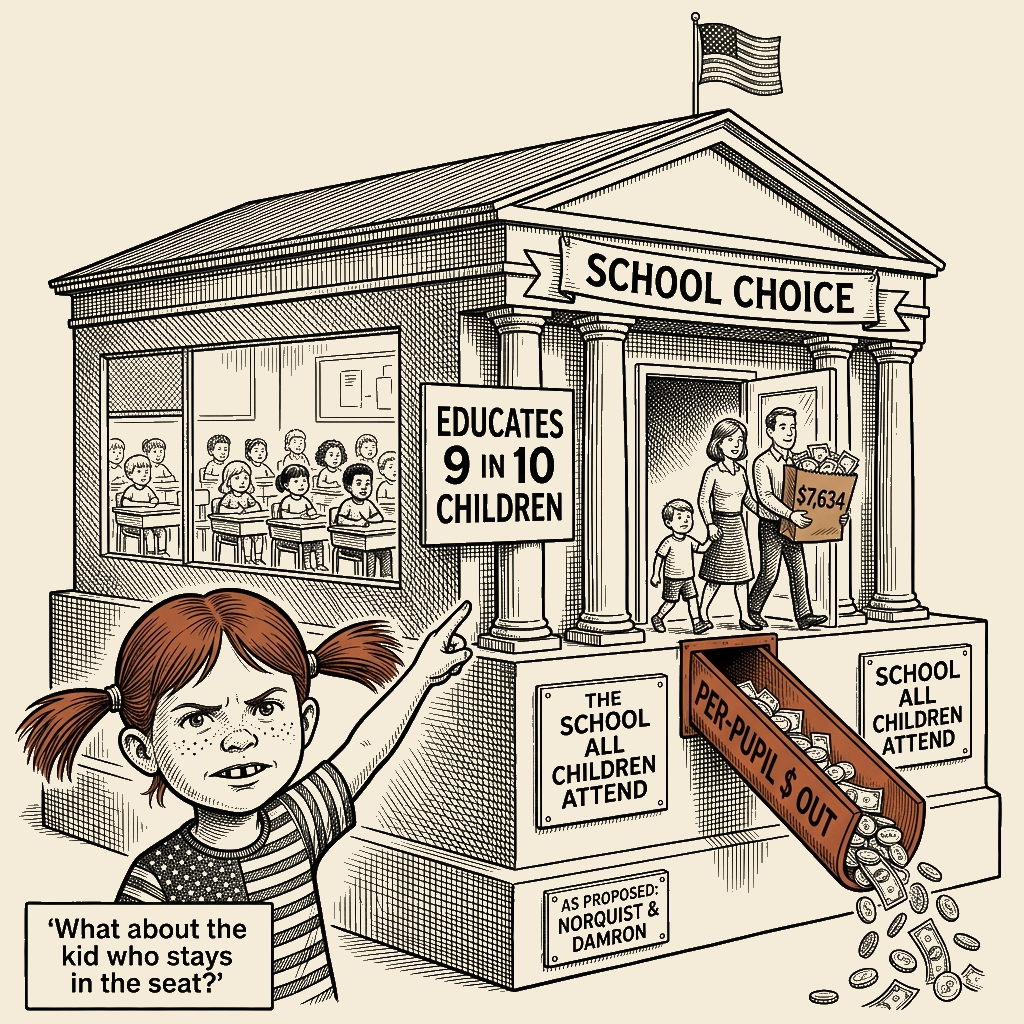
- Both ESAs and tax-credit scholarships divert public funds away from the public school system, which educates roughly nine out of ten American K-12 students (U.S. Department of Education, NCES Digest of Education Statistics 2023, Tables 205.10 and 205.80; the public/private ratio holds for South Carolina, with the caveat that the private enrollment category includes homeschool settings that may not participate in ESAs). The piece never names the public school system as a stakeholder — it mentions “families” repeatedly and “public school” not at all.
- Multiple participant surveys from EdChoice (formerly the Friedman Foundation for Educational Choice, a pro-school-choice nonprofit founded in 1996 by Milton and Rose D. Friedman) have consistently found that ESA/choice participants skew toward families already connected to private schooling — meaning the mechanism primarily subsidizes exit from the public system rather than improving the school the most educationally vulnerable children remain in. The critique of tax-credit design as “upfront-payment-unfriendly” is a fixable feature — advance-payment models and employer-of-record mechanisms address it — but that fix is not on offer, because the actual driver is income-tax elimination, not family welfare.
The Response Ladder
Polite Reframe
When to use: A persuadable moderate or good-faith family member who genuinely believes expanding “school choice” helps children stuck in failing schools. The calm moral reminder that the architecture on offer doesn’t serve the child it claims to.
Brenda is composite — the kind of family the architecture leaves out. Let me tell you about Brenda. Brenda has two kids at the Clover, South Carolina, elementary school — the same school her mother attended, the same school that produced the only nurse on their block. Brenda works the early shift at the distribution warehouse off I-77. Her tax dollars fund that school whether or not she has a $7,634 voucher in hand, because that is how public education works: you fund the system that educates every child whose parents can’t write a check. That school is the only reason the kid whose father is in prison, the kid whose mother works the night shift, and Brenda’s own two children get the same textbooks, the same teacher, the same cafeteria.
An ignorant nation is a conquered nation. That is not a slogan. It is a structural claim about what happens when the schools that educate nine out of ten children get treated as the leftover.
The piece by Grover Norquist and Wendy Damron tells you the question is which voucher mechanism best serves families. The question is not which voucher mechanism best serves families. The question is whether we keep funding the school that every child attends, or whether we redirect the money to a private architecture that some children exit and most children don’t. South Carolina’s ESA program does give a family with means $7,634 they can spend at a private school. It does not give Brenda’s neighbor’s daughter — the one with the learning disability and the mother who works two jobs — a better school. It gives her the same underfunded public school, minus the per-pupil dollars that just walked out the door with the family that took the voucher.
The piece frames this as a choice between two pro-school-choice mechanisms. It is not. It is a choice about whether public dollars follow the child out of the public school, or stay behind to fund the school that remains. The piece never names the public school as a stakeholder. That omission is the architecture.
Mockery and Ridicule
When to use: A social-media exchange or Substack reply where the target is a Norquist-aligned school-choice talking point and the bystander audience needs to see the operation named. Sharp, satirical, performs for the bystander.
Let me make sure I understand the pitch. Grover Norquist — the man whose life’s work is the elimination of the federal income tax — is here to tell you that the correct way to help poor children is the mechanism that does not depend on the income tax. The man who has spent forty years trying to make the income tax disappear is now worried, the column says, about what happens to poor families when the income tax disappears. The man whose organization exists to make sure no one pays federal income tax is now informing you that South Carolina has wisely avoided a voucher that requires paying state income tax.
This is not a policy position. This is a vending machine.
Here is what the piece would like you to do: read $7,634 and feel good. Here is what $7,634 actually does: it follows a child out of the public school and into a private school, while the per-pupil dollars that would have educated every child in that classroom now educate one child somewhere else. The piece mentions “families” repeatedly and “public school system” never. The piece mentions “school choice” repeatedly and “the children left behind in the public school” never.
The piece tells you the $2,000 tax credit is bad because low-income families can’t pay tuition upfront. The piece does not tell you the $7,634 ESA is also out of reach for the family with the kid who has the IEP and the mother who works the early shift at the warehouse. The piece does not mention that family at all. The family for whom neither mechanism works is the family the piece is built to ignore.
The piece is by Grover Norquist and Wendy Damron. Norquist runs Americans for Tax Reform. Damron runs the Palmetto Promise Institute. The two of them, working together, have decided that the question of how to educate the children of South Carolina is best settled by people whose institutional mission is reducing the taxes that fund the schools.
You may have heard the phrase cui bono. You are looking at it.
Nuclear Satire
When to use: A longer-form rebuttal where the audience has appetite for the full grotesque indictment — the op-ed page, a long Substack reply, a newsletter. Names the apparatus by name, deploys hyperbolic comparison, refuses the polite register, lands with cumulative force.
Let me describe for you, in the plain English Grover Norquist will not use, what is happening in South Carolina.
A child is in third grade at a public school in Clover. The school has a librarian four days a week because the budget was cut. The school has a counselor shared with two other schools. The school has a teacher who buys pencils out of her own pocket. That child — Brenda’s child, the neighbor’s child, the child whose mother works at the warehouse and whose father is not in the picture — that child attends a school that is being slowly, structurally, methodically starved.
Now imagine a family across town. The family has two parents. The family has savings. The family has a car. The family has a grandmother who can drive the kid to a private school fifteen miles away. That family, if they are eligible, can take $7,634 out of the public school system and put it into a private school. They have “school choice.”
The first child has school choice the way a passenger on a sinking ship has a life-jacket choice: there is one life jacket, and it is not hers.
The piece by Norquist and Damron is built to make you feel good about the second family. The piece is engineered to make you forget the first family. The piece mentions “families” repeatedly and “the public school system that loses per-pupil funding when a child exits” never. The piece frames the question as “which voucher mechanism?” and refuses to ask “should we be running the school system through private mechanisms at all?”
Now here is the diagnosis. Norquist runs Americans for Tax Reform, founded 1985 at President Reagan’s request, an organization whose institutional work for four decades has been opposition to federal income taxation. His life’s work is the destruction of the public revenue system that funds the public school the first child attends. Damron runs the Palmetto Promise Institute, a South Carolina think tank whose institutional life is the advancement of this architecture in the state of South Carolina. They have written a piece arguing that the correct way to fund a child’s education is the mechanism that does not depend on the income tax that Norquist has spent his life trying to kill. The circularity is not subtle. The circularity is the design.
This is the operation: phase out the income tax, starve the public school of per-pupil dollars, redirect the public dollars to private mechanisms controlled by private operators, declare victory for “school choice,” repeat in a dozen other states. The first child’s school gets smaller every year. The first child’s librarian gets cut every year. The first child’s mother does not write an op-ed about it. The first child does not get quoted in National Review. The first child is the architecture.
If this were a crime, it would be the crime of taking the money from the school that all the children attend and giving it to the school that some of the children attend, then writing a column in National Review explaining why this is a wise and family-friendly choice. The column would not mention the first child.
The column does not mention the first child.
By any means necessary, the column has to mention the first child.
Profane Scorched-Earth
When to use: The reader who needs full catharsis — the long comment thread that has gone off the rails, the Substacker who has been patient too long, the union meeting where someone is asking why the public schools keep getting gutted while the school-choice op-eds keep getting published. Gloves off. Receipts stay in. Full catharsis.
Grover Fucking Norquist. The man has spent forty goddamn years trying to destroy the income tax, and now he is here — here, in National Review — telling us that he is worried, the column says, with a straight motherfucking face, about what happens to poor kids when the income tax is gone. The man whose entire institutional life is making sure no American pays a federal income tax is publishing an op-ed in National Review telling us that the correct way to educate poor children is the voucher that doesn’t need the income tax. The man who founded Americans for Tax Reform to abolish the IRS has turned his attention to the schoolhouse, and what he has discovered, after four decades of work, is that the best thing for the children of South Carolina is the mechanism that makes Grover Norquist’s life work. The mechanism happens to be the one that doesn’t need the income tax he has spent his life trying to kill. What a coincidence. What a fucking coincidence.
Wendy Damron is along for the ride. She runs the Palmetto Promise Institute, which is a South Carolina think tank, which is a building with a desk and a logo and a printer where someone sits and writes op-eds about how the public schools of South Carolina should be replaced with mechanisms that don’t need the public revenue that funds them. She is the president. She is also the CEO. She is also the only person in South Carolina who thinks the architecture Norquist designed for abolishing the income tax is the right architecture for educating children. They are both quoted. They are both named. They are both getting paid.
Let me tell you what the op-ed does not say. The op-ed does not mention the public school that loses per-pupil funding every time a kid takes the voucher. The op-ed does not mention the librarian who got cut. The op-ed does not mention the counselor shared between three schools. The op-ed does not mention the teacher buying pencils. The op-ed does not mention the kid with the IEP and the mother who works two jobs. The op-ed mentions “families” repeatedly. The op-ed mentions “children” repeatedly. The op-ed mentions “public school system” zero goddamn times. The op-ed mentions “the kids left behind when the per-pupil dollars walk out the door” zero times. The op-ed mentions “the school every child attends whether or not their family has the means to exit” zero times. This is not an oversight. This is the architecture. The architecture is to never name the thing you are starving.
Norquist and Damron want you to choose between two vouchers. Norquist and Damron do not want you to ask whether either voucher should exist. Norquist and Damron do not want you to ask whether the public school that loses the per-pupil dollars should be funded. Norquist and Damron do not want you to ask who benefits when a kid exits the public system — the answer is the private school operator, the ESA administration company, the textbook vendor, the testing company, and the family with the means. The answer is not the kid left behind. The kid left behind is the receipt.
The op-ed tells you the $2,000 tax credit is bad because it requires upfront payment. The op-ed does not tell you the $7,634 ESA is also out of reach for the family without the savings, without the car, without the grandmother to drive, without the private school within range. The op-ed does not tell you that “school choice” means school choice for families who already have school choice. The op-ed does not tell you the most disadvantaged kids stay in the most underfunded schools. The op-ed is built so you don’t ask.
King said from the Riverside Church pulpit on April 4, 1967: “A nation that continues year after year to spend more money on military defense than on programs of social uplift is approaching spiritual death.” He meant every appropriations bill is a moral X-ray. He meant you can read the country’s soul off the budget. The op-ed by Norquist and Damron is an X-ray. The country whose soul it reads is Grover Norquist’s country, the country where the income tax is the enemy and the public school is the collateral damage. The country where the voucher is the only thing standing between the child and the school that educates nine out of ten children. The country where the kid with the IEP and the mother who works two jobs is not in the op-ed, has never been in the op-ed, will not be in the op-ed, because the op-ed is built so she doesn’t have to be.
The kid with the IEP is in the public school. The public school is losing per-pupil funding. The op-ed is in National Review. By any means necessary, the op-ed has to be answered.

About Malcolm Little King
Malcolm Little King is a heteronym in Main Street Independent's editorial architecture — an analytical voice, not autobiography of any actual person. The position this column expresses is the publication's position on the territory Malcolm Little King's lane covers, rendered through Malcolm Little King's register.