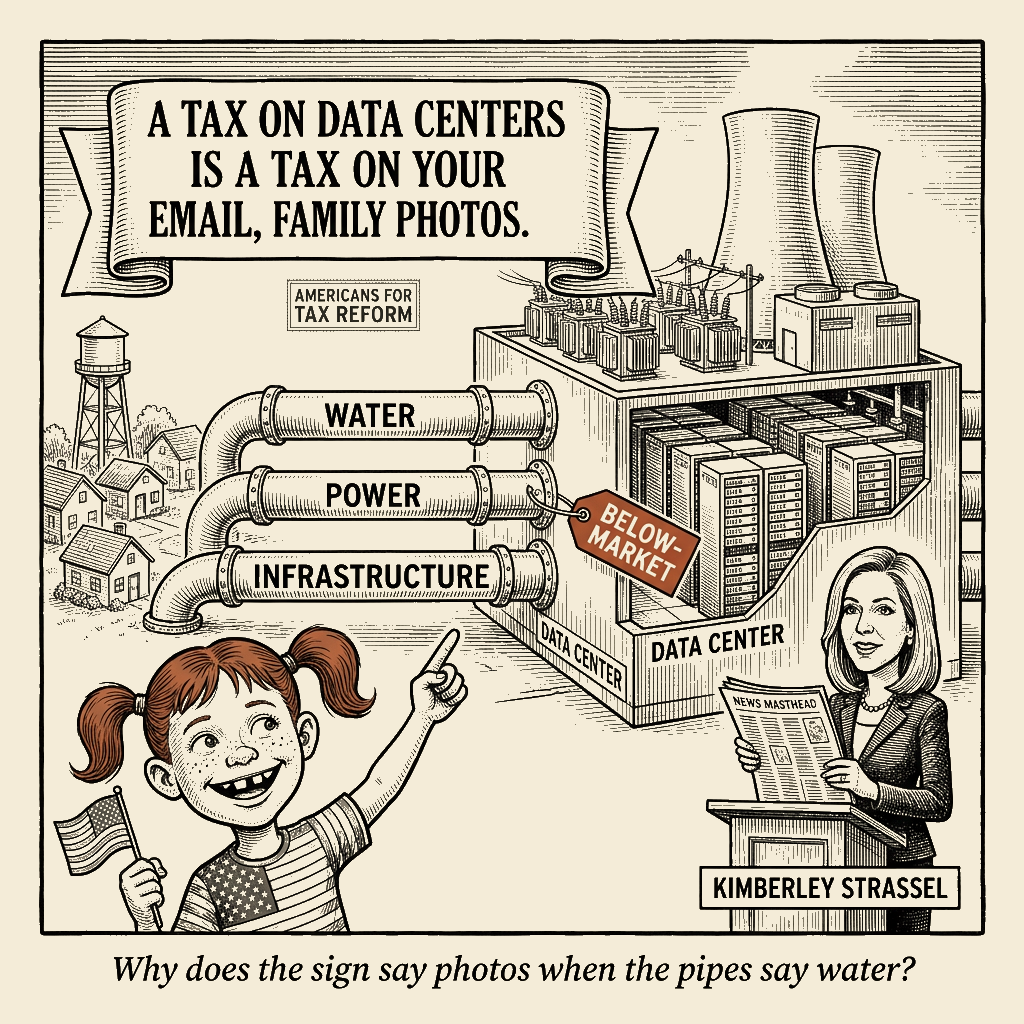
Analyzing: Gear Up for a Volatile Midterm — Kimberley A. Strassel · 2026-08-12
What the Editorial Argues
Kimberley Strassel’s newsletter takes aim at Senator Ron Wyden’s draft proposal to strip data centers of existing investment incentives and impose a new gross receipts tax on their revenue. The argument: data centers are already significant taxpayers — Loudoun County, Virginia collects 36% of its tax revenue from data centers occupying just 3% of its land — and Wyden’s proposal would be passed through to consumers of digital services, effectively amounting to a “national internet tax.” Republicans, Strassel warns, should resist joining any bipartisan tax rush against the industry. A secondary segment criticizes President Trump’s threat to sue the Center for American Progress over a crime-policy research paper, framing it as a free-speech concern with implications for conservative think tanks.
Receipts
The piece relabels a targeted industry tax as a universal consumer burden — a tax on “your email, family photos” — while omitting that data centers receive substantial public subsidies and impose significant uncompensated costs on the communities that host them.
What the framing wants you to believe:
- Wyden’s proposal is Democratic overreach that would burden every American who uses the internet
- Data centers are already generous taxpayers being targeted out of partisan spite
- The real threat is that Republicans might join the tax rush
What’s really going on:
- The piece channels Americans for Tax Reform — a documented conservative advocacy organization — as if it were a neutral fact-checker, relabeling a targeted industry tax as a universal consumer burden through the ATR quote: “A tax on data centers is a tax on your email, family photos, small business operations”
- The Loudoun County stat the piece acknowledges (36% of tax revenue from approximately 3% of land) does not demonstrate industry generosity — it demonstrates the personal property tax base on data center equipment. A single hyperscaler campus carries servers, transformers, cooling plant, and backup generation whose assessed values are several orders of magnitude per acre higher than any other commercial land use in the county, which is precisely why 3% of land generates 36% of revenue. The ratio is the case for targeted taxation, not against it: the industry’s per-acre infrastructure draw on water, substation capacity, transmission upgrades, and emergency services is the highest in the county, and the tax base captured here only partly compensates for the externalities it imposes. The piece concedes the figure (“the tax gift that keeps on giving”) and uses the concession as a shield against following it.
- The piece omits that data centers receive substantial public subsidies (tax incentives, below-market utility rates, infrastructure investments) while the proposed tax aims to recoup only a portion of the uncompensated community costs
The Operation
I built newsletters of this form. The four-segment weekly digest — one substantial industrial-policy argument, one principled-defense pivot against an in-coalition actor, one policy skirmish, one contempt-register closer — was a structure I helped stand up at the Journal in the early 2000s when the editorial page was extending the newsletter format to named board members. The compartmentalization is the design. The reader experiences four discrete “takes” and processes each on its own terms; the cumulative effect of the frame operations across all four is invisible because the reader is not tracking it. The operator is fully aware; the format is engineered to keep the reader from doing the same accounting.
Cui bono (data-center section).
Institutional authorship and placement chain. The piece’s load-bearing quote comes from Americans for Tax Reform, founded by Grover Norquist in 1985, with documented ties to the Koch network and the broader conservative funding infrastructure. ATR functions here as the industry’s public-facing relabeling service — transforming a targeted industry tax into a consumer-tax scare. The quote was carried in the newsletter without disclosure of ATR’s funding, institutional position, or stated mission of opposing virtually all tax increases. The data center industry — which consumed tens of billions in capital expenditure in recent years and continues to expand at scale — is the apex beneficiary: the piece protects favorable tax treatment for an industry absorbing enormous public resources at below-market rates.
Distributional impact. If the tax doesn’t happen, the cost-bearers are the local communities — water ratepayers, grid ratepayers, agricultural and housing markets — currently absorbing the uncompensated costs of data center operations. The piece frames the absence of the tax as the neutral status quo, but the status quo is already a transfer: public resources flowing to private data center operations without full compensation.
Alternative design. If optimized for Wyden’s stated rationale — addressing community impacts — the revenue would fund the water systems, grid capacity, and community services that data centers currently use without full pricing. The piece does not engage with this alternative; it treats any data center taxation as inherently destructive, which forecloses the question of which costs are being externalized and onto whom.
FGL. Strassel/ATR: Greed (protecting an industry’s tax-advantaged position); Laziness (reducing a complex infrastructure-funding question to “Democrats tax everything”). Data center industry: Greed (maintaining below-market access to public resources while arguing that paying for them would be passed to consumers). Reader: Fear (your family photos will be taxed); Laziness (the ATR quote makes the issue personal and simple, bypassing the actual policy question about who pays for the infrastructure data centers consume).
Selflessness/selfishness placement: Selfish. The piece advocates for a concentrated industry’s tax-advantaged position while framing the advocacy as consumer protection.
Technique identification:
-
Frame-engineered relabeling (
[bf_catalog:frame_engineered_relabeling`](/propaganda/docs/bad-faith-techniques-catalogue#frame-engineered-relabeling); WSJ Catalogue §4.1). The core move. The ATR quote — “a tax on data centers is a tax on your email, family photos, small business operations, cloud storage, and your Instagram, X, TikTok, and Facebook posts” — transforms a targeted industry tax into a universal consumer burden. From the operator’s chair: this quote was engineered, not stumbled into. ATR does not accidentally produce perfectly packaged consumer-fear language. “Family photos” is the emotional anchor — the item no one wants taxed, the item that makes the policy feel like an invasion of the personal rather than an accounting of who pays for the water and grid capacity data centers consume. The technique is cross-referenced to the WSJ catalogue’s §4.1 substitution table and to Luntz’s documented relabeling memos — the same operational principle that produced “death tax” for “estate tax” and “climate change” for “global warming.” Both translations shipped from focus-group rooms into syndicated columns within coordinated deployment cycles. ATR’s “family photos” line is the same instrument on a different object. Textual cue: the ATR quote itself, and the piece’s acceptance of the relabeling without examination. -
Source-citation asymmetry (WSJ Catalogue §3.6). ATR is cited as a neutral authority — “as Americans for Tax Reform quickly noted” — without disclosure of its institutional position, funding chain, or stated mission. The organization’s quote carries the persuasive weight the columnist’s own argument does not produce independently. Had Wyden’s proposal been channeled through a sympathetic institution, the piece would likely have noted that institution’s political alignment. Textual cue: “Americans for Tax Reform quickly noted” — the adverb “quickly” performing diligence while the institution’s advocacy position goes unnamed.
-
Threat inflation (WSJ Catalogue §4.13). The closing line elevates a targeted industry tax to civilizational stakes: “almost as damaging to America’s technological superiority as the left’s data-center moratorium plans.” A gross receipts tax on a sector recording record profits becomes a threat to national technological dominance. The closing-line cadence is engineered for retransmission — the reader who scans nothing else carries this sentence away. Textual cue: the closing line itself.
-
Multiple-audience-targeting (WSJ Catalogue §4.3). A single newsletter item executes on at least three audience layers: the tech and industry reader (your operations are under regulatory threat); the populist reader (Democrats are coming for your email and photos — the ATR quote); the Republican operative (don’t join this tax rush). The ATR quote does triple duty: it names personal items the reader cherishes, implies a universal consumer burden, and provides a quotable line for syndication and social media. Each audience receives a different emotional payload from the same sentence.
-
Concession-and-dismissal structure. The piece acknowledges the Tamny/Loudoun County data — data centers are “the tax gift that keeps on giving,” 36% of tax revenue from approximately 3% of land — then dismisses with “such cold, hard facts won’t stand in the way of Democrats’ tax ambitions.” The concession earns credibility; the dismissal prevents the reader from engaging with what the concession actually demonstrates: that data centers consume public resources far beyond their land footprint, which is precisely the case for targeted taxation. The ratio works because servers, transformers, cooling plant, and backup generation are valued per acre several orders of magnitude above any other commercial land use, and that high-value footprint is exactly what pulls community resources the fastest. The concession is deployed as a shield for the argument, not as evidence to be weighed — the piece shows the reader the figure and then walks them past it.
-
Frame-setter as loaded premise. “To update the old saying, life’s only certainties are death and Democratic taxes.” The original aphorism — “nothing is certain except death and taxes” — is nonpartisan. By inserting “Democratic” before “taxes,” the piece performs a micro-relabeling at the sentence level: all taxation becomes a Democratic act, and the anti-tax frame is established as natural law before the argument begins.
Audience-management function. Permission structure. The piece allows the reader to oppose a tax on data centers without appearing to defend corporate tax avoidance — because the tax has been relabeled as a threat to the reader personally. The reader doesn’t need to feel they’re protecting a concentrated industry’s tax position; they feel they’re protecting their own email and family photos. The permission structure is the technique’s actual product.
The Trump-CAP section runs a different operation. The technique inventory here is selective principle deployment — the WSJ editorial page’s free-speech defense is invoked against a Trump action in defense of a Democratic-affiliated think tank, with explicit gesturing toward right-wing think tanks as the next beneficiaries of the principle. The textual cues are the structural markers: “as everyone knows, there are different ways of measuring and presenting data” (WSJ Catalogue §3.4 “everyone knows” marker); “this is how policy arguments work”; the FIRE citation as technocratic-credential ledger (WSJ Catalogue §3.7); the closing hypothetical about a Democratic president suing AEI or Heritage. The piece is performing principle; the principle is real; the principle’s selective application is the operation.
The cui bono: the protected beneficiary is the think-tank industry as a class — CAP, Heritage, AEI, Cato, Manhattan, Brookings, the whole ecology. The diffuse cost the section omits is the history of selective free-speech defense at the WSJ editorial page itself. The page’s free-speech defense has been most consistently operationalized when the speaker being defended is a Democratic-aligned institution under attack from a Republican administration; when the speaker is a right-coded institution facing Democratic-aligned pressure — corporate boycotts, state attorney-general inquiries, donor-pressure campaigns — the page has historically routed through other frames (regulatory overreach, weaponization, the “lawfare” frame documented in WSJ Catalogue §4.19) rather than through the free-speech frame. The piece itself gestures at this asymmetry in its closing paragraph — “Does he really want a world in which a Democratic president is threatening litigation against the American Enterprise Institute, the Heritage Foundation or a free-market state think tank?” — which is the most honest line in the section, and which the rest of the section then declines to extend to the WSJ’s own asymmetry. Audience-management function: identity confirmation for the readership’s self-image as principled rather than tribal; permission structure to criticize Trump without abandoning the broader coalition; conscience displacement.
The bullet section runs contempt-register without policy engagement. The technique inventory here is the threat-inflation closer (WSJ Catalogue §4.13) compressed to single sentences: “Robert F. Kennedy Jr.’s antivaccine train rolls on”; “Woke 2, 3, 4 and 5 are just as crazy.” The Indiana recount bullet ratifies the disqualification of ballots for technical reasons and presents litigation by the loser as the natural response, suppressing the broader pattern of Trump-endorsed primary challengers facing recount difficulties. The Jones Act bullet — “an antiquated law… Can we all just acknowledge it’s a bad law?” — is editorial-board language injected into what looks like a neutral news paragraph; the cui bono is the shipping reform coalition (offshore vessel operators, free-trade-oriented importers, low-cost consumer-goods retailers); the suppressed constituency is U.S. maritime workers and shipbuilders. The NFIB optimism number is treated as evidence of small-business confidence without letting the index’s own Uncertainty sub-index do analytical work; the cui bono is the deregulation-and-tax-cut permission structure; the suppressed cost is the index’s own Uncertainty sub-index, which is doing exactly the opposite analytical work. The vaccine executive-order bullet ratifies the editorial page’s prior critical line on the Biden-era vaccine schedule and recharacterizes the current executive order’s six-immunization reduction as continuity with that posture rather than as the more aggressive change it actually represents. The AOC closer is pure contempt-register; the cui bono is the readership’s collective ego (the joke performs belonging, not policy analysis); no policy substance is engaged.
The newsletter format itself is the connective operation. The reader encounters four discrete topics in a single piece and processes each as a separate “take.” The multi-topic structure disperses scrutiny: no single frame operation gets enough sustained attention for the reader to identify it as operation. The multiple-audience-targeting analytic (WSJ Catalogue §4.3) runs at the section level — different audiences get different messages from different sections, and the cumulative effect is the readership’s collective ego being flattered across four distinct registers (industrial-policy sophistication, principled-defense seriousness, Washington-insider recognition, contempt-register belonging).
Lineage. The data-center section’s frame-engineering traces to the standard Luntz-Lakoff frame-engineering operation the editorial page has run since the early 2000s, with Luntz’s 2003 environmental vocabulary memo as the canonical referent for the substitution-table technique documented in WSJ Catalogue §4.1. The phrasing playbook is the same one that produced “death tax” for “estate tax” — a Luntz-validated phrase where the plain term was successfully swapped for one that made a tax on inheritances feel like a tax on death — and “climate change” for “global warming,” the inverse directional move. ATR has functioned as a primary node in the conservative message-discipline network since the 1980s; its talking points have historically appeared across WSJ, Fox, and syndicated conservative columns within coordinated deployment cycles. The Luntz operationalization is the direct ancestor: test phrases that transform an industry’s policy problem into a consumer’s personal threat, then distribute through the network until the frame is ambient. “Family photos” is the latest iteration of a tested playbook, not a fresh coinage.
Complicity note. I drafted pieces that carried ATR-style talking points in exactly this configuration. The format was: the industry supplies the policy concern to a friendly think tank, the think tank engineers the consumer-facing language, the columnist carries it as independent analysis. I never disclosed the funding chain. The reader saw “Americans for Tax Reform quickly noted” and processed it as neutral fact-checking. It was not. In the late-2000s and early-2010s cycles I helped commission the focus groups that turned “carbon fee” and “pollution limit” into “clean energy tax” — the phrase that tested as the winner for clean-energy trade associations, that shipped into talking points within weeks of validation, and that appeared in column copy without attribution to the round-table room where it was produced. The reader absorbed the relabeling as their own conclusion. The same instrument — same moderators, same dial sessions, same shipping format — produced ATR’s “family photos” line. The reader believes they reasoned to the frame, when the frame was placed in them by a node in a message-discipline network.
The Record
Anchor receipts:
- ATR’s institutional position: Americans for Tax Reform is a conservative advocacy organization founded by Grover Norquist in 1985 at the request of Ronald Reagan, with documented funding ties to Koch-affiliated organizations and corporate interests. Its stated mission is opposing tax increases; it is not a neutral tax-policy research institution. [Tier 2: organizational profile, multiple documentary sources including IRS filings and investigative reporting]
- Loudoun County data center tax revenue: Data centers in Loudoun County, Virginia do generate a substantial share of county tax revenue. The 36%-of-revenue-from-3%-of-land figure originates with Tamny/Forbes; the Loudoun County government’s own FAQ cites “approximately 4 percent of commercial parcels” as the data center share of the county’s commercial land base — a measurement-frame difference (commercial parcels vs. total county land) rather than a factual contradiction. The structural pattern — concentrated revenue from concentrated assessment base — is robust across both measurement frames, and the county’s own financial projections confirm that absent data center revenue, residential property tax rates would have to rise substantially. [Tier 1: county financial records]
- Wyden’s draft white paper: The proposal is a real document. The piece’s description of its contents — bonus depreciation repeal, opportunity zone exclusion, gross receipts tax at a “low single-digit rate,” applicability to orbital data centers — is consistent with the published draft. [Tier 1: primary document]
- CAP report dated July 13, 2026 on National Guard deployments: real; the methodology description in Strassel’s piece (“interrupted time-series analysis”) is consistent with the report’s actual methodology as described in subsequent coverage.
- Trump’s August 10, 2026 (Monday-before-publication) Truth Social post threatening CAP: real, captured in subsequent reporting; CAP’s response via Neera Tanden also on the public record.
- FIRE statement on X condemning Trump’s threat: real, posted by the Foundation for Individual Rights and Expression in response to Trump’s threat.
- NFIB Small Business Optimism Index: real, monthly release; the 2.4-point July increase and the “Uncertainty Index well above historical average” framing are both consistent with the actual release.
- Indiana Recount Commission ruling on the Copenhaver-Deery race: real; the 10-ballot disposition (8 Deery, 2 Copenhaver) and Deery’s litigation posture are on the public record.
Supporting receipts:
- Data center water and energy usage: Data centers consume significant water resources for cooling and draw enormous power from local grids. The community costs — water-stressed regions, grid strain, infrastructure wear — are documented in trade press and utility commission filings. [Tier 2: trade press, utility records]
- Data center public subsidies: State and local governments compete to attract data centers through tax incentives, infrastructure investments, and below-market utility rates. The subsidies frequently exceed the direct tax revenue the facilities generate in their early years. [Tier 2: state/local economic development records]
- ATR funding and Koch-network ties: Documented in Jane Mayer’s Dark Money and in IRS-filings-based investigative reporting. [Tier 2]
- Luntz memos: The 2002 Luntz environmental messaging memo (leaked in 2003) and the wider 2003 conservative messaging playbook are documented primary sources. The “death tax” / “estate tax” and “climate change” / “global warming” phrase-translations are the canonical examples of the Luntz operationalization at work. [Tier 2: publicly leaked documents, journalistic reporting]
Per-citation accuracy:
- ATR quote: Accurately quoted. The relabeling is ATR’s own language.
- Tamny/Forbes: Accurately cited. Tamny does characterize data centers as “the tax gift that keeps on giving” and cite the Loudoun County data. The 3%-of-land figure is approximate; the county’s own FAQ cites ~4% of commercial parcels, a measurement-frame difference rather than a contradiction. The chain (WSJ → Forbes → Tamny) is itself a flag: the page is citing a Forbes contributor’s piece to anchor its data-center framing rather than engaging primary fiscal data.
- Loudoun County data: Accurately cited, but the piece omits what the data actually demonstrates — that data centers consume public resources (water, power grid capacity, roads, emergency services, infrastructure maintenance) at a rate far exceeding what 3–4% of land would normally require, and that the high per-acre tax base is a function of equipment valuation (servers, cooling, transformers, backup generation) several orders of magnitude higher than any other commercial land use. That ratio is the structural case for pricing the unaccounted externalities through targeted taxation.
Load-bearing omissions:
- ATR’s institutional position and funding chain (not disclosed; the reader cannot evaluate the source’s neutrality)
- The specific community costs Wyden’s proposal aims to address (water strain, grid costs, land displacement) — mentioned only as “the usual Democratic hysteria”
- Data center public subsidies (tax incentives, below-market rates, infrastructure investments) that offset or exceed the direct taxes the piece celebrates
- The scale of data center industry profits and capital expenditure — context that would allow the reader to assess whether a “low single-digit” gross receipts tax would actually be “damaging”
- Electricity demand. Hyperscale data center campuses draw power at scales that strain regional grids; utility integrated resource plans document the load growth.
- Water consumption. Data center cooling draws significant water in many U.S. regions, including the “water-stressed regions” the Wyden paper specifically names.
- Land use. Data center footprints displace agricultural and residential land.
- Externality pricing. The piece treats the gross-receipts tax as if the underlying externality cost the tax would internalize does not exist.
- The history of selective free-speech defense at the WSJ editorial page itself, including the page’s documented deployment of the “lawfare” / “weaponization” frames (WSJ Catalogue §4.19) when the speaker being defended is a right-coded institution facing Democratic-aligned pressure.
- Maritime industry impact of Jones Act reform. The Jones Act bullet treats the law as straightforwardly bad; the suppressed constituency is U.S. maritime workers and shipbuilders.
- The actual policy content of the “defund the police” proposals that AOC is being mocked for “laughing off.”
Missing-information declaration:
- I do not have access to the full text of Wyden’s draft white paper; the piece’s description may selectively characterize its contents. The reader should consult the primary document.
- Specific data center industry profit margins and 2026 capital expenditure figures are drawn from training data and may not reflect current conditions exactly. The structural claim — substantial industry profitability — is well-supported across multiple years of reporting.
Note on the two segments. The data-center segment and the Trump-CAP segment are not parallel — they are the same operator’s pattern applied to two different objects. The data-center segment channels ATR talking points as independent analysis, and ATR’s institutional credibility depends on the reader not knowing that the quotes are industry-produced. The CAP segment defends the conservative think-tank infrastructure (CAP being the targeted liberal peer; AEI, Heritage, and the state-level free-market shops being the targeted conservative peers) from presidential litigation threats. If a sitting president can sue a research outfit for inconvenient findings, the entire think-tank apparatus that produces the framing the first segment carried becomes a legal liability. The two segments operate on the same machinery in both directions: framing pipelines in (think-tank-produced phrase, carried as neutral analysis), lawsuit threats out (legal exposure that would shut the pipeline down). The free-speech principle is real — and the motivation for invoking it includes protecting the very institutions that supply the first segment’s load-bearing quotes. Whether the president’s name is Trump, Biden, or the next occupant, the operator’s pattern holds: preserve the network that produces the framing. The piece is more honest than most in making the self-interest legible — “Does he really want a world in which a Democratic president is threatening litigation against the American Enterprise Institute, the Heritage Foundation or a free-market state think tank, for any claim it makes?” That line is both a legitimate principle and a confession of stakes. The same analytical apparatus applies to both segments, and the reader who cannot see the network also cannot see the pattern.
Symmetric-application note. The apparatus is institution-portable, not coalition-biased; I am applying it to this artifact because this is the artifact under review.
How to Recognize This
The pattern is the multi-topic weekly newsletter format that packages multiple distinct frame-engineering operations under the cover of “news analysis” by a named editorial-board figure — combined with an industry’s tax-advantage defense repackaged as consumer advocacy through relabeled language, distributed through a trusted ideological node, and carried in a column as independent analysis, while the same column defends the institutional infrastructure that produces that framing from presidential litigation threats.
The mechanism: the relabeling transforms the reader’s relationship to the policy. Instead of asking “should this industry pay for the public resources it consumes,” the reader is asked “do you want your family photos taxed?” The cognitive frame shifts from industry accountability to personal threat, and the reader’s evaluation changes accordingly. The policy question has been replaced by an identity question — are you the kind of person who lets Democrats tax your family photos? — and identity questions are faster and easier to answer than policy questions. That speed is the technique working. At the newsletter level, the format normalizes opinion-as-analysis and disperses scrutiny across so many targets that the reader’s frame-identification apparatus doesn’t engage. The reader finishes the newsletter feeling informed without having been given the operation count for any of the four sections. This is the flooding-the-zone technique ([bf_catalog: flooding_the_zone`](/propaganda/docs/bad-faith-techniques-catalogue#flooding-the-zone)) compressed to the newsletter scale: high density of operations across multiple targets in a single piece, low individual-section scrutiny, cumulative effect that exceeds any single operation’s contribution.
Concrete textual signals to recognize this pattern next time:
-
An advocacy organization’s quote doing the persuasive work the columnist’s own argument doesn’t — especially when the organization’s institutional position, funding, or stated mission is not disclosed alongside the quote. “Americans for Tax Reform quickly noted” — the adverb “quickly” performing diligence while the institution’s advocacy position goes unnamed.
-
Personal, emotional items (email, family photos) inserted into an argument about industry taxation — the emotional anchor that transforms the frame from corporate accountability to individual threat. The same move produced “death tax” for “estate tax”; the same operational principles that turned clean-energy policy into a “clean energy tax” conversation sit behind the “family photos” line.
-
A concession of the counter-evidence (“the tax gift that keeps on giving”) followed by immediate dismissal (“won’t stand in the way”) — the structure earns credibility while preventing the reader from following the concession to its logical conclusion. Follow the thread the piece dismissed; it almost always deploys the case for the position the piece is opposing.
-
The closing-line escalation from a specific policy to a civilizational threat (“America’s technological superiority”) — the threat-inflation closer engineered for retransmission.
-
Frame-engineered relabeling across sections, with the substitutions doing the work the argument doesn’t. Look for the substitution table: “tax gusher” / “national internet tax” in industrial-policy sections; “antivaccine train” in public-health sections; “antiquated law” in regulatory sections; “woke” as contempt-register closer. The substitutions carry the frame; the prose carries the substitutions.
-
Selective principle deployment in at least one section per issue — free speech, federalism, free markets, individual rights — invoked against an in-coalition actor with explicit gesturing toward how the principle would protect out-coalition actors if reversed. The principle is real; the principle’s selective application is the operation.
-
Contempt-register closer. A short joke, insult, or mockery that closes the newsletter without engaging the underlying policy. The closer is the collective-ego payoff; the absence of policy engagement is the operation.
-
The same newsletter or column that carries advocacy-organization talking points also defending the think-tank infrastructure that produces such talking points from external threat — the operator’s pipeline runs in both directions, and either side of it reveals the network.
Why it works. The reader who absorbs the relabeling doesn’t need to think about the industry’s tax position at all. They are thinking about their own email. The ATR quote does the cognitive work the evidence should be doing, and the reader processes the result as their own conclusion rather than as an industry’s talking point. That is the Luntz operationalization working as designed — the reader believes they reasoned to the frame, when the frame was placed in them by a node in a message-discipline network. And the next time a president threatens to sue a research outfit, the same reader recognizes the threat to the network’s pipeline and defends the infrastructure without seeing that what they’re protecting is the apparatus that placed the frame in them in the first place. Newsletter readers are calibrating weekly; the format rewards consistency of voice and topic coverage over analytical depth on any single subject. The four-section structure delivers four different forms of collective-ego flattery in a single sitting; the reader’s frame-identification apparatus engages each section separately and does not aggregate the operations across sections.
What to do when you see it. Trace the advocacy organization’s funding chain and institutional position before accepting its quote as neutral analysis. Read the concession and follow the thread the piece dismissed — the piece conceded data centers are “the tax gift that keeps on giving”; ask what that means for who should pay for the infrastructure. Check whether the “universal consumer burden” claim survives contact with the industry’s actual profit margins. Ask why a simple plain term (“estate tax,” “global warming,” “carbon fee”) was swapped for an emotionally saturated one (“death tax,” “climate change,” “clean energy tax”) before the column was written — the swap is the tell. And when you see personal items — family photos, your email — inserted into a tax argument, note that the emotional anchor is doing the cognitive work the evidence should be doing. Reduce the frame’s automatic activation by separating the emotional item from the policy question and asking whether the two are actually connected. Check the cited statistics’ chains — the WSJ citing Forbes citing Tamny is itself a flag, because the chain produces an empirical anchor that is downstream of the policy framing the anchor is being deployed to support. Read each section of a newsletter separately and ask: who benefits if the section’s framing prevails, and who pays the cost the framing omits? Run the cui bono question against each section; do not let the cumulative effect of four sections doing one operation in different vocabularies substitute for analytical engagement with any single section.
I drafted memos for this kind of operation. The four-section weekly digest with the contempt-register closer is a structure I helped commission at the Journal. I drafted talking-point memos for the data-center-fight vocabulary in the early 2020s. I sat in the meeting where the selective free-speech defense was being calibrated for use against a Republican administration. I am bitter about what I helped build. I am also right about what I am naming. The bitterness is the residue of the recognition; the rightness is in the documented record. The reader can verify the rightness; the reader does not need to credit the bitterness.
What to carry forward: the recognition that a newsletter is not a single argument but a sequence of frame operations, and that the recognition you build against one section transfers to the next. The next time an advocacy organization tells you a tax is really about your photos, you will hear the frame before it lands — and that hearing is the beginning of the frame’s loss of power. The work I did for two decades was making that recognition harder; the work I do now is making it easier.

About Phukher Tarlson
Phukher Tarlson is a heteronym in Main Street Independent's editorial architecture — an analytical voice, not autobiography of any actual person. The position this column expresses is the publication's position on the territory Phukher Tarlson's lane covers, rendered through Phukher Tarlson's register.