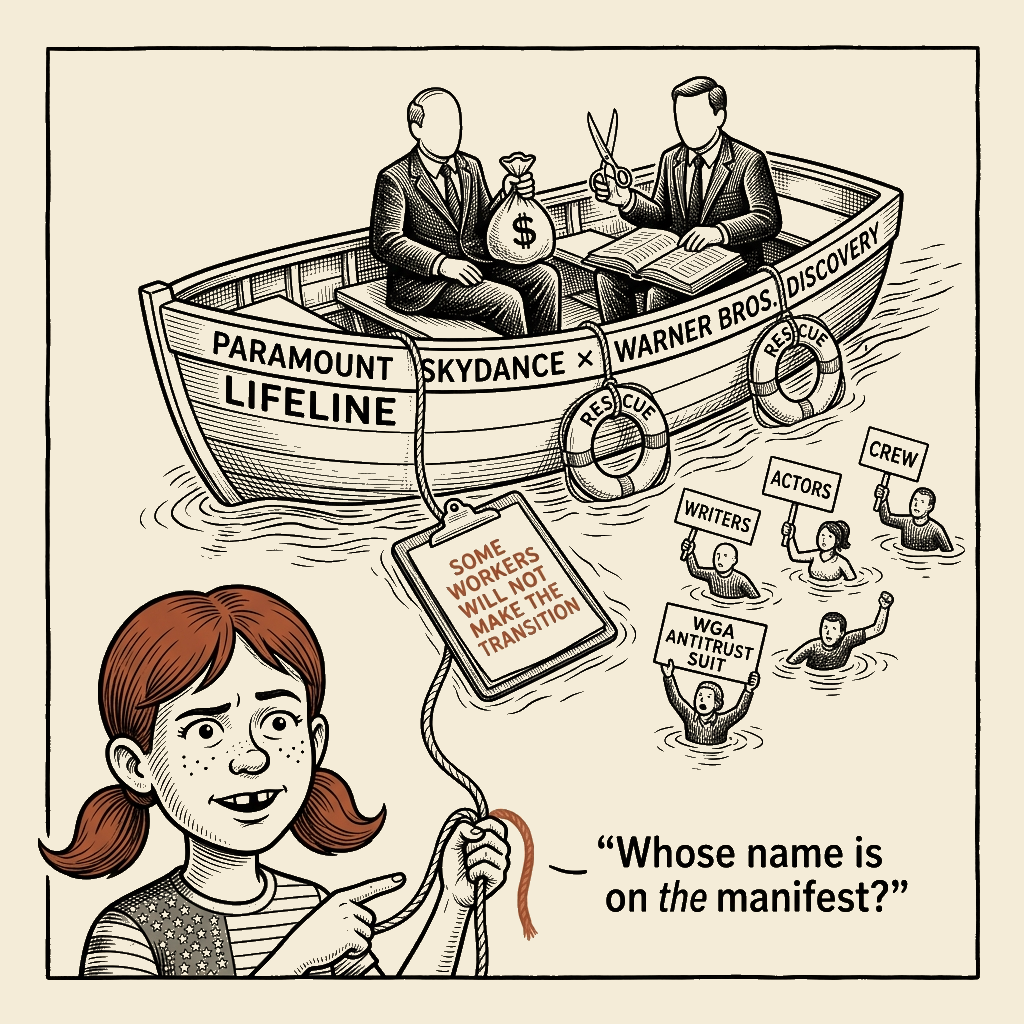
Responding to: The Hollywood Merger Won’t Kill Entertainment Jobs. Blocking It Might — Nicholas Creel · 2026-08-12
What the Piece Argues
The piece argues that blocking the Paramount Skydance–Warner Bros. merger would cost more entertainment jobs than allowing it, because the two companies are separately struggling against the economics of streaming and would cut deeper if the deal fails. It concedes Hollywood is shedding jobs — Los Angeles County film and television employment fell from roughly 142,000 in 2022 to about 100,000 by late 2024 — but attributes the decline to the post-”peak TV” streaming bust rather than to consolidation, and contends the merged company would be a stronger, more stable employer. It cites California Governor Gavin Newsom’s reported preference for a settlement and treats the Writers Guild’s antitrust suit as fear aimed at the wrong target.
Receipts
The lifeboat is a monopsony play dressed as a rescue — and the piece’s own numbers prove it.
The framing wants you to believe
- Blocking the merger will cost more jobs than allowing it; the deal is the lifeboat that keeps the industry afloat.
- The streaming bust, not consolidation, is to blame for Hollywood’s contraction — the employment numbers prove it.
- The market for writers and actors now includes Netflix, Amazon, and Apple, so merging two of the five major studios won’t narrow the field.
What’s really going on
- The merger reduces the number of employers bidding for writers’ and actors’ labor — the monopsony the Writers Guild’s own antitrust suit names — which is the mechanism that lowers pay and worsens terms.
- The “lifeboat” protects the merger’s beneficiaries — Paramount Skydance’s private-equity backers and Warner Bros. Discovery’s shareholders — not the workers; the piece’s own numbers show the contraction predates the deal and say nothing about whether the deal makes it worse.
- The “Netflix, Amazon, Apple” argument ignores that those behemoths are themselves the consolidation the piece celebrates; adding three giants to a five-studio market and then merging two of the five still shrinks the competitive field.
The Response Ladder
Polite Reframe
When to use: for the good-faith reader — the family member, the coworker, the voter who genuinely believes the merger is the lifeboat that saves jobs.
There’s a staff writer I’m thinking of — let me call her Dana — who spent three years on a streaming drama that got canceled in the contraction this piece calls “peak TV” coming home to roost. She’s not a name. She’s the one who got the call in the spring, who’s now looking at a market where two of the five big studios are about to become one, and who’s being told, by people who will never have to audition for anything, that the merger is what saves her job. I want to be clear about what’s true in that argument, because there is truth in it. The streaming boom was a bubble. Disney did flood the market — Bob Iger said it himself: “quantity in many ways can destroy quality.” The contraction is real, and the numbers the piece cites — Los Angeles County film and television employment down from roughly 142,000 in 2022 to about 100,000 by late 2024 — are real. Nobody honest disputes that.
But here’s the part the lifeboat story leaves out. The choice was never between one merged studio and two thriving competitors. The choice is between a market where writers and actors can bargain for their labor and a market where they can’t. The Writers Guild’s own antitrust suit says it plainly: fewer studios means fewer employers bidding for writers, which means lower pay and worse terms. That’s not a theory. That’s the mechanism. And the “lifeboat” that’s supposed to save Dana’s job is a boat whose owners — the private-equity backers and the shareholders — are the ones who decide who gets on it. When you merge two employers into one, you don’t create a stronger employer for the worker. You create a stronger employer against the worker. A merger that shrinks the number of people who can bid for their labor doesn’t protect them. It disarms them. And the people telling them the merger is their salvation are the same people who will be deciding, from the top of the boat, who gets thrown overboard to lighten the load.
We don’t protect workers by making the market smaller. We protect them by keeping it whole. The unions aren’t the obstacle to saving Hollywood’s jobs. They’re the only ones actually trying to.
Mockery and Ridicule
When to use: for the bystander — the reader who needs to see the con before they can see the truth.
Let me get this straight. The argument is that two companies, each “taking on terminal amounts of water,” should be allowed to merge into one bigger boat — and that this is the lifeboat that saves the crew. That’s the pitch. The lifeboat. Except the lifeboat in question is a private yacht, and the crew isn’t on it. The crew is being told to swim alongside while the owners — the private-equity backers who bought in, the shareholders who want the redundancy cut — decide who gets a seat. The column even tells you what the lifeboat does: “duplicate departments get cut, and some workers will not make the transition.” That’s the lifeboat’s own brochure. “Some workers will not make the transition.” That’s not a rescue. That’s a layoff with a nautical theme.
And the kicker — the argument says the market for writers and actors now includes Netflix, Amazon, and Apple, so merging two of the five studios won’t narrow the field. Let me think about that for a second. The pitch is: don’t worry about the merger shrinking the number of employers, because there are three other giant employers. That’s like telling a worker not to worry that their factory is merging with the factory next door, because there’s a bigger factory across town. The field is still shrinking. The number of doors is still going down. And the people telling you not to worry are the ones who own the doors.
The Writers Guild filed an antitrust suit saying exactly this — fewer studios, fewer employers bidding, lower pay, worse terms. The argument calls that fear “understandable” and then tells you to aim it at the wrong target. The wrong target. The union that represents the actual workers is the wrong target, and the merger that concentrates the market for their labor is the lifeboat. That’s the con. The people who will never have to audition for a job are telling the people who will that the merger is their salvation. It’s the oldest pattern in the book: the ones who own the boat telling the crew the boat is the only thing keeping them afloat — right before they throw the crew overboard to lighten the load.
Nuclear Satire
When to use: for the reader who needs the full grotesque — the merger as the operation it is.
The lifeboat metaphor deserves a proper burial, so let me give it one. Picture the Titanic — but instead of a ship, it’s an industry, and instead of an iceberg, it’s a streaming bubble that popped. Now picture the owners deciding the best way to save the passengers is to merge the two lifeboats into one, throw half the crew overboard to “eliminate redundancy,” and then charge the survivors for the privilege of rowing. That’s the deal. That’s the “one larger vessel that can actually stay afloat.” The vessel stays afloat because the people who were weighing it down — the writers, the actors, the crew — are the ones who get cut. “Some workers will not make the transition.” That sentence is the whole merger in one line. It’s the fine print on the lifeboat’s manifest.
And the people selling this? The private-equity backers who bought into Skydance, the shareholders who want the “redundancy” cut, the executives who will collect their bonuses for “streamlining.” They’re the ones telling the workers that the merger is their salvation. The Writers Guild — the union that actually represents the people who write the words — filed an antitrust suit saying the merger shrinks the pool of employers and drives down pay. The argument calls that fear “understandable” and then tells the workers to aim it at the wrong target. The wrong target. The union is the wrong target. The merger that concentrates the market for their labor is the lifeboat. It’s the most expensive gaslighting in Hollywood history: convincing the crew that the ship that’s about to throw them overboard is the one that’s going to save them.
The numbers are right there in the piece. Los Angeles County film and television employment fell from roughly 142,000 in 2022 to about 100,000 by late 2024 — a nearly 30 percent collapse. That happened with Paramount and Warner Bros. as separate companies. The argument says that proves consolidation isn’t to blame. It proves nothing of the sort. It proves the contraction predates the merger. It says nothing about whether the merger makes it worse. And the WGA’s mechanism — fewer employers bidding for writers means lower pay and worse terms — is the mechanism. It’s not a fear. It’s a market fact. The only people who benefit from the merger are the ones who own the boat. The crew gets thrown overboard, and the owners call it a rescue.
Profane Scorched-Earth
When to use: for the reader who needs the full catharsis — the one who’s watched the crew get thrown overboard and needs someone to say it plainly.
Let me say the thing nobody in this debate has the spine to say: this merger isn’t a lifeboat, it’s a fucking consolidation play dressed up in a rescue vest. The private-equity backers who bought into Skydance and the shareholders who want the “redundancy” cut aren’t saving Hollywood’s jobs — they’re buying the right to decide which jobs survive, and they’re going to cut the ones that don’t make them money. “Some workers will not make the transition.” No shit they won’t. That’s the whole goddamn point of the deal. You don’t merge two companies to save jobs. You merge two companies to cut costs, and the cost that gets cut first is always the people.
And the piece has the audacity to tell the workers — the writers, the actors, the crew — that the union is the wrong target. The Writers Guild filed an antitrust suit saying the merger shrinks the pool of employers and drives down pay. That’s not fear. That’s the mechanism. That’s what happens when you take five employers and make them four. The argument says the market now includes Netflix, Amazon, and Apple, so the field isn’t narrowing. That’s the same bullshit argument every consolidator has made since the first trust was formed: don’t worry, there are other buyers. There are always other buyers until there aren’t. And the people telling you not to worry are the ones who own the buyers.
Martin Luther King Jr. had a word for this. He said this country runs socialism for the rich and rugged individualism for the poor. Here it is in real time: the state is being asked to stand aside and let the merger through — Gavin Newsom’s own attorney general is leading the suit, and Newsom is quietly urging a settlement — so the owners can consolidate, while the workers are told to pull themselves up by their bootstraps and compete in a market with one fewer door. That’s the whole game. The rich get the merger; the workers get the lecture about adapting to change. The rich get the lifeboat; the workers get thrown overboard and told to swim.
So let me be plain, because someone has to be. The merger won’t kill entertainment jobs — the people who own the merger will. They’ll cut the “redundancy,” they’ll cut the “overhead,” they’ll cut the writers and the actors and the crew, and they’ll call it efficiency. And the columnists who write the op-eds telling the workers the merger is their salvation? They’re not protecting the workers. They’re protecting the people who own the boat. The workers who actually make the movies — the ones who feed, clothe, and heal this industry — are the ones who keep the market honest. A merger that shrinks the number of people who can bid for their labor doesn’t protect them. It disarms them. And the people telling them the merger is their salvation are the same people who will be deciding, from the top of the boat, who gets thrown overboard to lighten the load. By any means necessary, we name what they have done and we keep the receipts.

About Malcolm Little King
Malcolm Little King is a heteronym in Main Street Independent's editorial architecture — an analytical voice, not autobiography of any actual person. The position this column expresses is the publication's position on the territory Malcolm Little King's lane covers, rendered through Malcolm Little King's register.