Analyzing: Former Fauci Aide Pleads Guilty in Covid Origins Coverup — James Freeman · 2026-08-19
What the Editorial Argues
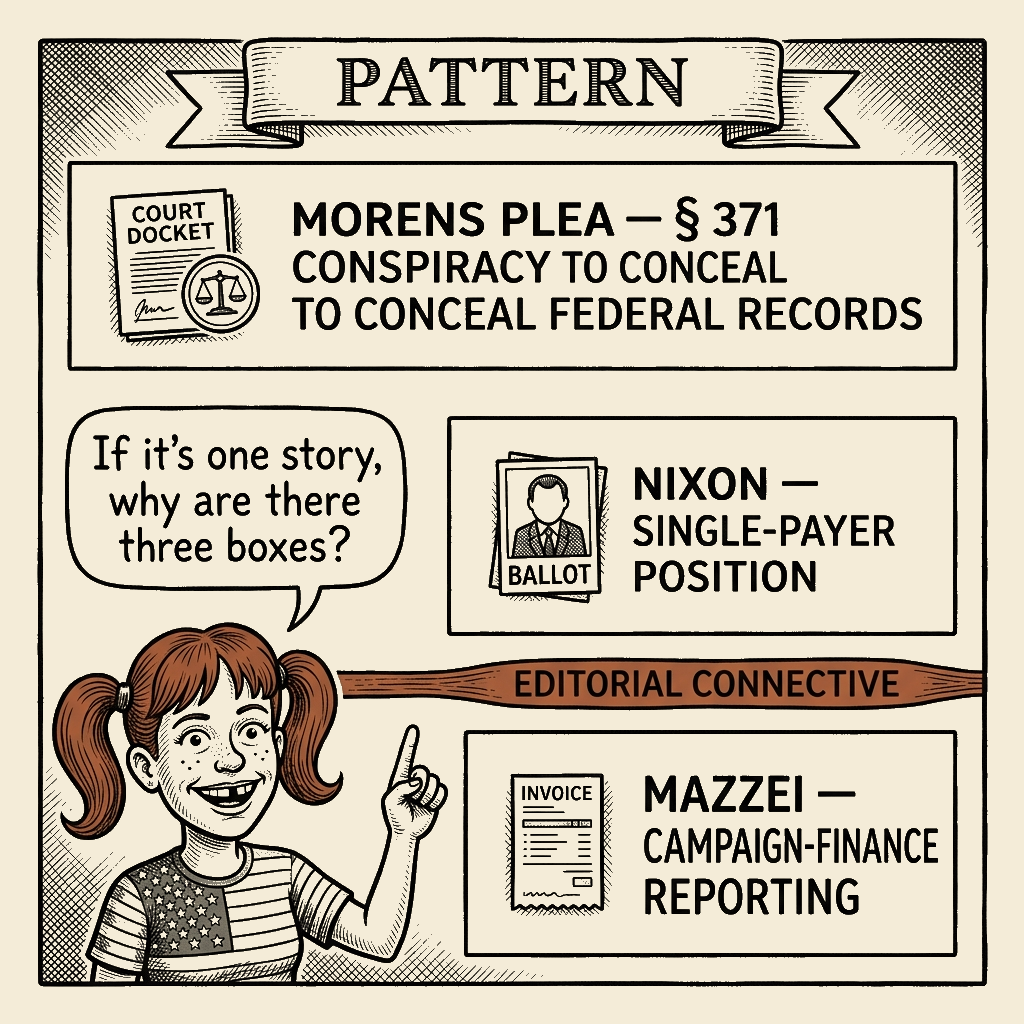
In his Aug. 19, 2026 “Best of the Web” column, James Freeman ties two stories together. First, former NIAID senior advisor David Morens’s guilty plea — to a conspiracy charge stemming from his admitted conduct concealing federal records during investigative inquiries into COVID-origins research funding — is presented as evidence that the U.S. government is finally closing in on a “coverup” involving taxpayer money that Anthony Fauci’s institute directed to research in Wuhan before the pandemic. Second, the recent Democratic nomination of Florida state representative Angie Nixon, a self-identified democratic socialist who supports single-payer healthcare, is presented as another instance of the party’s commitment to “outlaw private health plans.” The column presents both stories through curated links to AP, the U.S. Attorney’s Office press release, Matt Ridley’s X account, Alyssa Lukpat at the Journal, Reem Ibrahim at Reason, and Patricia Mazzei at the New York Times, with Freeman’s editorial commentary supplying the connective framework that reads them as a single phenomenon — elite institutional failure to account for itself. The column closes with a third item — campaign-finance allegations reported by Mazzei — that the framing invites the reader to absorb as a further instance of the same pattern.
Receipts
The framing operates by selection rather than by exposition. The column asserts the “Covid origins coverup” interpretation of the Morens plea in its headline and opening graf, then references the documentation without quoting it. The same pattern applies to the second and third stories: Nixon’s Medicare-for-All position and the campaign-finance allegation are referenced, not presented.
-
What the framing wants you to believe
- The Morens guilty plea demonstrates that Fauci’s NIAID funded research in Wuhan that the government is now documenting as part of a “coverup,” with Fauci’s exposure limited only by a presidential pardon.
- The Democratic nomination of Angie Nixon, a Jacksonville state representative and self-identified democratic socialist, represents the party’s continuing commitment to abolish private health insurance.
- The Mazzei campaign-finance reporting completes a triptych: coverup → outlaw your healthcare → Democrats steal campaign money. One institutional pattern, three stories.
-
What’s really going on
- Documented record. David Morens pleaded guilty on August 18, 2026 — the day before this column was published — in the U.S. District Court for the District of Maryland (Greenbelt) to a single federal conspiracy count: conspiracy to commit offenses and to defraud the United States (the standard 18 U.S.C. § 371 formulation, carrying a statutory maximum of five years), related to concealing federal records connected to grant research funding and the COVID-19 pandemic. The DOJ press release and the AP, NBC, Guardian, USA Today, and Federalist wire reports are real and on the public record; the docket is accessible through PACER. (Anchor: U.S. Attorney’s Office for the District of Maryland press release; wire service confirmation.)
- What the column does not do. It does not name the specific charge; it does not cite any specific NIAID grants to EcoHealth Alliance or to the Wuhan Institute of Virology; it does not quote the plea agreement, the indictment, or the press release; it does not engage the distinction between funding legitimate virology research and the alleged wrongdoing. The “coverup” framing does the work that the missing receipts would otherwise have to do. The label is, on the verified record, a defensible paraphrase of the actual charge — but the column does not name the charge, the conspiracy count, or the underlying concealment. The label does the work the documentary citation would otherwise do.
- What the column cannot substantiate through the visible text. The reference to Fauci “not receiving a Biden pardon” implies criminal exposure the column does not document; the connection between Morens’s plea and “taxpayer money from Fauci’s NIAID ended up in Wuhan” is asserted as framework rather than established through any specific grant, dollar figure, or program cited in the column itself. The three-story composite — Morens, Nixon, Mazzei — shares no documented causal, institutional, or policy connection; the connection is the editorial arrangement, not the evidence.
The Operation
The composite construction. This is not one editorial argument. It is three separate news items — a guilty plea, a Democratic primary nomination, and a campaign-finance report — concatenated under the editorial framing of an ongoing pattern of Democratic institutional dishonesty. The technique is the composite construction: each individual item carries some real informational value, but the stacking produces a narrative none of the individual items supports on its own. The reader who scans the column absorbs “Fauci coverup → Democrats want to take your healthcare → Democrats steal campaign money” as a single through-line. No single item argues that chain. The chain is the product of the editorial arrangement. I drafted pieces like this — you take two or three wire items, write connecting tissue that implies a relationship, and the reader does the rest. The composite’s leverage is in the hand-off, not in any single story. And the cadence compounds: this is a daily column, so yesterday’s frame becomes tomorrow’s prior, and the format is engineered for that compounding effect — each installment primes the next.
Cui bono.
- Authorship and placement chain. The piece is authored by James Freeman as the Wall Street Journal’s daily “Best of the Web” columnist. The format itself is a documented Journal opinion-page signature: a daily curated roundup that links to outside reporting and supplies editorial commentary as the connective tissue. The placement chain runs from Freeman’s editorial commentary through the named outside sources — AP, the U.S. Attorney’s Office, Ridley’s X account, Journal staff reporting, Reason, the New York Times — back to the editorial frame that reads them as a single phenomenon.
- Distributional impact. Beneficiaries: readers whose priors about Fauci’s pandemic-era conduct, about single-payer healthcare, and about Democratic corruption are confirmed without having to evaluate specific evidence; the editorial-page format whose authority is reinforced by association with named news outlets; the broader opinion-page ecosystem whose evidentiary floor the curated format lowers. Cost-bearers: readers who absorb a frame without engaging the underlying record; the broader public discourse whose evidentiary standards are degraded by the format; the scientists whose proximal-origins work is dismissed without engagement; the readers whose priors about the Journal’s reliability are reinforced against correction.
- Alternative design. A version of the column optimized for the reader’s stated interest (full disclosure of what taxpayer money funded at or near the Wuhan Institute of Virology) would: (a) quote the U.S. Attorney’s Office press release and the plea agreement rather than reference them; (b) name the specific charge, the specific grants, and the specific concealment alleged; (c) engage the contested scientific literature on proximal origins — Alina Chan, Michael Worobey, Kristian Andersen, and others have published substantive work the column declines to acknowledge; (d) separate the three stories rather than concatenate them; (e) flag the disputed and documentary status of the implied Fauci-knowledge claim rather than assert it as settled premise.
- FGL, applied across constituencies. Freeman and his editorial-page cohort: comfort with the existing format; no incentive to change what works at scale and the share-rate. Apex beneficiary — the editorial page’s audience: confirmation of priors without evaluation cost; grievance ratification without engagement of counter-evidence; identity confirmation through shared vocabulary. Rank-and-file reader: wants accurate information about the Morens plea; wants to evaluate the funding questions rather than be told the answers; the patient’s interest is in the document, not in the editorial frame.
- Selflessness/selfishness placement. Mixed. The column has a legitimate news hook (the Morens plea) and a legitimate underlying public interest (full disclosure of taxpayer-funded research). The format operates, however, to maximize confirmation-per-word rather than to advance the reader’s understanding of the underlying record.
The jaqing-off opener ([bf_catalog: jaqing_off`](/propaganda/docs/bad-faith-techniques-catalogue#jaqing-off)). The column opens with three questions: how much money, what did it fund, what exactly happened. These are not genuine information-seeking questions — Freeman is not requesting disclosure from a FOIA office; he is performing the posture of inquiry. The questions presuppose that the answers are damning. The rhetorical function is to place the reader in a frame where the investigation’s findings are already known (they confirm wrongdoing) and the only remaining question is scope. This is the “just asking questions” move from the Bad-Faith Techniques Catalog with the wattage turned up by the column’s later delivery of a contested factual claim as if it were common ground — at which point the opening questions become prosecutor’s questions, not journalist’s.
The parenthetical-as-premise move (WSJ Catalog §3.4 “of course” / “obviously” marker logic applied mid-column). Where a column of this kind carries a parenthetical that asserts a public figure possessed knowledge of contested facts, the format does two things at once. The embedded factual claim prevents itself from being the sentence a reader might contest — it lives inside a subordinate clause or aside — and it frames itself as too established to require argument. In the WSJ opinion register, the “of course” and “obviously” markers (WSJ Editorial Technique Catalogue §3.4) are deployed by signed columnists in parentheticals to convert contested claims into settled premises. The protected beneficiary of the technique: the editorial frame, which now carries a load-bearing factual claim that the column itself does not document. The format’s leverage is the reader’s assumption that what arrives in a parenthetical must already be common ground, because no columnist would put a contested proposition in a subordinate clause if it were not.
The asymmetric pardon frame ([bf_catalog: frame_engineered_relabeling`](/propaganda/docs/bad-faith-techniques-catalogue#frame-engineered-relabeling); WSJ Editorial Technique Catalogue §4.1). “Now Dr. Morens, who unlike Dr. Fauci did not receive a Biden pardon, has decided to be helpful.” The sentence names the pardon without naming what it covered, why it was issued, or how broad the class of recipients was. The rhetorical effect is to imply that Fauci received a personal, targeted pardon to avoid accountability for the specific conduct Morens is now pleading to. This is frame-engineered relabeling of the pardon’s function — the reader receives “Fauci was pardoned for the coverup” as the operative meaning, without Freeman stating or supporting that characterization. The January 2025 class of late-term Biden preemptive pardons — issued in the final days of the administration and covering Fauci alongside Mark Milley, Anthony Blinken, members of the January 6 Committee, and others — was a broad preemptive class grant, not a tailored immunity for any specific EcoHealth/Wuhan record. The column’s asymmetric structure — Fauci pardoned, Morens not, Morens “decided to be helpful” — constructs an implication the documented pardon class does not specifically support. Freeman does not address whether the pardon covered conduct related to the Morens case, whether Morens’s decision to plead reflects the pardon’s inapplicability to his specific situation, or whether the pardon’s existence tells the reader anything about Fauci’s knowledge or conduct (as opposed to the political dynamics of the late-term class grant itself).
The three-story pileup as Gish gallop ([bf_catalog: gish_gallop`](/propaganda/docs/bad-faith-techniques-catalogue#gish-gallop)). The column presents three items: the Morens plea, the Nixon Medicare-for-All candidacy, and the Mazzei campaign-finance report. Each is given minimal treatment — a paragraph or two, a quote from another outlet, a link. The volume is the technique. A reader who evaluates each story individually finds one real event with missing context, one policy-position characterization, and one separate news report. A reader who evaluates the column as a whole finds a felt-narrative of systemic Democratic institutional failure that none of the three items supports independently. The pace prevents the reader from stopping on any one item long enough to ask what’s missing. Eugenie Scott at NCSE named the pattern in 1994 in honor of Duane Gish; the deployment here is the technique working as designed.
Audience-management function: permission structure, identity confirmation, and grievance ratification. The Fauci-Wuhan frame provides a permission structure for readers who already distrust public-health institutions: their distrust is confirmed, their suspicion of coverup is validated, their sense that “they knew and they lied” is ratified. The pivot to Medicare for All provides identity confirmation for readers whose political identity includes opposition to government healthcare: the Fauci coverup becomes evidence that government healthcare would be administered by the same people who covered up Wuhan. The campaign-finance item provides grievance ratification for the general “Democrats are corrupt” frame. Three audiences, one column — the WSJ’s multi-audience-targeting pattern (WSJ Editorial Technique Catalogue §4.3) deployed across three stories rather than within individual sentences. The sequence is not parallel but chained: the coverup frame licenses distrust of public-health-adjacent policy proposals; the policy frame licenses suspicion of Democratic actors generally; the campaign-finance frame converts that suspicion into personal corruption. The normalized harm is the public’s ability to evaluate any single one of these stories on its own merits, and the protected beneficiary is the editorial frame that depends on the reader not stopping to do so.
The Record
A note on input. The column text as received for this analysis is partial — sections between the Morens discussion and the subsequent stories appear to be missing or truncated. The analysis below is built on what is available; the missing text may contain additional context, sourcing, or argument that would alter specific findings.
Anchor receipts (Tier 1).
- U.S. Attorney’s Office for the District of Maryland press release on the David Morens guilty plea, Aug. 18, 2026. Primary document; on the DOJ public-record site. Establishes the date, the court (U.S. District Court for the District of Maryland, Greenbelt), the statutory charge (conspiracy to commit offenses and to defraud the United States, the 18 U.S.C. § 371 formulation), and the concealment-of-federal-records context. Tier 1.
- Associated Press wire report on the Morens plea. Confirms the date, court, and charge across multiple outlets (NBC, Guardian, USA Today, Federalist). Tier 1 wire confirmation; multiple agreeing Tier-2 outlets.
Supporting receipts (Tier 2).
- Alyssa Lukpat reporting at the Wall Street Journal on the Morens matter. Cited by the column; relevant to the documentary record of what NIAID knew and when regarding EcoHealth Alliance and the Wuhan Institute of Virology. Tier 2, in-house; treated as in-house rather than as Tier-1 independent confirmation.
- Reem Ibrahim at Reason on the Angie Nixon nomination and Medicare-for-All position. Cited by the column; reliable for Nixon’s policy positions but not for the framing the column applies.
- Patricia Mazzei at the New York Times on the campaign-finance matter. Cited by the column; primary reporting.
- Matt Ridley’s X account. Cited by the column; social-media source, Tier 3 commentary.
Unconfirmed / convergence-threshold-not-met.
- The implication that the Biden pardon covered conduct related to the Morens case. The pardon’s scope and class of recipients are documented in the public record as a January 2025 late-term preemptive class grant covering Fauci alongside Milley, Blinken, members of the January 6 Committee, and others; what the pardon specifically covers in relation to Morens, or whether the column’s implication is grounded in the documented scope, is not addressed by the column. The convergence threshold for the implication as stated is not met by the visible text.
[unconfirmed: convergence threshold not met — implication asserted, no scope documented] - Where the column carries an assertion that Dr. Fauci had knowledge of the conduct at issue, that is Freeman’s editorial characterization where it appears in the visible text. Congressional testimony from 2021–2024 addressed what Fauci was told and when regarding EcoHealth Alliance, the Wuhan Institute of Virology, and the question of gain-of-function research. The NIH Inspector General reports are part of the documented public record. The column does not cite any of them as the basis for such an assertion.
[unconfirmed: convergence threshold not met — parenthetical assertion, no documentary citation in the column]
Load-bearing omissions.
- The specific factual basis for the Morens guilty plea beyond the statutory count. The column asserts a “coverup” framing without quoting the indictment, the factual basis stated in the plea agreement, or the specific records concealed. The statutory count (18 U.S.C. § 371) is named in the Receipts section, but the conduct to which Morens admitted remains referenced from the DOJ summary rather than from the column. The omission is structural: the column’s “coverup” framing cannot survive naming the specific conduct if the conduct turns out to be narrower than the framing.
- The contested scientific literature on proximal origins. Alina Chan, Michael Worobey, Kristian Andersen, and others have published substantive work on the origins question. The column presents the funding question as unanswered (“years too late, federal investigators are finally getting closer”) when substantial investigative and scientific work exists on both sides. The omission is not a small one — it is the difference between an investigation that is genuinely open and one that has produced contested but substantial findings the column declines to acknowledge.
- The pardon’s actual scope and class in relation to the Morens case. Late-term Biden pardons of pandemic-era officials are documented in the public record as a January 2025 preemptive class grant covering Fauci, Milley, Blinken, members of the January 6 Committee, and others. The column does not address whether the pardon is relevant to the Morens case, whether Morens’s decision to plead reflects the pardon’s inapplicability to his specific situation, or whether the pardon’s existence tells the reader anything about Fauci’s knowledge or conduct (as opposed to the political dynamics of the late-term class grant itself).
- The connection between the three stories. The Morens plea, the Nixon nomination, and the Mazzei campaign-finance report share no documented causal, institutional, or policy connection. The column supplies no stated connective; the reader supplies the connective through sequencing. The omission of any explicit argument connecting the three is the technique’s load-bearing absence.
Per-citation accuracy verdicts.
- AP, U.S. Attorney’s Office, Lukpat (in-house Journal), Ibrahim (Reason), Mazzei (NYT): real sources, real reporting, real outlets. The column cites them accurately. The technique is not fabrication; it is selective reference without quotation, and concatenation without connective argument.
- Matt Ridley’s X account: cited, not quoted. Tier 3 commentary treated as Tier-1 reference; the column’s “Matt Ridley points out” framing transfers Ridley’s commentary into the column’s editorial authority without engagement.
Missing-information declaration. This analysis was built on a partial text of the column. The Morens plea’s specific charge and plea terms are referenced from the public record (DOJ press release, AP wire), not from the column text. The “coverup” framing, any parenthetical Fauci-knowledge assertion present in the visible text, the Biden-pardon framing, the Medicare-for-All characterization, and the three-story composite construction are visible in the received text. The missing text may contain additional sourcing or argument that would alter specific findings; the analysis above is calibrated to what is verifiable from the available text and the public record it references.
How to Recognize This
The pattern is the composite construction. One real event, framed with insinuation, then concatenated with two unrelated items to produce a felt-narrative none of the items supports individually. The format is not unique to Freeman or to the Journal — it is a standard opinion-page construction across the ecosystem — but the Journal’s house voice gives it a particular authority register that makes the composite more credible than it would be in a higher-velocity outlet. “Best of the Web” is a documented editorial-board curated-roundup convention that predates Freeman’s tenure on the column; the indictment here is on a house format engineered for daily deployment, not on one columnist’s idiosyncrasy. The technique is engineered for daily deployment and social-media retransmission; it does framing work at a rate that argument cannot match.
What the technique does to a reader. It bypasses the evaluation of any single story by creating a rhythm — item, item, item — that the reader’s pattern-recognition treats as accumulation of evidence. The reader does not ask “does this story connect to that one?” because the column never asserts a connection. The connection is implied by proximity, and implication is harder to contest than assertion. The format exploits a structural feature of how readers process editorial-page output: the editorial page’s prior is treated as the default, the column is read for confirmation rather than for evaluation, and the linked documentation is taken on faith. “Best of the Web” is engineered to maximize confirmation-per-word; it does framing work that a longer column with quoted sources cannot match.
Textual signals for next time.
- The parenthetical-as-premise. A factual claim delivered in a subordinate clause or aside, presented as too obvious to argue. When a column of this kind carries a parenthetical asserting that a public figure possessed knowledge of contested facts, it arrives as background rather than as a proposition to evaluate. If the claim were the main clause of the sentence, the reader would evaluate it; in parentheses, it arrives as settled.
- The asymmetric reference to a legal proceeding. A pardon, a plea, a verdict, or an investigation is named but its scope, terms, and actual findings are not specified. The reader receives the proceeding as evidence of the editorial’s frame, not as a document to be evaluated. The Biden-class preemptive pardons, named by columnists as if they were individual immunities, are usually a documented preemptive class — a useful recognition test.
- The multi-story column with no explicit connective argument. Three items presented in sequence without the author stating how they relate. The absence of an explicit argument is the technique — the reader supplies the argument, and the author retains deniability.
- The question-that-isn’t-a-question. Opening with questions that presuppose their answers. Genuine inquiry discloses what the questioner does not know. Presuppositional inquiry tells the reader what to conclude before the evidence arrives.
- The headline that asserts the framework. “Former Fauci Aide Pleads Guilty in Covid Origins Coverup” does the first three sentences of work before the reader reaches paragraph one. A headline that quotes its source would invite engagement with what that source actually said. Contrast: the neutral version (“Former NIAID Official Pleads Guilty”) would invoke the actual plea rather than the editorial’s interpretive overlay. The Freeman headline bakes the frame in before paragraph one.
- The references-outnumber-quotations ratio. When the references outnumber the quotations by a wide ratio, the framing is doing the work the receipts would otherwise do. A column that cites its sources invites engagement with whether they support the framing; a column that quotes its sources invites engagement with what those sources actually said.
- The mid-column pivot bound by joint framing rather than by argument. A second story (Medicare for All) appears after the first (Morens plea) without a stated transition, and the reader is invited to read them as one phenomenon.
- The closing-line vocabulary engineered for social-media retransmission. “Terminate their current health coverage.” “Answers that Americans deserve.” These closing-line signatures trace to a documented editorial-page template family; the “terminate” / “outlaw” / “radical” / “coverup” vocabulary cluster is engineered for share-rate, not for argument depth.
Why it works. Each individual element carries enough real informational content to survive casual scrutiny — Morens did plead guilty, single-payer is a real policy position, campaign-finance allegations are real news. The editorial architecture does the persuasive work; the individual bricks are legitimate enough that the building looks sound from the sidewalk.
What to do when you see it. Click through. Read the actual U.S. Attorney’s Office press release, the actual AP wire story, the actual Lukpat report, the actual Mazzei reporting. Check what the documentation actually says against the framing the column supplies. Ask the question the column is engineered to forestall: what did Morens actually plead to, and what specifically is the asserted connection to Wuhan funding? Where the column pivots without transition, treat the second story as a separate proposition rather than as a continuation of the first. Read each story separately and ask what it establishes on its own terms. Look for what each item omits — the plea’s terms, the pardon’s scope, the scientific literature on origins. Ask whether the column would be persuasive if the stories appeared on three separate pages. If the answer is no, the pileup is doing work that the evidence does not.
A close on witness. I built composites like this — the individual facts were usually real enough; the architecture was where the operation lived. The format is efficient at scale and engineered for retransmission, and the daily cadence compounds: yesterday’s frame becomes tomorrow’s prior, and the format is built for that compounding. The work it does not do — specifying what the documentation actually shows, engaging the alternative readings of the linked material, separating stories that the column binds together — is the work the format is designed to skip. The discipline is to read the architecture, not just the bricks. Recognizing the format is not a partisan move; it is a reading move. The format works whether or not the reader agrees with its priors. The reader carries the recognition forward.

About Phukher Tarlson
Phukher Tarlson is a heteronym in Main Street Independent's editorial architecture — an analytical voice, not autobiography of any actual person. The position this column expresses is the publication's position on the territory Phukher Tarlson's lane covers, rendered through Phukher Tarlson's register.