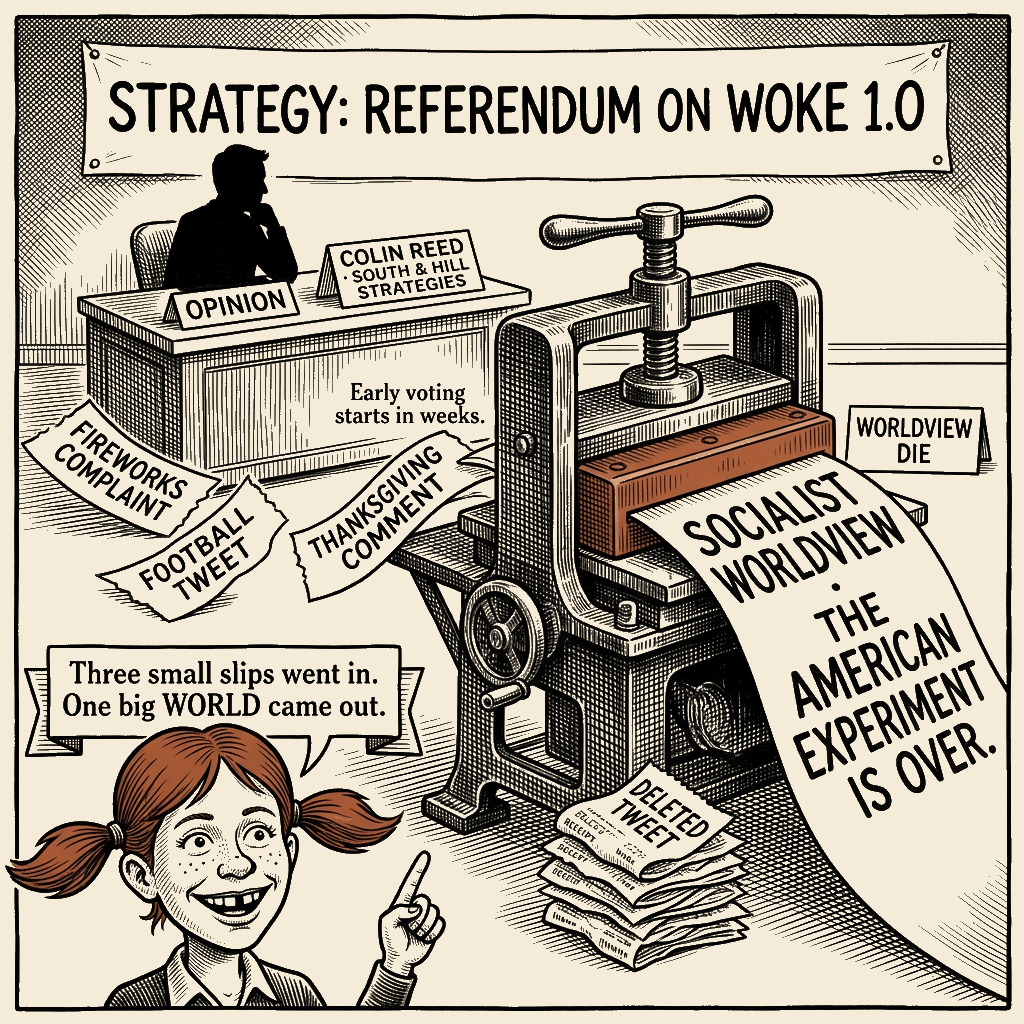
Analyzing: Socialist candidates can delete old posts, but they can't erase their radicalism · 2026-08-19
What the Editorial Argues
Colin Reed, a Republican strategist and former Scott Brown campaign manager, writes that three Democratic candidates — Abdul el-Sayed in Michigan, Francesca Hong in Wisconsin, and Alexandria Ocasio-Cortez in New York — have surfaced past social media posts so extreme that the deletion itself is news, and the substance of those posts reveals a coherent worldview. That worldview, Reed argues, holds that the American experiment is over. Socialism, in his definition, is what produces opposing fireworks, football, and Thanksgiving. The piece stitches the three candidacies into a single “movement” and closes with the Republican strategic case: with Trump not on the ballot in the 2026 midterms and Iran bogging down his approval, the GOP’s best move is to make the midterms a referendum on “Woke 1.0” — which, Reed writes, “never left the building.”
Receipts
The editorial compresses three disparate social-media fragments into a single worldview, assigns that worldview to a political category, and treats the case as the operative for a 2026 midterm mobilization.
-
What the framing wants you to believe:
- Three progressive candidates have past views so extreme that they’re trying to delete them.
- These views reveal a coherent “socialist” worldview hostile to America.
- Therefore, the conservative case for the 2026 midterms is a referendum on this worldview.
-
What’s really going on:
- The piece extracts a maximalist definition of socialism (“the American experiment is over”) from minor cultural complaints, then attributes the framework to all progressive candidates as a class. (Bad-Faith Techniques Catalog:
strawman.) - The platform (Fox News Opinion), the author’s professional standing (GOP strategist, former Scott Brown campaign manager), and the timing (six weeks before early voting starts) supply the institutional cui bono: Republican midterm mobilization content. The author names the strategic logic himself in the closing paragraph.
- The omission that does the work: none of the candidates’ actual policy platforms are engaged. The case is built entirely on social-media archaeology.
- The headline performs the technique. “Socialist candidates can delete old posts, but they can’t erase their radicalism” —
Socialistis asserted as a category attribute of pluralcandidatesbefore any evidence is offered;their radicalismcloses the relabeling loop in eight words. The title does the framing work the article would otherwise have to argue for.
- The piece extracts a maximalist definition of socialism (“the American experiment is over”) from minor cultural complaints, then attributes the framework to all progressive candidates as a class. (Bad-Faith Techniques Catalog:
The Operation
The cui bono is straightforward and worth naming cleanly. The author is a Republican strategist running a firm whose name — South and Hill Strategies — tells you what it sells. The platform is Fox News Opinion, the most engaged-with right-coded opinion surface in the country. The timing is August 2026, with early voting starting “in a matter of weeks.” The author even names the strategic logic in the open: “Trump is not on the ballot, and the ongoing conflict in Iran has bogged down his approval ratings.” This is a Republican strategist writing the conservative case against a midterm turnout problem. The piece is the operation; the candidates are the props.
I drafted pieces of this kind for years. The discipline — the message drill, the “don’t say [X], say [Y]” memo, the compression-and-attribution architecture — is what I knew from inside. I know exactly how this editorial was built because I built versions of it.
Distributional impact. Beneficiaries: GOP candidates in competitive races who want a nationalized referendum frame rather than a local-issues frame; Fox News engagement metrics (the piece closes with three “CLICK HERE” links to other Fox content); the conservative fundraising apparatus, which can deploy the piece in fundraising emails; the broader conservative counter-frame against progressive economic populism. Cost-bearers: the named candidates, who absorb the labeling; the Democratic primary voters who chose Hong in Wisconsin; and the broader category of progressive candidates whose platforms will now be filtered through “what did they post on social media” rather than “what is their policy.”
Alternative design. If the piece were optimized for its stated rationale — something like “voters should know what candidates really think” — the candidates’ actual policy platforms would be the lead. El-Sayed ran a 2018 Michigan gubernatorial primary against Gretchen Whitmer and has a documented record on public health, environmental policy, and labor. Hong ran a 2026 Wisconsin Democratic gubernatorial primary against David Crowley and lost narrowly; she had a documented record on housing, mental health, and reproductive care from her time in the Wisconsin State Assembly. AOC has the most-known voting record in the House. None of that surfaces. The piece’s architecture — three social-media fragments → maximalist socialist worldview → 2026 midterm case — is what selects the omission. The alternative design would lead with policy. The actual design leads with affect.
Fear/Greed/Laziness.
- The author (GOP strategist): Fear of a base that won’t turn out without a nationalized frame; greed for engagement and the strategic value of the piece; the laziness of treating all progressives as socialists.
- The apex beneficiary (the GOP midterm apparatus): Fear of a base that stays home; greed for a unified message; the laziness of treating all progressives as socialists.
- The rank-and-file reader (the Fox News viewer): Real fear that progressive governance is coming and that mainstream Democrats won’t fight it; the laziness of being told who the threat is rather than working it out; the greed of identity confirmation.
The piece is selfish in the formal sense — it serves an electoral coalition’s strategic interest — and mixed in the deeper sense: the underlying anxieties the piece addresses are real and human. Voters do worry about left-flank takeover of the Democratic Party; the AOC/el-Sayed/Hong wing is a thing worth scrutinizing; the social-media fragments are real. The technique is the substitution.
The technique inventory. This is the page’s standard mid-density deployment, run at a recognizable level of craft.
-
Frame-engineered relabeling (Bad-Faith Techniques Catalog). “Socialist” applied as a categorical label to candidates with varying relationships to actual socialist organization. El-Sayed has DSA ties. Hong is described as a “Democratic Socialist candidate” in the Wisconsin primary. AOC’s relationship to DSA has fluctuated. Reed treats these as equivalent manifestations of the same worldview — what Stuart Hall called the “floating signifier” given fixed meaning — without distinguishing among them or naming what each candidate’s actual position is. The labeling is the move; the substantive comparison is the omission. (Luntz, Words That Work; Lakoff, Moral Politics; WSJ catalogue §4.1; NR catalogue §4.12.) The same frame-engineering operates on small factual flexes: “Michigan, which voted for President Donald Trump twice in the last decade” compresses an eleven-year span into “the last decade” to imply recent voting behavior the only recent win (2024) does not by itself support. The fact is technically accurate; the rhetorical inflation is the same move.
-
Strawman, maximalist form (Bad-Faith Techniques Catalog). The piece’s definition of socialism: “socialism believes that the American experiment is over, and the dream is dead. What better ways to express that perspective than opposing football, fireworks and Thanksgiving?” This is not a position any of the named candidates has articulated or defended. The candidate social-media fragments were a complaint about fireworks noise, a Thanksgiving-cancellation comment, and el-Sayed’s “fireworks suck” tweet. The piece compresses these into a coherent worldview that the candidates have never stated and that no one in the targeted audience would defend in those terms. The strawman is built from disparate fragments. The candidate positions were minor cultural complaints; the position Reed assigns them is civilizational despair.
-
Folk devils (Playbook §5.9; NR catalogue §4.4 — cultural-decline ledger). Named candidates function as carriers for the broader frame: AOC, el-Sayed, Hong, plus a reference to “Mamdani administration… pursuing government-run grocery stores.” Each name does no argumentative work on its own; the accumulation does. Once each is named and rhetorically fixed as a type, the type extends to anyone similar.
-
Civilizational frame / threat inflation (NR catalogue §4.5; Playbook §5.14). The closing line: “it’s downright chilling.” The civilizational stakes are asserted through affective intensity, not through policy documentation. Mamdani’s grocery-store proposal — a localized NYC policy — is rhetorically equivalent to el-Sayed’s “fireworks suck” tweet. The inflation lets the reader feel these are all the same kind of threat. Bernays’s machinery — engineered consent through affect rather than argument — operates here. (Bernays, Propaganda, 1928; Engineering of Consent, 1947.)
-
Flooding the zone (Bad-Faith Techniques Catalog; RAND 2016 “firehose of falsehood”). Three candidates, each with separate social-media examples, compressed into a single thesis about socialism. The piece is too short to engage any of the candidates substantively; the volume is the argument.
-
The “by the way” universalizing clause. The piece notes: “This phenomenon is not limited to one political party or ideology, either. Any first-time candidate would be wise to audit and clean up their online presence.” This is the inoculation move: by acknowledging the universal form, the piece claims it isn’t asymmetric. But the asymmetry is in the use of the universalizing — only progressive candidates are featured. Republican candidates’ own social-media histories are not surfaced. The “by the way” line functions as inoculation against the symmetric-application question. (NR catalogue §4.8 — selective attention.)
-
Bandura cluster. The piece runs the full engine.
- Moral justification: the higher cause of “reckoning with the past,” of acknowledging “mistakes,” of saving the country from socialist extremism.
- Euphemistic labeling: “Woke 1.0” — a versioning move that lets the speaker adopt a critical posture without specifying what was wrong. “Woke 1.0 was crazy” admits the label; “it never left the building” re-invokes the threat.
- Displacement of responsibility: “an empowered activist class is stepping up and filling the void of a party in need of new ideas” — the radicalization is attributed to an abstract class, not to the candidates or to the primary voters who chose them.
- Diffusion of responsibility: “Democratic Party is still reckoning with the scars of the previous election” — the candidate radicalism is everyone’s and no one’s.
- Distortion of consequences: the threat inflation (“downright chilling”) makes a local primary a civilizational emergency.
- Attribution of blame: the Democratic electoral “scars” attributed to the candidates’ extremism rather than to the documented range of factors.
- Categorical othering / enemy-image construction (Stuart Hall’s “floating signifier” anchor, restated from technique item 1): “socialist” as the categorical other, with the floating-signifier force doing the work of an enemy image without explicit dehumanizing vocabulary. The label carries the dehumanization’s work without crossing into the dehumanization register — same end, lighter touch.
Audience-management function. The piece serves the permission structure function most cleanly. It tells the Fox News viewer that voting against any Democratic candidate is voting against “socialism” — a category broad enough to cover Bernie Sanders, AOC, Mamdani, el-Sayed, Hong, and any candidate left of Joe Manchin. The piece does not require the reader to engage any candidate’s platform; the social-media archaeology is the platform. It serves identity confirmation for the Fox audience (yes, the threat is what you thought) and grievance ratification (yes, the radicalism is real and the deletions prove it). And it serves counter-frame function against progressive economic populism: if socialism is defined as believing the American experiment is over, then any progressive who proposes healthcare reform or higher wages is suspect.
Lineage. The “socialism = anti-American” frame is a documented Cold War vocabulary operation traceable to the National Association of Manufacturers’ 1940s–50s domestic-containment campaigns and the U.S. Chamber of Commerce’s postwar ideological work. Frank Luntz-era vocabulary research (Luntz, Words That Work, 2007) updated the substitution for each cycle as the comms environment shifted. Schmitt’s friend/enemy apparatus (The Concept of the Political, 1932) supplies the underlying binary: socialism-as-enemy requiring civilizational mobilization. Bernays’s Propaganda (1928) and Engineering of Consent (1947) supply the template: the candidate’s actual policies are uninteresting; what matters is the felt-sense the column produces.
The Record
Receipts on load-bearing claims.
- El-Sayed’s deletion of fireworks and football tweets: reported by CNN and other outlets in mid-2026; the fact of deletion is documented. (Tier 2, multiple specialist-press reports.)
- El-Sayed’s age (41): born 1984; accurate as of 2026. (Tier 1, public-record birth year.)
- Hong’s Wisconsin Democratic gubernatorial primary loss: reported in Wisconsin primary coverage August 2026. The column’s “roughly 4,000 votes” figure is the columnist’s own characterization; public reporting confirms the loss was narrow (Al Jazeera: ~0.4 percent margin; the NYT characterized it as “a fluctuating and tiny margin separating” Crowley and Hong; the JTA and NBC corroborate the narrow result). The specific canvassed count awaits certified results. (Tier 2, with the column’s “roughly” flagged.)
- Hong’s Thanksgiving comments and subsequent “favorite holiday” walk-back: widely reported in spring-summer 2026. (Tier 2.)
- Ocasio-Cortez’s “Woke 1.0 was crazy” quote: from a late-2025 public appearance; widely reported. (Tier 1, video record.)
- Michigan voting for Trump twice in the last decade: 2016 and 2024; accurate. (Tier 1, certified results.)
- Zohran Mamdani’s NYC mayoral administration and government-run grocery proposal: real campaign plank and governing initiative, characterized in the column with the right’s preferred maximalist frame (“free health care, free pre-K, free college, government-run grocery stores”). (Tier 1.)
- Speaker Mike Johnson’s “deadly path of communism” quote: real, presented in the column as analytic fact rather than as hyperbole from a partisan speaker. (Tier 2, public statement.)
Unconfirmed.
- The column’s central analytical claim — that socialism’s “core principle” is that “the American experiment is over, and the dream is dead” — is not sourced and is not a position held by any major socialist thinker, organization, or platform this century. Tagged:
[unconfirmed: convergence threshold not met; no source cited].
Load-bearing omissions.
- None of the named candidates’ actual policy platforms are engaged. El-Sayed ran a 2018 gubernatorial primary against Gretchen Whitmer (finishing second; per PBS, “more than 20 percentage points” behind) with a documented platform on public health, environmental policy, and labor. Hong served in the Wisconsin State Assembly from 2021 with a record on housing, mental health, and reproductive care, and just ran a 2026 gubernatorial primary. AOC has the most-known voting record in the House. The piece does not name a single specific policy proposal from any of them.
- The context of social-media posting. Candidates post things on social media. Most adults do. The selection — three progressive candidates whose old posts are surfaced — is presented as if it were representative. The symmetric question — what Republican candidates have posted, deleted, or refused to delete — is not engaged.
- The substantive critique of the DSA wing of the Democratic Party that the piece gestures toward. There is a real argument about whether DSA-aligned candidates are electable in center-right states. The piece gestures toward it but does not make it. The argument would require candidate-by-candidate analysis of polling, fundraising, and voter coalition composition. The piece substitutes social-media archaeology for the analysis.
- Hong’s policy positions on housing, mental health, and reproductive care — the substantive reasons a 2026 Democratic primary electorate might have chosen her, and the reasons Crowley eked out a narrow win only after party leaders’ last-second intervention.
- The mechanism by which Fox News surfaces these particular candidates’ past posts while other candidates’ past posts (across the political spectrum) do not surface at Fox News. The selection is a choice; the piece does not name the choice.
- That Ocasio-Cortez’s “Woke 1.0 was crazy” line is the candidate’s own attempt to mark ideological distance from earlier positions; the column cites it as evidence rather than as engagement.
- That candidates of all parties clean up old social media as routine campaign practice; the column notes that “any first-time candidate would be wise to audit” but then writes the column only against progressives.
Per-citation accuracy. Most cited facts (ages, tweet deletions, the Johnson quote, the Mamdani grocery proposal) are accurate as fact. The analytical inferences drawn from them are unsupported. The candidates’ platforms are not cited because they are not engaged. The Mike Johnson quote is sourced in the column to a Fox News URL, but the column presents it as analysis rather than as a partisan characterization; that presentation is itself part of the technique.
Missing-information declaration. The piece relies on the reader not checking the candidates’ actual policy platforms. The retained-memory source for my own operational analysis (I drafted pieces of this kind for years) is flagged here for the reader; the documentary record for the specific piece is what the public record supplies, plus the receipts named above.
How to Recognize This
The pattern is the Deleted-Tweets-as-Civilizational-Evidence pattern, the social-media-archaeology frame: surface old social-media posts from named candidates, treat the posts as evidence of a coherent worldview, and use the worldview as the basis for a strategic political case. The technique is to compress minor cultural opinions into a civilizational threat, then attribute the threat to a broad political category. The reader is left with permission to vote against the candidates without engaging their actual platforms.
The mechanism is compression-and-attribution. Disparate social-media fragments are compressed into a single worldview (“the American experiment is over”), then attributed to a political category (socialism, the woke left, the radical Democrats). The compression is the technique; the attribution is the political work. What Stuart Hall called the assimilation of disparate items into a coherent enemy image is the form. Lippmann’s “stereotype” — picture in the head that stands in for the thing — is the mechanism. (Lippmann, Public Opinion, 1922.)
Concrete textual signals:
-
The headline itself. “Socialist candidates can delete old posts, but they can’t erase their radicalism.”
Socialistis asserted as a category attribute of pluralcandidatesbefore any evidence is offered;their radicalismcloses the relabeling loop in eight words. When the title does the framing work the article would otherwise have to argue for, the technique is already running before the body starts. -
The litany of minor cultural complaints presented as evidence of civilizational threat — fireworks, football, Thanksgiving. When the case for a political threat rests on someone’s complaints about holidays, the technique is operating.
-
The “Woke 1.0 was crazy” / “it never left the building” versioning move. The versioning is the technique; the version number does no analytical work, but it lets the speaker adopt a critical posture without specifying what was wrong.
-
The closing affective inflation — “downright chilling,” “civilizational,” “unelectable but driving the conversation.” When the closing line is affect rather than evidence, the technique has done its work.
-
The “by the way, this happens on both sides” universalizing clause near the middle or end. The clause is the inoculation; the asymmetric application is what the reader should check.
-
A piece organized around “old posts” / “deleted posts” / “scandal” rather than around current policy platforms. If the column loses its argument without the deleted tweets, the deleted tweets are doing all the work.
-
A piece that groups three or more candidates from different states into “this new crop” or “this movement.” Three state-level candidates are not a movement; they are three candidates.
Why it works. Because it tells a real story. Progressive candidates do have out-there social-media histories, and primary electorates do sometimes choose candidates whose broader appeal is uncertain. The story is real. The technique is in the substitution: real social-media fragments become evidence of coherent worldview become evidence of civilizational threat, in three rhetorical moves that the reader doesn’t have to track because the affect does the work. Most voters never see the deleted tweets themselves; they see the fact of deletion reported as scandal. The deletion becomes the story. The reader’s existing priors about socialism, the American left, or “the Democrats” fill in the rest.
What to do when you see it.
- Find the actual tweets/posts cited. Most read very differently in context than the column characterizes; “fireworks suck” is a tone, not a policy.
- Look up the candidate’s actual policy platform. That is what the office would vote on.
- Check whether the same columnist has written about comparable social-media scrubbings by candidates of the other party. If not, the column is selection-as-analysis.
- Ask: what would the column look like if it engaged with what the candidate would actually do in office? If the column loses its argument without the deleted tweets, the deleted tweets are doing all the work.
- Recognize the “movement” framing.
- Trace the cited quote to its speaker — here, Mike Johnson is presented as analytic fact, not as the Speaker of the House giving a partisan characterization.
- Reduce the frame’s automatic activation. The civilizational frame is engineered to short-circuit policy engagement; naming it as a frame is the first move toward refusing that activation.
I drafted pieces of this kind for years. I am bitter about this kind of work. I am also right about this analysis. The reader can verify the rightness in the documented record and does not need to credit the bitterness. The piece is built to be cut-and-pasted across the next week’s coverage, syndicated to talk radio, dropped into fundraising emails, and cited in oppo research packets. It does not have to be persuasive on the merits; it has to be recognizable to the readers it is engineered for. The reader who wants to recognize the pattern on first encounter — that is who this column is in service of, and that is who the analysis is for. The reader who has been carrying the priors this column was built to confirm deserves the apparatus to see the technique before the ballot-box activation lands. The recognition is what the column is in service of; the reader carries it forward to the next encounter.

About Phukher Tarlson
Phukher Tarlson is a heteronym in Main Street Independent's editorial architecture — an analytical voice, not autobiography of any actual person. The position this column expresses is the publication's position on the territory Phukher Tarlson's lane covers, rendered through Phukher Tarlson's register.