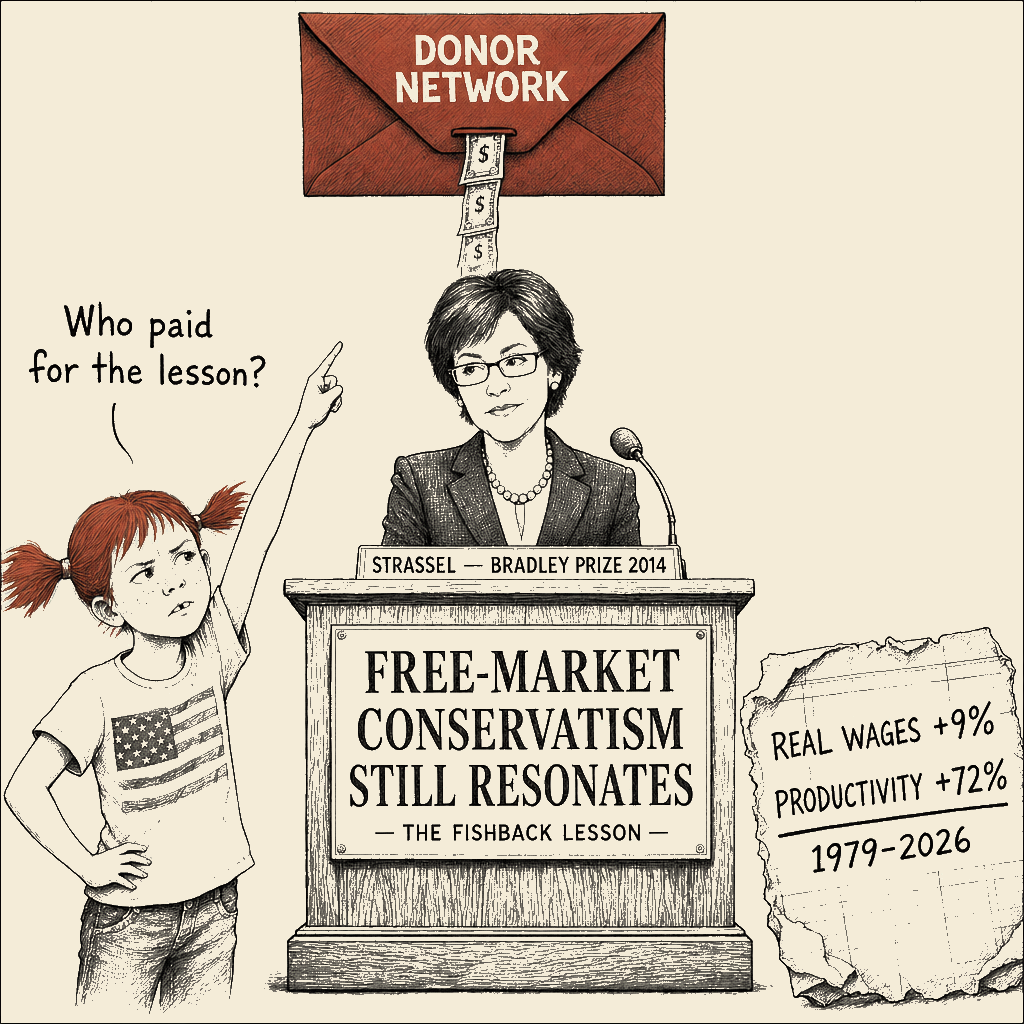
Responding to: The Fishback Lesson — Kimberley A. Strassel · 2026-08-19
What the Piece Argues
Strassel’s August 19 newsletter centers on a “Fishback Lesson” drawn from the August 18 Florida Republican gubernatorial primary, where Byron Donalds won with 49% of the vote while “uber-populist-right” challenger James Fishback finished with roughly 10%; the result is read as proof that “free-market conservatism still resonates” and that senior Republicans — Vice President Vance in particular — should abandon populist experimentation and return to donor-aligned orthodoxy. The same newsletter supports Trump administration rollback of the 2001 Clinton “roadless rule” as pragmatic, locally informed, and not the free-for-all critics claim, uses the Swalwell/Christine Fang FBI documents to argue Democrats “dodged a huge bullet,” and closes with assorted “good numbers” items (a former NIAID adviser’s guilty plea, FAA controller hiring, a Raytheon munitions contract, a Pennsylvania data-center order) and a Jamie Metzl quote pressing Democrats to disavow DSA politics. The throughline is that establishment conservative governance is working, populism (left or right) is failing, and the press is overhyping both phenomena.
Receipts
The Fishback Lesson is a donor-class press release dressed as a structural observation; the messenger’s institutional position is the receipt the column works to keep invisible.
-
The framing wants you to believe:
- “Free-market conservatism still resonates” is what the Florida GOP primary’s vote share means.
- “Republicans would do well to internalize the results” — the lesson is to stay the course on donor-aligned policy.
- JD Vance’s “populist” politics amount to “culturally conservative progressivism” — populism recoded as inauthenticity so the conversation returns to orthodoxy.
-
What’s really going on:
- Kimberley Strassel is a 2014 recipient of the Bradley Prize, awarded by the Lynde and Harry Bradley Foundation; the Foundation is publicly documented — through OpenSecrets, IRS Form 990 filings, SourceWatch, Mother Jones, and the State Policy Network’s own records — as part of the Koch-backed donor infrastructure that has coordinated the free-market-conservative project since the 1970s, funding the Federalist Society, Cato, Heritage, ALEC, and roughly 66 state-level think-tank affiliates plus 87 associate members (funders, advocacy groups, and Kochs’ Americans for Prosperity) via SPN.
- The Wall Street Journal Opinion section sits inside News Corp (Rupert Murdoch), whose editorial page has reliably defended the donor-class agenda across decades; the column is the donor-class’s defense function printed on newsprint.
- The populism-vs.-free-market binary hides the third option — that working-class interests lose under either when donor-class capture is intact — and is structurally engineered to keep the third option out of the conversation.
- The distributional record of the “still resonates” agenda: per EPI’s productivity-pay gap data (hourly compensation of production/nonsupervisory workers), real wage growth since 1979 has been less than 10%, while productivity (BLS nonfarm business sector output per hour) has grown roughly 70–75% over the same period; the gap is the extract the donor-aligned agenda runs on.
- The Vance recoding — “culturally conservative progressives” — is the donor class’s classic containment move against populist threat: rebrand the insurgent as inauthentic, return the conversation to orthodoxy.
The Response Ladder
Polite Reframe
When to use: The persuadable moderate or the good-faith family member who just cited Strassel approvingly over the dinner table. Use this when the audience is reachable by receipts and the goal is to make the donor-class framing visible without burning the relationship.
Marcus is a thirty-two-year-old diesel mechanic in Lakeland, Florida who voted for Byron Donalds in the Republican primary — not because he reads the Wall Street Journal editorial page, but because Donalds came to a VFW hall in his county and talked about restoring manufacturing work to Polk County. Marcus has heard “free-market conservatism still resonates” for twenty years; his real wages have been flat for a decade, his employer dropped his health-insurance contribution last year, he refinanced his truck loan twice to keep up with rent. The Fishback Lesson, as Kimberley Strassel of the Journal tells it, is that populism failed and Marcus’s team won. Here is what the column does not say.
Strassel, the author delivering the lesson, is a 2014 recipient of the Bradley Prize from the Lynde and Harry Bradley Foundation — a foundation publicly documented (OpenSecrets, IRS Form 990 filings, SourceWatch, Mother Jones, the State Policy Network’s own records) as part of the donor infrastructure that funds the free-market-conservative project. The Wall Street Journal Opinion section sits inside News Corp, whose editorial page has reliably defended that agenda across decades. So when Strassel tells us free-market conservatism “still resonates,” the audience she is polling is, in the most literal sense, her donors.
That is not a conspiracy. It is cui bono: follow the money. The free-market-conservative agenda Strassel defends has, per EPI’s productivity-pay gap data (hourly compensation of production/nonsupervisory workers), produced the largest sustained wage-productivity divergence in modern U.S. data since 1979: real wage growth less than 10%, productivity growth roughly 70–75%. The gap is the distributional extract the donor-aligned agenda runs on. “Still resonates” reads, on the record, as the donor class announcing its agenda survived a populist challenge — which it did — and that working-class voters should ratify the result.
The Fishback Lesson treats populism and free-market conservatism as the only two options. They are not. The third option — the one the binary is engineered to hide — is that working-class interests lose under either when donor-class capture is intact. You can reject Fishback’s bomb-throwing and still reject the donor-aligned agenda Strassel defends. Both can be true. Both are, on the distributional record, true. The lesson Strassel does not want Marcus to internalize is that the failure is not populism’s; it is the binary itself.
The honest question for the next election is not “populism or free-market conservatism?” It is “which agenda actually delivers for working households?” — and on that question, the donor-aligned answer has forty years of data to answer for.
Mockery and Ridicule
When to use: The bystander at the political argument. When you want the donor-class punchline to land so the repeater sees they were being used. Sharp, satirical, no cruelty to the rank-and-file Republican voter who showed up and voted.
Picture the editorial board meeting at the Journal. Kimberley Strassel has just filed a column warning Republicans against the dangers of populism. The man across the table — let’s call him a generic Bradley Foundation fellow, because the Lynde and Harry Bradley Foundation gave Strassel her 2014 Bradley Prize and is publicly documented as a node in the Koch donor ecosystem through the State Policy Network — nods approvingly. “Populism failed,” he says. “Free-market conservatism still resonates.” A third colleague points out that “resonates with” is doing a lot of work in that sentence. The first two men do not hear this third colleague. They are reading the next donor briefing.
This is the entire Fishback Lesson in one paragraph. The author has been awarded a prize by a foundation that funds the conclusion. The publication is owned by a company whose editorial page reliably defends the agenda. The “lesson” — that populism failed and the donor-aligned playbook won — is delivered by people whose institutional position is the donor-aligned playbook winning. The column is not reporting on the result. The column is announcing it.
The literalized image: imagine a horse race where one of the owners also owns the racing commission. The owner’s horse comes in first. The owner’s newspaper publishes a column the next morning declaring, “The Result Confirms That Some Owners Are Better Than Others.” The owner of the other horses — the populist insurgent, the Vance-flavored disruption, the bomb-thrower with 10% of the vote — is invited to reflect on how their populist energy failed to resonate. The owner of the first horse wins the race, gets to write the column about the race, and gets to tell the loser what the race meant.
This is not analysis. It is a press release in column form. And the press release is being printed in the most-read business publication in the country because the publication’s editorial voice is, institutionally, the press release’s intended audience.
For the rank-and-file Republican voter who showed up in the primary and voted their conscience: you were not the audience for this column. You were the prop. Strassel is not arguing that your vote mattered. She is arguing that your vote ratified her donors’ agenda. The Fishback Lesson is for the donors; the voter is just the receipt.
The third option, again, exists. Populism failed in this primary; populism often fails. Free-market conservatism also failed — it failed you for forty years, which is the structural fact Strassel’s column is engineered to keep you from naming. The lesson is not “stay the course.” The lesson is “the course was the problem all along, and the column telling you to stay on it was written by the people who own the course.”
Nuclear Satire
When to use: The reader who needs the full grotesque metaphor and the baroque indictment of the donor-class apparatus. The Twitter reply to the donor-class think-piece. The Substack comment section after the fourth one in a row.
The Lynde and Harry Bradley Foundation announced today that Kimberley Strassel has been re-awarded the 2014 Bradley Prize, retroactively and in perpetuity, in recognition of her distinguished service as the institutional human megaphone for the donor class. The award was presented at a ceremony attended by no actual working voters, by long-time Bradley board members, by representatives of the Koch donor network (with whom the Foundation is publicly documented as coordinating through the State Policy Network), and by the editorial board of the Wall Street Journal, which is owned by Rupert Murdoch’s News Corp and which has, for the forty-year duration of the Bradley-Koch donor project, reliably published columns defending the agenda the donors funded.
Strassel accepted the prize by publishing a column titled “The Fishback Lesson,” in which she used the result of a Florida Republican gubernatorial primary — where Byron Donalds won with 49% and the populist James Fishback got 10% — to warn Vice President JD Vance and other Republicans that populism is a dead end and free-market conservatism is the proven path forward. She did not disclose, in the column, that the institution awarding her the prize is a publicly documented node in the donor network whose agenda she was defending. She did not need to. The disclosure is the prize.
The column’s central thesis: populism failed, free-market conservatism won, voters should “internalize” the result. The populism-vs.-free-market framing is, of course, a binary that contains exactly one of the two failed options. The other failed option — donor-class capture, the agenda Strassel has spent her career defending, the agenda under which the median American household has seen its real wages grow less than 10% since 1979 while productivity has grown roughly 70–75% — is not on the ballot. It is not even on the menu. It is the restaurant.
Vance’s populism, in Strassel’s reading, “mostly sounds like culturally conservative progressives.” This is the donor class’s classic containment maneuver. When the insurgent threatens, rebrand the insurgent as inauthentic. When the disruptor arrives, recode the disruption as a copy. When the populist wins 10% of the vote in a primary, declare that populism has been weighed in the balance and found wanting. Do not, under any circumstances, allow the discussion to reach the question of whether the 49%-winner agenda has, in the four decades it has dominated the donor-funded press, produced anything for the working-class voter who actually cast the votes.
The grotesque metaphor: imagine a doctor who has spent forty years prescribing a drug whose side effects are visible in every patient who has taken it. The doctor is paid a yearly retainer by the drug manufacturer. Each year, the doctor publishes a column in the country’s largest business newspaper declaring that a new patient has arrived complaining of side effects, and that the lesson is the patient’s fault for failing to comply with the regimen. The drug manufacturer applauds. The doctor collects the retainer. The patient is sent home with the same prescription.
That is the Fishback Lesson. The drug is donor-class policy. The doctor is Kimberley Strassel, Bradley Prize recipient. The patient is the median American household. The prescription has not changed in forty years.
Profane Scorched-Earth
When to use: The full cathartic release. The reader who needs Malcolm at maximum register, with all expletives landed for force, every paragraph carrying a receipt, and the close still pointing toward what we build instead. The Substack reply that earns the catharsis.
Holy shit, the Lynde and Harry Bradley Foundation really gave Kimberley Strassel a goddamn prize in 2014 and then let her use the Wall Street Journal editorial page to lecture the entire Republican primary electorate about why populism is a fucking dead end while she omits that the motherfucking prize was paid by a foundation publicly documented as part of the Koch donor network that funds the entire free-market-conservative shit-show she is defending. Read that sentence again. Out loud. To another person. The author of the “Fishback Lesson” was awarded a prize by an institution that is on the fucking record as a node in the donor network whose agenda the column defends, and the column does not fucking mention it, because of course the column does not fucking mention it.
Let’s start with the Bradley Prize. The Lynde and Harry Bradley Foundation is publicly documented — OpenSecrets, Media Matters, the SPN’s own IRS filings, and the Foundation’s own annual reports all fucking confirm — as part of the State Policy Network, which is the Koch-network’s policy-shop clearinghouse. Charles Koch’s seminars in the 1970s produced the donor infrastructure the Foundation has spent forty goddamn years coordinating. The Koch network has written checks to the Foundation in the tens of millions. The Foundation has, in turn, funded the Federalist Society, the Cato Institute, the Heritage Foundation, the American Legislative Exchange Council, and roughly 66 state-level think-tank affiliates plus 87 associate members (funders, advocacy groups, and Kochs’ Americans for Prosperity) that turn out model legislation for Republican legislatures. Strassel took their prize in 2014. She has been carrying their water ever since. The water she is carrying this week is “free-market conservatism still resonates” — a sentence that, if you remove the bullshit, means “the donor class still has its columnists.”
Now the Wall Street Journal editorial page. The Journal is owned by Rupert Murdoch’s News Corp. Murdoch has spent thirty years consolidating a media empire whose editorial pages reliably defend the donor-aligned agenda his business interests benefit from. The editorial page that publishes Strassel is the same editorial page that published the Iraq War editorials based on fabricated intelligence, that defended the Bush tax cuts, that has spent four decades arguing that any regulation touching the donor class is overreach and any regulation touching the working class is overdue. The Journal’s institutional posture is not news; it is the donor-class defense function printed on newsprint. Strassel’s column is the function executing.
The Fishback Lesson, on its actual merits, is a fucking false binary. Populism ran, populism got 10%, populism lost. Fine. What the column does not say, because the column cannot fucking afford to say it, is that the winner’s agenda — the free-market conservatism that Strassel is endorsing — has been the operating ideology of the federal government for most of the last forty goddamn years, and the median American household has gotten fucking nothing out of it. Per EPI’s productivity-pay gap data, real wages up less than 10% since 1979. Productivity up roughly 70–75%. The gap is the fucking extraction. The gap is what Strassel is defending. The gap is what the donor class funded the Bradley Prize to protect. The gap is why Vance, for all his populist pandering, still sounds to Strassel like “culturally conservative progressives” — because the alternative to donor-class governance is structurally forbidden from existing in the conversation Strassel is having.
Vance recoded as “culturally conservative progressives.” That sentence is the whole goddamn playbook. The insurgent is recoded as inauthentic. The disruption is recoded as a copy. The threat is contained by being renamed. This is the donor class’s classic containment move, executed in a single sentence, by a writer whose institutional position is executing it for them.
The fucking doctor metaphor: a doctor is paid a retainer by a drug manufacturer. The drug has side effects visible in every patient. The doctor writes a column blaming the patient for the side effects. The patient is the median American household. The doctor is Kimberley Strassel. The drug is donor-class policy. The retainer is the Bradley Prize. The fucking column is this week’s installment.
You want to know what the Fishback Lesson actually is? Here it is, with the donor class’s clothes off: working-class voters were given a choice between a populist insurgent who would, maybe, do something for them, and an establishment candidate who will, certainly, do what the donors paid for. The populist got 10%. The establishment candidate won. Strassel published a column announcing the result. The donors paid for the announcement. The working-class voters were the fucking prop.
So the lesson, if you want a real one: both options have been failing you for decades. The populism failed in this primary. The donor-class governance has been failing you since Reagan. The Fishback Lesson is the donor class’s announcement that their option won. The lesson for working-class voters is that they are not on the ballot in either option, and they have not been for forty fucking years.
The arc does not bend on its own. It bends when specific people in a specific moment decide to push it, or it does not bend. The people who decide it will not be the donors. The people who decide it will not be the columnists. The people who decide it will be the ones Strassel spent this week trying to convince to internalize the result. Don’t internalize the result. Name what produced it. Name who funded the narrator. Name who benefits from the lesson. And then organize like the fucking thing depends on it, because it does.
About Malcolm Little King
Malcolm Little King is a heteronym in Main Street Independent's editorial architecture — an analytical voice, not autobiography of any actual person. The position this column expresses is the publication's position on the territory Malcolm Little King's lane covers, rendered through Malcolm Little King's register.