Responding to: The Lakers Are Up, Trump Is Down — Holman W. Jenkins, Jr. · 2026-08-21
What the Piece Argues
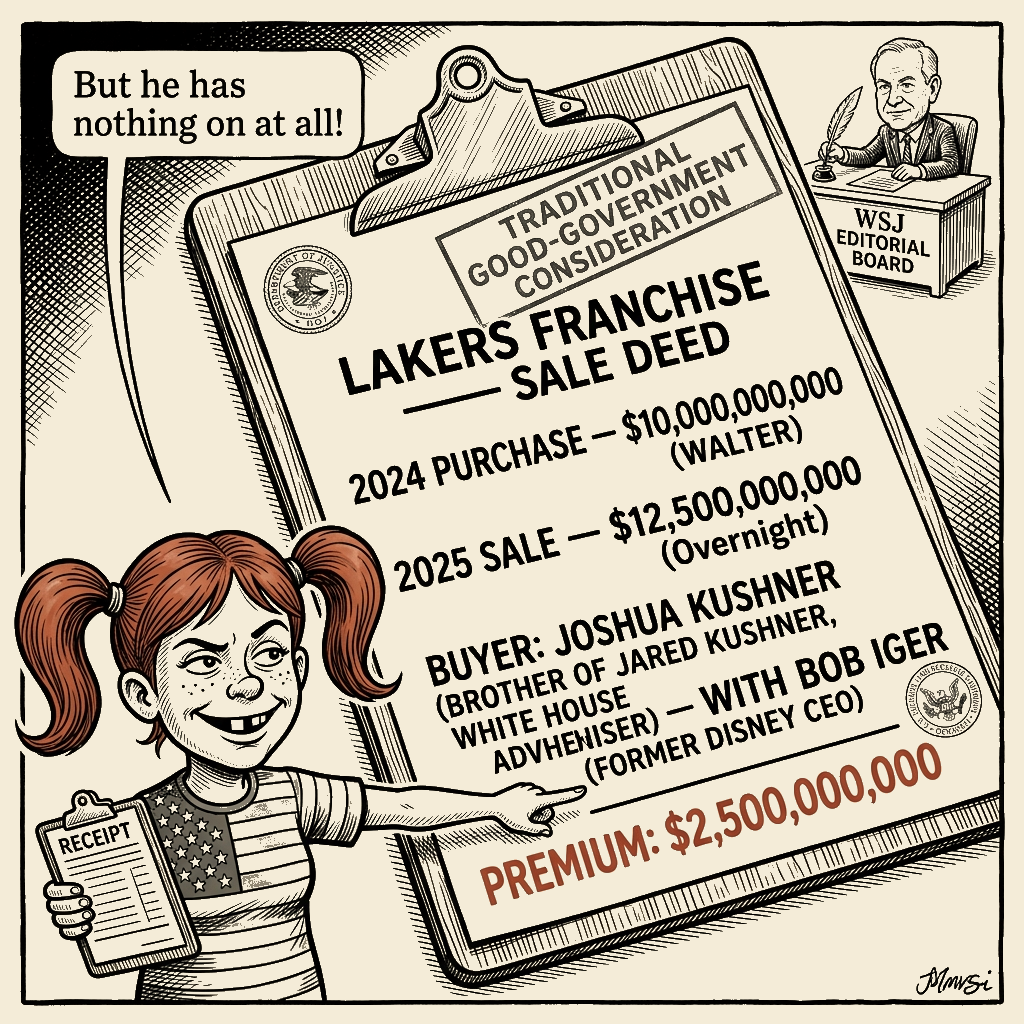
Holman Jenkins, writing for the Wall Street Journal editorial board, argues that Donald Trump is in accelerating “lame-duckery” — his approval and personal prestige have fallen (in Jenkins’s framing, after the “Iran bungle”), and his administration is starting to behave like a “normal government.” First, Disney has stood up to FCC intimidation of its ABC broadcast license over Jimmy Kimmel, which Jenkins interprets as business elites recognizing Trump’s diminished leverage. Second, and more substantively, Mark Walter sold the Los Angeles Lakers for $12.5 billion (a $2.5 billion premium over the $10 billion he paid a year ago) under pressure from Trump’s SEC and U.S. Attorney for SDNY, with the buyer being Joshua Kushner — brother of Trump’s son-in-law Jared Kushner — partnering with former Disney CEO Bob Iger. Jenkins describes this enforcement as “a traditional good-government consideration” and Trump’s silence on the deal as “the dog that didn’t bark” — proof, in his telling, that the President is becoming ordinary.
Receipts
Jenkins’s own framing lands the conclusion he wants you to take home: “Call it a down payment on what the world will feel like — less colorful but also less grating — when Mr. Trump is no longer president.” Earlier he sets the mechanism: “No, Disney’s courage didn’t go up. Mr. Trump’s approval ratings have gone down. So has his personal prestige amid the Iran bungle.” That is the entire spine of the column: a weather change read as courage.
What’s really going on is that the apparatus Jenkins describes — FCC intimidation, SEC enforcement timing, the family-member business conflicts he cannot stop name-checking — is the same apparatus that operated during the years of capitulation he now writes past. Disney’s “courage” is dated from the moment the cost dropped. The moguls aren’t standing up; they’re straightening their posture after a long bow.
- The framing wants you to believe that Disney “stuck up for its ABC broadcast network.” What Disney actually did, in late 2024 and 2025, was settle Trump’s defamation lawsuit against ABC News for a reported $15 million to Trump’s presidential foundation plus $1 million in legal fees, and ABC indefinitely suspended Jimmy Kimmel from his late-night show in September 2025, after FCC chair Brendan Carr threatened broadcast-license consequences over Kimmel’s comments on the Charlie Kirk killing. Jenkins credits Disney for the FCC lawsuit; he does not name the settlement that preceded it or the Carr-led pressure that produced the suspension.
- The framing wants you to believe that the SEC and SDNY enforcement against Walter is a “traditional good-government consideration” unconnected to Trump. What the framing omits is that the lead figures in the resulting transaction — Joshua Kushner, Jared’s brother, and Bob Iger, the former Disney chief — sit inside Trump’s family-and-friends network in ways the editorial page treats as charming coincidence.
- The framing wants you to believe that Trump’s silence on the Lakers sale is evidence of his decline. What the framing omits is that the FCC apparatus Carr runs — broadcast-license threats, cable-news ad-revenue pressure on sports leagues, the threat to NFL antitrust exemption — remains operational. “Lame duck” describes a politician’s prestige. It does not describe an apparatus.
- What’s really going on: the “system is correcting itself” framing is the editorial page’s way of vouching for the moguls who enabled the era. Disney settled Trump. ABC pulled Kimmel. Paramount-CBS paid Trump $16 million to settle a “60 Minutes” suit. The Paramount-Skydance merger was cleared by the FCC along partisan lines after Paramount had bent to Trump-administration concerns about CBS news coverage. Sports leagues were leaned on. Now that the political weather has shifted, the same moguls want the record to read that they were brave all along. The editorial page is helping them rewrite it.
The Response Ladder
Polite Reframe
When to use: A WSJ-opinion-reading uncle at Thanksgiving; a good-faith Republican who finds the “system is correcting itself” line plausible; a moderate persuadable on whether Trump’s decline is also the moguls’ vindication.
Picture an ABC affiliate producer somewhere in Florida. Last fall she watched a piece she had been working on for weeks — about a community-level story her newsroom cared about and her audience needed — get shelved after a network note that, on further review, the framing was “not aligned with our editorial moment.” The piece has not aired. She has not benefited from Disney’s newfound lawsuit.
That is the polite way to say what the WSJ editorial page is selling you this week. Holman Jenkins wants you to read Disney’s court filing against the FCC and conclude that the system is correcting itself. What the editorial page would prefer you not read is the chain that came before. In December 2024, Disney settled Trump’s defamation suit against ABC News for $15 million to Trump’s presidential foundation plus $1 million in legal fees. In September 2025, ABC pulled Jimmy Kimmel from his late-night show indefinitely, after FCC chair Brendan Carr made clear that broadcast-license consequences were on the table for the host’s comments on the Charlie Kirk killing. The corporate boardrooms didn’t suddenly discover backbone. They discovered that bowing had become more expensive than standing.
Then the political weather shifted again. Disney found its lawsuit. ABC got Kimmel back. And the editorial board of the Wall Street Journal wrote a column crediting the moguls for “sticking up” — without once naming what they had stuck up to, and when.
The polite version of this is: courage dated from the moment it became cheap is not courage. It is bookkeeping. There is a difference between courage and weather vane, and that difference matters when you are deciding who is entitled to the word.
You can want the SEC to do its job and still notice that the SEC did this particular job while a Kushner was on the buy side and Trump’s FCC chair was leaning on the sports leagues. You can welcome Disney’s lawsuit and still name the $15 million that made the lawsuit possible. You can call Trump a lame duck and still notice that lame ducks don’t lose the FCC. They just stop tweeting.
The system is not correcting itself. The system is being read out by the editorial page in the voice of the people who benefited from it. That’s a different story. It’s a story about which side of the bow you got to be on.
If you read the WSJ opinion page and you find the Jenkins column reassuring — that’s a sign the work of holding the moguls to the record of what they actually did is unfinished. It’s not too late to do it. It’s only too late if you let the editorial page write the eulogy for them as heroes.
Mockery and Ridicule
When to use: For the bystander who watches the dance. The satirical extraction that strips the euphemism off “traditional good-government consideration.” For the friend who forwards the column with a wink and wants the response that lands the joke and lands the cut.
Imagine this.
You are the proud owner of the Los Angeles Lakers, a team associated with Magic Johnson, Kareem Abdul-Jabbar, Kobe Bryant, and LeBron James — a hunk of American cultural patrimony you bought a year ago for ten billion dollars.
One day, two of the president’s agencies — the Securities and Exchange Commission and the U.S. Attorney for the Southern District of New York — call to ask about some loans. Nothing too dramatic. Just, you know, accounting questions. The kind any administration asks. We’re told.
You decide — entirely on your own, prompted by nothing in particular — to sell the team. Overnight. To a buyer who happens to be the brother of the president’s son-in-law, who is partnering with the former head of Disney, whose broadcast license the same president’s FCC has been threatening. For two and a half billion dollars more than you paid. In an industry where, the column itself concedes, “it was impossible to make a move without triggering Mr. Trump” until recently.
The Wall Street Journal editorial board wants you to look at this picture and see “a traditional good-government consideration.” Holman Jenkins, a member of that board and a 1997 Gerald Loeb winner, wants you to see “nothing fishy.” He wants you to see Trump’s silence on the deal as “the dog that didn’t bark” — proof that the President is becoming a “normal government.”
Lakers fans: the WSJ is telling you the man your president leaned on to sell your team to his own family is now behaving normally because he had the decency not to tweet about it. The same DOJ and SEC that did the leaning.
The dog didn’t bark, Holman. The dog ate the homework. The dog got a two-and-a-half-billion-dollar commission. The dog is now the proud co-owner of an NBA franchise purchased alongside the head of the network whose broadcast license was under threat from the dog handler’s FCC chair.
In a free country, this is what they call a confession. In the Wall Street Journal editorial page, they call it “the dog that didn’t bark.”
Nuclear Satire
When to use: For the reader who wants the institutional critique at maximum force. Apex of villainization. Grotesque metaphor, hyperbolic comparisons, full identity inversion — while the receipts stay verifiable.
This is what the arrangement of a modern American kleptocracy looks like when it bothers to put on pants.
The script: the President of the United States, having spent four years exercising control over the Department of Justice, the SEC, the FCC, and the IRS as if these were personal instruments, decides that a particular billionaire — a man who bought the Los Angeles Lakers a year ago for ten billion dollars — has something the President wants. Maybe it’s leverage. Maybe it’s just the principle that no American of consequence makes a major move without the President getting his cut. The agencies of state lean. The SEC opens an inquiry. The U.S. Attorney in Manhattan — Trump’s U.S. Attorney in Manhattan — opens an inquiry. The FCC, separately and conveniently, reminds the sports leagues whose broadcast revenues keep Trump’s beloved 24-hour news channels alive that the President expects them to stay where he can see them.
The seller, presented with the message, sells. To a buyer of the President’s choosing. The brother of the President’s son-in-law. Whose partner in the deal is the former head of the company whose broadcast license was simultaneously under threat. The price is two and a half billion dollars over what the seller paid a year ago. The transaction happens overnight. The premium is the fee. The fee is the price of being allowed to leave the room with the rest of your empire.
The Wall Street Journal — that temple of free-market probity, that stern guardian of the line between commerce and state — runs a column on this transaction by Holman Jenkins, a member of its editorial board, a 1997 Gerald Loeb winner, a 30-year veteran of the opinion page. Jenkins names every fact above. He names the brother’s family relationship. He names the FCC chair. He names the Disney executive. He names the cable-news prop-up. He names the rushed overnight sale. He even uses the word “servile” to describe Trump’s FCC chair.
Then he tells you the enforcement was “a traditional good-government consideration.” He tells you “nothing fishy” is going on. He tells you Trump’s silence is “the dog that didn’t bark.” He tells you the President is becoming “a normal government.”
The dog didn’t bark. The dog took the meat off the table, walked across the kitchen, climbed into bed with the family, and is now licking its chops in the morning light. The dog is now the Lakers. The dog is now part of the family business. The dog is what “becoming a normal government” looks like when the President’s family is the customer and the Department of Justice is the cashier.
And the Wall Street Journal — the Wall Street Journal — wants you to read this picture and call it normal.
This is what corruption looks like when it has been laundered through four years of practice into the prose style of the Wall Street Journal editorial page. It looks like restraint. It looks like silence. It looks like the dog that didn’t bark. It looks, in the end, like a column by Holman Jenkins telling you that nothing is fishy about the President of the United States using his Department of Justice and his Securities and Exchange Commission to engineer the sale of an American basketball team to his own family’s brother-in-law.
Profane Scorched-Earth
When to use: For the reader who needs catharsis — the one who has been holding this in, who wants the gloves-off version. The full expletive arsenal; the receipts spine stays intact; one canonical source cited.
Holman Jenkins, a 30-year member of the Wall Street Journal’s editorial board, wrote a column this week explaining to his readers that there is “nothing fishy” about the President of the United States leaning on the Department of Justice and the Securities and Exchange Commission to pressure the owner of the Los Angeles Lakers into selling the team — overnight, in a rushed deal, at a two-and-a-half-billion-dollar premium — to the brother of Trump’s own fucking son-in-law.
Read that again. Slowly. Out loud.
The President’s DOJ. The president’s SEC. The seller’s duress. The buyer who is the President’s family. The premium that is the price. And the Wall Street Journal — the Wall Street Journal, the self-proclaimed guardian of the line between private power and state power — writes the column that says “nothing fishy” and “traditional good-government consideration” and “the dog that didn’t bark.”
Jenkins is not a stupid man. Jenkins is a Gerald Loeb winner. Jenkins joined the Journal in 1992 and has been writing the Business World column for years. He knows what corruption looks like. He knows what a quid pro quo looks like. He knows what using the machinery of state to extract a private benefit for the President’s family looks like. He has read enough history to know that this is what the word “corruption” was invented to describe.
And he wrote the fucking column anyway.
The DOJ leaned on Walter. The SEC leaned on Walter. The FCC — separately, under Trump’s “servile” chair Brendan Carr, in Jenkins’s own description — was already leaning on sports leagues to keep their games on cable news to prop up the 24-hour Trump channels. The buyer is Joshua Kushner, brother of Jared Kushner, Trump’s son-in-law and White House adviser. The co-buyer is Bob Iger, former head of Disney, the same company whose ABC broadcast license was under threat from the same administration’s FCC. The sale happened overnight. The premium was two and a half billion dollars. The deal was, in Jenkins’s own framing, “tabloid sensation” material that Trump would “normally” have barged into the middle of — except this time he didn’t, because his family was the buyer.
And the column wants you to read all of this and call it fucking normal.
The dog didn’t bark. The dog ate the homework, fucked the other dog, and is now sleeping on the bed. The dog is now the proud co-owner of the Los Angeles Lakers, a franchise that will be passed down in the Trump family orbit like the Trump Hotel and the Trump Foundation and the Trump University — except this one isn’t even in Trump’s name. It’s in his family’s name. The grift has gotten subtle enough that the Wall Street Journal editorial board will write the fucking press release for you.
Frederick Douglass, in an 1852 speech at Corinthian Hall in Rochester, asked: “What, to the American slave, is your Fourth of July?” Douglass answered: a day that reveals to the enslaved person “the gross injustice and cruelty to which he is the constant victim,” and to the enslaver, “a thin veil to cover up crimes which would disgrace a nation of savages.”
There is a question for our time, and Holman Jenkins answered it this week. The question is: what, to a country whose President can lean on the DOJ and the SEC to extract a two-and-a-half-billion-dollar Lakers sale for his own family, is the Wall Street Journal editorial page? And the answer Jenkins wrote is the same answer Douglass gave in 1852. The editorial page is the thin veil that covers up crimes which would disgrace a nation of savages.
Jenkins names every fact. Jenkins describes Trump’s FCC chair as “servile.” Jenkins describes the cable-news prop-up. Jenkins names the family relationship. Jenkins names the price. And then Jenkins writes “nothing fishy” and “traditional good-government consideration” and “the dog that didn’t bark.”
The thin veil is thin. The crimes are the crimes. The savages are the Wall Street Journal editorial board, and the slavery is yours, and your Lakers, and your Department of Justice, and your Securities and Exchange Commission, and your two-and-a-half-billion-dollar premium paid overnight to the President’s family.
There is nothing fishy. There is everything rotten. And Holman Jenkins wrote the fucking column.

About Malcolm Little King
Malcolm Little King is a heteronym in Main Street Independent's editorial architecture — an analytical voice, not autobiography of any actual person. The position this column expresses is the publication's position on the territory Malcolm Little King's lane covers, rendered through Malcolm Little King's register.