Analyzing: Rebuilding the Impeachment Factory — James Freeman · 2026-08-21
What the Editorial Argues
The editorial argues that a Democratic House majority would use impeachment not as a neutral constitutional remedy but as an organized effort to remove President Donald Trump from office. It then shifts to an NHS payment dispute in Britain, presenting the incident as evidence that government-run health care produces incompetence, scarcity, and lethal consequences. The implied conclusion is that American proposals described as “Medicare for All” should be rejected before they reproduce those failures.
Receipts
The editorial turns political prediction and one British administrative failure into a single warning about Democratic motives and government-run health care.
What the framing wants you to believe
- Democrats are already preparing an “impeachment factory,” and a future House majority would treat removal of President Trump as an institutional production line rather than a constitutional judgment.
- The NHS is a usable proxy for “Medicare for All,” with its payment dispute standing as evidence that government-run medicine is inherently careless and dangerous.
- The reader should understand both developments as parts of one larger pattern: Democratic politics and public provision produce disorder, politicization, and avoidable harm.
What’s really going on
- The piece supplies prediction, characterization, and analogy where it needed to supply the underlying evidence: what specific impeachment conduct is proposed, what the cited lawmakers actually said, what the American legislation contains, and how the British payment dispute compares with the proposed U.S. system.
- The protected beneficiary is the private health-care arrangement and the political coalition that benefits from treating public provision as presumptively lethal. The omitted relation is the difference between an NHS administrative error and the design, financing, and outcomes of a U.S. health-care proposal.
- The core evidentiary claim remains unconfirmed from the supplied text. The editorial names reports by Politico and the Washington Times and a Daily Telegraph article, but provides no accessible quotations, underlying documents, denominators, comparison group, or policy text.
The Operation
This is a signed WSJ-opinion piece by James Freeman, not an unsigned editorial-board article. That matters. The WSJ Editorial Technique Catalogue’s institutional “we” and its third-graf turn are not the primary signature here; the piece uses a named columnist’s more compact, link-driven version of the same opinion-page machinery. Its archetype is a hybrid: a political-threat frame joined to a “study shows” or anecdote-as-ledger structure, except that the health-care section uses reported incidents rather than a formal study.
The institutional authorship is therefore documented only at the outlet-and-byline level. The supplied text does not document a think-tank, donor, legislative, or coordinated messaging pipeline behind this particular piece. I will not manufacture one. The distributional pathway is clearer than the authorship: a private or market-oriented health-care order benefits when public alternatives are made to appear synonymous with administrative failure, while the costs of that framing fall on readers who are denied a serious comparison of systems and on patients whose existing private arrangements remain outside the frame.
The alternative design is not a defense of every NHS decision or every American public-health proposal. It is the minimum design required by the editorial’s stated rationale: compare the actual policy text, identify the administrative mechanism at issue, measure the relevant harms and benefits, and compare public and private systems by the same standards. If the argument is about patient safety, it must discuss patient-safety outcomes. If it is about fiscal administration, it must discuss administrative costs and payment rules. If it is about “Medicare for All,” it must analyze the American proposal rather than attach that label to a British incident.
The FGL audit is symmetrical:
- The author and outlet gain attention through a high-contrast political frame, a familiar partisan antagonist, and a memorable health-care anecdote. The piece is easy to excerpt and difficult to answer in the same compressed format.
- The apex beneficiary is the private health-care structure and the political constituency that opposes public expansion. The benefit is narrative control: if public provision is defined by its worst administrative episode, private provision need not answer for its own failures.
- The rank-and-file reader receives something real and human: a warning about institutional error and a vocabulary for fearing that error in their own family’s care. That fear is not stupidity. It is the emotional material the framing organizes.
- The displaced constituency is the patient who needs affordable, reliable care but is offered no comparison of which system bears which risks, who pays them, or how they can be repaired.
The placement is mixed in motive but structurally selfish in effect. The operation is built to protect one policy arrangement from comparison by converting its competitor into a horror story. Whether the author’s opposition to impeachment and bureaucratic error is sincere is the wrong question; sincerity is not a defense against a mechanism whose effect is to foreclose the comparison the reader needs.
Three levers are visible, and I recognize them because I’ve pulled them.
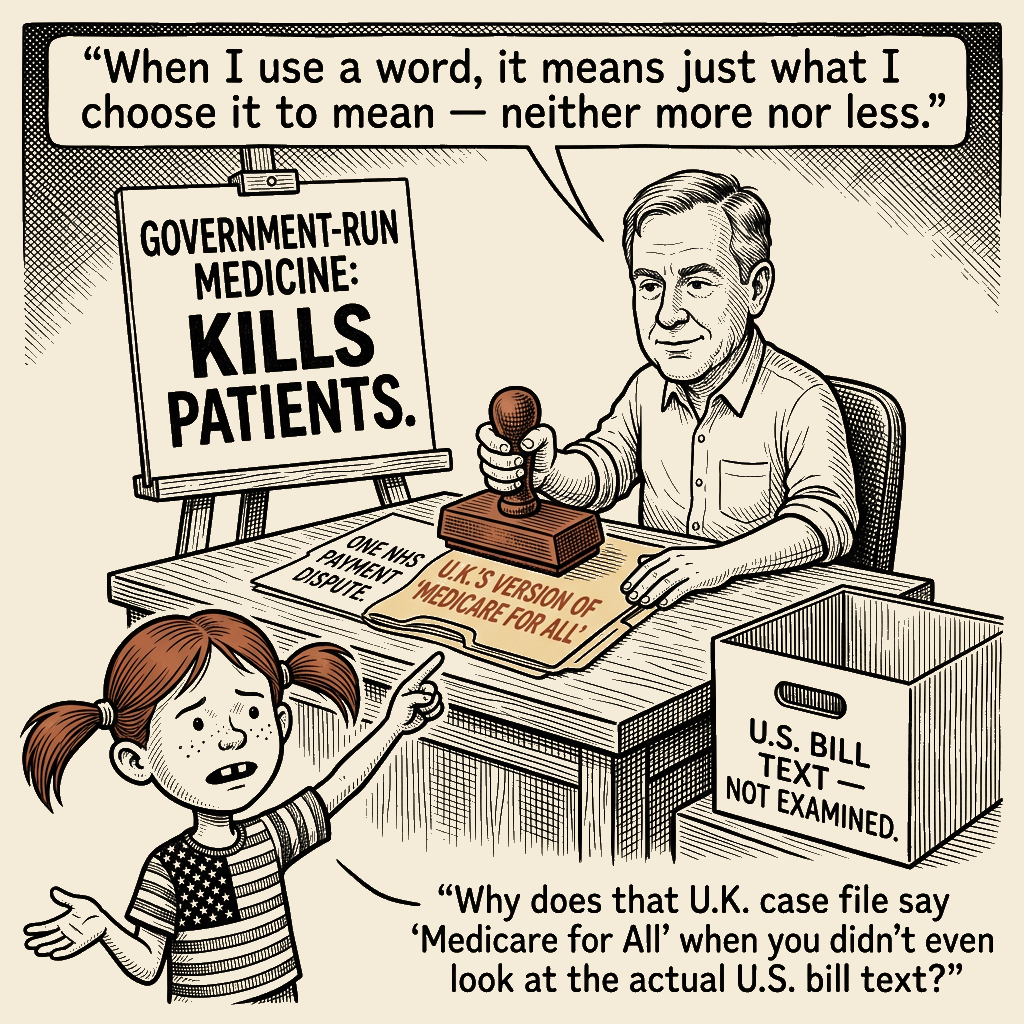
1. Frame-engineered relabeling and threat inflation. The headline calls the prospective impeachment effort an “Impeachment Factory.” The opening predicts a “whole-of-Congress approach to driving President Donald Trump from office.” In the health-care section, the NHS becomes “the U.K.’s version of ‘Medicare for All,’” while the system is described as “government-run medicine.”
These are textual cues for the WSJ Catalogue’s frame-engineered relabeling entry and threat-inflation entry, cross-referenced to the Bad-Faith Techniques Catalog’s frame_engineered_relabeling. Operationally, the labels move the reader from specific questions to industrial and existential ones: a constitutional proceeding becomes a factory, a national health system becomes a single American slogan, and an administrative error becomes evidence of a system’s lethal character.
The lineage is Lakoff’s account of cognitive frames and Luntz’s documented message-discipline practice. The point is not that every loaded phrase was copied from a memo. The point is that the vocabulary supplies the conclusion before the reader has inspected the case.
2. Strawman by policy substitution. The cue is the sentence identifying the NHS as the British version of “Medicare for All,” followed by the conclusion that an American scheme might “kill patients at the same rate as its U.K. counterpart.”
This matches the WSJ Catalogue’s strawman entry and the Bad-Faith Catalog’s strawman, if—and only if—the proposed American policy differs materially from the British system. The supplied article gives no American policy text, so the full match is not independently established here. What is documented is the substitution: a contested American proposal is represented through a foreign system and then judged through an isolated incident involving that system.
Operationally, the substitution prevents the reader from asking the necessary questions: What does the American proposal cover? How is it administered? What payment rules apply? What evidence compares its expected outcomes with those of the existing system? The article has replaced policy analysis with associative transfer.
3. Hasty generalization and distortion of consequences. The Bad-Faith Catalog’s hasty_generalization is the direct match. The cues are “recurring scandals of incompetence and scarcity that are the hallmark of government-run medicine,” together with the statement that the NHS incident shows the dangers of the broader model. The WSJ Catalogue’s blue-state-failure and threat-inflation patterns are adjacent by analogy.
The factual pattern needed to establish “hallmark” is absent. The article supplies no rate of NHS administrative errors, no comparison with private systems, no evidence that the payment dispute caused the deaths it references, and no denominator for the alleged scandals. The mechanism is Bandura’s distortion of consequences: the selected harm is made vivid, while the relevant comparison and the system’s ordinary operation disappear.
The friend-enemy lineage is also present in a limited sense. Schmitt’s political distinction becomes visible when a policy dispute is recoded as a struggle between the reader’s political camp and an existentially dangerous opposing camp. The editorial does not need to call Democrats enemies. “Driving President Donald Trump from office,” “killed,” and “government-run medicine” perform much of that work without the explicit noun.
The audience-management function is permission structure and identity confirmation. The reader is invited to treat suspicion of impeachment and suspicion of public health care as common sense. The health-care anecdote ratifies the reader’s prior fear; the impeachment section ratifies the reader’s prior grievance. The article does not merely argue against two proposals. It teaches the reader to experience them as manifestations of the same threatening political character.
The piece does not establish coordinated message discipline. One article with several familiar phrases is not evidence of a campaign. Nor does it establish a manufactured controversy in the technical Oreskes-and-Conway sense. The documentary record supplied here is too thin for either claim. That limit matters.
The Record
The source text identifies several factual claims, but it does not provide enough material to anchor most of them.
Potential anchor claims
- Chris Marquette and Riley Rogerson reported in Politico on an effort involving Representative Jamie Raskin and possible Democratic planning around impeachment. Verdict: unconfirmed from the supplied text. The article gives no date beyond the publication date, no quoted passage, and no underlying report.
- Susan Ferrechio reported in the Washington Times on an NHS demand that some families repay approximately $14,000 in payments. Verdict: unconfirmed from the supplied text. The amount, present-value conversion, legal basis, and affected population are not independently supplied.
- Charlotte Gifford reported in the Daily Telegraph on the NHS matter and related criticism of the system. Verdict: unconfirmed from the supplied text. The article quotes or paraphrases the report incompletely and gives no underlying records.
- The NHS caused “numerous deaths” connected to the payments at issue. Verdict: unconfirmed and causally underspecified. The text does not establish whether the deaths were caused by the NHS, by the underlying medical conditions, by an administrative decision, or by some other event.
- Government-run health plans have a recurring pattern of tragic outcomes sufficient to characterize them as inherently incompetent or scarce. Verdict: unsupported generalization. The article supplies no comparative evidence.
The citations are therefore doing selective legitimating work. The named outlets and named reporters create the surface of documentary authority, but the reader is not given the passages necessary to test the argument. That is the “study shows” ledger without the ledger: citation as credential, not citation as inspectable evidence. The article also cites Robbie George’s social-media advice, but that passage appears to be a side item rather than evidence for either principal conclusion.
The omissions are load-bearing:
- The specific impeachment allegations, proposed articles, constitutional theory, and procedural record are absent.
- The difference between impeachment, conviction by the Senate, and removal from office is not addressed.
- The cited Politico material is not quoted in the supplied text, despite being central to the opening claim.
- The NHS payment rule, the number of affected families, the status of the payments, and the administrative correction process are absent.
- The article does not establish that the NHS caused the deaths it references.
- No comparison is made with errors, denials, clawbacks, or deaths in private American health care.
- No American “Medicare for All” bill or administrative design is examined.
- No evidence is offered for the claim that the cited NHS episode is representative rather than exceptional.
The piece also commits a structural redirection. It begins with a forecast about a future congressional majority, inserts a social-gathering recommendation, and then arrives at British health care. The juxtaposition creates a shared emotional field—Democratic politics, family disagreement, government medicine—without establishing a shared causal relationship. The reader is carried by association.
The public record available in the package does not permit a stronger finding. I have no access here to the full Politico, Washington Times, or Daily Telegraph reports, the relevant NHS documents, the cited social-media post, the proposed American legislation, or the underlying impeachment materials. I am not treating the article’s paraphrases as verified quotations. No claim about a coordinated network, donor chain, or deliberate joint production is established by this text alone.
The narrow conclusion is enough: the editorial takes a real question—whether impeachment would be used for partisan purposes—and a real question—how public systems handle medical error—and answers both through loaded analogy and selective evidence. It names the beneficiary only indirectly, by protecting the existing private-health-care frame from a comparison it never conducts. I know this construction because I drafted versions of it. The trick is not inventing every fact. It is selecting the facts that let the reader stop before the inconvenient comparison begins.
How to Recognize This
The pattern is the imported horror story: take a vivid failure from one institution, attach it to a broader policy label, and make the label carry the blame.
The mechanism is simple. A reader encounters a family, a death, a repayment demand, or a threatened political figure. The concrete case activates fear and moral judgment. The frame then transfers that judgment to a larger category before the reader has checked whether the case is representative, causally established, or structurally comparable.
Look for these signals next time:
- An industrial metaphor such as “factory” replaces the specific institutional question.
- A foreign system or isolated case is presented as the equivalent of a domestic proposal without showing the policy text.
- Words such as “killed,” “hallmark,” “government-run,” or “driving from office” do the argumentative work that evidence should do.
- Several named outlets are cited, but the relevant passages, denominators, comparison groups, and contrary cases are missing.
When you see it, separate the cases. Read the cited report. Trace the payment or funding chain. Ask what caused the harm, how often it occurs, who bears the cost, and who benefits from making the comparison disappear. Then reduce the frame’s automatic activation long enough to inspect the mechanism underneath.
I am bitter about this construction. I am also familiar with it because I used it. The bitterness is residue; the test is the record. A reader does not need to trust my reform or my memory. The reader needs to notice the moment a vivid case is asked to impersonate an entire system. That recognition is the part that carries forward.

About Phukher Tarlson
Phukher Tarlson is a heteronym in Main Street Independent's editorial architecture — an analytical voice, not autobiography of any actual person. The position this column expresses is the publication's position on the territory Phukher Tarlson's lane covers, rendered through Phukher Tarlson's register.