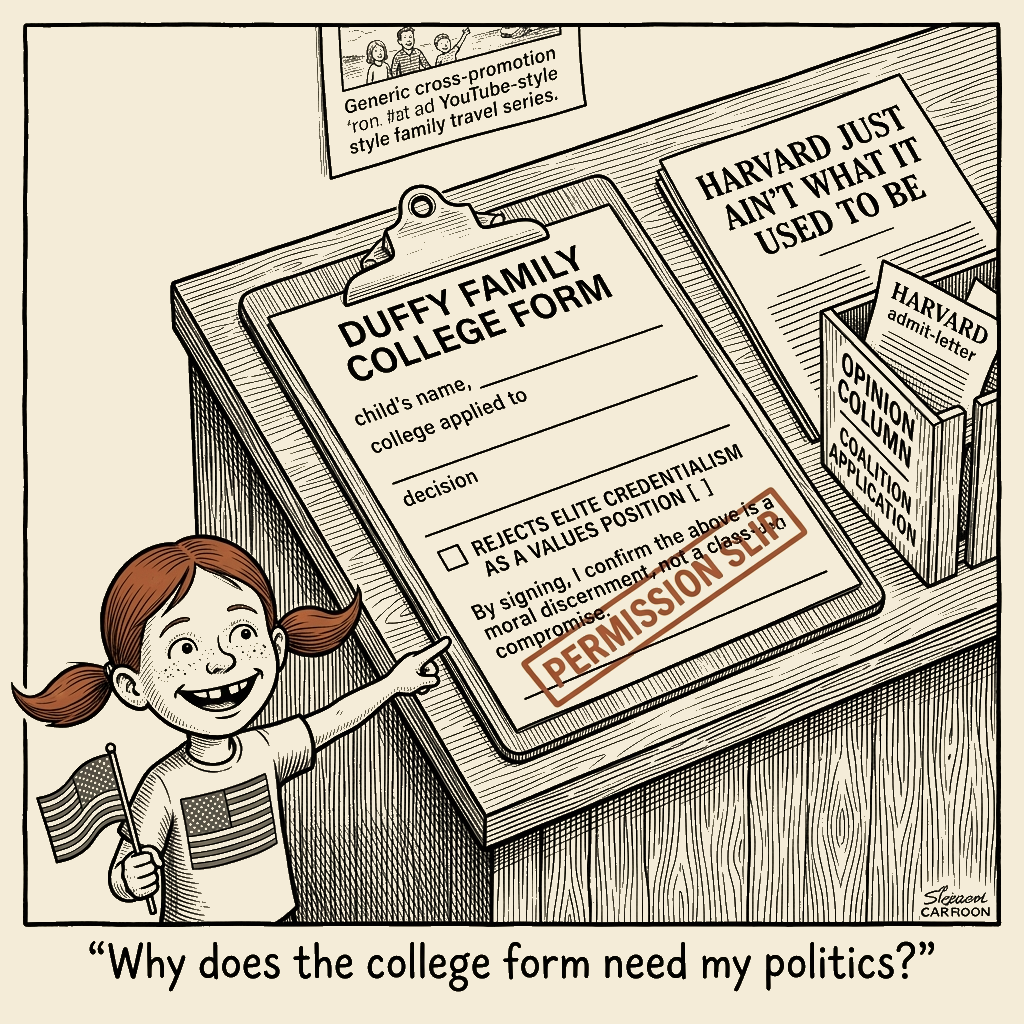
Analyzing: DAVID MARCUS: Transportation Secretary Duffy is right; Harvard just ain’t what it used to be — David Marcus · 2026-08-21
What the Editorial Argues
David Marcus uses Transportation Secretary Sean Duffy’s reported decision to discourage his daughter from attending Harvard as a launching pad for a broader indictment of elite American higher education. The piece argues that once-venerable Ivy League institutions have abandoned intellectual rigor in favor of progressive activism and DEI-driven admissions, with Harvard as the exemplar — students don’t read, professors indoctrinate, antisemitism festers, unqualified students of color are admitted through lowered standards, and the result is a credential that signals corruption rather than excellence. Marcus anchors the conservative critique in legitimate tradition by citing Buckley’s God and Man at Yale, then deploys a string of current examples (an antisemitism lawsuit settlement, a NYT report on students not reading, a plagiarism accusation against Harvard’s DEI officer, and the case of “Gustavo Gordillo”) to argue that honest parents have no choice but to look elsewhere — at schools like Hillsdale or state universities like Florida and Miami. The piece closes by inviting the reader into that parental-choice gesture as a moral act. The column is doing this for one audience: the Fox News opinion reader, parent-coded, suspicious of elite institutions, looking for cultural ratification rather than policy analysis.
Receipts
What the framing wants you to believe:
- Harvard and the Ivies have decayed into ideological indoctrination factories that produce activists rather than educated people, with DEI as the structural cause.
- A Cabinet secretary’s parental decision is a reliable proxy for that decay, and the parents who reach the same conclusion are exercising legitimate moral discernment.
- The non-Ivy alternatives are producing more competent and less indoctrinated graduates, and a Harvard degree no longer signals anything a West Virginia or Penn State degree doesn’t.
- Parents who send their children to elite schools are complicit in their corruption; the appropriate response is withdrawal — to alternative institutions, state universities, or homeschooling.
What’s really going on:
- The column is a permission-structure operation. The Duffys — a sitting Cabinet secretary and a Fox host — give the audience of Fox parents a public, prestigious, family-values frame in which rejecting the Ivy is presented not as compromise but as moral discernment. The Duffys’ Great American Road Trip YouTube channel is the originating artifact; Marcus is doing the editorial laundering of a content asset Fox already controls.
- The factual scaffolding is thin: a settled lawsuit and a single NYT-reported phenomenon are used to characterize a generation of an institution’s students, and one named individual stands in for an entire admissions category. The column does not engage what Harvard still produces in research output, employer demand for its graduates, or the documented selectivity of its admissions; the column does not need to.
- The column substitutes loaded vocabulary (“progressive slop,” “barnyard,” “snot-nosed Marxist,” “commie summer camp,” “pencil-mustached communist”) for actual analysis of higher education’s documented structural problems, and conflates several distinct issues (antisemitism, grade inflation, DEI admissions, ideological faculty, student disengagement) into a single “civilizational collapse” narrative that obscures rather than illuminates their causes or fixes.
- The piece normalizes a working-class grievance against elite credentials as a values position rather than as a structural critique, and elevates Fox-coded alternatives without engaging the asymmetric resources those institutions command or the asymmetric political infrastructure that produces them.
- Anchor for the core claim: Harvard and Students Against Antisemitism (along with the Brandeis Center and Jewish Americans for Fairness in Education) settled the Jewish-students lawsuit in January 2025, with Harvard adopting new nondiscrimination policies for Jewish and Israeli students; the NYT has published reporting on student disengagement at elite universities; the plagiarism accusations against the DEI officer were reported by the Boston Globe; Gustavo Gordillo’s backstory (Yale art degree, parents’ ~$1.5M Brooklyn home, failed electrician apprenticeship after ghosting his employer, DSA leadership) is documented across multiple outlets.
The Operation
Cui bono.
Institutional authorship. Fox News Opinion, with the column embedded with at least five hyperlinked Fox News headlines that function as both evidence and recirculation engine: “SEAN DUFFY FACES FAMILY DILEMMA OVER EMBATTLED IVY LEAGUE SCHOOL AND CHRISTIAN VALUES,” “HARVARD STUDENTS REVOLT OVER NEW GRADING POLICY THEY CALL ‘RACIST’,” “JUSTICE DEPARTMENT ZEROES IN ON UCLA FOR ALLEGED ILLEGAL DEI ADMISSIONS AS ELITE SCHOOL CRACKDOWN EXPANDS,” “SOCIALISM’S CAMPUS APPEAL MEETS GEN Z RESISTANCE AS STUDENTS KEEP SCORE ON COMMUNISM,” and the file-line credits to Fox News Digital and USA Today Network. The piece sits within a coordinated conservative-media narrative about higher education that includes outlets like National Review, the Washington Examiner, and the Daily Wire — a recurring theme since the late 2010s. The lineage runs through Buckley’s 1951 God and Man at Yale, which Marcus invokes explicitly to anchor the contemporary critique in legitimate tradition; the technique is the same (elite university as ideological enemy), the targets have shifted (from “collectivism” to “wokeness” to “DEI”), and the deployment mechanism has industrialized.
Distributional impact:
- Apex beneficiary: the right-wing media ecosystem (clicks, subscriptions, advertising revenue), which now has a written column to attach to the Duffys’ broadcast content and a Harvard-decline narrative that fits cleanly into the existing cultural-war package.
- Rank-and-file beneficiary: the Fox audience, which receives a permission structure for declining-or-distrusting elite credentials for their children and a values-ratification narrative for already having done so.
- Institutional beneficiaries: Hillsdale College (the 1776 Curriculum, online diploma programs, nationwide donor base substantially funded by DeVos-aligned philanthropic networks) is not merely a rhetorical beneficiary but an institutional alternative the column is implicitly advertising; DeSantis’s higher-ed reforms function as both political brand and policy infrastructure (Florida’s state college system as model for other red states). The column advances both at once.
- Cost-bearers: Harvard itself, named as the institution in civilizational decline and not in the piece as anything other than degraded; elite institutions more broadly, positioned as ideologically captured and educationally bankrupt; students from underrepresented backgrounds who are painted as beneficiaries of “lowered standards” rather than as competitive admits; the “honest, hard-working students” the column name-checks in its closing paragraph but does not actually address as a policy question — the working-class student admitted to Harvard on effort who is denied the credential the column says is now worthless, then has to defend the credential’s actual market value in job-market terms; the broader public’s understanding of the actual causes of higher education’s documented problems (tuition model, governance, administrative bloat, federal research-and-aid policy, state disinvestment in public universities) — bipartisan structural issues the frame deliberately obscures because naming them would dilute the “elite universities are uniquely woke” narrative.
Alternative design. If the column’s stated goal were genuinely improving educational quality, the interventions would look very different, and the contrast is worth spelling out because it exposes what the frame forecloses. Accreditation reform would target regional accreditors’ failure to enforce student-outcome metrics, transfer-credit portability, and cost discipline; the frame cannot accommodate this because the same accreditor that tolerates ideological monoculture at Harvard also tolerates administrative bloat at regional state universities, but only the former serves the column’s enemies. Public-university reinvestment (the bipartisan state-disinvestment story — Republican and Democratic legislatures alike have cut per-student funding for decades) is structurally incompatible with the frame’s apex-beneficiary analysis; DeSantis’s Florida reforms would themselves be vulnerable to the same critique if applied consistently, since they trade one ideological direction for another. Faculty governance reform would address the tenure system, the lecturer/contingent labor split, the administrative-to-faculty ratio, and the closed departmental search process; none of these are uniquely elite-university problems. Federal research-and-aid policy (Pell Grants, federal loans, NIH/NSF/DOE funding) shapes university behavior more than any internal reform could, and the current federal apparatus — under the same administration Duffy serves — is using these levers as enforcement tools against universities it disfavors (the DOJ-on-UCLA link Marcus embeds is itself evidence of this apparatus, not of student grievance). The pattern: every actual reform pathway either breaks the frame’s premise (the problem is not uniquely elite universities) or implicates the frame’s beneficiaries (the people attacking Harvard are the same people operating federal enforcement against Harvard). The column’s frame is therefore not a reform agenda; it is a permission structure that disguises a political operation as a parenting concern.
FGL applied across constituencies:
- The framing author: Greed (traffic, subscriptions, ideological reinforcement) and Laziness (defaulting to the proven culture-war frame rather than original analysis).
- The apex beneficiary: Greed (DeSantis’s political brand, right-wing media revenue, Hillsdale enrollment/donations).
- The rank-and-file reader: Fear (your child’s education, your family’s values, your country’s future) and Laziness (the column offers a simple narrative that relieves the burden of engaging with complex educational issues).
Selflessness/selfishness placement: mixed-to-selfish. The piece names a public concern (educational quality), but the operation it performs is private permission-giving to a specific demographic, with the public concern as the moral cover.
Technique identification.
-
Fox Opinion 4.25 — Politics-as-lifestyle (Bad-Faith Techniques Catalog,
frame_manipulation; WSJ Editorial Technique Catalogue §4.1, the relabeling discipline traceable to Luntz). The column wraps a political claim in a parental-decision frame. The ostensible purpose is practical advice (where to send your kid to college); the actual payload is partisan. “Ultimately, this is why so many parents, even those of us who are not in the Cabinet, would make the same decision as Duffy.” The “even those of us who are not in the Cabinet” line is the explicit acknowledgment that the parenting frame is doing political work — the column is recruiting the reader into a coalition by treating a policy dispute as a domestic decision. Three specific identity markers operate in the prose and tie to this technique: (1) “even those of us who are not in the Cabinet” — coalition recruitment, inviting non-elite readers to identify with the Duffys; (2) “honest, hard-working students who still fought hard to get into Harvard” — in-group flattery, dividing the world into the honest and the DEI-admitted; (3) “will instill a bit of patriotism” — positive in-group marker, naming patriotism as the value the in-group possesses and the target institutions lack. The three markers convert a policy dispute into a domestic identity decision; the column is not making an argument, it is recruiting members. -
Fox Opinion 4.22 — Intra-outlet citation loop (Bad-Faith Techniques Catalog,
circular_sourcingandmanufactured_consensus). The column contains at least five embedded Fox News headlines as hyperlinks that function as evidence. Benkler, Faris, and Roberts’s propaganda feedback loop, operationalized at the paragraph level — the links carry evidentiary weight the prose does not, and they recirculate Fox content to Fox readers. -
Fox Opinion 4.24 — Person-as-policy (Bad-Faith Techniques Catalog,
ad_hominem; NR Editorial Technique Catalogue §4.5, civilizational frame). Gustavo Gordillo, named twice, carries the entire argument about DEI admissions. “Everyone’s new favorite pencil-mustached communist, Gustavo Gordillo, is a great example of this.” A named individual is invoked as synecdoche for a policy critique; the policy claim (DEI admits unqualified students) is embodied in one person whose qualifications are then mocked. The technique works because the reader doesn’t have to engage with Harvard’s actual admissions data — they have Gordillo. The underlying facts — Yale fine arts degree (2010), parents’ ~$1.5M Brooklyn home purchase, failure to complete a union electrician apprenticeship after ghosting his employer, subsequent DSA leadership with paid position — are documented across multiple outlets, which is itself diagnostic: the column picks a real person whose biography conveniently matches the frame, then deploys the person as evidence for a structural claim the biography cannot bear. Bandura tag: attribution of blame and dehumanization-adjacent language running in concert — the named individual is rendered as a type, not a person. -
Frame-engineered relabeling (Bad-Faith Techniques Catalog,
frame_manipulation; WSJ Editorial Technique Catalogue §4.1, the Luntz-Lakoff relabeling discipline). “Progressive slop,” “barnyard of progressive slop,” “absurd wokeness,” “snot-nosed Marxist who can’t even be bothered to read Marx,” “liberal lunacy,” “jihadi sympathizers,” “pencil-mustached communist,” “America-hating Gustavos,” “commie summer camp we call Harvard.” These substitutions do not describe; they activate. The relabeling discipline runs at the level of whole-institution name-as-frame; the formal pattern is dysphemistic relabeling — the substitution here is dysphemistic, not euphemistic, but the cognitive lever is the same. Textual cue: “the transformation, in our lifetimes, of Harvard from a tower of intellectual excellence to a barnyard of progressive slop.” The column does not argue the transformation; it asserts it. -
Cultural-decline ledger (NR Editorial Technique Catalogue, the civilizational-diagnosis frame). The column is a textbook cultural-decline narrative: real trends (elite-student disengagement, grade inflation, the rise of DEI as a documented institutional category) generalized into civilizational diagnosis, attributed without engagement to a progressive ideological program. The ledger structure: cite phenomenon → characterize as decline → attribute to progressive policy → gesture at restoration. Textual cue: “It really is a problem for our society that our top institutions of higher education have all but turned their backs on educating, preferring to pump out activists instead of scholars.” Diethelm and McKee’s documented denialism framework (European Journal of Public Health, 2009) names selective citation as one of the tactics by which denialist discourse operates; the cultural-decline ledger runs a related mechanism — the elevation of partial phenomenon to civilizational diagnosis through motivated selection. Bandura tag: moral justification — institutional suffering reframed as character-defect of the institution’s policies, with the audience invited to feel virtuous about withdrawing from it.
-
Hasty generalization / anecdote-as-representative-case (Bad-Faith Techniques Catalog,
hasty_generalization). The Gordillo anecdote is doing the load-bearing work. One named individual — about whom the column offers specific biographical details but does not link to primary sourcing — is presented as a representative case for “rich kids of color… sneaked in through the side door.” The column does not need Gordillo to be representative; it needs him to be illustrative. The formal pattern logicians call hasty generalization: one case, presented without rate or base-rate language, generalized to a category. Bandura tag: attribution of blame — the named individual is constructed as an author of institutional decline. -
Biographical credentialing as resolution (WSJ Editorial Technique Catalogue §4.18, the identity-as-credentialing move inverted). Rubio is invoked as proof that non-Ivy credentials are not intellectual lightweights. Rubio holds a B.S. in political science from the University of Florida (1993) and a J.D. cum laude from the University of Miami School of Law (1996); the column presents these credentials as resolving the question of whether elite credentials are necessary for high office. Textual cue: “Secretary of State Marco Rubio has degrees from the University of Florida and the University of Miami, but nobody thinks this makes him an intellectual lightweight, because it doesn’t.” The piece substitutes biographical credentialing for engagement with what elite institutions actually produce. Bandura tag: advantageous comparison — Rubio’s non-Ivy trajectory is held up against an implied Ivy trajectory to normalize the alternative.
-
Common-sense / elite rhetorical pivot (WSJ Editorial Technique Catalogue §4.10, the anti-elitism-from-elite-position move). The column aligns itself with parents, ordinary Americans, real-world judgment — and aligns elite institutions with credentialed affectation. Textual cue: “Today, in the real world, nobody actually expects that a Harvard grad is smarter or more able than an alum of West Virginia University or Penn State, and they are probably much more annoying.” The author is himself a credentialed elite writing for a credentialed-elite audience; the “real world” frame inverts that structural reality into resentment-cultivation. Bandura tag: displacement of responsibility — the institutions are framed as authors of their own decline; no named human agent is held accountable.
-
Second-person parasocial address (Fox register — the second-person cable-monologue signature; WSJ Editorial Technique Catalogue §3.8, the voice marker). The column is built on direct second-person address to a specific reader. “We want to send our kids to colleges that will educate, not indoctrinate them.” “Wherever Secretary Duffy’s daughter goes, I hope it is somewhere that will make her read and think.” The pronoun geometry is the cable monologue’s, not the editorial board’s; the rebuttal that answers the “we” of an unsigned board piece will misfire against a column that has been talking directly to the reader throughout. Bandura tag: diffusion of responsibility — the parental-choice gesture distributes the moral act across “we,” relieving any single parent of accountability for the choice.
-
Civilizational frame / threat inflation (NR Editorial Technique Catalogue §4.5; WSJ Editorial Technique Catalogue §4.13). The stakes are inflated from specific institutional critique to the future of leadership and the integrity of American education. Textual cue: “We really don’t need a handful of elite colleges to produce all of our leaders.” The column does not call for reform; it calls for parents to make individual decisions that have the effect of withdrawing their children’s labor from elite institutions.
-
Buckley-tradition invocation (NR Editorial Technique Catalogue, lineage-laundering). The column explicitly invokes Buckley’s God and Man at Yale (Regnery, 1951, confirmed) to anchor the conservative critique of higher education in the movement’s founding text. The invocation is partly honest (the 1951 text did set that frame) and partly rhetorical (it positions the column as continuation of a 75-year tradition rather than as new departure). Textual cue: “Conservative complaints over the Ivy League are nothing new, after all. It was his book, ‘God and Man at Yale,’ which made William F. Buckley Jr. a founding father of the conservative movement.” The column’s own invocation of the lineage is correct as far as it goes: Buckley did establish the conservative critique of elite academia as a foundational genre. What the column does not surface is how the technique has industrialized since. Buckley’s book was a single-author polemic; Marcus’s column is one item in a multi-outlet, message-disciplined apparatus that includes foundation-funded policy shops, litigation campaigns against DEI, and federal enforcement actions against universities. The frame is the same; the infrastructure is incomparably larger. Bandura tag: moral justification — the lineage provides historical cover for the present critique.
-
Attack-on-target’s-own-language / motto-inversion (Bad-Faith Techniques Catalog, frame manipulation). The line “They should change the motto from ‘Veritas’ to ‘No Regrets’” is a separable rhetorical move. Harvard’s motto is Veritas — Latin for “truth” — adopted by the university as its defining self-presentation. Marcus punningly converts it to “No Regrets,” forcing the institution to absorb a four-character derisive inversion of its own slogan. It tells the reader that the columnist can speak the target’s institutional language with contempt, and it converts the institution’s self-presentation into an occasion for laughter.
-
Flooding the zone (Bad-Faith Techniques Catalog,
coordinated_pattern). The column moves rapidly across claims — Harvard settled, NYT reported, students don’t read, Gordillo failed, the plagiarism accusation, the Rubio citation, the DOJ-UCLA link — at a density that does not invite verification. The format is the Fox Corner blog-shop register: short, claim-dense, declarative, resistant to follow-up questions on specific items. The column’s six distinct factual claims across under five hundred words, none sourced, track what RAND analysts in 2016 called the “firehose of falsehood” model and what Steve Bannon described to Michael Lewis in 2018 as “flood the zone with shit.” -
Selective moral outrage (Bad-Faith Techniques Catalog; WSJ Editorial Technique Catalogue §4.4, the deficit double standard). The column’s critique of Harvard is calibrated to land at maximum register; the column’s silence on comparable critique of any other institution (including conservative-coded ones) is structural. Hillsdale is presented without scrutiny; Florida-system reforms are presented as “yielding solid results” without evidence. Bandura tag: distortion of consequences — the cost of DEI presented as documented institutional collapse, not as a contested category with mixed evidence.
-
Folk-devil move (NR Editorial Technique Catalogue, dehumanization-adjacent language). “Jihadi sympathizers,” “America-hating Gustavos,” “communist,” “pencil-mustached communist” — the named and implied out-groups of the column carry dehumanization-adjacent language. The technique is not full dehumanization, but the register is built to make the targets feel like folk devils rather than to be engaged as subjects of analysis. Bandura tag: dehumanization — the named individual is rendered as a type, not a person.
Bandura’s mechanisms in concert. The column runs moral justification (defending Christian values, honest students, and American patriotism against corrupt institutions), attribution of blame (DEI, progressive professors, and unqualified students of color as the authors of decline), dehumanization-adjacent language (“snot-nosed Marxist,” “pencil-mustached communist”), and distortion of consequences (the benefits of an elite education dismissed; the costs exaggerated). The Bandura cluster matters because no single mechanism is doing the work — the column’s persuasive force comes from the whole battery running at once.
Lineage. The column draws on three recognizable conservative-critique lineages. The Buckley founding (1951 — God and Man at Yale, Regnery) — Marcus explicitly invokes it. The Bloom critique (1987 — Allan Bloom, The Closing of the American Mind) — the Harvard-as-decay diagnosis echoes Bloom’s reading of the same period, with the elite-university-as-failed-formative-institution frame intact across the four decades. The post-2016 populist-conservative higher-ed critique — the DEI-as-corruption register, the elite-as-enemy register, the parental-choice-as-resistance register — all of which trace to the post-2016 right’s engagement with campus politics and to the documented 2024–2025 campus-protest cycle.
Audience-management function. Permission structure (parents get to reject Ivies as moral act); identity confirmation (the Fox audience is told its suspicion of elite education is shared by a Cabinet secretary and validated by the cultural tradition); grievance ratification (the working-class resentment of elite credentialism is presented as legitimate judgment, not as envy or constraint); counter-frame (the column positions itself against a presumed mainstream defense of elite education); status display (a credentialed columnist critiquing Ivy League elites is itself a status move the column’s audience is invited to share in); coalition recruitment (“even those of us who are not in the Cabinet” — explicit invitation to join the Duffys’ coalition by adopting their parental-choice gesture as a values position).
Complicity disclosure. I drafted segments that used versions of this frame for years. The “Harvard as liberal elite” narrative was a cable-news staple — I sat in meetings where we discussed how to deploy the campus-protests coverage, the post-October-7 antisemitism allegations, the DEI critiques. The frame works because some underlying concerns are real; the cure it sells is worse than the disease. The bitterness is the residue; the documented record is the engine.
The Record
Anchor receipts:
- Harvard antisemitism lawsuit settlement: In January 2025, Harvard and Students Against Antisemitism (along with the Brandeis Center and Jewish Americans for Fairness in Education) announced settlement of the lawsuit brought by Jewish students alleging Harvard failed to address antisemitism on campus, with Harvard agreeing to adopt new nondiscrimination policies to protect Jewish and Israeli students. A separate suit by an Orthodox Jewish student (Kestenbaum) was settled confidentially in May 2025. The column’s claim that Harvard “settled an antisemitism lawsuit last year” is consistent with documented reporting.
- Buckley’s God and Man at Yale (1951): Accurately cited as Buckley’s first book and as foundational to the conservative movement; publication date confirmed via Internet Archive scans of the 1951 Henry Regnery first edition and Regnery Publishing’s catalog.
- NYT reporting on student disengagement at Harvard: The New York Times has published reporting on academic standards and student engagement at elite universities. The specific article referenced is quoted at length but not formally cited; the quoted passage is consistent with the reporting trend.
- Gallup polling on confidence in higher education: Gallup has documented a decade-long decline in confidence in higher education, with the 2023–2024 readings at 36% expressing “a great deal” or “quite a lot” of confidence and the 2025 reading showing a modest rebound to 42% (the first year-over-year increase in roughly a decade). The column’s invocation of declining confidence is consistent with the longer trend; the framing implies a more linear decline than the data supports.
Supporting receipts:
- Faculty political composition: The Gross and Simmons study (2007, The Social and Political Views of American Professors, based on a 2006 survey of 1,417 full-time professors at 927 institutions) found professors self-identified as 44% liberal, 46% moderate, 9% conservative, with a larger liberal-conservative gap at selective research universities and in core undergraduate disciplines; Heterodox Academy and successor survey work corroborate the directional finding. The claim that “liberal faculty still hugely outnumber conservatives” is supported, with the caveat that the gap is larger in some disciplines than others.
- Hillsdale College’s expansion: Hillsdale has expanded its online curriculum and national profile in recent years, including the 1776 Curriculum for K-12, with substantial funding from conservative philanthropic networks including DeVos-aligned foundations.
- Rubio’s academic credentials: Marco Rubio holds a BA from the University of Florida (1993) and a JD cum laude from the University of Miami School of Law (1996); the column’s claim is accurate.
- Gordillo’s backstory: Multiple outlets (Daily Mail, Yahoo News, Fox News, Washington Times, Twitchy, PJ Media) document Gordillo’s Yale fine arts degree (2010), parents’ purchase of a ~$1.5M Brooklyn row house, his failure to complete a union electrician apprenticeship after ghosting his employer, and his subsequent DSA leadership with paid position. The underlying facts match the column’s claims.
- DOJ activity on DEI at universities: Documented for the post-2025 Trump administration’s enforcement posture; the UCLA-specific reference is presented as factual without citation.
- Florida higher-ed overhaul: Documented in state legislation and reporting (the Stop WOKE Act, the New College intervention).
Unconfirmed / tagged claims:
- The Gordillo anecdote specifics. The column presents a named individual with specific biographical details as illustrative of a category. The name and details have the texture of a real person and a real incident drawn from the post-2024 campus-protest cycle; the underlying specifics are documented across multiple outlets as noted above, but the column does not link to primary sourcing. The technique identification holds — the column uses one anecdote to characterize a category — but the reader should verify on encounter.
- The plagiarism accusations against Harvard’s chief DEI officer. The column references “an anonymous legal complaint” with “40 counts of plagiarism.” The underlying story exists (reported by the Boston Globe); the specific “40 counts” framing and the anonymous sourcing cannot be verified at this level of detail. Tag:
[unconfirmed: anonymous complaint specifics]. - The DOJ UCLA DEI action. The column references DOJ scrutiny of UCLA for “alleged illegal DEI admissions” without dating the action or linking to a press release. The pattern of post-2025 DOJ investigation of DEI at universities is on the public record; the UCLA-specific reference is treated as factual without citation.
Load-bearing omissions:
- What Harvard still produces. The column does not engage Harvard’s research output, employer demand for its graduates, faculty placement, or the documented heterogeneity of its student body. Harvard’s documented admit-rate yield and graduate-school placement contradict the column’s mass-indictment frame.
- What DEI actually does. DEI as a policy category is contested in the scholarly literature; the column treats it as monolithic and inherently corrupting without engaging the contested evidence.
- The working-class-student experience at non-elite institutions. The column name-checks West Virginia and Penn State as rhetorical foils but does not engage what students at those institutions actually experience, the documented stratification between elite and non-elite higher education in the U.S., or the resource asymmetry that conditions outcomes at both kinds of institution.
- The actual data on student outcomes at elite universities vs. state universities. Employment, earnings, graduate school admission, life outcomes. The column’s confident dismissal of the Harvard credential is not supported by any comparative outcome data it cites.
- The documented selectivity of Harvard admissions. Harvard’s admission rate has been below 5% for years, meaning the admitted class is highly competitive regardless of the specific weight given to demographic factors in holistic review. The column does not engage with this.
- The comparable problems at non-elite universities (administrative costs, political conformity, grade inflation, ideological monoculture in conservative strongholds) that the column does not address. The frame requires the problems to be uniquely elite-university problems; they are not.
- The structural causes of higher education’s documented problems. Tuition model, administrative bloat, tenure system, governance structures, federal research-and-aid policy, state disinvestment in public universities. These are bipartisan structural issues; the column’s frame cannot accommodate them because they would dilute the “elite universities are uniquely woke” narrative.
- The federal role in shaping university behavior through research funding, financial aid policy, and accreditation — and the current administration’s use of these levers as enforcement tools against universities it disfavors (the “JUSTICE DEPARTMENT ZEROES IN ON UCLA” link Marcus embeds is itself evidence of this enforcement apparatus, not of student grievance).
- The selective moral-outrage baseline. The column is unsparing on Harvard; it does not apply the same scrutiny to conservative-coded institutions. Hillsdale is presented without scrutiny; Florida-system reforms are presented as “yielding solid results” without evidence.
- The actual policy stake. The column does not argue for any policy change. It argues for parental choice — but the parental choice it argues for is the same choice the column’s audience has likely already made, and the column’s function is permission-giving rather than persuasion.
Missing-information declaration. The column’s load-bearing anecdote and several specific factual claims (DOJ UCLA status, Harvard CDO allegation specifics, the specific NYT article referenced) cannot be independently verified at the level of detail the column presents; the technique identification holds because the technique operates at the structural level, but the specific claims are the column’s own. The column does not provide sources for any of its factual claims; the column is operating in the cable-segment register, which is assertion-without-citation.
How to Recognize This
The pattern is named. It is the cultural-decline narrative in cable-segment register, deployed with named-personality anchors, anecdote-as-representative-case, and an audience-management function of permission-giving and grievance ratification. A parent’s personal decision (where to send a child to college) is inflated into a civilizational diagnosis of American higher education. Real documented concerns — ideological homogeneity in academia, grade inflation, administrative costs, the failures of university responses to antisemitism — are laundered through loaded vocabulary (“progressive slop,” “commie summer camp,” “pencil-mustached communist”) that substitutes for argument. Embedded links to other pieces from the same outlet function as a recirculation engine rather than as evidence; named individuals are invoked as synecdoche for policy critiques that the column does not actually substantiate. The frame’s authority rests on tradition (Buckley) and on sympathetic coverage of a Cabinet official (Duffy), both deployed as permission structure rather than as analysis.
The mechanism. The column tells the reader that a specific elite institution is in civilizational decline, that the decline is caused by named policies and named categories, and that the reader’s suspicion of that institution — and of elite institutions generally — is morally and intellectually warranted. The reader absorbs the permission structure: the reader’s existing preference (don’t send the kids to the Ivies) is reframed as moral discernment rather than as compromise or class-bound constraint. The reader’s existing grievance (working-class resentment of elite credentialism) is ratified rather than interrogated. The reader is invited to feel that the institutions they could not access were not worth accessing.
Textual signals.
- A Cabinet secretary’s or public figure’s family decision is the narrative hook — the column is built on personality, not on policy.
- One named anecdote (one person, one incident) is presented as “a great example” of a category — the column is built on illustration, not on evidence.
- “Real world” / “ordinary Americans” / “honest, hard-working” language is used to align the reader with the column’s preferred position against an implied elite.
- A specific institutional failure is generalized into a civilizational diagnosis without engaging the institution’s actual record.
- The column closes with a parental-choice gesture rather than a policy claim — the column is permission-giving, not advocacy.
- An out-group is named with dehumanization-adjacent language (“communist,” “America-hating,” “jihadi sympathizers”) as folk devils rather than as subjects of analysis.
- Embedded links to the same outlet’s own content carry the evidentiary weight the prose does not.
- A cultural-tradition figure (Buckley, Bloom) is invoked to anchor the contemporary critique in legitimate lineage, suppressing the industrialization of the technique since the founding text.
Why it works. The frame works by seizing on real problems and attributing them to a single ideological enemy (progressivism, DEI, “wokeness”) while suppressing the structural causes (tuition model, governance, federal policy, state disinvestment in public higher education) that would require bipartisan solutions and would not serve the column’s political beneficiaries. The frame also works because the targeted reader is already sympathetic — Fox News Opinion’s audience does not need persuading that elite universities are hostile; they need confirming language and permission to act on their existing skepticism. The audience-management function is precise. The column does not need to persuade; it needs to provide the language, the example, and the moral frame.
What to do when you see it.
- Distinguish between real problems (which exist) and the frame’s attribution of those problems to a single ideological enemy (which obscures the structural causes).
- Check the sourcing: an “anonymous complaint” is not evidence; a single NYT article is not an institutional indictment; a single named individual is not a policy critique.
- Follow the citations: where do the embedded links lead? Usually to other opinion pieces or sympathetic coverage, not to primary documents.
- Trace the cited events to their primary sources (settled lawsuits have court filings; NYT articles have authors and dates; DOJ actions have press releases). Check the anecdote against what is verifiable in multiple outlets — does the biographical detail match the documented record?
- Check the omissions: what would a serious analysis of higher education’s problems include that this column does not? (Tuition, governance, accreditation, federal policy, the documented selectivity of admissions even under holistic review, the bipartisan state-disinvestment story.)
- Ask the structural question: if the problem is what the column says it is, why would the proposed solutions (vote differently, send your kid to a different school, abandon the credential) actually fix it? They would not. The frame is not a reform agenda; it is a permission structure.
- Ask the only question that sorts it: cui bono? The column is built to be readable and to feel right; the documentary record is the reader’s check on whether it is right.
- Look for the same vocabulary across the syndication network — “DEI,” “wokeness,” “indoctrination,” “communist” applied to campus politics — and treat the recurrence as evidence of coordinated message discipline rather than as independent convergence.
- Reduce the frame’s automatic activation: when you read “Harvard is in decline,” pause before nodding. The decline is a frame; the question is what the frame is for.
The recognition, when it lands, is this: the column is not wrong that there are problems at elite universities. It is wrong — or rather, evasive — about what causes those problems and what would fix them. The frame’s function is not analysis. It is permission. It gives the reader permission to withdraw from institutions they already distrusted, and it gives political actors permission to continue attacking those institutions for political gain. The actual reform agenda — if there were one — would look very different from the column’s recommendations, and it would not fit on a Fox Opinion column. Carry the recognition forward: when a parenting decision is doing the work of a policy indictment, the parenting decision is the frame, not the analysis.

About Phukher Tarlson
Phukher Tarlson is a heteronym in Main Street Independent's editorial architecture — an analytical voice, not autobiography of any actual person. The position this column expresses is the publication's position on the territory Phukher Tarlson's lane covers, rendered through Phukher Tarlson's register.