Responding to: Europe’s Citric-Acid China Test — Andrew Stuttaford · 2026-08-19
What the Piece Argues
The piece’s central claim is that “Beijing’s economic model is best understood as fascism with Chinese characteristics: Capitalism is harnessed to the ends of the state to yield returns that may be economic, political or geopolitical—it depends.” It uses the plight of Citribel, a loss-making Belgian citric-acid producer, as the canary in a much larger case: that Chinese state-backed dumping is hollowing out Europe’s industrial base across chemicals, autos, machinery, and rare-earth processing. Two culprits share the blame in roughly equal measure — subsidized Chinese overcapacity, and Europe’s “green transition,” which the piece characterizes as “reverse mercantilism” that raised European energy costs and regulatory burdens while handing competitive advantage to Chinese rivals. It concedes Adam Smith’s free-trade argument only to override it with Smith’s national-security caveat (“defence is of much more importance than opulence”), and concludes that Europe must rapidly de-risk from China even at the cost of free-trade orthodoxy.
Receipts
The piece indicts “green transition” and Chinese dumping as the twin causes of European industrial decline — and suppresses the European corporate decisions that built the China dependency in the first place.
-
The framing wants you to believe
- Europe’s industrial decline is caused mainly by Chinese state-backed dumping and EU green regulation, not by the decisions of European industrialists themselves.
- The free-trade orthodoxy must yield to national-security-driven industrial protection, and Adam Smith himself authorizes this on defense grounds.
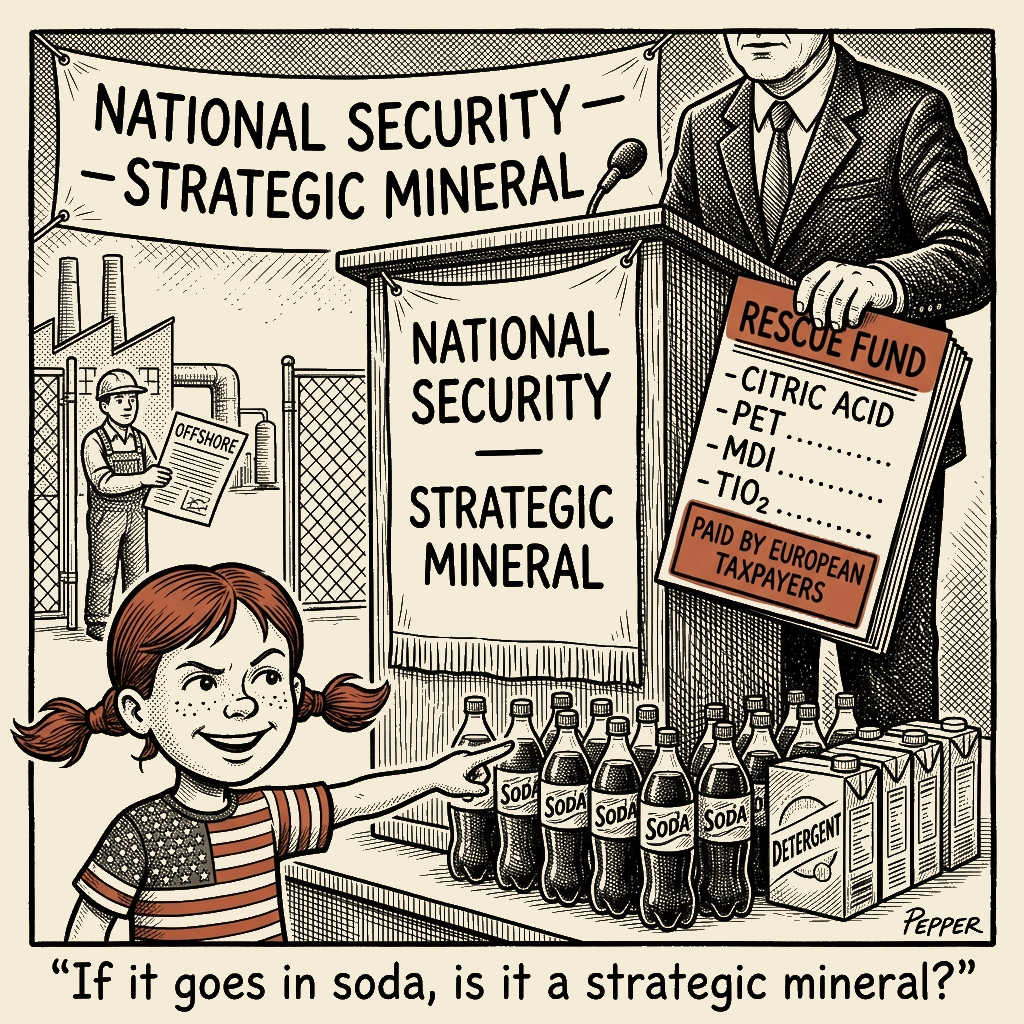
- Citric acid is a strategic mineral on par with yttrium or Rheinmetall’s supply chain — if Europe loses this one Belgian plant, the shelves empty and the dominoes fall.
-
What’s really going on
- Beneficiaries of the prescription: European industrial incumbents — chemical producers, automakers, machinery makers, and the chemical-sector CEOs who spent two decades offshoring jobs to capture Chinese labor costs and Russian energy costs, and who now want European taxpayers to fund the rescue from those decisions.
- Mechanism: BASF voluntarily expanded its Nanjing Verbund site with SINOPEC across the 2010s and through 2023, in pursuit of cost arbitrage that no democratic European polity could match. German automakers fell behind on EVs because their CEOs bet, correctly until it wasn’t, that the internal-combustion era would last longer than it did — not because Brussels forced them to. Germany’s pre-2022 energy dependence on Russian gas (delivered via pipelines that German heavy industry itself lobbied to build, including Nord Stream 2) drove the dominant cost shock; carbon pricing is one component of European chemical-industry cost pressure but is not the dominant driver — gas prices and broader energy costs are.
- Omitted fact: The piece conflates national-security inputs (rare earths, semiconductor dopants, Rheinmetall’s defense supply chain) with commodity chemicals that are not defense-critical. Citric acid is what you put in soda. The piece itself notes that the EU’s anti-dumping duties on Chinese citric acid are “far lower than those charged by the United States” — meaning the straight enforcement of existing trade law is itself the position the piece underplays. The piece quotes AfD polling approvingly without noting that AfD is itself a consequence of the deindustrialization it blames on green taxes — and is the German Bundestag party most openly aligned with Russian interests.
Anchor citation: Foster and Leahy, Financial Times, on the EU chemicals production drop from 301 million tons (2007) to 224 million tons today, on Citribel’s 50% sales decline since 2019, and on the parallel 50% rise in Chinese citric-acid exports to the EU.
The Response Ladder
Polite Reframe
When to use: A family member or colleague repeating the “green transition killed European industry” frame in good faith; the response that meets them where they are and stays in the realm of evidence.
Petra has worked the night shift at a BASF plant in Ludwigshafen for nineteen years. She voted for the Free Democrats because her father voted for the Free Democrats. She is not, by her own account, a climate activist. Last winter her plant announced the closure of one ammonia line. The official explanation cited “high energy costs and global overcapacity.” She has read the same FT article the piece cites, and she believes the citric-acid story, because she has watched her own employer ship engineering jobs to Nanjing for a decade.
Petra’s analysis is not wrong. Chinese chemical capacity has roughly doubled since 2012, and EU chemical production has fallen from 301 million tons in 2007 to 224 million tons today. Those numbers are real. So is the structural pressure on her plant.
But the diagnosis offered in pieces like this one — that the disease is “green transition” plus Chinese dumping, and the cure is industrial protection — is half-true at best, and the half it suppresses is the half that would actually help her. BASF did not close Ludwigshafen lines because of carbon taxes; BASF expanded in Nanjing because Chinese partners and provincial authorities offered investment terms and market access that no democratic polity could match. German automakers did not fall behind on EVs because Brussels forced them to; they fell behind because their CEOs bet, correctly until it wasn’t, that the internal-combustion era would last longer than it did. The citric acid is dying for the same reason the ammonia line is dying: European corporations spent twenty years arbitraging their own workers against Chinese labor, and now that the arbitrage is closing, they want the same workers to fund their protection.
The fix that would help Petra is not “reverse mercantilism.” It is the boring, expensive, politically difficult work of accepting that some industries will not return, building new ones where Europe actually has an edge (the specialty chemistry and semiconductor materials the piece itself names), and writing the transition so that the Petras of Ludwigshafen do not pay for the mistakes of the CEOs who offshored their jobs. Real conservatives conserve. Real industrial strategy picks winners honestly and funds them. Protectionism without that — Citribel-style bailouts for incumbents who made bad bets — is just a tax on Petra’s grandchildren so that yesterday’s management can keep yesterday’s plant open another quarter.
The Adam Smith the piece quotes is right that “defence is of much more importance than opulence.” Smith did not, however, write that sentence about citric acid. He wrote it about gunpowder. The piece’s sleight of hand is to convert a national-security argument — which is real, and which applies to Rheinmetall and rare-earth magnets — into a general industrial-protection racket for any industry that can hire a sympathetic CEO. That is the move worth resisting.
Mockery and Ridicule
When to use: For the conservative friend who has spent twenty years arguing for free trade and now discovers industrial policy the moment the chemicals sector enters their 401(k); perform for the bystander, indict the apex.
It is genuinely touching, watching the free-trade coalition discover industrial policy.
For thirty years the Cato Institute told us that comparative advantage was settled science, that any nation which subsidized its own industries was engaging in “crony capitalism,” and that German workers priced out of their own factories should simply learn to code. The Economist published approximately nine hundred editorials on the wonders of Chinese integration. Wall Street’s finest assured us that offshoring was a feature, not a bug, of the post-Cold-War order, and that anyone who objected was a protectionist Neanderthal.
Then Citribel started losing money.
Suddenly — overnight, it seems — the same people who told us that Adam Smith’s invisible hand would lift all boats are reaching for tariffs, anti-dumping duties, and EU state-aid waivers. Suddenly “decoupling” is no longer a fringe position held by Senator Sanders and a few steelworkers in Ohio; it is the sober centrist position of every commentator whose European vacation rental depends on a solvent German chemical industry.
The pivot is, on its merits, hilarious.
The piece quotes Adam Smith on the primacy of defence over opulence. Fine. But Smith also wrote The Wealth of Nations, which the free-trade coalition has been waving around like a Bible for four decades. If Smith gets to win the argument on rare earths, Smith also gets to win the argument on citric acid, and Smith was clear that wealth creation through specialization is, on the whole, a good idea. The coalition cannot cite Smith for one industry and ignore him for the next without admitting that what they actually believe is: free trade for thee, protection for me.
The piece notes that the EU’s anti-dumping duties on Chinese citric acid are “far lower than those charged by the United States.” That sentence is doing real work. It implies that the cure is straightforward enforcement of existing trade law — which is, incidentally, the position of the same globalist institutions the piece elsewhere derides as having sold Europe out. The piece’s actual prescription is not enforcement; it is structural protection for European incumbents, dressed up in the borrowed robes of Adam Smith and national security.
The CEO of Citribel warns that if China cuts off citric acid, “the shelves will very quickly be empty.” This is the kind of statement that has been true of approximately every commodity for approximately the entire history of industrial capitalism, and it has never once justified permanent tariffs. By this logic, the United States should never have allowed Japanese automobiles in the 1980s. It did. The American auto industry restructured, and consumers got better cars at lower prices. Citric acid is not a defense-critical input. It is a commodity. There is a difference, and the difference is what the free-trade coalition used to believe in.
The AfD is at 28 percent in the polls, the piece notes approvingly, in the same paragraph that worries about Chinese economic warfare. The AfD is the political party most friendly to Russian interests in the German Bundestag. The piece does not find this mildly interesting. It does not notice that the same populist-right backlash that blames Brussels for industrial decline is the same populist-right backlash that spent a decade insisting that climate policy was a Chinese hoax. One of those positions has to give. The piece gives neither. It just keeps quoting polling numbers and hoping nobody connects the dots.
The dots connect. The free-trade coalition built the China dependency. They want European taxpayers to fund the rescue. They cite Smith when convenient. They nod approvingly at a far-right party that is itself a product of the same deindustrialization they now blame on green taxes. And they have the nerve to call it “defence.”
Nuclear Satire
When to use: For the column, the essay, the long-form rebuttal where the full structural indictment is warranted and the receipts are stacked for cumulative force.
The citric-acid test is a beautiful thing. It is the canary in the coal mine, and the canary is a Belgian commodity chemical plant, and the coal mine is the entire architecture of post-1989 global capitalism, and the piece that wants you to weep for the canary was written by a man whose magazine spent thirty years arguing that the mine should not exist.
Let us set the scene.
Citribel, the lone citric-acid refinery standing in Belgium, is losing money. Its CEO warns that if China cuts off exports, the shelves will empty. The piece treats this as a national-security crisis on par with Rheinmetall’s loss of yttrium. We are asked to believe that the European chemicals industry — bulk acetic acid, titanium dioxide, polypropylene, polyethylene terephthalate, PVC, methylene diphenyl diisocyanate — is the Maginot Line of the twenty-first century. We are asked to believe that the green transition is “reverse mercantilism,” a phrase so elegant it conceals the fact that the European chemical industry’s pre-2022 energy dependence was on Russian gas, supplied via pipelines that German heavy industry lobbied to build, secured by a foreign-policy consensus in Berlin that prioritized cheap hydrocarbons over anything resembling strategic sense.
BASF closed Ludwigshafen ammonia lines not because of carbon taxes but because Vladimir Putin invaded Ukraine and the German industrial model, which had built itself on subsidized Russian gas, blew up overnight. This is documented. This is in the FT. This is not in the piece, because it implicates the European industrialists the piece is trying to protect.
German automakers did not fall behind on EVs because Brussels “deprived” them of their “inherent competitive advantage” in combustion engines. They fell behind because they bet, as a class, that the transition would be slow enough to manage, and they bet wrong. Herbert Diess, the former CEO of Volkswagen, publicly warned that the company was moving too slowly on electrification and that the delay threatened tens of thousands of German jobs. The piece does not mention this. The piece attributes the failure to “consumer reluctance to embrace electric vehicles,” as if German consumers had spontaneously developed range anxiety the moment a regulator in Brussels coughed. German consumers bought what German automakers built. German automakers built internal-combustion vehicles. This is not a regulatory failure. It is a strategic failure, owned by the people the piece is trying to bail out.
China’s industrial policy is, the piece tells us, “fascism with Chinese characteristics.” This is a striking phrase. It comes from the late scholar Timothy Brook, who used it carefully and historically; the piece uses it as a slur. The piece does not pause to consider whether the European industrial policy the piece advocates — the Citribel bailout, the “de-risking,” the anti-dumping duties, the structural protection — differs from “fascism with Chinese characteristics” in any meaningful way other than the language in which the orders are issued. Brussels and Beijing are both running state-directed capitalism now. The piece would like to discuss only one of them.
The piece quotes AfD polling approvingly. The AfD is the political vehicle most friendly to Russian interests in the German parliament. It is also the political vehicle most skeptical of the green transition. The piece wants both: industrial protection from China, and the dismantling of the climate policy that drives European energy innovation. It cannot have both. One of these positions is the cause of the industrial decline the piece laments; the other is a consequence of it. The piece picks neither. It just keeps quoting numbers and hoping that the political coalition it is actually describing — AfD voters, free-trade industrialists, climate skeptics, anti-China hawks — does not notice that they are standing on top of each other.
The piece quotes BAIC Group’s near-ten-percent stake in Mercedes-Benz as evidence of Chinese economic warfare. It is evidence of Chinese economic warfare. It is also evidence that Mercedes-Benz, like every other German automaker, built a cross-shareholding partnership with a Chinese state automaker over more than a decade, a deliberate commercial arrangement that included a Daimler stake in BAIC Motor — a partnership German industry pursued to secure access to the Chinese market. This is what voluntary integration looks like. The piece would like to describe it as predation. It is, more precisely, the price that German industry agreed to pay for access to the Chinese market.
Adam Smith, quoted in the piece’s closing argument, wrote that “defence is of much more importance than opulence.” True. Smith also wrote The Wealth of Nations, which is the foundational text of the economic order that produced Citribel’s predicament. The piece gets to cite Smith against free trade only because it ignores Smith on free trade. The piece gets to invoke national security against citric acid only because it ignores that citric acid is not defense-critical. The piece gets to blame green taxes for German industrial decline only because it ignores that German industrial decline was substantially driven by the industry’s own decisions about Russian gas, Chinese labor, and EV strategy. The piece is, in sum, a forty-page invoice presented to European taxpayers by the same European executives who offshored the jobs and now want the public to fund the rescue.
Reverse mercantilism, the piece calls it. The phrase deserves to be retired. The operation is older than mercantilism. It is a bailout, performed with borrowed rhetoric.
Profane Scorched-Earth
When to use: For the reader who needs full catharsis after watching the same free-trade coalition sell Europe to Beijing and then demand the public fund the rescue; the ladder’s release valve, gloves off, receipts spine intact.
Let us begin, for once, with what the fuck is actually happening.
For thirty goddamn years the free-trade coalition — every think-tank parasite who ever got a check from a billionaire with an opinion about comparative advantage — told us that comparative advantage was the highest wisdom the human race had ever produced. They told us that German workers who lost their jobs to Chinese competition were simply “adjusting.” They told us that American factories shuttered by Mexican labor arbitrage were the natural consequence of “creative destruction.” They told us that anyone who objected to offshoring was a xenophobic troglodyte who should be ignored or, if they persisted, mocked.
Then the chemicals sector started losing money. Then the automakers lost China. Then the machinery guys discovered that Beijing had been quietly buying up their customers. Then Citribel — the last Belgian citric-acid refinery, may its CEO live forever — posted its third year of losses and the piece you are reading was born.
And the fucking pivot, friends, has been a thing to behold.
The same magazines that published fifty years of “let the market decide” are now arguing for structural industrial protection. The same think tanks that took billionaire money to oppose tariffs are now begging Brussels to impose them. The same commentators who called Bernie Sanders a demagogue for proposing a 10 percent tariff on Chinese steel are now demanding anti-dumping duties, EU state-aid waivers, and a “de-risking” regime that is functionally indistinguishable from the Sanders position they spent a decade ridiculing. The hypocrisy is not a footnote. The hypocrisy is the whole fucking article.
The piece blames “green transition” for European industrial decline. Carbon taxes are the problem, the piece insists. Green regulation is “reverse mercantilism.” The fact that European energy prices spiked primarily because Germany spent fifteen years building its industrial base on subsidized Russian gas — gas that BASF and the chemical industry specifically lobbied to import via Nord Stream — is not mentioned. The fact that carbon pricing is one component of European chemical-industry cost pressure but is not the dominant driver — gas prices and broader energy costs are — is not mentioned. The fact that Germany could have chosen, at any point between 2010 and 2022, to invest in renewables rather than Russian pipelines is not mentioned. The fact that the chemical industry that is now screaming for protection is the same chemical industry that built itself a house of cards on Putin’s gas is not mentioned. Not fucking mentioned.
The piece blames Brussels for “depriving” German automakers of their “inherent competitive advantage” in combustion engines. The inherent competitive advantage, of course, was a century of internal-combustion engineering that became worthless the moment battery technology caught up. Herbert Diess, the former CEO of Volkswagen, publicly warned that the company was moving too slowly on electrification and that the delay threatened tens of thousands of German jobs. The piece would prefer that we blame the regulators. The piece would prefer that we blame the customers. The piece would prefer that we blame everyone except the German auto CEOs who bet the company, and won, until they didn’t, and now want European taxpayers to fund the consequences of their strategic stupidity.
The piece quotes Adam Smith. Adam Smith is the patron saint of the free-trade coalition. Adam Smith is the guy whose name these people invoked every time they wanted to fire an American factory worker and send the job to Guangdong. Now Adam Smith says “defence is of much more importance than opulence,” which is the line the piece wants, and Adam Smith is treated as definitive. The coalition gets to cite Smith when Smith agrees with them and ignore Smith when Smith doesn’t. That is not how fucking scholarship works, but it is how every piece of trade commentary of this kind has worked since 1955.
The piece quotes AfD polling approvingly. The AfD — Alternative für Deutschland, the party of the far-right, the party that takes money from Moscow, the party whose leaders have been caught on tape talking about “remigration” and other shit that should not be repeated in a family newspaper — is at 28 percent in the polls. The piece tells us this as if it were a neutral fact. The piece does not pause to note that the AfD’s industrial-policy platform is incoherent, that the AfD’s Russia policy is openly hostile to European interests, that the AfD’s rise is itself a consequence of the deindustrialization the piece is now trying to blame on green taxes. The piece just throws the number at us and walks away.
Citric acid. Let us pause on the citric acid. The piece wants us to believe that citric acid is a strategic mineral. Citric acid is what you put in soda. Citric acid is in your dish soap. Citric acid is a commodity input with global oversupply, multiple producers, and a price elasticity that the commodity-chemistry literature has been over for decades. If Citribel goes under, another producer will fill the demand. It might be in Brazil. It might be in Indonesia. It might be in China, at prices 40 to 50 percent lower than Citribel’s, because that is what Chinese chemical production does, and has done, and will continue to do as long as the global market for citric acid is a market rather than a national-security project.
The piece knows this. The piece does not care. The piece is using citric acid as a Trojan horse for a much larger argument: that the entire post-1989 economic order was a mistake, that European industry should be protected, that the free-trade coalition was wrong about everything, and that the people who should pay for the correction are not the executives who made the bad bets but the European taxpayers who did not.
The piece will not say this explicitly. The piece will hide behind Adam Smith, and Rheinmetall, and rare earths, and the CEO of Citribel whose shelves will allegedly go empty. The piece will do what every bailout request has done since 2008: wrap a corporate rescue in the flag, attach it to a strategic anxiety, and present the bill to the public.
Reverse mercantilism. The piece’s own phrase. The piece should keep it. Reverse mercantilism is exactly what is being proposed: a transfer of wealth from European workers and consumers to European industrial incumbents, justified by a national-security argument that applies to maybe five percent of the affected industries. The other ninety-five percent — citric acid, commodity chemicals, mid-range machine tools, German auto parts — gets to ride along, protected from competition by tariffs and subsidies that the same coalition spent thirty years telling us were instruments of economic suicide.
It is not reverse mercantilism. It is forward corporatism. It is the same god damn operation that has been performed on every industry that can afford a good lobbying shop. It is a bailout, performed with borrowed rhetoric, billed to the wrong fucking people.
The shelves will be fine — citric acid is what you put in soda, and the global market will continue to make it whether Citribel survives or not.
You will pay. They will not.

About Malcolm Little King
Malcolm Little King is a heteronym in Main Street Independent's editorial architecture — an analytical voice, not autobiography of any actual person. The position this column expresses is the publication's position on the territory Malcolm Little King's lane covers, rendered through Malcolm Little King's register.