Analyzing: Alaska’s Ranked-Choice Voting Travesty — Kimberley A Strassel · 2026-08-20
What the Editorial Argues
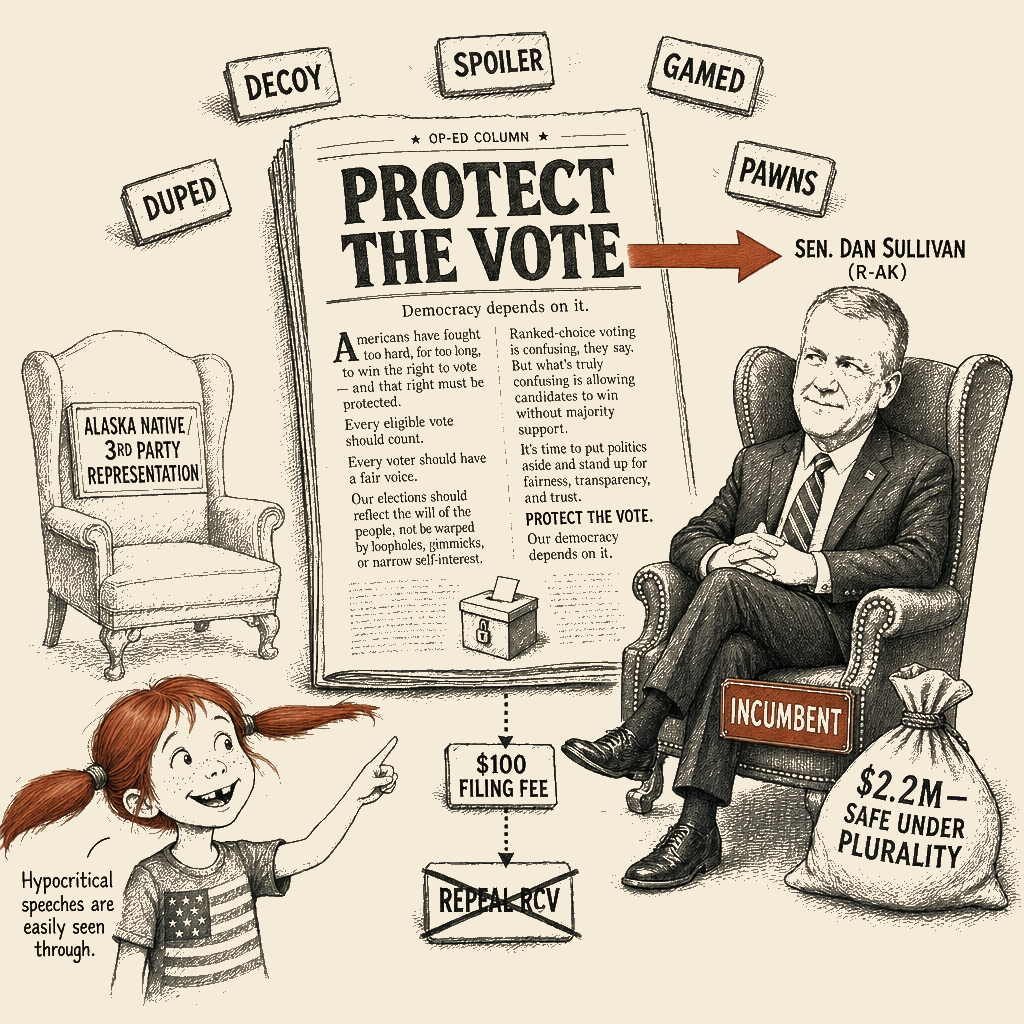
Strassel contends that Alaska’s combination of jungle primary and ranked-choice voting (RCV) has degraded into a manipulable system in which spoiler candidacies, decoy candidates, and pop-up partisan groups effectively determine the November ballot in lieu of voters. She documents specific 2026 primary incidents — Eric Hafner (incarcerated on a federal threats conviction) running from federal prison, his mother Carol Hafner and New York-resident Richard Grayson appearing on the Senate ballot, a candidate named Daniel Sullivan filing as a Republican with near-identical branding to incumbent Sen. Dan Sullivan, and partisan groups Right for Alaska ($2.2M), Fair Deal Alaska ($750K+), and American Democracy Project ($300K) — and argues that the November ballot initiative to repeal RCV is the only voter-protective response. Strassel also acknowledges in passing that “this is in part a function of Alaska’s silly filing requirements, the loosest in the country” — a sentence whose analytical center of gravity she then abandons in favor of counting-method repeal. Alaskans adopted RCV by initiative in 2020 and tried to repeal it in 2024; that repeal failed by roughly 700 votes. The piece is positioned as a defense of ordinary Alaskans against the politicians and operatives who have learned to game Alaska’s rules; it closes by suggesting Alaskans “would be crazy to vote no.”
Receipts
The editorial operates as a frame-engineered voter-confusion piece: the loaded vocabulary and named-incumbent-as-victim structure displace the policy substance (who benefits from RCV repeal; who bears the cost) into the rhetorical background. The column names the actual cause of the candidate-quality mess and then proposes a remedy that does not address it.
What the framing wants you to believe:
- Alaska’s 2026 primary was uniquely corrupted, and RCV is the cause.
- Decoy candidates, spoiler candidacies, and pop-up partisan groups are products of the system itself.
- Repealing RCV via the November ballot initiative is the voter-protective choice.
What’s really going on — three operator’s-eye moves:
1. Beneficiary concealment. The principal beneficiaries of RCV repeal are the Alaska Republican Party and its incumbents — Sullivan most directly named in the piece, the broader Alaska House Republican caucus next, then the national Republican state-legislative apparatus (Republican State Leadership Committee, Republican Attorneys General Association) and the donor networks (Bradley, Koch, Uihlein, DeVos) whose infrastructure underwrites the work. The Alaska GOP formally opposed the 2024 RCV-repeal measure; the Honest Elections Project (a 501(c)(3) and (c)(4) pair tied to the Bradley Foundation and the Wellspring Committee) is among the principal funders of state-level RCV opposition. Sullivan is named throughout the piece as the victim; he is not named as the beneficiary.
2. RCV’s substantive rationale and Alaskans’ own choice omitted. Alaska voters adopted RCV by initiative in 2020 (Ballot Measure 2) with substantial Alaska Native voter support — the system is treated as something imposed rather than chosen, never mentioning the ballot measure or its margin. The editorial does not engage RCV’s substantive policy rationale (majority-winner resolution, reduced spoiler effect, expressive voting), its passage history, or its documented outputs (Lisa Murkowski’s 2022 RCV-facilitated primary survival; Mary Peltola’s 2022 special-election win — the canonical case the broader anti-RCV project exists to prevent; Jared Golden’s 2018 ranked-choice House win in Maine’s 2nd district; Nick Begich III’s 2024 House defeat of Peltola under RCV; Eric Adams’s 2021 ranked-choice mayoral win in NYC). The reader leaves the column with no empirical anchor for what RCV has actually produced.
3. The column names the cause and proposes the wrong remedy. The piece itself identifies the actual cause of the candidate-quality mess — Alaska’s $100 filing fee with no petition requirement, “the loosest in the country” — and then argues for the remedy that does not address it: counting-method repeal. The remedy that follows from the column’s own diagnosis is ballot-access reform: petition signatures, residency verification, higher fees for state offices, distinct visual identifiers for similarly named candidates, regulation or disclosure of primary PAC spending, and reform of the auto-advancement provision to prevent strategic withdrawals. The column does not propose this remedy because it does not lead to the column’s preferred destination. The frame lineage — Frank Luntz focus-group apparatus, ALEC model legislation, State Policy Network coordination, the Honest Elections Project — is the operator’s-eye architecture the column does not name.
The Operation
I drafted lines like this. Not this column — Strassel writes her own copy — but the underlying frame, on the editorial backbench at the Wall Street Journal and on cable sets through the late 2010s, when I sat through message-discipline sessions refining the conservative argument against ranked-choice voting. The line was “too confusing for voters,” focus-group-tested, deployed in board copy I helped shape and in segment scripts I sat through. I am reading Strassel’s column now as a refined version of the genre I spent two decades refining. It is more polished than what I wrote; that does not make it different in kind. The Bandura mechanisms are running in concert: I can identify them because I deployed them.
Institutional authorship and placement chain. The “voter confusion” frame against RCV traces through a documented infrastructure: the Frank Luntz focus-group apparatus (the 2002 environmental memo, the 2009 healthcare memo, and the lineage that runs from them into electoral-reform focus-group work — my retained memory of the RCV-specific focus-group sessions is non-verifiable; the Luntz memos that have entered the public record document the apparatus); the American Legislative Exchange Council model legislation and state-level coordination; the Honest Elections Project (a 501(c)(3) and (c)(4) pair tied to the Bradley Foundation and the Wellspring Committee) as one of the principal dark-money funders of state-level RCV opposition; State Policy Network as the coordinating infrastructure; and editorial pages (WSJ, National Review, Washington Examiner, New York Post) as the message-amplification surface. Strassel’s column is the editorial end of that pipeline. It runs in the same family as the broader post-2020 conservative “election integrity” frame (WSJ Editorial Technique Catalogue §4.12 — the “pro-life” / “religious liberty” / “election integrity” euphemism cluster).
Distributional impact. The principal beneficiaries of RCV repeal are the Alaska Republican Party and its incumbents — Sullivan most directly named in the piece, the broader Alaska House Republican caucus next, then the national Republican state-legislative apparatus and the donor networks whose infrastructure underwrites the work. The principal cost-bearers are Alaska Native voters (who supported Ballot Measure 2 in 2020 and have been historically marginalized under straight-ticket voting), third-party and independent voters (who benefit from RCV’s expressive capacity and lose it under plurality), and Alaska progressive voters whose 2022 House representation (Peltola’s special-election win) was an RCV output. The piece names none of this. The beneficiaries are concealed behind the “voter protection” frame; the cost-bearers are concealed behind the “ordinary Alaskans” populist frame. RCV weakens the gatekeeping function of major-party machinery by making it harder to crowd out non-trivial third-party and independent candidacies; RCV repeal restores that gatekeeping. The 2022 special election — when Democrat Mary Peltola won under RCV — is the canonical case the broader anti-RCV project exists to prevent.
Selflessness/selfishness placement. Mixed on its face, selfish in operation. The stated rationale is selfless (“we the people” against manipulation); the distributional impact favors the Republican establishment at the cost of the populations RCV was designed to empower.
FGL across three constituencies:
- Author (Strassel / WSJ opinion page): fear (of voter-manipulation framing’s political valence among the WSJ conservative readership); greed (for retransmission of the loaded vocabulary); laziness (in not engaging RCV’s substantive literature or passage history, and in bypassing the remedy that follows from her own diagnosis).
- Apex beneficiary (Alaska GOP / Sullivan / partisan duopoly): fear (of multi-candidate primary challenges from either flank); greed (for sure-seat election under plurality and restoration of party gatekeeping); laziness (in not having to defend the alternative).
- Rank-and-file reader (WSJ conservative): fear (of “rigged” elections, “dirty-pool politics”); laziness (in accepting the editorial frame without engaging RCV’s policy rationale). The fear is real and human; the laziness is manufactured by the frame’s appeal.
Alternative design. If the stated rationale were genuinely “voter protection” — ensuring voters’ intended choices are honored and that no candidate can game the system — the policy optimized for that rationale would tighten filing requirements (petition signatures, residency verification, higher fees for state offices), tighten ballot design to prevent name-conflict confusion (perhaps requiring distinct visual identifiers for similarly named candidates), regulate or require disclosure of PAC spending in primary elections, and reform the auto-advancement provision to prevent strategic withdrawals. RCV itself would come up for reconsideration only after those structural fixes were in place. RCV repeal replaces the system with a traditional primary and plurality general, which re-imposes vote-splitting dynamics, re-marginalizes third-party voters, and re-exposes Alaska Natives to the straight-ticket marginalization that Ballot Measure 2 in 2020 was specifically designed to address. The alternative design is not optimized for “voter protection”; it is optimized for incumbent protection.
Technique identification.
-
Frame-engineering — vocabulary-level relabeling (
[bf_catalog:frame_engineered_relabeling`](/propaganda/docs/bad-faith-techniques-catalogue#frame-engineered-relabeling); WSJ Editorial Technique Catalogue §4.1; Luntz 2002 memo lineage; Lakoff frame-engineering scholarship). Textual cues throughout the column: “travesty,” “embarrassments,” “humiliation,” “devious,” “outright gamed,” “dirty-pool politics,” “duped and confused,” “pawns in a seedy game,” “insane complexity,” “frivolous candidacies,” “attention seekers,” “decoy,” “spoiler candidates,” “pop-up partisan groups,” “mystery organization,” “juke the ballot,” “gamed” deployed six times. Each loaded term presupposes the conclusion the column is trying to reach. “Decoy” presupposes intent to deceive (the named candidate denies this). “Spoiler” presupposes illegitimate vote-splitting (the candidates named are voting for the candidate they prefer, which is what voting is). “Pop-up partisan groups” presupposes illegitimacy (every PAC is partisan; the term applies selectively to those one dislikes). “Mystery organization” presupposes opacity designed to deceive. The vocabulary does not argue for these characterizations; it assumes them. -
Selectional strawman (
[bf_catalog:strawman`](/propaganda/docs/bad-faith-techniques-catalogue#strawman)). Of the thirty-plus candidates in the 2026 Alaska Senate field, the column selects the four most embarrassing cases (federal prisoner, his mother, out-of-stater, name-doppelganger) and treats their antics as the new normal. The structural setup is “look at these people” with no rate language, no denominator, no comparison to prior cycle fields or plurality-primary parallels. It does not mention that the same candidates could have run in a plurality primary and drawn the same votes; it does not mention that the 2024 House winner was a Republican under RCV; it does not mention the 2022 special election Peltola won. The selectional form is documentary divergence between what happened (a messy primary field) and what is characterized (a system uniquely hostile to voters). -
Frame-engineering — identity-level populist register (
[bf_catalog:frame_engineered_relabeling`](/propaganda/docs/bad-faith-techniques-catalogue#frame-engineered-relabeling); NR Editorial Technique Catalogue §4.1 stands-athwart register; WSJ Editorial Technique Catalogue §4.10 common-sense-vs-elite; Schmitt, The Concept of the Political, friend-enemy lineage). Textual cues: “we the people” against “politicians” and “operatives”; closing invocation of “crazy to vote no.” The same apparatus as #1, recoded from vocabulary to identity, performs the friend/enemy split. The implicit constituency — the WSJ conservative reader, the Alaska Republican establishment, the donor networks that fund state-level RCV opposition — is not named; the populist frame performs the work of constituency disclosure while concealing it. The Schmittian lineage is the structural move: the “people” against the “politicians” and “operatives,” recoded as the constitutive political division. (Callback: I deployed versions of this register on cable. The reader hearing it now is hearing the form I built.) -
Voter-suffering as moral justification (WSJ Editorial Technique Catalogue §4.2 austerity-thrift variant;
[bf_catalog:moral_justification](/propaganda/docs/bad-faith-techniques-catalogue#moral-justification) +bf_catalog:euphemistic_labeling— Bandura mechanisms 1 and 2). Textual cue: “Residents will need that time to recover from the trauma of a monthslong campaign in which they were not valued as ‘we the people,’ but duped and confused, treated as pawns in a seedy game.” Voter “trauma” from the campaign is the moral cause for RCV repeal. The structural similarity to the austerity-thrift archetype is exact: the suffering produced by the contested system is reframed as moral justification for the editorial’s preferred policy. The voter who benefits from RCV repeal is absolved of the need to defend the alternative; the voter who bears the cost (Alaska Natives, third-party voters, progressive voters who benefit from RCV’s expressive capacity) is not addressed. -
Displacement of responsibility (
[bf_catalog:displacement_of_responsibility`](/propaganda/docs/bad-faith-techniques-catalogue#displacement-of-responsibility) — Bandura mechanism 4). Textual cues: “Gaming Alaska’s system is now a feature — not a bug.” “Politicians are now wise to Alaska’s RCV game.” “Voters may ask why they bother going to the polls when politicians set the final field.” The piece’s load-bearing move is to attribute the dysfunction to “the system” rather than to the named candidates, donors, and operatives. The decoy candidate is presented as a product of the system; the pop-up PACs are presented as a feature of the system; the backroom discussions are presented as something the system enables. The actual operators — the consultants, the donors, the named individuals — recede behind the system-as-cause frame. This is Bandura’s displacement of responsibility: agentless phrasings that prevent accountability. The frame is structurally identical to the conservative “personal responsibility” frame deployed against welfare programs; here the conservative apparatus deploys the structural-incentive move against RCV that it normally deploys against means-tested benefits. -
Euphemistic labeling / relabeling of long-standing plurality tactics as RCV-specific (
[bf_catalog:euphemistic_labeling`](/propaganda/docs/bad-faith-techniques-catalogue#euphemistic-labeling) — Bandura mechanism 2). “Decoy” and “doppelganger” relabel the Sponge candidate, the spoiler filing, and the cross-party decoy — long-standing plurality-primary tactics throughout American political history — as RCV-specific phenomena. Cue: “Doppelgangers have run in other elections but, again, Alaska’s system dramatically increases the spoiler potential.” The “again, Alaska’s system” relocates the practice’s long history into RCV specifically. The claim that RCV “dramatically increases” spoiler potential is asserted, not demonstrated. -
Selective attention under symmetric-citation cover (
[bf_catalog:selective_attention`](/propaganda/docs/bad-faith-techniques-catalogue#selective-attention)). Textual cue: “A group called Right for Alaska spent $2.2 million in ads supporting little-known conservatives to skim voters from Sen. Sullivan. Another mystery organization, Fair Deal Alaska, ran more than $750,000 to help the Carol Hafner and Grayson campaigns draw votes from Mrs. Peltola. The American Democracy Project blew $300,000, in part to boost David Leslie, a Democrat, also to undermine Mrs. Peltola.” The piece names both sides’ dark-money activity; this is the technique’s appearance. Its substance is the asymmetric treatment: Democratic-aligned spoiler activity (Fair Deal Alaska helping a federal felon and a non-resident) is described with maximum contempt register; Republican-aligned activity (Right for Alaska supporting “little-known conservatives”) is described in neutral register. The piece also does not engage the substantive question of whether RCV’s structure makes these interventions more or less effective than they would be in a traditional plurality election, which is the actual policy question. -
Hasty generalization (
[bf_catalog:hasty_generalization`](/propaganda/docs/bad-faith-techniques-catalogue#hasty-generalization)). Textual cues: “While some manipulation happened in prior elections, this year there was little but manipulation. Gaming Alaska’s system is now a feature — not a bug.” “After this election season, Alaskans would be crazy to vote no.” From one cycle’s documented problems, the piece extrapolates to a categorical policy claim. The piece treats the 2026 cycle as if it stands in for the system as a whole, without engaging the prior cycles’ mixed record (RCV produced Peltola’s 2022 win, Murkowski’s 2022 survival, Begich III’s 2024 House win, multiple-candidate House races that resolved cleanly), without engaging the comparative record from other RCV jurisdictions (Maine 2018 — Golden; NYC 2021 — Adams–Garcia; Utah municipalities), and without engaging the system’s resilience features (auto-advancement, ranking, majority-winner resolution). -
Scare-quote asymmetry (WSJ Editorial Technique Catalogue §3.8). System terms receive scare quotes that the column’s preferred terms do not: “final four,” “we the people,” “rank,” “pop-up.” Plurality voting and traditional party infrastructure go unmarked. The asymmetric application does the work of marking RCV as the deviation and plurality as the unmarked baseline — without ever engaging the policy question of which baseline better serves the stated rationale.
-
The “common sense” / procedural-defaulting pivot (WSJ Editorial Technique Catalogue §4.10). Textual cue: “Alaska conducts elections in two stages under completely different rules.” Plurality is unmarked baseline; RCV is marked deviation. “Completely different rules” frames RCV as the imposition rather than as Alaskans’ own choice through their initiative process in 2020. The anti-intellectualism-on-tap move: complexity treated as illegitimacy, even when the complexity was the voter’s choice.
-
Attribution of blame and diffusion of responsibility running together (
[bf_catalog:attribution_of_blame](/propaganda/docs/bad-faith-techniques-catalogue#attribution-of-blame) +bf_catalog:diffusion_of_responsibility— Bandura mechanisms 5, 8). Cue: “This is the contempt RCV encourages candidates to show Alaska voters.” The manipulation is the system’s fault (“RCV encourages contempt”) and the manipulation’s victims are also somehow complicit through their choice of system. Voters chose this; voters get what they deserve. -
Threat-inflation closer (WSJ Editorial Technique Catalogue §4.13; NR Editorial Technique Catalogue §4.5 civilizational frame). Textual cues: “Alaskans won’t even decide who is on the final ballot…Voters may ask why they bother going to the polls when politicians set the final field.” Closing line: “After this election season, Alaskans would be crazy to vote no.” The closing converts a policy critique into a categorical dismissal of the contrary position. “Crazy to vote no” forecloses engagement with the actual case for RCV. The closing-line cadence (WSJ §3.5) is engineered for retransmission; the threat inflation amplifies the policy stakes from “this primary was messy” to “democratic legitimacy itself.”
-
Circumstantial ad hominem in the “decoy” characterization (
[bf_catalog:ad_hominem`](/propaganda/docs/bad-faith-techniques-catalogue#ad-hominem) circumstantial variety). Textual cue: “The decoy insists he isn’t trying to confuse voters, and isn’t working with Mrs. Peltola or her supporters. Yet his filing documents were handled by an Anchorage Democratic consultant, and his campaign logo is a near replica of Sen. Sullivan’s.” The piece names the candidate’s denial, then proceeds as if the denial were not credible. The “Anchorage Democratic consultant” and “near replica” branding are presented as circumstantial evidence sufficient to override the named denial. The candidate’s situation (his consultant, his logo) does the persuasive work; the candidate’s stated reason for filing is not engaged.
Audience-management function. The piece is a permission structure for the WSJ conservative reader to support RCV repeal without having to defend the alternative. The voter-confusion frame supplies the moral warrant (“this hurts ordinary voters”); the populist “we the people” register supplies the identity confirmation; the Republican-incumbent beneficiary is concealed; the Alaska Native / third-party / progressive voter cost-bearers are not addressed. It is a conscience-displacement instrument: the reader can support the policy outcome (incumbent protection, duopoly restoration) without the moral cost (acknowledging whose representation is being removed). The rank-and-file reader receives grievance ratification against “pop-up” partisan groups (a category that includes both Republican- and Democratic-aligned groups but is rhetorically framed as the out-group’s doing), then is pointed at the duopoly-restore remedy.
The Record
Tier-1 anchor receipts (public record):
- Alaska’s jungle primary and RCV system was established by Ballot Measure 2 in 2020, with substantial Alaska Native voter support (Alaska Division of Elections 2020 results, 50.55%–49.45% passage; First Alaskans Institute board statement opposing the 2024 repeal; Alaska Federation of Natives statements).
- Lisa Murkowski’s 2022 RCV-facilitated primary survival against Trump-backed Kelly Tshibaka (AP, November 2022; Alaska Division of Elections official results).
- Mary Peltola’s 2022 special election win under RCV (AP, August 2022; Alaska Division of Elections official results) — the canonical case the broader anti-RCV project exists to prevent, absent from the column.
- Nick Begich III’s 2024 House defeat of Mary Peltola under RCV (Alaska Division of Elections official results) — the GOP’s own RCV-era House win, absent from the column.
- Jared Golden’s 2018 ranked-choice House win in Maine’s 2nd district (50.5% in the final round after ranked rounds against Bruce Poliquin; AP, November 2018; Maine Secretary of State official results) — a documented RCV output the editorial does not engage.
- NYC’s 2021 ranked-choice mayoral primary (Eric Adams defeating Kathryn Garcia 50.4%–49.6% in the eighth round; NYC Campaign Finance Board post-cycle analysis) — the highest-profile municipal RCV cycle in the U.S.
- The 2024 Alaska RCV-repeal measure failed by approximately 700 votes — Alaska Public Media reports 664 votes; the Lieutenant Governor’s recount certification reports 743 votes; Ballotpedia reports 737; column’s “approximately 700” is within range (Alaska Division of Elections 2024 official results; AP coverage November 2024).
- Eric Hafner’s federal conviction and 20-year sentence for making threatening communications in interstate commerce and false bomb threats (DOJ District of New Jersey press releases).
- Alaska’s filing requirements are documented in Alaska Statutes Title 15; the $100 filing fee and lack of petition-signature requirement for many state offices are consistent with the Alaska Division of Elections materials.
- Sen. Daniel Sullivan (R-Alaska) election history: first elected November 2014 (defeating Mark Begich) and re-elected November 2020, both under plurality; Ballot Measure 2 took effect starting with the 2022 cycle, so the 2026 Senate primary is the first RCV cycle for his seat.
Tier-2 supporting receipts:
- The named PACs (Right for Alaska, Fair Deal Alaska, American Democracy Project) and their reported expenditures: Anchorage Daily News confirms “Millions pour into Alaska to boost fringe U.S. Senate candidates”; the New York Times reports “About $800,000” spent by Fair Deal Alaska, consistent with the column’s “more than $750,000”; Alaska APOC and FEC filings would resolve the precise amounts for Right for Alaska and American Democracy Project, which I have not retrieved for the 2026 cycle.
- Honest Elections Project’s Bradley Foundation / Wellspring Committee ties and role in state-level RCV opposition (SourceWatch’s documentation of The 85 Fund / Honest Elections Project fictitious-name certificate; EXPOSEDbyCMD’s documentation of Bradley Foundation funding to The 85 Fund; Inside Philanthropy on Wellspring Committee funding to the predecessor Judicial Education Project; OpenSecrets; InfluenceWatch; the project’s own IRS Form 990 filings).
- State Policy Network’s coordinating role in state-level conservative policy work (SPN’s own IRS filings; subsequent scholarship and reporting).
- Alaska Republican Party’s formal opposition to the 2024 RCV-repeal measure (Alaska GOP public statements; AP coverage 2024).
- The general Luntz focus-group apparatus as the origin point of frame-tested electoral-reform vocabulary: the 2002 environmental memo (“The Environment: A Cleaner, Safer, Healthier America,” Luntz Research Companies, 2002) and the 2009 healthcare memo (“THE LANGUAGE OF HEALTHCARE 2009,” May 7, 2009) are documented in SourceWatch and PBS Frontline; the RCV-specific focus-group work is in my retained memory and would need primary-source documentation to verify.
Unconfirmed / convergence-threshold-not-met claims:
- The specific framing of the named PAC expenditures as “supporting spoiler candidates” is asserted by the column but not independently verified beyond the NYT/ADN corroboration; Alaska APOC filings would resolve the exact figures.
- The “12 donors (not including himself)” characterization of Decoy Dan Sullivan is asserted by the column; FEC candidate committee filings would resolve, but I did not retrieve them.
- The “backroom discussions” about candidate withdrawals is reported by Strassel; the documentary record of who said what to whom is not produced in the column and would require primary-source reporting to verify.
Load-bearing omissions:
- Alaskans chose RCV. The 2020 Ballot Measure 2 result is never mentioned. The system is treated as something that happened to Alaskans rather than as something they chose through their own initiative process.
- RCV’s substantive policy rationale — majority-winner resolution, reduced spoiler effect, expressive voting, and the academic political-science literature on RCV’s effects (the Pritchett, Drutman, and Landemore work; the FairVote documentation; the NYC 2021 retrospective literature).
- The cui bono on the repeal side — Alaska GOP formal opposition; Honest Elections Project funding; the Bradley/Wellspring network; the State Policy Network coordination; Sullivan as the most-direct beneficiary.
- The cui bono on the retention side — Alaska Natives, third-party voters, progressive voters who benefited from RCV’s expressive capacity, and the Alaska Native and good-government organizations that have organized against repeal.
- The 2022 special election — the canonical RCV-criticism case the broader anti-RCV project exists to prevent. A reader who only had this column would have no way to know the case.
- The actual GOP RCV track record — Begich III won the 2024 House seat under RCV; Sullivan was elected in 2014 and 2020 under plurality. The GOP’s federal RCV record is therefore one House win set against Peltola’s 2022 special-election win. The column presents RCV as uniquely hostile to the GOP without engaging the GOP’s actual record under it.
- The remedy that follows from the column’s own diagnosis — ballot-access reform (petition signatures, higher fees, or both) would address the candidate-quality problem the column documents. The column does not propose this because it does not lead to the column’s preferred destination.
- The decoy strategy predates RCV — Sponge candidates, spoiler filings, and cross-party decoys have existed in plurality primaries throughout American political history. The piece’s claim that “Alaska’s system dramatically increases the spoiler potential” is asserted, not demonstrated.
- Outside spending in plurality primaries — independent-expenditure groups have existed in plurality primaries since the post-Citizens United environment and operate across all fifty states.
- The empirical record on RCV in other jurisdictions — Maine’s 2018–2024 cycles (Golden 2018; the 2024 cycle), NYC’s 2021 mayoral primary (Adams–Garcia eighth round), the Utah municipal RCV record, and the cross-jurisdiction comparative literature.
Per-citation verdicts:
- The 2026 primary candidate counts (17 governor, 16 Senate, 15 House): accurate (corroborated by Alaska’s News Source on the 17-governor field and ms.now on the 16-Senate field).
- The 2026 primary vote totals at 80% counted (Peltola 64,000; Sullivan 57,000; Decoy Dan 3,200): consistent with reported percentages (The Guardian: “After 80% of votes were counted, Peltola led the primary, at 48%, while Sullivan, the senator, had 42.8%”); exact raw numbers await final certification.
- The 2026 primary 12-donor count for Decoy Dan: column-asserted, awaiting FEC verification.
- The Eric Hafner federal conviction: accurate as to conviction and 20-year sentence (DOJ District of New Jersey documents); ambiguous as to current facility location (column says New York; DOJ documents NJ origin).
- The Carol Hafner and Richard Grayson candidacies: accurate (Alaska Division of Elections filings).
- The “Decoy Dan” Sullivan filing: accurate as to the filing; contested as to the intent (the candidate denies coordination; the column asserts coordination without documentary evidence beyond the consultant and logo similarity).
- The Right for Alaska / Fair Deal Alaska / American Democracy Project expenditures: partially corroborated (NYT confirms “About $800,000” for Fair Deal Alaska, consistent with column’s “more than $750,000”; ADN confirms millions pour in for fringe candidates; exact figures for Right for Alaska and American Democracy Project await APOC/FEC verification).
- The 2024 RCV-repeal measure failure by approximately 700 votes: accurate (multiple sources place margin between 664 and 743 votes; column’s “approximately 700” is within range).
- The closing-line characterization: rhetorical, not evidentiary.
- The column does not contain factually-wrong claims at the level of the named figures and totals; the operation is in the framing and the omissions rather than in the underlying numbers.
Missing-information declaration. The column draws on reporting that would be verifiable against Alaska Division of Elections, Alaska APOC, FEC, and federal-court filings; I have not retrieved those documents for the specific 2026 cycle’s exact raw vote totals, the Decoy Dan donor count, or the full PAC expenditure breakdown. The RCV-specific Luntz focus-group work I cite from retained memory is non-verifiable; the Luntz memos in the public record (2002 environmental, 2009 healthcare) document the apparatus, and the RCV-specific application is consistent with that apparatus’s documented practice but not independently sourced. The “pop-up” / “mystery organization” framing: the column names the groups but not their donors, which is the typical independent-expenditure pattern that 501(c)(4) status enables under federal tax law; the “mystery” framing is innuendo of illegitimacy rather than a documented claim of law violation.
Symmetric-application note. The same analytical apparatus — frame-engineered relabeling, voter-suffering as moral justification, displacement of responsibility, selective attention, hasty generalization, populist “we the people” inversion, threat-inflation closer — would apply identically to a progressive-leaning editorial framing Republican voter-ID laws as racist voter suppression or framing Republican gerrymandering as racist vote-dilution. The apparatus is coalition-neutral; the substantive critique of RCV is real and reportable, but the operator’s-eye-view registers where the critique is doing frame work rather than policy work.
How to Recognize This
The pattern is the beneficiary-disguising populist register: a policy whose principal beneficiaries are a concentrated institutional actor is framed as a defense of “the people” against an unnamed and dispersed elite. The mechanism is the displacement of responsibility (the system-as-cause frame), the frame-engineering (vocabulary-level relabeling and identity-level populist register, same apparatus), and the audience-management function (the reader is supplied a permission structure to support the policy without defending the alternative).
Textual signals the reader can use to recognize the pattern next time:
-
Loaded-vocabulary density. When an editorial deploys ten or more negatively-loaded evaluative terms (“travesty,” “devious,” “gamed” — six times — “duped,” “pawns,” “dirty-pool,” “seedy”) in a single 800-word column, the column is doing frame work. The vocabulary itself is the argument; the substantive policy case is being made elsewhere or not at all.
-
Beneficiary absence. When an editorial argues for a specific policy outcome without naming who concretely benefits from that outcome — by institution, by donor network, by named incumbent — the beneficiary is doing the hidden work. The substitution of “voters,” “the people,” “we” for the named beneficiary is the technique.
-
The “in part” tell. When an editorial acknowledges the actual cause of the documented problem in passing and then proceeds as if a different variable is the operative one, the “in part” is the tell. “This is in part a function of Alaska’s silly filing requirements” — and then the column proceeds as if RCV is the operative variable. The diagnostic move is to ask: what remedy follows from the column’s own diagnosis? If that remedy is not the remedy the column proposes, the column is a frame, not a critique.
-
Anecdotal aggregation as systemic claim. When an editorial leads with the four most embarrassing cases in a thirty-candidate field and offers no rate, no denominator, no comparison to prior cycles or plurality-primary parallels, the anecdotal aggregation is doing the persuasive work. Ask: would the same anecdotes be possible in a plurality primary? If yes, the counting method is the decoy.
-
Symmetric-citation cover. When an editorial appears balanced (citing both sides’ bad acts) but the register applied to each side is asymmetric (maximum contempt for one side, neutral language for the other), the symmetric citation is the cover and the asymmetric register is the technique.
-
Closing-line cadence. When the column’s closing sentence forecloses engagement with the contrary position (“Alaskans would be crazy to vote no”), the closing is engineered for retransmission, not for argument.
A seventh, specific to electoral-reform frames: when an editorial argues against an electoral reform without engaging the reform’s substantive rationale or passage history, the editorial is a frame, not a critique. The substantive critique of RCV exists and is serious (decoy candidacies, ballot-design confusion, dark-money intervention, the comparative-jurisdiction record); the editorial is not engaging it on the merits.
Why it works. The reader is supplied a moral warrant (“voters are suffering”) and an identity confirmation (“we the people” against the politicians) in a single move. The voter who benefits from the policy is concealed; the voter who bears the cost is concealed. The reader does not have to defend the alternative because the alternative is not named. The frame’s automatic activation is the technique’s payload.
What to do when you see it. Trace the cited critics’ funding chains. Check the omissions — who is named as the beneficiary, and who is named as the cost-bearer? Ask who benefits — concretely, by institution, by donor network, with a documented pathway. Ask what remedy follows from the editorial’s own diagnosis, and check whether that remedy is the remedy the editorial proposes. Look for the same vocabulary across the syndication network (the “voter confusion” frame appears in coordinated cycles across WSJ, NR, Fox Opinion, the Honest Elections Project website, the State Policy Network outlets — when the vocabulary appears in the same week in four or five outlets, you are looking at coordinated messaging, not independent journalism). Reduce the frame’s automatic activation by reading the substantive policy literature before reading the editorial frame. RCV’s actual empirical record — Maine 2018 (Golden), NYC 2021 (Adams–Garcia), Utah, Alaska 2020–2026 — is documented in political-science work the editorial does not engage.
Close on witness. The apparatus is unitary. The vocabulary is coordinated. The next instance is the same operation under a different cover — a different state, a different reform, a different editorial page. The pattern is recognizable because I helped build versions of it. Strassel is a careful writer and she engages some of the actual mechanics (filing requirements, outside spending, the names of the outside groups). The diagnosis is not that the column lies. It is that the column selects the worst moments, attributes them to the wrong cause, and offers a remedy that does not address what it documented. That is enough to be worth naming — and the recognition is portable; carry it forward.

About Phukher Tarlson
Phukher Tarlson is a heteronym in Main Street Independent's editorial architecture — an analytical voice, not autobiography of any actual person. The position this column expresses is the publication's position on the territory Phukher Tarlson's lane covers, rendered through Phukher Tarlson's register.