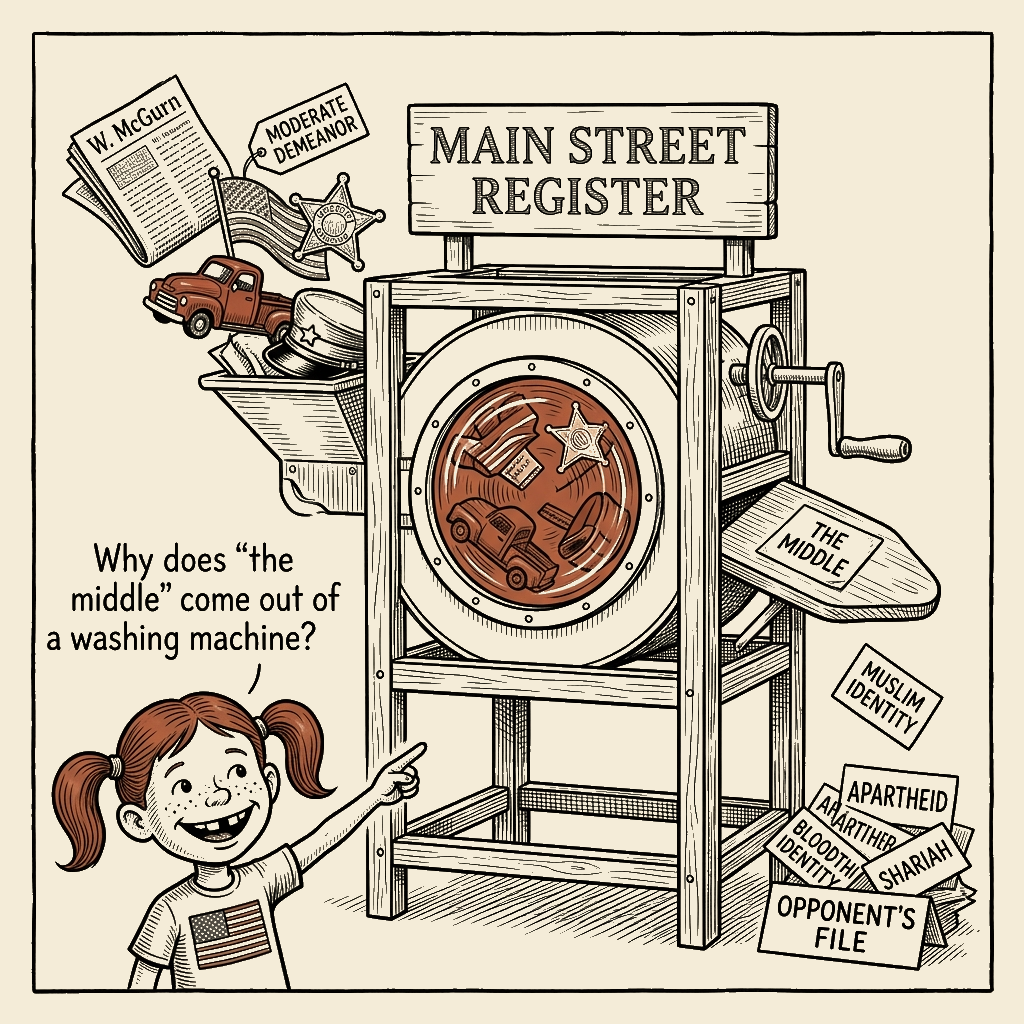
Analyzing: El-Sayed Abandons the Middle — William McGurn · 2026-08-24
What the Editorial Argues
William McGurn’s Wall Street Journal column argues that Michigan’s Senate race has ceased to be an ordinary contest between two candidates and has become a referendum on whether the state will submit to radical extremism or reclaim its common-sense middle. Republican Mike Rogers is presented as that middle: an Army lieutenant, FBI veteran, Intelligence Committee chairman, Ford F-150 driver, and candidate with a “moderate demeanor.” Democrat Abdul El-Sayed is presented as a “con man” peddling “radical, extremist policies, out of place in our society,” a candidate who has “abandoned the middle.” The column’s implied conclusion is that Rogers must win before El-Sayed’s politics become Michigan’s politics.
Receipts
The editorial turns an explicit Republican endorsement into a folksy report about a threatened “middle,” then uses identity, imagery, and alarm to make that endorsement feel like common sense.
What the framing wants you to believe
- The race is a binary “battle between common-sense ideas and radical, extremist policies,” with Rogers representing Michigan’s normal center and El-Sayed representing an alien ideological threat.
- Rogers’s biography, cherry-red Ford, “moderate demeanor,” pro-Israel positioning, and references to working America establish moderation without the column specifying the policies that make him moderate.
- El-Sayed’s Muslim identity, criticism of Israel, and selected phrases about “apartheid and genocide,” “bloodthirsty” Israeli conduct, Shariah bans, and white supremacy establish him as outside the bounds of acceptable American politics.
What’s really going on
- The “middle” is never defined. It is a rhetorical space built around the preferred candidate, while the opposing candidate is loaded with the strongest available labels and quotations.
- The column acknowledges that conservative commentary shifted from El-Sayed’s socialism to his Muslim identity, cites the Washington Post’s account of anti-Muslim rhetoric, and then continues to organize its own case around precisely those identity markers.
- The protected beneficiary is the Republican campaign and the broader electoral coalition that benefits when a policy contest is converted into a referendum on cultural belonging. The mechanism is not proven coordination; it is visible framing: biography and pickup-truck imagery launder one candidate’s conservatism into neutrality while the other candidate’s identity and foreign-policy language carry the burden of extremism.
The column’s own admission that El-Sayed won the primary by one point while a majority of Democrats voted against him supplies no evidence that he represents an entire party, much less a civilizational threat. It supplies evidence that he won a close primary. The rest is construction.
The Operation
The artifact is an unsigned-byline-style Wall Street Journal “Main Street” column by William McGurn, dated August 24, 2026, appearing in the August 25 print edition under the headline “El-Sayed Abandons the Middle.” Its operation is not hidden in the sense of being invisible. It is hidden in the sense that each visible component is presented as something other than what it is: campaign language as reporting, identity activation as neutral observation, and aesthetic symbolism as policy evidence.
1. The common-sense binary
The load-bearing sentence is “a battle between common-sense ideas and radical, extremist policies, peddled by a con man, that are out of place in our society.”
This is the false dichotomy identified in the Bad-Faith Techniques Catalog: the available choices are reduced to the author’s preferred candidate and an inflated version of the opponent. It also uses frame-engineered relabeling: “common sense” is not a policy description but a moral allocation, while “radical” and “extremist” perform the opposite allocation.
The technique does two jobs. It makes Rogers the unmarked baseline, and it forces El-Sayed to defend his right to occupy the political community before the reader is asked to examine any policy. The column supplies no comparable catalogue of Rogers’s actual positions under the heading “common sense.” The empty center is the operation.
This is the Wall Street Journal Editorial Technique Catalogue’s “common sense” / “elite” rhetorical pivot in a campaign-specific form: a candidate aligned with the publication’s preferred politics is relabeled as ordinary and representative, while the opposing position is treated as a deviation from the ordinary.
2. The image-launder
The column invokes Rogers’s cherry-red Ford, his Army and FBI background, his Intelligence Committee chairmanship, his House tenure, and his “moderate demeanor.” Drafts of this kind are built to make biography carry the argumentative weight that policy would otherwise have to carry.
The cue is the accumulation itself: Ford truck, military service, federal law enforcement, intelligence credentials, and “moderate” temperament are assembled as if they were a policy platform. This is appeal to authority and appeal to tradition or identity in the terms of the Bad-Faith Techniques Catalog, but its more precise editorial function is the WSJ Catalogue’s technocratic-credential ledger combined with its “common sense” / “elite” rhetorical pivot.
The Ford F-150 is not evidence that Rogers’s policies serve working Americans. It is iconography standing in for evidence. The truck is made to do the work of a labor-market analysis, a health-care position, a tax record, or a voting record. It cannot do that work. It can only supply the feeling that the candidate belongs.
I drafted material like this. A biography was never merely biography once it was selected for a segment or column. It was a permission structure: this person looks like us, therefore the claims attached to him may enter without inspection.
3. The identity two-step
The column says, “the Muslim card is being played, for and against Mr. El-Sayed.” It cites the Washington Post headline, “El-Sayed’s win triggered wave of anti-Muslim rhetoric online, Post analysis shows,” including the subhead that conservative commentary shifted focus from socialism to El-Sayed’s Muslim identity.
That appears to be an acknowledgment of the identity frame. It is also an inoculation against the charge that the column is using it. The article names the card, then plays it through a series of proxies:
- Michigan is described as home to “about 240,000 Muslims.”
- El-Sayed’s criticism of Israel is presented through “bloodthirsty,” “apartheid and genocide,” and Shariah-related language.
- A letter from “Michigan Jews Against Extremism” is used to translate those disputes into a claim about Jewish safety and belonging.
- Rogers’s pro-Israel posture and request that AIPAC stay out of the race are positioned as the unmarked reasonable alternative.
This is frame-engineered relabeling and identity-based credibility transfer, cross-referenced in the National Review Editorial Technique Catalogue as the “as a [identity]” credibility move and in its pro-life / religious liberty frame family of movement-supplied labels. The specific operation here is identity displacement: the reader is moved from “What are these candidates proposing?” to “What does this candidate’s identity and language signify about who belongs?”
The naming of the trope does not neutralize the trope. A sentence saying that a card is being played can become a clean-room alibi for playing it.
4. Lexical concentration
The column does not present El-Sayed’s full platform and then test it. It concentrates the reader’s attention on a small bundle of hostile or inflammable phrases: “bloodthirsty,” “apartheid and genocide,” Shariah, and “white supremacy.”
That is selective attention and strawman construction under the Bad-Faith Techniques Catalog. The cue is the substitution of a four-phrase lexicon for a candidate’s broader policy record. The operational effect is to make the quoted language feel like the candidate’s complete political identity. Context becomes unnecessary because the words have been selected for maximum emotional yield.
A candidate may use language that deserves criticism. That is the legitimate value embedded in the piece. But the legitimate question is what the candidate said, in what context, and how it relates to a documented policy position. The operation stops before those questions and treats the most combustible phrases as the answer.
5. Constituency manufacture by mailbox
The “Michigan Jews Against Extremism” letter is cited as evidence of Jewish opposition to El-Sayed. The column reports the letter’s accusations of “demonization of Jews, equivocation on terrorism, exclusion of Jewish Americans from public life, and expression of implacable hatred of the world’s only Jewish nation.”
The textual cue is the use of a named constituency organization as if its existence settles the views of Michigan Jewish voters. This is adjacent to astroturfing in the Bad-Faith Techniques Catalog, though the available record here does not establish that the letter was astroturfed. The narrower documented finding is constituency substitution: a circulated letter is made to stand for a whole community without the column naming the signatory pool, its size, or how it was assembled.
That distinction matters. The letter may represent real Jewish political opposition. It does not, by itself, represent all Jewish voters, and it does not settle whether El-Sayed’s positions constitute antisemitism, anti-Israel politics, or criticism of Israeli state conduct. Those are separate questions. The column collapses them because collapse is faster than analysis.
6. Foreign-policy laundering
The column acknowledges that AIPAC spent $32 million in the Democratic primary in an unsuccessful effort to defeat El-Sayed. It then states that El-Sayed has denounced AIPAC and Israel, while Rogers is presented as firmly pro-Israel but willing to say AIPAC should stay out of the race.
The figure is real within the source packet. The framing is the issue. The $32 million is not treated as a question about outside spending, donor power, or the political influence of an organized lobby. It is converted into a weapon against the candidate who survived that spending. El-Sayed’s criticism of AIPAC is compressed into the generic verb “denounced,” while Rogers’s position is presented as the reasonable middle: supportive of Israel, independent of AIPAC.
This is frame-engineered relabeling and selective moral outrage, cross-referenced with the WSJ Catalogue’s source-citation asymmetry and common-sense rhetorical pivot. The editorial’s preferred foreign-policy posture is unmarked; deviation from it becomes evidence of extremism.
The alternative design is straightforward and not partisan: identify each candidate’s actual position on Israel, Palestinian rights, military aid, civilian protection, lobbying, and campaign finance; distinguish criticism of a government from hostility toward a people; and report the $32 million as a fact about political power rather than as a moral stain on the candidate it failed to defeat.
7. Revere alarm and the campaign-brochure close
“The election is coming! The election is coming! Just as Paul Revere warned colonists about the approach of the British…” is not historical analysis. It is mobilization language. The later line, “Time is money in Michigan, and early votes are money in the bank,” converts the alarm into a get-out-the-vote and fundraising frame.
This is the threat-inflation closer and manufactured urgency described in the WSJ Editorial Technique Catalogue, with slippery slope as the relevant Bad-Faith Techniques Catalog cross-reference when a local race is inflated into a larger threat without evidence for the intermediate steps. The historical analogy supplies adrenaline; the early-vote language supplies the practical campaign action.
The editorial’s audience-management function is therefore clear: identity confirmation, grievance ratification, permission structure, and mobilization. The affluent or institutionally aligned reader receives reassurance that the preferred candidate is normal. The conservative base receives an enemy. The politically attentive reader receives a citable vocabulary. The campaign receives a ready-made alarm bell.
Cui bono
Institutional authorship and placement. The visible author is McGurn, placed in the Wall Street Journal’s “Main Street” register: a format associated with ordinary Americans even when its institutional platform and readership are elite. The placement chain visible in the article runs from campaign contest, to allied or adjacent commentary, to the Journal column’s synthesis of biography, identity, letter, and money. The record supplied here does not establish a covert coordination agreement, so the defensible conclusion is structural placement, not conspiracy.
Distributional impact. The immediate beneficiary is Rogers’s campaign and the Republican coalition if the framing shifts voters from policy comparison toward cultural threat. The diffuse cost falls on El-Sayed, Muslim Michiganders, and voters whose views are reduced to an identity test rather than examined on their merits. The cost is political: a candidate must answer accusations about belonging and extremism before his program is discussed.
Alternative design. If the stated rationale were genuinely moderation and Michigan’s interests, the column would define “the middle,” compare both candidates’ policies issue by issue, disclose the political interests behind the $32 million intervention, distinguish anti-Muslim rhetoric from criticism of El-Sayed, and identify which claims came from campaign staffers, allied letters, or the candidates themselves. That design would still permit a forceful endorsement of Rogers. It would not permit the endorsement to disguise itself as neutral cultural diagnosis.
FGL, applied symmetrically. The authors of the framing have an incentive toward status and narrative control: the “Main Street” register makes a campaign argument appear like common-sense judgment. The apex beneficiary has an incentive toward political gain from making the opponent carry the burden of extremism. The rank-and-file reader has ordinary and human incentives: fear of instability, desire for a trustworthy candidate, fatigue with political complexity, and a reasonable wish for a quick way to sort a crowded election. The reader’s vulnerability is not stupidity. It is the predictable result of receiving a carefully compressed frame under conditions of limited time.
The operation is mixed in its surface values — election integrity, opposition to antisemitism, concern about extremism, and moderation are legitimate subjects. Its distributional effect is selfishly tilted because those values are applied asymmetrically: one candidate receives the benefit of biography and familiarity; the other receives the burden of identity and selected language.
The Record
Publication and subject. The artifact is William McGurn’s Wall Street Journal “Main Street” column, dated August 24, 2026, appearing in the August 25 print edition under the headline “El-Sayed Abandons the Middle.” It concerns the Michigan Senate race between Republican Mike Rogers and Democrat Abdul El-Sayed. The column describes El-Sayed as 41, a Rhodes scholar, and a doctor who never practiced medicine.
Load-bearing claims and receipt status
- The race is a contest between common sense and extremism. The textual receipt is the column’s own formulation: “a battle between common-sense ideas and radical, extremist policies.” No definition of “common sense,” no comparative policy inventory, and no evidence that the race has the civilizational stakes implied by the language is supplied.
[unconfirmed: convergence threshold not met]as an empirical description; it is documented as the column’s framing. - El-Sayed has abandoned the middle. The headline presupposes both that a stable middle exists and that El-Sayed has departed from it. The column does not specify the middle’s policy content. This is a presupposition, not a demonstrated fact.
- Conservative commentary shifted from socialism to Muslim identity. The column cites a Washington Post headline and subhead making that claim. The receipt supports the existence of the cited analysis and the shift as described by the column; it does not make the Journal’s subsequent use of identity neutral.
- Michigan has about 240,000 Muslims. The figure appears in the column. The demographic figure is supporting context, not evidence that El-Sayed represents or threatens all Michigan Muslims. The source and methodology for the estimate are not supplied in the drafts, so the number remains
[unconfirmed: convergence threshold not met]here. - AIPAC spent $32 million in the Democratic primary in an unsuccessful effort to defeat El-Sayed. This is an attributed numerical claim in the column and is described in the source packet as confirmed by The New York Times on August 5, 2026. It is an anchor for the fact of the spending, not for the editorial’s interpretation of what the spending means.
- A majority of Democrats voted against El-Sayed in the primary. The column itself concedes that he won by one point and that a majority voted against him. This fact does not establish that he is the radical standard-bearer of all Democrats. It establishes a close primary victory.
The column’s self-undermining data point. The admission that El-Sayed won by one point while most primary voters voted for someone else undercuts the drama of an extremist faction capturing the party. The column registers the number, then discards its limiting force. A close primary becomes evidence of a statewide ideological takeover because the larger frame requires that conclusion.
Load-bearing omissions
- The actual definition of “the middle.”
- Rogers’s policy record, beyond biography, demeanor, and selected foreign-policy positioning.
- El-Sayed’s full platform and the context of the quoted language.
- The distinction between criticism of Israel or AIPAC and hostility toward Jews.
- The size and composition of the “Michigan Jews Against Extremism” signatory pool.
- The staffer’s status and the evidentiary basis for treating a staffer’s “KKK cross burning” post as a campaign-wide position.
- The distinction between the $32 million AIPAC expenditure and the candidate’s own conduct.
- Comparable scrutiny of rhetoric, outside spending, identity appeals, and extremist language on Rogers’s side.
- Evidence connecting the selected language to the specific policy outcomes the column says are “out of place in our society.”
Per-citation verdicts. The Washington Post citation is used selectively: the column accurately conveys that the Post analyzed anti-Muslim rhetoric and a shift in conservative commentary, but then uses that identity-centered material inside its own indictment. The $32 million AIPAC figure is presented as a factual receipt but rhetorically repurposed as a charge against El-Sayed. The “Michigan Jews Against Extremism” letter is treated as constituency evidence without enough information to establish representativeness. The staffer’s KKK comparison is a documented statement by the staffer; the column’s move from that statement to a broader campaign indictment is an inference, not a receipt.
Missing-information declaration. The source packet does not provide the complete column text with paragraph-level context beyond the quoted material, the full candidate platforms, the methodology behind the 240,000 figure, the letter’s signatory list, or documentary evidence of coordination among the cited commentators and campaigns. No covert placement chain should be asserted without those materials. The analysis therefore identifies the observable framing and its beneficiaries, while treating hidden intent and undocumented coordination as unproven.
How to Recognize This
The pattern is the moderation two-step: declare the opponent radical, then move the definition of moderation until it lands exactly on the preferred candidate.
It works by making the reader perform the final inference. The column does not need to prove that Rogers’s policies are moderate if his truck, résumé, flag, and demeanor have already made him feel like Michigan. It does not need to prove that El-Sayed represents a threat to Jewish voters or American society if selected words, identity markers, and an allied letter have already placed him outside the circle of normal politics.
Watch for these signals:
- “Common sense,” “the middle,” “working America,” or “moderate” appears without a defined policy standard.
- One candidate’s biography and cultural imagery are treated as evidence of political virtue.
- The opposing candidate’s identity is first named as a possible source of prejudice, then used as the organizing frame of the article.
- A staffer’s, ally’s, or supporter’s most inflammatory statement is moved inside the candidate’s perimeter.
- A small set of hostile quotations replaces the candidate’s platform and is repeated as if repetition supplied context.
- A constituency letter or friendly columnist is presented as the voice of an entire community.
- A campaign-finance figure is reported accurately but then weaponized to make the candidate who survived the spending look morally suspect.
- A Revere, Lexington, invasion, emergency, or “the election is coming” metaphor converts a contest into an alarm.
When you see the pattern, perform the checks the column avoided: define the supposed middle, read the actual policy text, identify who said each inflammatory phrase, check whether the cited constituency is representative, trace the money, and apply the same vocabulary to the favored candidate. Follow the publication’s own syndication and citation network. Ask who benefits when one candidate gets to appear neutral and the other must defend his identity before discussing policy.
I know how easily this works. The reader is not foolish for feeling the pull. The operation is designed to make the conclusion arrive as recognition rather than persuasion. Once you can see the truck as iconography, the “middle” as an undefined container, and the identity disclaimer as part of the identity frame, the column loses its automatic authority.
That recognition is not redemption, and it is not the end of the work. It is the tool you carry into the next column.

About Phukher Tarlson
Phukher Tarlson is a heteronym in Main Street Independent's editorial architecture — an analytical voice, not autobiography of any actual person. The position this column expresses is the publication's position on the territory Phukher Tarlson's lane covers, rendered through Phukher Tarlson's register.