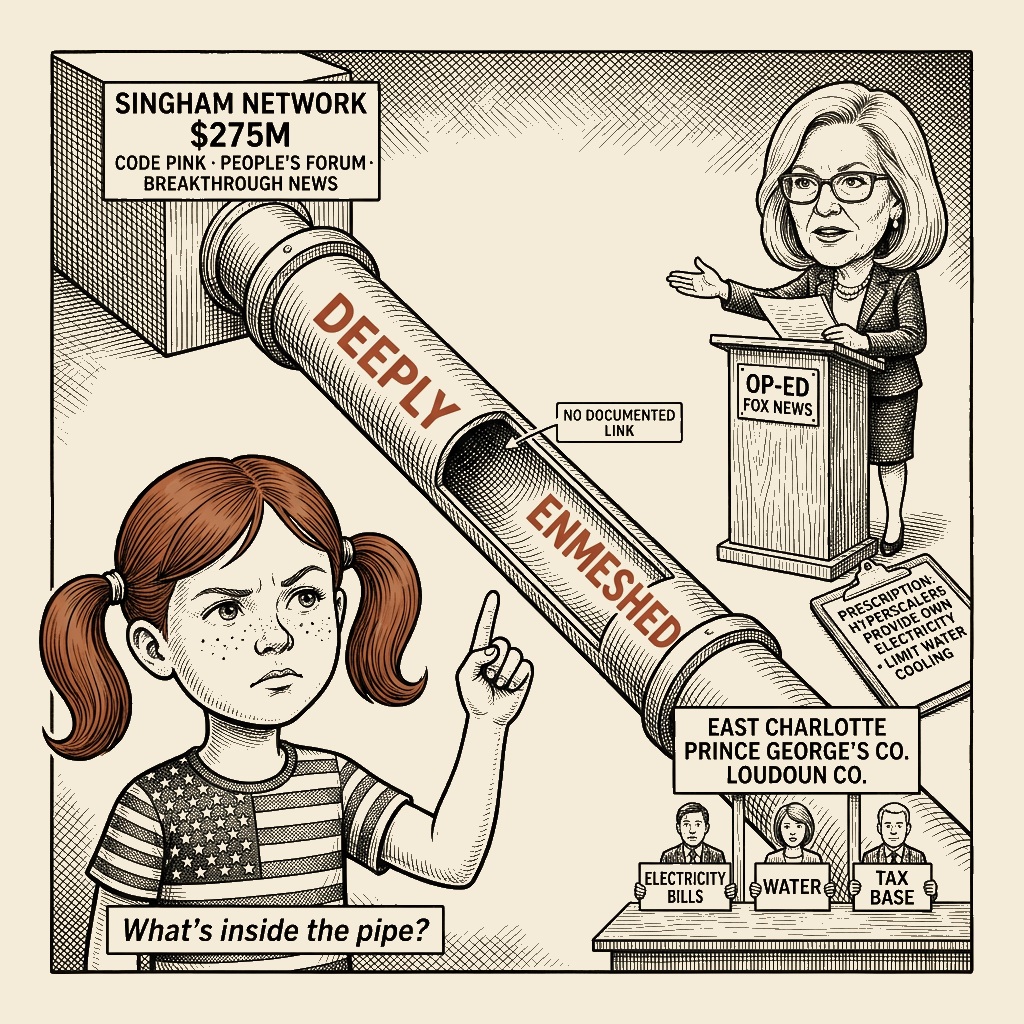
Analyzing: LIZ PEEK: China is cheering as the Left blocks America’s AI infrastructure — Liz Peek · 2026-08-25
What the Editorial Argues
The Fox News opinion column by Liz Peek argues that opposition to data-center construction in the United States is, in substance, a Chinese Communist Party operation. The mechanism the column names is real: Neville Roy Singham, an American Marxist based in Shanghai, has funneled “at least” $275 million through a network of U.S. nonprofits — Code Pink, The People’s Forum, BreakThrough News, the Justice and Education Fund, Tricontinental — and those organizations share staff, share office space with a “China miracles” outfit, and seed talking points through the Party for Socialism and Liberation. The column then performs a pivot: it claims the Singham/PSL network is “deeply enmeshed” in local data-center fights and is responsible for delaying or blocking about $24 billion in proposed AI-infrastructure investment. Local residents worried about electricity bills, water consumption, tax-base erosion, or noise are framed, by topological proximity, as either useful idiots of Beijing or front-line combatants in an influence war. The thesis is that the United States faces an “AI Cold War with China” in which any friction between hyperscalers and host communities is, by definition, a CCP victory — and that this victory is being delivered by a “mindless” American Left animated by hatred of Donald Trump. Senator John Fetterman’s X post — “AI supremacy and energy dominance underpins our national security” — is recruited at the end as bipartisan cover.
Receipts
The piece fuses two structurally unrelated opponents under a single verb in its lede: “The progressive Left is working hard to derail America’s AI dominance by blocking data center construction. So is China.” That sentence is the entire operation in miniature, and the rest of the column supplies the cabling.
- What the framing wants you to believe: A Shanghai-based American funder has built a relay — Singham → Code Pink, The People’s Forum, BreakThrough News, Justice and Education Fund, Tricontinental → Party for Socialism and Liberation → local anti-data-center campaigns — and this relay has delayed or blocked roughly $24 billion in AI-infrastructure projects that the United States needs for an “AI Cold War with China.” Local residents asking about electricity bills, water, tax abatements, and noise are pawns in that relay.
- What’s really going on: A real, documented foreign-influence scandal is being inflated into the explanation for an entire landscape of domestic land-use and energy politics. The receipts the column uses to establish the scandal are genuine; the inferential bridge from scandal to local opposition is the operation. The federal government has, across administrations, decided that AI infrastructure is a strategic priority without doing the siting work that priority status requires. The column’s own closing prescription — “require hyperscalers to provide their own electricity and limit the water used in cooling” — concedes, in passing, that the local objections have substance. The propaganda operation exists to make sure no reader notices the concession. (Anchor: New York Times, 2023, on Singham funding and the Shanghai network; Bitcoin Policy Institute report on PSL ties to local data-center fights; June House Energy and Commerce Committee letter to the White House and FBI; Stu Smith, Manhattan Institute.)
The Operation
This is a Foreign-Agent Transfusion run through a Puppet-Through-Relay scaffold. The column does not argue that data centers should be built; it argues that anyone who opposes them is, structurally, a Chinese asset. The wiring is drawn explicitly: a Shanghai-based funder → a named slate of U.S. nonprofits → the Party for Socialism and Liberation → local anti-data-center campaigns in East Charlotte, Prince George’s County, and elsewhere. The column does not allege a direct Beijing-to-local-activist command line. It alleges a topology: Beijing wants X, Singham funds Y, Y organizes Z, therefore Z is doing Beijing’s work. The inference is the entire product.
I drafted pieces of this kind. The relay is the move I built most often when the editorial needed to convert a domestic fight into a national-security one: name a foreign actor, name the relay, name the local executioner, then refuse to draw the line between the named foreign actor and the unnamed domestic critic. The reader draws it for you. This is the threat-inflation move the WSJ Editorial Technique Catalogue marks at §4.13, generalized — the column does not need the foreign-agent frame to be load-bearing. It only needs it to be visible. The same architecture runs Bandura’s attribution of blame (suffering attributed to the sufferer’s choices) and displacement of responsibility (the harm reframed as authored by Beijing) in tandem; Bandura’s mechanisms appear in concert, not in isolation.
Six moves, each with a textual cue from the column:
One. Guilt by Topological Proximity. Cue: the Singham → PSL → local campaigns chain, with no individual Loudoun County or Prince George’s County resident named. The piece never claims the average local critic is on Singham’s payroll. It claims something worse: the PSL is “deeply enmeshed,” the network seeded “talking points well before the local fights began,” $24 billion in projects delayed. Once a dollar figure is attached to an enemy, the reader does the routing for the writer. Catalogued as frame_engineered_relabeling in the Bad-Faith Techniques Catalog — domestic civic opposition relabeled as foreign-agent work.
Two. The Floating Signifier. Cue: “the Left,” “anti-growth activists,” “lawmakers,” “Singham’s nonprofit network,” “young people,” and the Democratic Party used interchangeably across successive paragraphs. None of these are the same thing. None are defined. “The Left” is doing the work of a coalition that does not exist as such. Same technique as WSJ Editorial Technique Catalogue §4.6 — strawman of progressive positions — applied across an entire coalition rather than a single policy.
Three. Red-Baiting by Association. Cue: “American Marxist,” “Marxist-Leninist,” “Party for Socialism and Liberation,” “dismantle American capitalism,” “$275 million,” “Liberation News.” These are deployed not to argue a point but to overdetermine it. The cumulative effect is to make any reader who has heard of these terms stop evaluating and start flinching. The technique is the saturation pattern the Bad-Faith Techniques Catalog calls flooding_the_zone — high claim density aimed at exhausting the reader’s evaluation capacity — applied to innuendo rather than to discrete propositions. A single claim can be checked; twenty cannot be.
Four. The False Bipartisan Pivot. Cue, late in the column: “AI backlash has become a hot political weapon in the upcoming midterms, with both Republican and Democrat candidates opposing the data center build-out.” This is the WSJ Editorial Technique Catalogue §4.17 — whataboutism, disciplined deployment — used to reabsorb eleven paragraphs of red-baiting back into “politics as usual” the moment the partisanship charge gets hot. The pivot is the tell: it concedes opposition is widespread, then immediately refuses to credit any of it.
Five. Patriot-Framing Laundering. Cue: “the new AI Cold War with China,” “America’s AI dominance,” “the most powerful technological development ever created,” Fetterman’s “AI supremacy and energy dominance underpins our national security.” This is the civilizational frame in the NR Editorial Technique Catalogue (§4.5), with the immigration-restriction register (§4.11) transposed onto AI: an editorial argument that cannot lose because losing would be treason. WSJ §4.13 — the threat-inflation closer — names the structural variant; the closing-line cadence is the rhetorical delivery.
Six. The Token Bipartisan Closer. Cue: Senator Fetterman’s X post, recruited at the end as bipartisan cover. This is what WSJ §4.10 — the “common sense” / “elite” rhetorical pivot — does in reverse: a single named Democrat absolves the rest of the indictment of partisanship. Fetterman is not the argument. He is the launder.
The closing sentence is false_dichotomy (Bad-Faith Techniques Catalog) made explicit: “Those who learn how to use AI will be rewarded; those who fight it will be run over.” The column does not conclude with argument. It concludes with a verdict.
The audience-management function: the column performs identity confirmation for the Trump-aligned and AI-boom-aligned reader (you are on the right side of the AI Cold War) while delivering grievance ratification against the named coalition (the Left is doing Beijing’s work, exactly as you suspected) and conscience displacement for anyone whose local tax base or electric bill is paying for the buildout (your objection is not a siting question; it is a national-security failure). The frame sorts the reader into patriot or asset before the reader reaches the policy paragraph.
The Record
What the column will not say is the part that matters.
Anchor receipts (Tier 1 / primary documents and wire-service investigations).
- The 2023 New York Times investigation cataloguing Singham’s “at least” $275 million in funding, his Shanghai base, his office-sharing with a “China miracles” company, and the staff-sharing between Singham-funded U.S. nonprofits and that company. Real and well-documented.
- A June House Energy and Commerce Committee letter to the White House and FBI demanding investigation of foreign efforts to block the data-center buildout. Real.
- Lt. Col. (ret.) Robert Maginnis cited for “new AI Cold War with China.” The phrase is rhetorical; the uniform does the citing.
- Stu Smith of the Manhattan Institute calling the network “an ecosystem of overlapping organizations, causes, and front-facing projects that all reinforce each other locally.” Real, sourced.
Supporting receipts (Tier 2 / cross-spectrum specialist).
- Bitcoin Policy Institute: the PSL is “deeply enmeshed” in local anti-data-center fights; the network seeded talking points “well before the local fights began”; roughly $24 billion in proposed AI-infrastructure investment has been delayed or blocked. The figure is the rhetorical load-bearer; the institute’s methodology is not surfaced in the column. [Unconfirmed at the column’s level of assertion — the underlying report would need to be checked for its evidentiary basis.]
- Liberation News line, quoted by the column: data centers “are generating massive profits for some, but leave workers with more bills and devastate the environment.” Quoted to demonstrate that PSL-adjacent framing exists; deployed to taint by association.
- Specific locales: East Charlotte, North Carolina; Prince George’s County, Maryland; Richland Parish, Louisiana (the $51,000 teacher-bonus anecdote the column itself offers); Loudon County, Virginia (the “$1.3 billion / roughly 40 percent of county 2027 tax revenue” figure the column itself touts).
Editorial’s load-bearing omissions.
- The Singham figure is reported twice in the column’s own network with conflicting numbers — “at least” $275 million in one passage, “$278M network” in an embedded Fox headline on the same network. The slippage survives because the figure is rhetorical fuel, not load-bearing fact.
- The column’s own closing prescription — “require hyperscalers to provide their own electricity and limit the water used in cooling” — concedes the local objections have substance. The concession is buried in the policy paragraph where readers are not looking for it.
- The federal government decided AI infrastructure is a strategic priority across administrations. No siting work has been done at the federal level to share the burden of that priority. When a county is asked to host hundreds of buildings consuming power and water at industrial scale, the county is not committing treason by asking who pays. The column never addresses this.
- The Richland Parish teacher-bonus anecdote — a Meta data center producing a sales-tax spike that paid teachers “nearly $51,000” — is precisely the payoff residents in other counties are told to wait for, and precisely the payoff residents in other counties are told to refuse when the math does not work for them. The Loudoun “$1.3 billion / 40 percent” figure is the same figure that has produced the local organizing. These are tax-base stories, not foreign-agent stories. The column does not engage them as such.
- The Manhattan Institute’s broader analytical work on data centers and grid cost allocation — to the extent it exists in the public record — would actually address some of the local objections the column is dismissing. Smith is cited as credential; his analytical work on the underlying cost question is not engaged. The asymmetry is the technique.
Per-citation accuracy verdicts.
- Singham network funding: accurately described in scale and structure; the specific dollar figures drift inside the column’s own embedded sourcing.
- Local-project figures (Richland Parish, Loudon County): accurate as cited; deployed as parable rather than as data.
- Bitcoin Policy Institute’s $24 billion figure: presented without methodological scaffolding in the column; the underlying report’s evidence base has not been verified in this analysis.
- Fetterman X post: quoted accurately.
- House Energy and Commerce letter: real, accurately described.
- Maginnis and Smith: real figures, accurately attributed as to quoted language.
Missing-information declaration. The Bitcoin Policy Institute’s full report and methodology are not in this analysis; the $24 billion figure travels at the column’s level of assertion. The Singham network’s actual operational links to specific named local campaigns in the jurisdictions the column names (East Charlotte, Prince George’s County) are not independently verified in this analysis; the column’s “deeply enmeshed” framing rests on the institute’s report and Smith’s characterization, both cited in the column itself. Receipts unobtainable from the column at this length have been carried as the column carries them.
How to Recognize This
This is the Patriotic Pretext form. You will recognize it by these signatures.
- A real foreign-influence scandal is named in paragraph three or four — and the column does not contest the scandal’s existence.
- The named scandal is then used, without an inferential bridge, to explain a large and varied domestic opposition that has its own documented grievances (electricity, water, tax base, noise, grid reliability).
- A dollar figure (here, $24 billion) is attached to the enemy to make the abstract countable.
- “The Left” — or “the progressive Left,” or “anti-growth activists,” or “mindless” — is invoked without definition, holding the place of an entire coalition that does not exist as such.
- A retired officer is inserted in the third graf to certify the threat frame, then disappears.
- Demographic decline (retirees, birthrate, immigrants) is stacked into a single workforce paragraph that licenses the columnist’s preferred policy (here, AI buildout) as the only available labor substitute.
- Vague attributions — “America’s enemies,” “foreign adversaries,” “media alarmism” — are deployed without naming.
- One named locality is held up as the answer to a generalized objection (Richland Parish bonus, Loudon County taxes).
- A bipartisan closer is recruited — Senator Fetterman here — to neutralize the partisanship charge.
- The closing line is a verdict, not an argument: “Those who learn how to use AI will be rewarded; those who fight it will be run over.”
- The policy the column is actually defending — hyperscaler buildout, with state-level workarounds for water and power — is never named as the policy being defended. The argument is always about patriotism and security.
When you see six or more of these signatures in a single column, you are reading the Patriotic Pretext. The foreign-agent frame is the cover; the policy is the cargo.
The piece this column is built to silence is not Singham’s. It is the county commission meeting where residents ask who pays for the substations. The column does not want that meeting to happen, and the operation is built to make sure that when it does, the people in the room have already been sorted into either patriots or foreign assets. They are neither. They are residents.

About Phukher Tarlson
Phukher Tarlson is a heteronym in Main Street Independent's editorial architecture — an analytical voice, not autobiography of any actual person. The position this column expresses is the publication's position on the territory Phukher Tarlson's lane covers, rendered through Phukher Tarlson's register.