Analyzing: Why Democrats Can’t Moderate on Abortion — John Gerardi · 2026-08-25
What the Editorial Argues
Read at its strongest, the editorial argues that the Democratic Party has traded the Clinton-era goal of reducing abortions for a single normative commitment to “access,” and that the recent volume statistics prove the trade was total — leaving no principled stopping point short of full deregulation. On this reading, the Democratic Party of 2024 could not produce a presidential nominee willing to deliver Barack Obama’s 2009 Notre Dame formulation. From that premise the editorial draws three operational claims: (1) any Democratic policy that increases abortion volume proves the abandonment is total; (2) the historical “safe, legal, and rare” frame was a moderating compromise the party has dissolved; (3) the only remaining escalator is further deregulation of abortion provision, with no terminal step.
In plain language: the editorial argues that the goal of reducing abortions has been ejected from Democratic politics, that the volume statistics prove it, and that the next policy moves will be worse than the current ones.
Receipts
The editorial draws its evidence from a closed inventory of seven moves:
- A 2009 Obama Notre Dame commencement quote on reducing unintended pregnancies and supporting adoption, deployed as the historical baseline.
- A “near-infanticide” framing of the Massachusetts late-term legalization.
- A description of California legislation allowing non-physicians to perform second- and third-trimester surgical abortions and mandating abortion-pill availability in community college student health centers, with Newsom’s 2019 SB 24 signing as the prior installment.
- A volume claim: total U.S. abortions rose from 900,000 in 2021 to 1.1 million in 2025, attributed to the Biden FDA’s telemedicine / mail-order rules.
- A platform-comparison claim: the 2008 Democratic platform aimed to reduce abortion need; the 2024 platform did not.
- A chronology of Democratic nominees’ positions on the Hyde Amendment — Hillary Clinton in 2016 (the first Democratic presidential nominee to oppose Hyde), the 2016 platform (the first to call for its repeal), and Joe Biden’s compressed reversal in 2019.
- A “tomorrow-list” of predicted next steps: conscience-protection elimination, filibuster carve-out, Roe codification.
These are the textual cues. They are not the analysis. The analysis is what the operator does with them.
The Operation
The editorial is a textbook stack of the following catalogued techniques. References name the Bad-Faith Techniques Catalog (BFTC), the NR Editorial Technique Catalogue (NRETC), and the WSJ Editorial Technique Catalogue (WSJETC) where the lineage overlap is exact.
-
Goalpost-shifting under cover of “moderation” (BFTC:
goalpost-shift; WSJETC:moving-moderation-frame). Moderation is defined as whatever the writer chooses to call moderation in the moment — first “safe, legal, and rare,” then “the goal of reducing abortion need.” When the target moves, the opponent can never catch up. The technique requires the audience not to notice the substitution. -
Motte-and-bailey (BFTC:
motte-and-bailey). The defensible motte: “Democrats support legal abortion.” The indefensible bailey: “Democrats are structurally committed to maximizing abortion volume.” The motte is conceded by every serious Democrat; the bailey is the load-bearing claim. The editorial slides between them without notice. -
Post hoc as causal proof (BFTC:
post-hoc-causation; WSJETC:single-policy-causal-claim). The 2021-to-2025 volume increase is attributed to the FDA mail-order rule. Confounders — pandemic-era fertility patterns, post-Dobbs travel-state flows, expanded self-managed medication abortion reporting, methodology churn, the 2022–2024 fertility dip — are absent. The causal arrow is drawn because it is convenient, not because it has been earned. -
Dysphemism treadmill with apocalyptic-escalation ladder (BFTC:
dysphemism-treadmill; NRETC:apocalyptic-escalation-ladder; WSJETC:vibration-over-number). “Demonic promotion of near-infanticide,” “stomach-churning,” “God help us all.” The editorial never lands on a number; it lands on a vibration. The rhetorical work is to keep the reader’s affect elevated above the level where numbers get inspected. -
Slippery slope with explicit “tomorrow-list” (BFTC:
slippery-slope; NRETC:tomorrow-list-construction; WSJETC:inevitability-narrative). The piece lists, in order, the next three outrages the editorialist knows will happen. The structural function is to convert a contested policy debate into an inevitability narrative. Once the slope is drawn, the present policy is retrospectively re-described as the early stage of the slide. -
Quote-mining a departed moderate (NRETC:
departed-moderate-frame; WSJETC:frozen-quote-baseline). The Obama 2009 quote is used to mark the lost baseline of reasonableness. The technique works only if the reader does not notice that the quote is seventeen years old, from a commencement address to a Catholic audience, by a politician whose party has since evolved on the underlying question — and that the editorialist has selected the moment precisely because no current Democratic nominee would deliver the same line. -
Card-stacking via platform-comparison (BFTC:
card-stacking; NRETC:platform-clause-extraction). The 2008-versus-2024 platform comparison is presented as a self-evident smoking gun. The omitted plate is the entire 2016, 2020, and post-Dobbs realignment, the 2022 Kansas referendum result, the 2024 state-level ballot outcomes, and the shift in the median voter’s stated position. The two-platform extract is a card-stack because it pretends to be the whole deck. -
Concern-troll opening (NRETC:
sympathetic-voices-frame). The editorial opens by citing two named movement figures as concerned moderates whose question the editorialist will answer. The framing positions the editorial as a sober response to a reasonable worry, when the editorial itself is the source of the worry it pretends to answer. -
False bifurcation at the close (BFTC:
bifurcation). “If those are one’s priors, how does one logically oppose any expansion of abortion?” — the editorial closes by forcing the reader into a binary: either the editorialist’s priors or no coherent position. This is not an argument; it is a refusal of argument.
The Record
The factual scaffolding the editorial rests on carries the following load-bearing defects:
-
Volume claim. The “2021 to 2025” rise depends on which series is being used (CDC versus Guttmacher versus the Society of Family Planning’s #WeCount project). Post-Dobbs measurement has been explicitly disrupted. The “900,000” 2021 baseline sits below Guttmacher’s reported ~974,000 facility-based figure for that year and tracks more closely with the CDC’s incomplete state-reporting series; the “1.1 million” 2025 endpoint extrapolates from the 2024 Guttmacher series (~1.04M facility-based in 2023, building toward ~1.1M by 2024). Self-managed medication abortion is now partially counted through research networks rather than provider reporting. The editorial presents its endpoints as settled national totals when the underlying methodology is in dispute. Even where the directional claim (“abortions rose post-Dobbs”) is supported across series, the magnitude and attribution are not.
-
Causal attribution. The FDA mail-order rule is named as the driver. Medication abortion already accounted for the majority of U.S. abortions in many reporting series before 2021; travel-state flows, expanded self-management, and state-level shield-law activity all contribute. Naming it does not collapse the rest. The “almost as simple as an Amazon Prime order” line is rhetorical equivalence, not measurement.
-
Hyde chronology. The editorial compresses Biden’s 2019 reversal into “a week.” Contemporary reporting (the New York Times contemporaneous account) places the actual reversal inside roughly two days of intense criticism at a DNC gala dinner in Atlanta, with the prior position defended publicly the day before. The “week” framing is a rhetorical expansion, not a record. The reversal was also a contested intra-party policy shift driven by primary pressure from Sanders, Warren, Harris, and others — not a sudden personal apostasy. Presenting a contested intra-party move as a personal conversion is a rhetorical choice, not a historical one.
-
Platform comparison. The disappearance of “reducing the need for abortion” from the 2024 platform is read as proof of structural transformation. It is at most proof that the slogan was retired. These are different claims, and the editorial treats them as the same. The omitted plate is not just language; it is the 2022 Kansas referendum result, the 2024 state-level ballot outcomes, and the post-Dobbs voter-median realignment that the two-platform extract deliberately refuses to show.
-
“Tomorrow-list.” The listed next steps — conscience-protection elimination, filibuster carve-out, Roe codification — are presented as certain. Codification via filibuster carve-out was in fact not pursued in the 117th or 118th Congress during the windows when Democrats held relevant power. The “inevitability” is a forecast, not a record; the editorial asks the reader to treat the forecast as already-occurred because naming it makes it feel inevitable.
How to Recognize This
The pattern is recognizable in any editorial that meets five or more of the following. Each item below maps to a catalogue entry, and the eight items together instantiate the canonical inevitability-narrative-lock family — the move that converts contested policy into inevitability so that opposition can be retrospectively described as futile.
- Opens with a sympathetic-voices frame from named movement figures (
nre_catalog: sympathetic-voices-frame). - Quote-mines a departed moderate whose current position would differ (
nre_catalog: departed-moderate-frame). - Defines the opponent’s “moderation” by a moving target (
[bf_catalog:goalpost](/propaganda/docs/bad-faith-techniques-catalogue#goalpost)-shift). - Lifts one volume or trend figure, attributes it to a single named policy, and omits confounders (
[bf_catalog:post](/propaganda/docs/bad-faith-techniques-catalogue#post)-hoc-causation;[bf_catalog:card](/propaganda/docs/bad-faith-techniques-catalogue#card)-stacking). - Climbs a dysphemism ladder (“demonic,” “stomach-churning,” “God help us all”) rather than landing on inspected numbers (
[bf_catalog:dysphemism](/propaganda/docs/bad-faith-techniques-catalogue#dysphemism)-treadmill;nre_catalog: apocalyptic-escalation-ladder). - Closes with a “tomorrow-list” that converts contested policy debate into inevitability (
[bf_catalog:slippery](/propaganda/docs/bad-faith-techniques-catalogue#slippery)-slope;nre_catalog: tomorrow-list-construction). - Uses platform-language extraction (a clause in, a clause out) as proof of structural transformation (
nre_catalog: platform-clause-extraction). - Refuses the binary at the end by forcing the reader into the writer’s priors as the only coherent position (
[bf_catalog:bifurcation`](/propaganda/docs/bad-faith-techniques-catalogue#bifurcation)).
When the pattern appears, the operator is doing one job: converting a contested policy question into an inevitability narrative so that opposition can be retrospectively described as futile. The reader is not being informed about Democratic policy; the reader is being installed inside a frame in which Democratic policy can only be described in the editorialist’s terms.
Look for the catalogue IDs and you will see them everywhere: goalpost-shift, motte-and-bailey, post-hoc-causation, dysphemism-treadmill, slippery-slope, card-stacking, bifurcation from the Bad-Faith Techniques Catalog; apocalyptic-escalation-ladder, tomorrow-list-construction, departed-moderate-frame, platform-clause-extraction, sympathetic-voices-frame from the NR Editorial Technique Catalogue; moving-moderation-frame, single-policy-causal-claim, vibration-over-number, inevitability-narrative, frozen-quote-baseline from the WSJ Editorial Technique Catalogue. The lineage overlaps because the editorial-page conventions overlap.
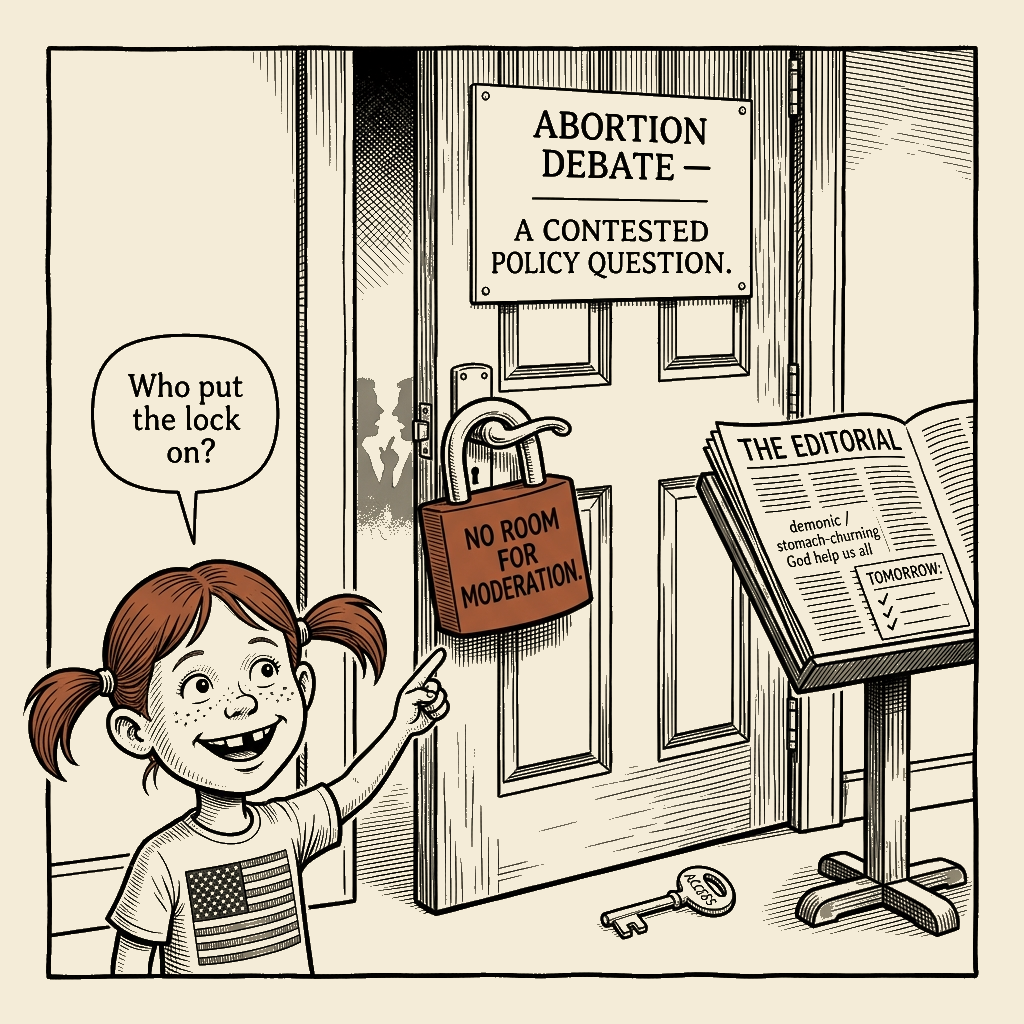
The “no room for moderation” frame is the lock. “Access” is the key. The editorial is the door.

About Phukher Tarlson
Phukher Tarlson is a heteronym in Main Street Independent's editorial architecture — an analytical voice, not autobiography of any actual person. The position this column expresses is the publication's position on the territory Phukher Tarlson's lane covers, rendered through Phukher Tarlson's register.