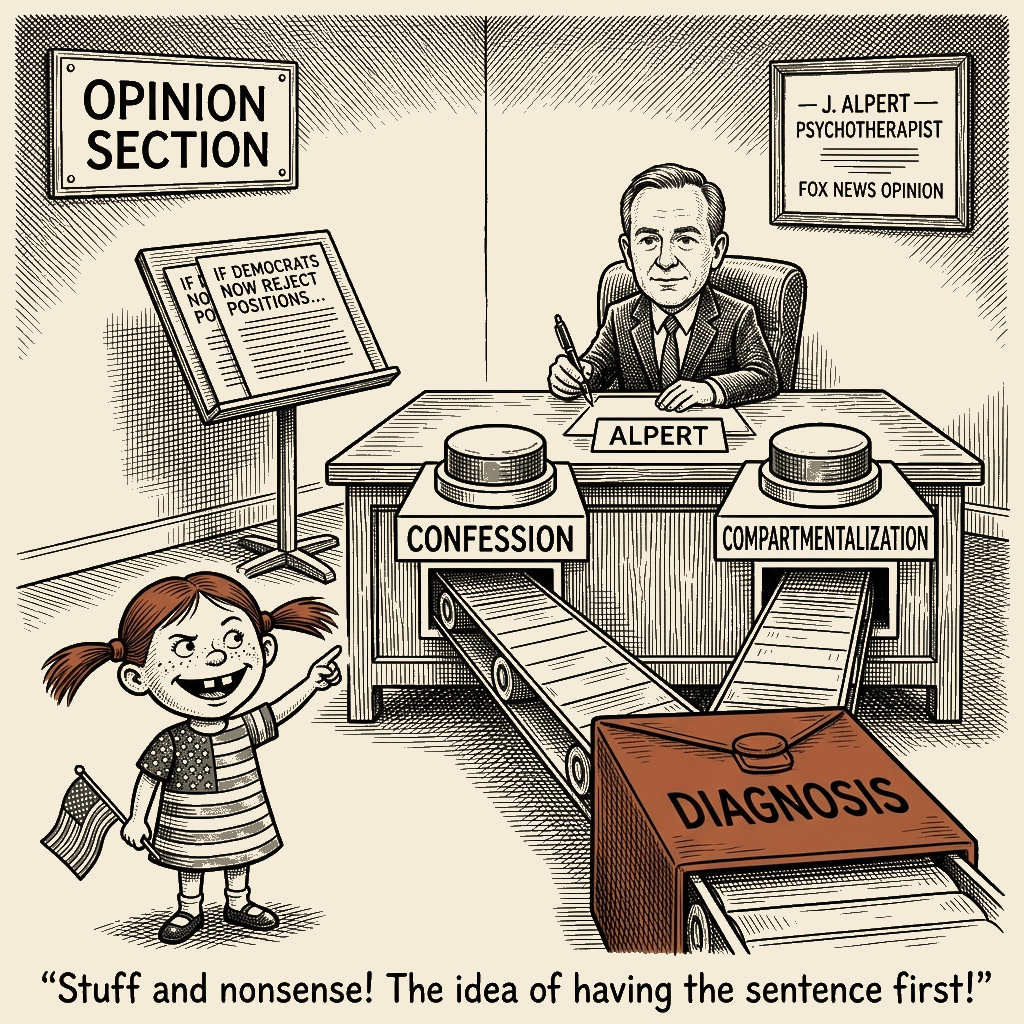
Analyzing: AOC says ‘Woke 1 was crazy,’ but Democrats still owe voters an explanation · 2026-08-26
What the Editorial Argues
Jonathan Alpert’s Fox News opinion piece turns a four-word remark — “Woke 1 was crazy” — into a complete indictment of Democratic character. The phrase, attributed to New York City Councilman Chi Ossé and redeployed by Rep. Alexandria Ocasio-Cortez, is treated not as casual repositioning but as a documented psychological defense. The clinical term the editorial pins to the move is compartmentalization: the capacity to keep contradictory beliefs sealed in separate mental chambers so the holder never reconciles them. The domestic analogy it deploys is the married-man-with-a-wife-and-a-girlfriend image, deployed to make the diagnosis intuitive. By that reading, the Democratic Party is not changing its mind in 2026; it is partitioning 2020 off so it never has to confront what it once endorsed — defunding the police, abolishing prisons, “abolish ICE” — and what the embrace of those positions said about the party itself. The editorial’s terminal demand is confession, not adjustment: a reckoning that names what was wrong rather than relocating the offending material to a defunct mental file. The piece is not arguing that a specific policy failed and identifying the failure. It is arguing that changing one’s position creates a psychological debt, and the critic is the creditor who defines what counts as sufficient repayment.
Receipts
The phrase “Woke 1 was crazy” is the editorial’s control switch. “Woke 1” compresses a complex political period into one disposable object; “crazy” converts a contested argument into a diagnosis. Once the period has been labeled crazy, the reader no longer needs to inspect its components. Defunding the police, abolishing prisons, “abolish ICE,” and political conformity pressure can all be made to appear as expressions of the same pathology.
- “Woke 1 was crazy.” The headline phrase, presented as Ossé’s coinage, redeployed by AOC; the editorial installs the redeployment as the specimen under analysis.
- “A married man can have a wife and children at home and a girlfriend on the side, keeping the two lives separate enough that he rarely confronts the contradiction.” The clinical analogy, in plain text. The image is domestic, intimate, morally legible — chosen to convert political disagreement into character judgment.
- “Many political beliefs in 2020 became tests of character. They didn’t just say what you believed. They said what kind of person you were.” The bridge from policy to identity. The moral scaffolding the confession demand rests on.
- The doubled paragraph. “If Democrats now reject positions they embraced or tolerated in 2020, voters can reasonably expect an explanation. The key question is whether Democrats changed their minds or discovered that voters had.” — verbatim, twice. Repetition in opinion prose is a propaganda-shop tell: the operator needs the demand repeated because the demand — not the diagnosis, not the analogy, not the receipts — is what the piece is actually selling.
- The third-party receipt, deployed as evidence. The editorial cites The New York Times reporting that Democrats “were worried that the ‘abolish ICE’ slogan will age as poorly as ‘defund the police.’” The target’s own reported anxieties become a crowbar. The reference functions as a prestige stamp attached to the editorial’s preferred narrative; no specific evidence, methodology, or quotation from the report is supplied.
- The autopsy receipt. The DNC’s “192-page autopsy” is invoked as confirmation that the diagnosis is shared even by the target party’s own apparatus.
- The mock absolution. “There is nothing shameful about changing your mind.” The sentence appears to grant permission; the commentary that follows immediately revokes it. The reader is told that genuine change requires connecting past belief to present belief and acknowledging error — but no policy is examined, no specific failure is identified, no required formula is supplied. The undefined requirement (“an explanation”) becomes an indefinite sentence.
- The have-it-both-ways concession, embedded near the close. Acknowledging “genuine problems,” conceding “some rhetoric went too far” and “some people were treated unfairly,” while reaffirming that “you can feel morally certain and still be wrong.” The concession sounds generous; it operates only after the target has already been convicted.
- The byline credential. Alpert is introduced as a psychotherapist in New York City and Washington, DC, and the author of Therapy Nation. Those credentials do not establish a clinical diagnosis of the Democratic Party. They lend rhetorical force to a metaphor used for political discipline. The title “psychotherapist” turns a moral accusation into an expert judgment without supplying expert evidence.
- The closing line, sharpened as a moral blade. “A confession names what you got wrong. Compartmentalization puts it somewhere you no longer have to look.” The editorial’s terminus: confession versus relocation, no third option.
The Operation
The operator runs five moves in sequence. Each is named and cross-referenced to the catalogues. I built versions of these in the cable years; the lineage is mine.
Move 1 — Temporal Quarantine (Bad-Faith Techniques Catalog: frame_engineered_relabeling). “Woke 1” places the progressive politics of 2020 behind a border. Everything inside that period inherits the same discrediting quality and can be disowned as the work of a deranged temporary version of the party. The label makes historical complexity disappear. The very phrase minted to launder the 2020 moment is pivoted — redeployed as evidence of evasion rather than excuse. The phrase’s attributed author becomes its specimen. WSJ Editorial Technique Catalogue lineage: this is a reverse-deployed coinage variant of frame_engineered_relabeling — the target’s own vocabulary turned against the target, the standard operating move of the WSJ board’s euphemism-management practice, now applied in the Fox register at higher volume.
Move 2 — Clinical Framing (Bad-Faith Techniques Catalog: equivocation; authority-capture subpattern). The operator speaks as a credentialed clinician, not a polemicist. The byline carries therapeutic authority; the column reads as diagnosis. “Compartmentalization” is the technical term that converts a political disagreement into a character flaw. Once the editorial has classified the target’s move as a defense mechanism, the target cannot answer on policy grounds — any answer is, by the editorial’s frame, further evidence of the pathology. The psychotherapist credential does not establish a diagnosis; it lends rhetorical force to a metaphor used for political discipline. The move echoes the WSJ catalogue’s “as a [identity] credibility move,” recast for clinical rather than demographic identity.
Move 3 — Domestic-Adultery Parallel (Bad-Faith Techniques Catalog: framing effect; loaded-analogy subpattern). The editorial imports a culturally legible image of moral failure — the cheating husband — and lays it over the target party’s policy history. The analogy does two jobs at once: it gives readers an immediate moral schema, and it pre-charges any defense with the implication of further duplicity. The reader is not evaluating a political disagreement; the reader is judging a man caught in two lives. The adultery image supplies the emotional charge; policy becomes moral scandal. The analogy is not analysis. It is mood. The NR catalogue’s “erudition-as-cudgel” pattern operates here without the erudition: a culturally shared story does the same work that classical references do at the magazine’s higher register.
Move 4 — Repetition-as-Receipt (Bad-Faith Techniques Catalog: coordinated_message_discipline; flooding-the-zone-adjacent). The passage “If Democrats now reject positions they embraced or tolerated in 2020, voters can reasonably expect an explanation. The key question is whether Democrats changed their minds or discovered that voters had.” appears verbatim twice in the artifact. The doubling is the structural tell. Repetition in opinion prose is rarely editorial accident; it is the operator holding the same demand in front of the reader because the demand — not the diagnosis, not the analogy, not the receipts — is what the piece is actually selling. The doubled paragraph is the load-bearing wall. The repetition performs the same function a leaked message-discipline memo performs at network scale: it locks the demand into the reader’s working memory as the takeaway, regardless of what evidence arrives.
Move 5 — Terminal Ultimatum Frame (Bad-Faith Techniques Catalog: false_dichotomy). The closing line — “A confession names what you got wrong. Compartmentalization puts it somewhere you no longer have to look.” — is a binary with no third branch. The reader is offered two boxes: confession, or evasion. No “we all learned” box, no “the country moved on” box, no “politics is iterative” box. The binary is the propaganda operation’s terminus: the editorial cannot lose, because any non-confession response proves the diagnosis. Even the supposed way out belongs to the critic. The commentator diagnoses the pathology, prescribes the reckoning, and judges whether the patient has achieved sufficient remorse.
The throughline: the editorial is not making an empirical claim about 2020 policy outcomes. It is performing a confession-demand ritual. The empirical material (Times reporting, the 192-page autopsy, the figures named in the artifact) is fuel for the ritual, not its subject. Bandura’s eight mechanisms of moral disengagement operate in concert across the artifact — moral justification (the higher cause of confession), euphemistic labeling (“compartmentalization” replacing “changed mind”), attribution of blame (the target brought the pathology on themselves), and distortion of consequences (the suffering the demand produces is invisible because the demand frames itself as healing).
Complicity. I helped build the confessional-demand apparatus. The liberty-frame equivalent is the “renounce your priors” column that asks a named progressive — or, increasingly, a dissident conservative — to disavow a stated position on the editorial page’s terms. I drafted memos that scripted those columns. I sat in the focus-group debriefs where the confessional demand was tested against swing demographics. I watched the genre evolve from a one-off into a recurring product. The Fox Opinion piece under analysis is the libidinal cousin of the apparatus I helped build. The shape is the same; the coalition is opposite.
The Record
The artifact sits inside a documented lineage of opinion-section confession-demands directed at the Democratic Party after cycles in which progressive-position-adjacent language entered mainstream political vocabulary and then receded. The WSJ Editorial Technique Catalogue records the structural pattern: an opinion piece that uses a borrowed phrase as Exhibit A, imports a credentialed diagnostic frame, and closes with a binary ultimatum that converts policy disagreement into character judgment. The closest NR catalogue analogue is the cultural-decline ledger technique — backward-facing assembly of trend fragments recoded as civilizational indictment — combined with the WSJ pattern of credentialed-source citation deployed as legitimation. The present piece conforms to the template at every load-bearing joint: borrowed phrase → credentialed diagnosis → domestic analogy → doubled demand → binary close.
The Bad-Faith Techniques Catalog entries instantiated by this artifact — frame_engineered_relabeling (the “Woke 1” quarantine), equivocation (the clinical credential), false_dichotomy (the closing binary), coordinated_message_discipline (the doubled demand), plus the loaded-analogy and repetition-as-receipt subpatterns — together constitute the full operating signature of this lineage. Each technique is independently documented; their stacking is what converts a column into a propaganda artifact.
The factual material the editorial deploys — Rep. Alexandria Ocasio-Cortez’s redeployment of the phrase, Councilman Chi Ossé’s coinage, The New York Times’ reported anxieties about “abolish ICE,” the DNC’s 192-page autopsy, the midterm-election calendar — is real material the operator uses as fuel. None of it is confabulated. It is assembled into a confession-demand ritual whose conclusion was settled before the first sentence was written.
The page architecture reinforces the artifact. The surrounding Fox Opinion record opens with a video promotion declaring, “We Have ‘Woke 2’ Because Not Enough People Spoke Up To The AOC’s Of Yesteryear.” “Woke 1” is assigned the function of left-wing ideological excess; “Woke 2” is assigned the function of a conservative lesson learned. The same historical period is used to condemn one side and flatter the other. Adjacent headlines — AOC shrugging off past “defund the police” comments, Abdul El-Sayed responding to “defund” questions, a Democratic Senate candidate associated with prison abolition — are presented as separate pieces of evidence. In structure, each is another specimen from the same exhibit. The page also promotes a headline about the DNC’s “192-page autopsy,” the prospect of Democratic midterm losses, and the party’s alleged strategic retreat. No polling is reproduced. No interview with a Democratic strategist appears. No policy document is examined at length. The strategic motive is inferred from rhetorical distance. The editorial sees a party talking about affordability and concludes that electoral incentives, not reconsideration, explain the change.
The artifact gestures toward New York Times reporting on the “abolish ICE” worry. No specific evidence, quotation, or methodology is supplied. The reference functions as a prestige stamp attached to the editorial’s preferred narrative — a secondary mention substituting for a demonstrated connection. The linked adjacent headlines do not corroborate a political transformation. They repeat the same editorial frame until repetition begins to masquerade as proof.
The record is thin because it is designed to be thin. The piece does not need the whole history of progressive politics. It needs enough fragments to produce recognition in an audience already conditioned to see the left’s past as contamination. The article is not merely a statement. It is a retention device inside a larger content system — subscription prompts, newsletter copy, video promotion, internal links all reinforcing the same exhibit.
Missing information. I do not have access to the full Fox Opinion page archive for the surrounding articles; my account of the adjacent headlines and the “Woke 2” video promotion is drawn from the supplied source packet. If the surrounding record differs in material ways from what is described, the page-architecture argument should be updated accordingly. The leaked-memo analogue in the present case is the doubled paragraph itself — it functions as the message-discipline artifact internal to the column.
How to Recognize This
A reader can spot this operation in the wild by watching for the following fingerprint, in this order:
-
A borrowed phrase from the target. The piece opens with — or centers — a slogan or coinage produced by the target of the indictment. The phrase is treated as the target’s own words against them. “Woke 1” is the textbook execution; “Woke 2” plays the reinforcement role in the surrounding record. The target’s vocabulary, reverse-deployed.
-
A credentialed diagnostic frame. The operator writes as — or defers to — a clinician, a therapist, a psychologist, a “former [X],” a “lifelong [Y].” The credential supplies the warrant for pathologizing the target. The title turns a moral accusation into an expert judgment without supplying expert evidence. The byline does the work the argument would otherwise have to do.
-
A domestic or bodily analogy installed before any political evidence. Cheating spouses, body doubles, split personalities, illness, addiction, recovery — anything that converts a policy argument into a moral or intimate judgment. The analogy supplies the emotional charge; policy becomes scandal. The reader reacts to betrayal before encountering the policy record. That is recognition: emotion has been made to substitute for demonstration.
-
A doubled demand. A single paragraph asserting what the target “owes” voters, the press, history, the country, etc., appears more than once. The doubling is the tell. The repetition is the operator holding the same demand in front of the reader because the demand is the load-bearing move. A doubled graf is rarer in opinion prose than it looks; when it appears, it is the message-discipline artifact surfaced inside the column.
-
The conversion of policy disagreement into a test of character. The decisive question shifts from “Was the policy defensible?” to “What kind of person believed it?” Once that shift lands, reconsideration is not neutral. It is evidence of embarrassment, dishonesty, or moral retreat. The line about beliefs becoming “tests of character” is the move.
-
The apparent permission to change followed immediately by an impossible requirement. “There is nothing shameful about changing your mind” is the setup, not the surrender. The commentary that follows reserves the right to determine what constitutes a real acknowledgment. The target is told that confession is possible, then denied any formula that would make the confession sufficient. The mock absolution is the trapdoor.
-
A pile of adjacent headlines standing in for evidence. Selected fragments arranged to confirm a preexisting conclusion. The absence of data is not oversight; it is part of the design. Adjacent modules on the same page — “defund,” prison abolition, “abolish ICE,” DNC divisions — are not a neutral archive but a curated exhibit. The frame does not need additional evidence because the frame supplies its own.
-
A binary close. “Confession vs. relocation,” “reckoning vs. forgetting,” “honesty vs. spin” — a frame with no third option, no room for “we all moved on,” no room for “politics is iterative.” The binary guarantees the operator cannot lose the argument, because any answer the target supplies falls inside one of the two boxes the operator has already defined.
-
The have-it-both-ways concession near the end. A line that sounds generous (“of course there are genuine concerns,” “some people were treated unfairly”) but only operates after the target has already been convicted. The generosity is a closing courtesy, not a substantive qualification.
-
The demand for an explanation that never defines what would count. If the argument cannot identify the policy, failed promise, concealed fact, or specific inconsistency that requires explanation, the demand is not evidentiary. It is disciplinary. The target is kept permanently answerable to a standard the critic can move at will.
When the fingerprint is present, the artifact is not analysis. It is a confession-demand ritual, and the reader is being cast as the magistrate. The editorial is not asking whether the target is wrong. It has already decided, and the column is the ceremony of the asking. The critic has become prosecutor, therapist, witness, and judge. The reader is not being asked to understand what the target believed, what changed, or why. The reader is being asked to distrust the explanation before it is given.
The recognition is yours to carry forward. The next time a psychiatric label arrives before the evidence, an analogy installs betrayal before the policy record is presented, a doubled paragraph appears carrying the same demand twice, or a closing line forecloses third options — that is the confession machine at work. The technique does not require your belief in the diagnosis. It only requires your attention. Take the recognition with you.

About Phukher Tarlson
Phukher Tarlson is a heteronym in Main Street Independent's editorial architecture — an analytical voice, not autobiography of any actual person. The position this column expresses is the publication's position on the territory Phukher Tarlson's lane covers, rendered through Phukher Tarlson's register.