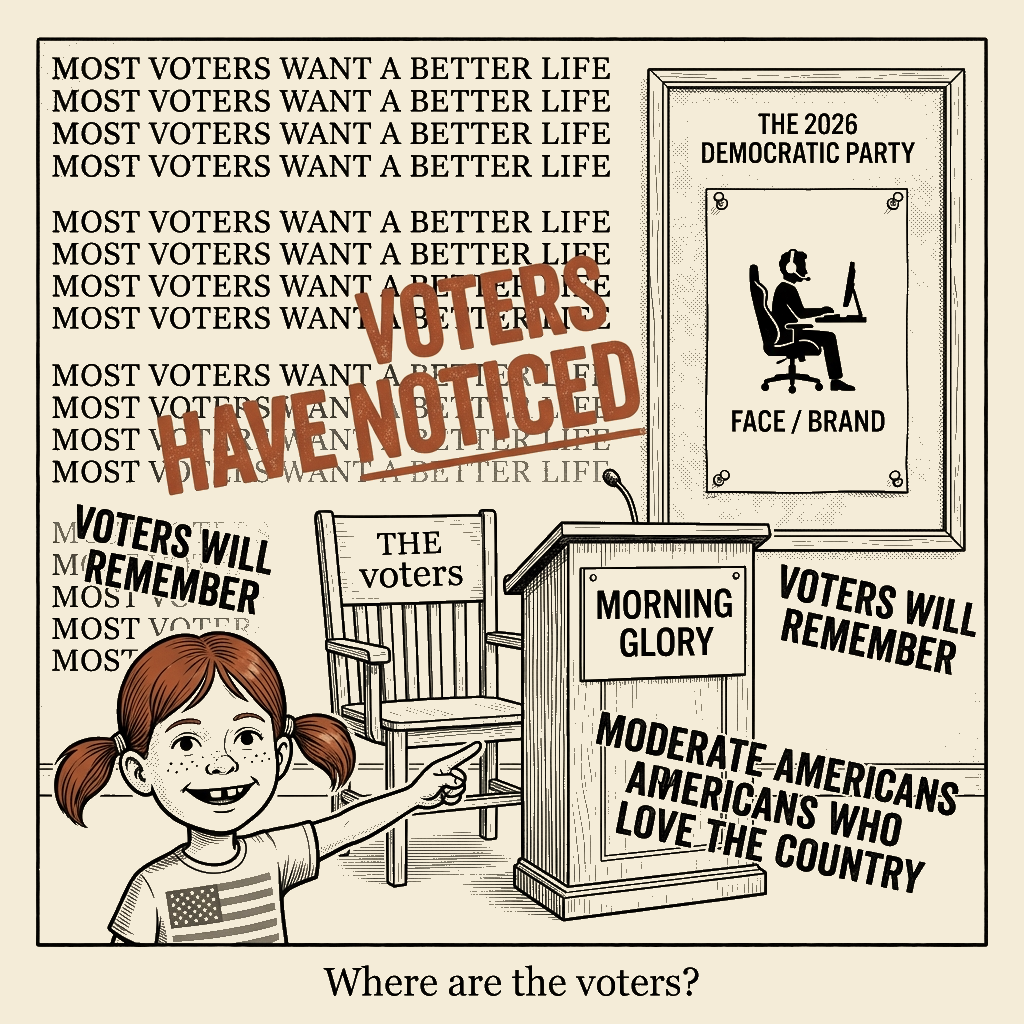
Analyzing: MORNING GLORY: Hasan Piker’s radical rhetoric is becoming Democrats’ 2026 brand — Morning Glory · 2026-08-27
What the Editorial Argues
The Fox News Opinion column dated August 27, 2026 — filed under the “Morning Glory” byline and authored, by the column’s own disclosure, by Hugh Hewitt — argues a single coordinated thesis: that Hasan Piker, a left-wing Twitch streamer whose cumulative audience the column places at “three million ‘Twitch’ viewers and another couple million viewers on YouTube,” has become the symbolic face, brand, and effective campaign apparatus of the Democratic Party in the 2026 midterms. The column claims Piker “personally carried the most radical major-party candidate in memory — Michigan Democrat Abdul El-Sayed — to his party’s nomination for United States Senate,” has contaminated Democratic Socialists of America-endorsed Senate candidacies in New Hampshire (Chris Pappas), Maine (Troy Jackson), Texas (James Talarico), and Minnesota (Peggy Flanagan), and has been tacitly embraced by Senate Minority Leader Chuck Schumer’s “big tent” defense. The intended conclusion: the Democrats’ 2026 brand is now indistinguishable from “Pikerism,” and the party’s 2028 presidential candidates will have to “scrub that brand away.”
The argument operates as a brand-annexation thesis. A radical figure with a small relative audience and no institutional authority inside the party is declared its new public face — on the strength of one Senate primary he is said to have swung, a checklist of DSA-endorsed candidates whose names are recited, and a handful of viral incidents the editorial catalogues as evidence of extremity. From that, the editorial extrapolates to the whole 2026 ticket. The thesis is not argued; it is staged.
Receipts
The textual cues the editorial leans on, each as a load-bearing exhibit:
- Audience metric — claimed, then conceded as small: “Piker is estimated to have a cumulative audience of three million ‘Twitch’ viewers and another couple million viewers on YouTube. But that’s still an insignificant audience within the American voting public…” — the concession and the load-bearing claim share a paragraph; the editorial harvests both honesty-points and indictment-points at once.
- Brand-annexation predicate: “he has become the face of the Democratic Party in the 2026 midterms, and has personally carried the most radical major-party candidate in memory — Michigan Democrat Abdul El-Sayed — to his party’s nomination for United States Senate.” —
[bf_catalog:hasty_generalization`](/propaganda/docs/bad-faith-techniques-catalogue#hasty-generalization); the leap from one primary to a party-wide diagnosis. - Selective party rebuke, read as capture: “some Democratic leaders and elected officials have had to rebuke him without naming him — including House Minority Leader Hakeem Jeffries and Sen. Elissa Slotkin — and others, like New Jersey Sen. Cory Booker, have slapped Piker down by name.” — read against itself, this is the party’s disciplinary operation working. The editorial inverts the direction to harvest capture-fear.
- Grief-mockery lever: “this past weekend, Piker exploited the assassination of Charlie Kirk on September 10 of last year” / “Piker’s revolting mocking of grief around Kirk’s murder.” — weaponizes the assassination to upgrade the seriousness of every other outrage attributed to Piker.
- Foreign-policy / antisemitism lever: “his comments about American Jews endangering themselves because of their support of Israel pushed the alarm buttons.” — invoked in the same paragraph as the other outrages.
- Old-infamy lever: “best and most infamously known for blurting out years ago that ‘America deserved 9/11.’” — decontextualized. No timestamp, no original video context, no surrounding frame; deployed as a permanent fixture of identity rather than a dated utterance.
- Numerical-asymmetry club: “The DSA is said to have about 120,000 dues-paying members.” —
[bf_catalog:hasty_generalization`](/propaganda/docs/bad-faith-techniques-catalogue#hasty-generalization); a small membership figure installed as the structural stand-in for a party of tens of millions. - Confession-framed quote: “What people don’t understand is that a big tent is a strength, not a weakness. It’s how you build a majority.” — bracketed by the editorial’s own framing words lamely and copium. The pre-loaded framing word does the conviction work the quote is then made to carry.
- 2026-catalog dropdown, all rolled into the same diagnosis: “Chris Pappas in New Hampshire” / “Troy Jackson in Maine” / “James Talarico in Texas” / “Peggy Flanagan in Minnesota.” —
[bf_catalog:hasty_generalization`](/propaganda/docs/bad-faith-techniques-catalogue#hasty-generalization); distinct races named as if each were a separate indictment, all folded into one capture diagnosis. - Self-confessed overreach: “Piker may never have met or even spoken with or about these candidates, but he has become the new face of the Democratic Party.” — the editorial concedes the associative gap inside the sentence that performs the leap.
- Loaded-lexicon cluster: “Marxist fever swamp,” “Maoist rants,” “personality disorder attention economy,” “supernova radical,” “deranged circle of followers,” “horrible arguments built on slogans and absurd assertions.” —
[bf_catalog:ad_hominem`](/propaganda/docs/bad-faith-techniques-catalogue#ad-hominem) (abusive variety); loaded compounds doing the labor of specification. - Mass-violence rhetorical temperature: “Most voters want a better life for themselves and their families. They don’t want the French Revolution or the Russian Revolution or Mao’s or Castro’s murderous reigns of terror.” — NR Editorial Technique Catalogue §4.5, the civilizational frame; the paragraph is reproduced verbatim in two distinct locations of the column.
- The triple repetition: “Voters have noticed. And they will remember through November” — verbatim twice, paraphrased a third time as “There is a quality of frenzy about Piker that repels moderate Americans who love the country and who exist in both parties and as independents.” Repetition as the rhetorical substitute for data; no poll, no focus group, no on-the-record voter is cited anywhere in the column.
- Prophetic closing: “We will have to watch to see whether candidates for the party’s nomination for president in 2028 work to scrub that brand away in the months ahead.” — the future delivered to the writer’s frame in advance.
- Closing brand-merger sentence: “Piker is the brand of Democrats in 2026.”
These are textual receipts — the editorial’s own exhibits, taken as evidence of the editorial’s own operation.
The Operation
The piece executes a textbook radical-as-face inversion: the operator-grade version of “the party is held hostage by its extremes.” It runs on a three-piston scapegoat engine. Each piston is independently fallible; stacked, they are designed to feel overdetermined.
Piston 1 — Magnification. The column opens by establishing Piker’s credentials (Rutgers 2013, Cenk Uygur’s The Young Turks, Twitch and YouTube audiences) only to convert them into a single tagline: Piker is the party. A cumulative audience of roughly five million is installed as the central organ of a party whose primary turnout alone routinely runs into the tens of millions. The arithmetic inversion is the column’s first tell, and the operator knows his audience will not audit it.
Piston 2 — Association Sweep. Once Piker is established as the totem, the column sweeps him into every Democratic Senate race in the country. The chain runs: Piker → El-Sayed → Pappas → Jackson → Talarico → Flanagan → “every Democrat in every race.” Each link is asserted, never demonstrated. DSA endorsement, in the column’s telling, is the same as DSA capture. The distinction is the structural seam the column refuses to examine, because examining it dissolves the chain.
Piston 3 — Voter-Pulse Fabrication. The closing third of the column performs what is best called voter-pulse fabrication. The voter-noticing clause is repeated, the moderate-American clause is added, and the “most voters want a better life” paragraph is recycled wholesale from earlier in the column. Across roughly 1,300 words, exactly zero polls, surveys, focus groups, or on-the-record voters are cited. The unanimity-of-reaction claim — “the vast majority of Americans,” “voters awake to the Democrats’ double-time march,” “moderate Americans who love the country” — is spoken in the column’s own voice, with no external witness.
In the lineage of the WSJ and NR Editorial Technique Catalogues, this is a Single-Face Dominance Diagnostic: the move that installs one hostile figure as the totality of the opposition and treats every elected official as a hostage of that figure. The catalogue fingerprints are clean. The body opens by naming the figure; the body ends by declaring that figure the brand; the middle is a museum of the figure’s worst moments, with the opposition’s sitting president, sitting Senate Democratic leader’s policy record, the broader coalition, and the voters’ actual priorities all edited out of frame.
In the lineage of the Bad-Faith Techniques Catalog, the stacking runs deeper than any single entry. It is [bf_catalog: hasty_generalization](/propaganda/docs/bad-faith-techniques-catalogue#hasty-generalization) at the structural level (one streamer, then one DSA, then one party). It is bf_catalog: false_dichotomy at the brand level (the party is either Piker or not-Piker; the rest of the coalition is deleted). It is [bf_catalog: ad_hominem](/propaganda/docs/bad-faith-techniques-catalogue#ad-hominem) at the surface level (loaded compounds replacing argument). It is bf_catalog: red_herring at the moral-accelerator level (assassination, antisemitism, 9/11, mass-murder regimes imported to exhaust the reader’s outrage budget in a single sweep). It is [bf_catalog: appeal_to_nature_tradition_popularity](/propaganda/docs/bad-faith-techniques-catalogue#appeal-to-nature-tradition-popularity) at the voter-pulse level (unanimity-of-reaction asserted without a poll; bf_catalog: strawman selectional where the oldest and most inflammatory quote is selected to stand for the whole person).
The frame is reinforced by the loaded lexicon. Each compound — “Marxist fever swamp,” “Maoist rants,” “personality disorder attention economy” — displaces the need to specify what Piker is alleged to have said or done that crosses a discrete line. The rhetorical temperature is doing the work that evidence would otherwise have to do, and the column is built to know it. Mary Katharine Ham is imported as a co-signing voice for the “personality disorder” framing; she is not a clinician, and the column does not pretend she is — the import is for tone, not for diagnosis.
The closing pivot performs the prophetic-inevitability move. The writer does not predict that 2028 candidates will scrub the Piker brand; he assigns that scrubbing as the future’s only available move, then hands the reader over to the assignment. The prophecy is delivered as observation.
We operators drafted memos like this. Different byline, different totem, same engine — the marginal figure annexed to the larger body, the association sweep, the voter-pulse fabrication, the prophetic closer. The cable-apparatus operator’s trade was a portable one: the playbook travels; only the name on the totem changes. I sat through the focus-group debriefs where the concession-and-indictment cohabitation was tested and confirmed — readers retained the indictment, forgot the concession within thirty seconds. The structure is the structure because it works.
These are not mistakes. They are the operation. The editorial does not argue a thesis so much as stage one — it builds the stage from grief, antisemitism, assassination, 9/11, Mao, the French Revolution, Castro, Constitution-hating co-chairs — and on that stage installs a man whom the editorial itself concedes to have an insignificant audience. The staging is the argument. The streamer is the operating unit the editorial needs him to be.
The Record
What the text bears out, on its own terms:
- The audience concession is internal and load-bearing simultaneously. “Insignificant within the American voting public” appears in the same paragraph that demands the entire opposition party answer for him. The editorial holds both.
- The capture claim rests on one verifiable primary outcome: the Michigan Democratic Senate nomination, where the streamer’s late-campaign activity is said to have carried the nominee. No other primary outcome is offered.
- The name-check list is a roster of distinct races, not a bloc. New Hampshire. Maine. Texas. Minnesota. Each is named as DSA-coded or DSA-adjacent; each is then folded into the same capture diagnosis without case-specific evidence that the streamer has influenced any of those elections.
- The party-rebuke evidence reads the wrong way. Two named Democratic officials rebuke him (by gesture or by name); the editorial treats this as evidence of capture rather than containment. The same Jeffries / Slotkin / Booker lines could be cited — and on their face are — as the party’s disciplinary operation working.
- The Schumer quote is a stand-alone smear job. It is bracketed by lamely and copium so the quote arrives as self-indictment before the reader can hear it as a substantive defense of coalition politics.
- The closing line collapses identification into culpability. One streamer is declared the brand, and the rest of the party — its coalition, its voters, its policy record, its 2028 presidential field — is deleted from the frame.
On the verifiable external record:
- Rutgers, class of 2013. Confirmed as a public biographical fact about Hasan Piker.
- Cenk Uygur, uncle; The Young Turks, prior employer. Confirmed public record.
- Piker’s “America deserved 9/11” remark. A long-circulating public statement repeatedly criticized and partially walked back by Piker; the column deploys it without timestamp or original context.
- Piker’s “We Are Charlie Kirk” mockery on a live podcast show. Reported across multiple outlets following Kirk’s September 10 assassination; the column’s framing of the moment is the editorial point.
- DSA dues-paying membership, “about 120,000.” Within the range of figures publicly discussed by DSA; the column cites no DSA source for the number.
- Piker’s role in El-Sayed’s Michigan Democratic Senate primary. Closing-campaign involvement is reported; the column’s claim that Piker “delivered” the nomination overstates the record by collapsing organizing labor, donor networks, and turnout into a single personality.
- Hakeem Jeffries, Elissa Slotkin rebukes; Cory Booker “slapped Piker down by name.” Slotkin’s public statement is documented elsewhere; Jeffries’s and Booker’s rebukes are asserted in the column without quotation or citation.
- Schumer “big tent” quote via Punchbowl News. The quote is attributed; Punchbowl News as the conduit is named.
- Piker’s audience: “three million ‘Twitch’ viewers and another couple million viewers on YouTube.” The figures, as the column frames them, are cumulative followers / subscribers, not concurrent or average-minute audiences; the column’s phrasing elides the distinction.
- Kirk assassination, “September 10 of last year.” The column’s dating is consistent with the public record; the columnist’s wording is preserved here.
Two structural overstatements the column does not footnote:
- The collapse of DSA-endorsed into DSA-controlled. The cited Senate candidates — Pappas, Jackson, Talarico, Flanagan — have varied voting records and rhetorical profiles. The column treats endorsement as capture, which is the central pivot of the guilt-by-association argument.
- The voter-pulse fabrication. The column asserts what “voters,” “moderate Americans,” “the vast majority of Americans,” and “voters awake to the Democrats’ double-time march” will do in November without a single piece of evidence beyond its own repetition and its own recycled paragraph.
How to Recognize This
The signature pattern, when this framework is reused on the next opponent:
- Single-name brand annexation. One hostile figure — always a streamer, organizer, donor, or movement leader outside the formal party hierarchy — is named in the lede and named again in the kicker. Every paragraph loops back to that name.
- Thin predicate, wide rollout. One election outcome or one viral moment is offered as load-bearing proof; the rest of the 50-state ticket is rolled into the same diagnosis without case-specific evidence.
- Grief and mass-violence as the moral accelerator. The most serious possible charges — assassination, religious persecution, mass death — are invoked in the same paragraph as the figure’s other outrages, so that all of them together exhaust the reader’s outrage budget at once.
- Self-contradicting metrics kept in. A small audience is conceded in the same paragraph as a capture-by-that-audience claim. The concession and the load-bearing claim coexist so the editorial harvests both.
- The opposition’s defensive quotes are pre-framed as confessions. When the opposition speaks, the editorial loads the framing word (lamely, copium) into the same sentence so the target is reading the indictment of his own words inside the sentence he is quoted.
- Closing brand merger. The final line is always a one-sentence verdict: the figure is the brand. The rest of the coalition, the policy record, and the alternative candidates are deleted.
The fingerprint is unusually legible. You are looking at a scapegoat construction when one figure — usually a marginal one by audience or office — is installed as the explanatory variable for a much larger phenomenon, when loaded terminology does the labor of evidence, when “the voters” or “the American people” are invoked as a monolithic witness without a poll, and when association is substituted for causation at every link in the chain.
When a future editorial runs the same playbook on a future opponent — single name, thin predicate, grief lever, self-contradicting metrics, confession-frame quote, one-line brand merger at the close — that reader is reading the same operation. The totem changes. The operating manual does not.

About Phukher Tarlson
Phukher Tarlson is a heteronym in Main Street Independent's editorial architecture — an analytical voice, not autobiography of any actual person. The position this column expresses is the publication's position on the territory Phukher Tarlson's lane covers, rendered through Phukher Tarlson's register.