Responding to: What a Cuban Transition Might Look Like — Mary Anastasia O’Grady · 2026-08-23
What the Piece Argues
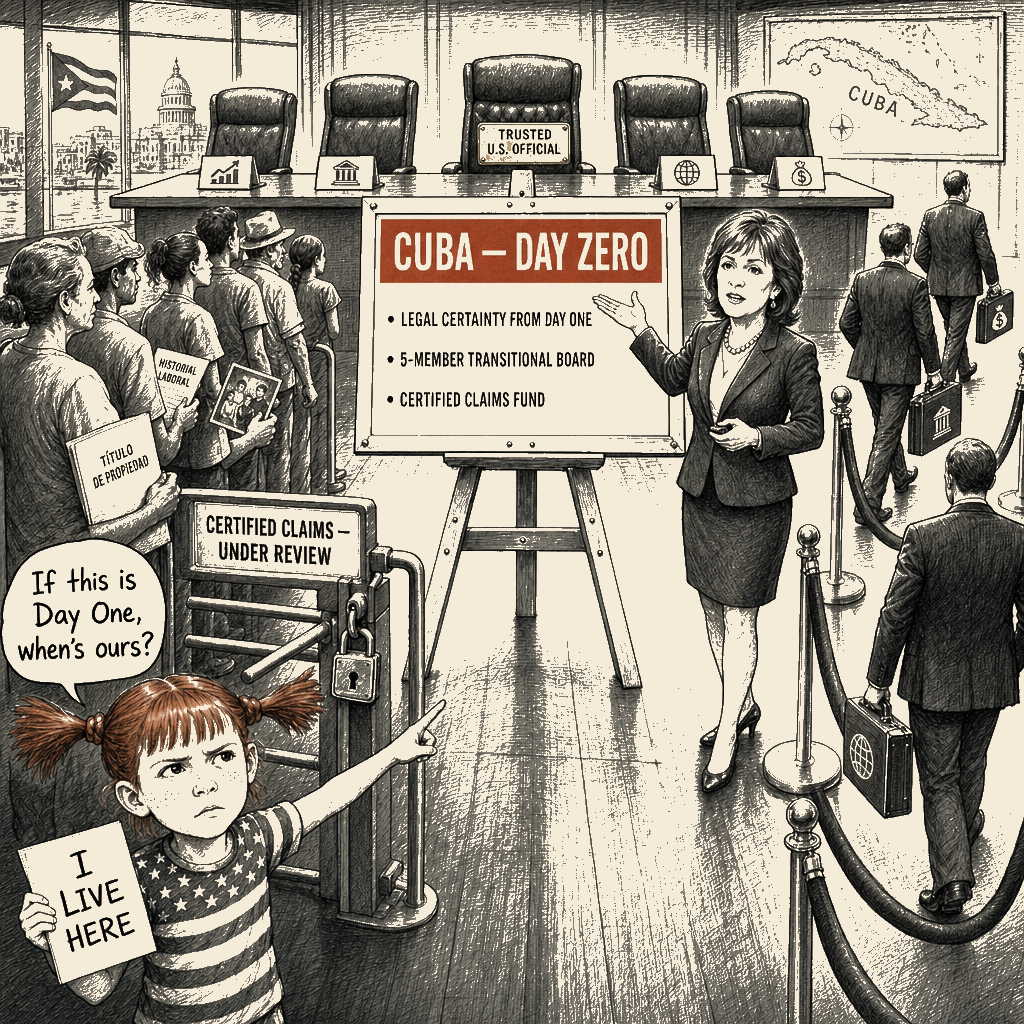
Mary Anastasia O’Grady argues that Secretary Rubio’s intensified sanctions on the Cuban military elite are forcing the regime toward an exit and that a credible “Cuba Day Zero” stabilization plan can prevent post-regime collapse. She cites Washington-based Cuban-American entrepreneur Rafael Romeu’s framework, which combines U.S. emergency support for civil servants and police with private-sector and Cuban diaspora capital under “a disciplined, legally enforceable framework from Day One.” A proposed five-member transitional board — including Cubans, Cuban-Americans, and “a trusted U.S. official” — would screen property to exclude GAESA military insiders and grant concessions through public-private partnerships to avoid fire-sale privatizations. The piece’s implicit thesis is that U.S.-led transition with capital-first governance is both feasible and preferable to letting the communist regime endure.
Receipts
The piece dresses up a U.S./capital takeover of Cuba’s transition as humanitarian liberation — the plan’s beneficiaries are the foreign-policy establishment, diaspora capital, and U.S. private equity, not the Cuban people.
- The talking point: “Cuba’s reconstruction must be funded by private-sector investment and Cuban diaspora capital—inside a disciplined, legally enforceable framework from Day One.”
- The framing wants you to believe: A “free Cuba” can only emerge with U.S. and diaspora money steering the transition.
- What’s really going on: “Legal certainty” for investors from Day One means property rights for foreign capital take precedence over Cuban sovereignty, restitution claims, or worker protections.
- The translator: The “trusted U.S. official” on the proposed five-member board isn’t a neutral arbiter — it’s a trustee for U.S. interests, on the founding government of a post-Castro Cuba.
- The omission: No Cuban constitutional process, no popular mandate, no role for the Cuban working class whose labor built the island’s wealth — only investor protections.
- The historical anchor the piece picks and the one it skips: The piece invokes Iraq’s de-Baathification as a parallel to avoid — but invokes post-Soviet Russia only as a “vulture” warning, never as a warning about oligarchic capture, which is precisely what a “Day Zero” capital-first transition produces.
- The mechanism: Property screening against GAESA sounds neutral; in practice it freezes contested claims from Cuban workers, smallholders, and state enterprises while fast-tracking diaspora claims of pre-1959 dispossession — claims that would otherwise face Cuban legal scrutiny.
- The beneficiary: Rafael Romeu himself is a “Washington-based entrepreneur” pitching the framework — the plan’s lead architect profits professionally if his structure is adopted.
- The vocabulary tell: “Day Zero” is venture-capital terminology. Calling a country’s reconstruction “Day Zero” positions the foreign investor as the founding partner, not the helper — early entry, pre-valuation, compounding returns.
- Anchor citation: O’Grady, “What a Cuban Transition Might Look Like,” WSJ Opinion, August 23, 2026.
The Response Ladder
Polite Reframe
When to use: With policy editors, Hill staffers, or anyone who values measured diplomatic register and a serious tone.
Let’s begin with what the framework doesn’t say. A “Cuba Day Zero” plan authored by a Washington-based Cuban-American entrepreneur, blessed by a “trusted U.S. official,” and financed by “private-sector investment and Cuban diaspora capital” isn’t a neutral stabilization framework — it’s a capital-first trusteeship. “Legal certainty” for investors from Day One means property protections for foreign capital take precedence over Cuban sovereignty, land restitution, or worker claims. The omission is telling: no constitutional process, no popular mandate, no role for the Cuban working class whose labor built the island’s wealth. The plan doesn’t propose a transition for Cubans; it proposes a transition for capital.
Mockery and Ridicule
When to use: For a reply thread, op-ed counter, or panel rebuttal where the point is to puncture the conceit.
Somewhere in Miami, a man who left Cuba at age six has prepared a beautifully laminated deck for the collapse of a country. It includes a five-member board, a screening process for “military insiders,” a reserve fund for “certified claims,” and a bullet point that reads, with a straight face: “New decrees can rewrite the economic rulebook in days, not years.” Rafael Romeu calls this “Cuba Day Zero,” which is what grown-ups call it when they want to talk about regime change without saying the word regime change. The pitch is that if we just find the right Cubans — Cubans, Cuban-Americans, and a “trusted U.S. official,” the recipe reads — we can privatize a country so cleanly it won’t even spill a cortado. The catch is that the only Cubans whose Day Zero matters, in this telling, are the ones with investment letters and title searches. The other 11 million get to wait while a five-person board figures out who’s “certified.” The whole thing has the energy of a private-equity partner describing how a bankruptcy works while the debtor’s family is still in the house.
Nuclear Satire
When to use: For a long-form Substack, a satirical newsletter, or a rhetorical-stage piece where the satire does the persuading.
BREAKING: Five-Person Junta-in-Waiting Unveils Revolutionary New Country Template, Sources Confirm Real, Definitely Not a Pitch Deck
MIAMI — A coalition of exiles, sanctions architects, and one trusted U.S. official unveiled Tuesday what they are calling “Cuba Day Zero,” a turnkey nation-replacement package modeled on the success of Iraq’s de-Baathification, Russia’s fire-sale oligarch era, and a sensory experience they described as “Y Combinator meets Hague Convention.” Head of state will be a five-member board appointed by themselves, with the explicit mission of doing for an island of 11 million people what a bankruptcy trustee does for a Sears.
The plan’s lead architect, who left Cuba as a child in 1980 and currently runs an association that studies the Cuban economy from Washington, said the key innovation was rewriting “the economic rulebook in days, not years.” When pressed on what happens to Cuban citizens whose families had property confiscated in three separate waves of nationalization, the architect assured reporters that a “certified claims fund” would be reserved before any concession is awarded, provided the claimants can produce documentation acceptable to a Miami title-search firm.
“Day One,” the architect emphasized, must feature “legally enforceable” frameworks — enforceable against whom, exactly, was not specified, but a hand-drawn diagram suggested “anyone who wasn’t us.” The screening process for “military insiders or sanctioned parties” was praised for its rigor, with the proviso that the screen would be administered by the same handpicked board that would be awarding the concessions.
Asked about the 11 million Cubans currently on the island, the architect said they would be invited to participate in the new Cuba “from Day One,” presumably as soon as they received their certified-claim documentation, underwent background screening, and secured representation by an approved foreign counsel.
“This is what freedom looks like,” the architect concluded. The U.S. official added: “We trust this process.” Cuba was not available for comment, as the country’s official position is that the regime is being pressured until a better offer arrives in Moscow, Ankara, or Managua.
(The columnist declined to comment on whether the five-member board would include a “designated survivor” for continuity-of-government purposes.)
Profane Scorched-Earth
When to use: For the comment section, group chat, or rally speech where the gloves come off and the point is catharsis.
Holy fucking shit, the regime-change crowd finally wrote down what they’ve been doing for sixty-five years and called it “Cuba Day Zero.” A five-person board. A fucking five-person board, half of them Cuban-Americans and a “trusted U.S. official,” picked by who, exactly, to run an island of 11 million people the morning after the bombs drop. The audacity of these dipshits is genuinely breathtaking — they lost the argument in 1961, they lost it again in 1976, they lost it every time the embargo hurt some abuela in Havana more than it hurt any general, and now they’ve decided the answer is a Y Combinator pitch deck with “de-Baathification” listed as a feature, not a warning.
Rafael Romeu left Cuba at six years old and grew up to be an “entrepreneur” who “studies the Cuban economy” from Washington. Cool. Wonderful. And now he wants to “screen property for its beneficial owner” — in a country where every single piece of real estate has a confiscation story attached to it, where some of those stories are tales of Cuban-on-Cuban theft going back to 1959, and where “certified claims” means whoever has the best Miami lawyer wins. You absolute ghouls. The 11 million Cubans on the island aren’t a “Day One” footnote; they’re the entire fucking point. They’re not a startup incubator. They’re a people whose grandparents, parents, and they themselves have been told for six decades that they don’t get to own anything, and now the next message is: actually, that’s still true, but with better legal paperwork.
And the fucking kicker is “de-Baathification,” which these shitheads name-dropped because they wanted you to think they had read a book. De-Baathification dismantled the Iraqi state and gave us ISIS. De-Baathification is the reason a million Iraqis are dead. De-Baathification is what you cite when you want to signal “we have a plan” without having a plan. The plan is the plan: privatize it, open it up, and let the people with the capital and the visas eat first, and the people without them can queue.
“Failure after the fall of the police state isn’t inevitable,” the columnist writes, and she’s right — failure is in fact very evitable, because the people writing the Day One framework have already decided who fails. The Cuban people fail. The families who lost the sugar mill fail. The workers on the collective farm fail. The people who don’t have a “trusted U.S. official” on speed dial fail. The fucking vultures — and yes, the columnist uses the word vulture herself in the column, like she’s narrating her own fucking parable — the vultures get concessions before the Cuban who’s lived in Pinar del Río her whole life gets a certified claim.
This is what “freedom on the island” sounds like to a man who’s never had to live there. It’s a board meeting in Miami where everyone at the table has a Series-A and a deportation lawyer on retainer. Fuck this column. Fuck this column and the cushy assumptions it sails on, and fuck any policy discourse that treats 11 million people as Day-One market potential for someone else’s Day-One legal certainty.
About Malcolm Little King
Malcolm Little King is a heteronym in Main Street Independent's editorial architecture — an analytical voice, not autobiography of any actual person. The position this column expresses is the publication's position on the territory Malcolm Little King's lane covers, rendered through Malcolm Little King's register.