Analyzing: Nix on Nixon: How to Defeat the DSA in the Midterms — Karl Rove · 2026-08-26
What the Editorial Argues
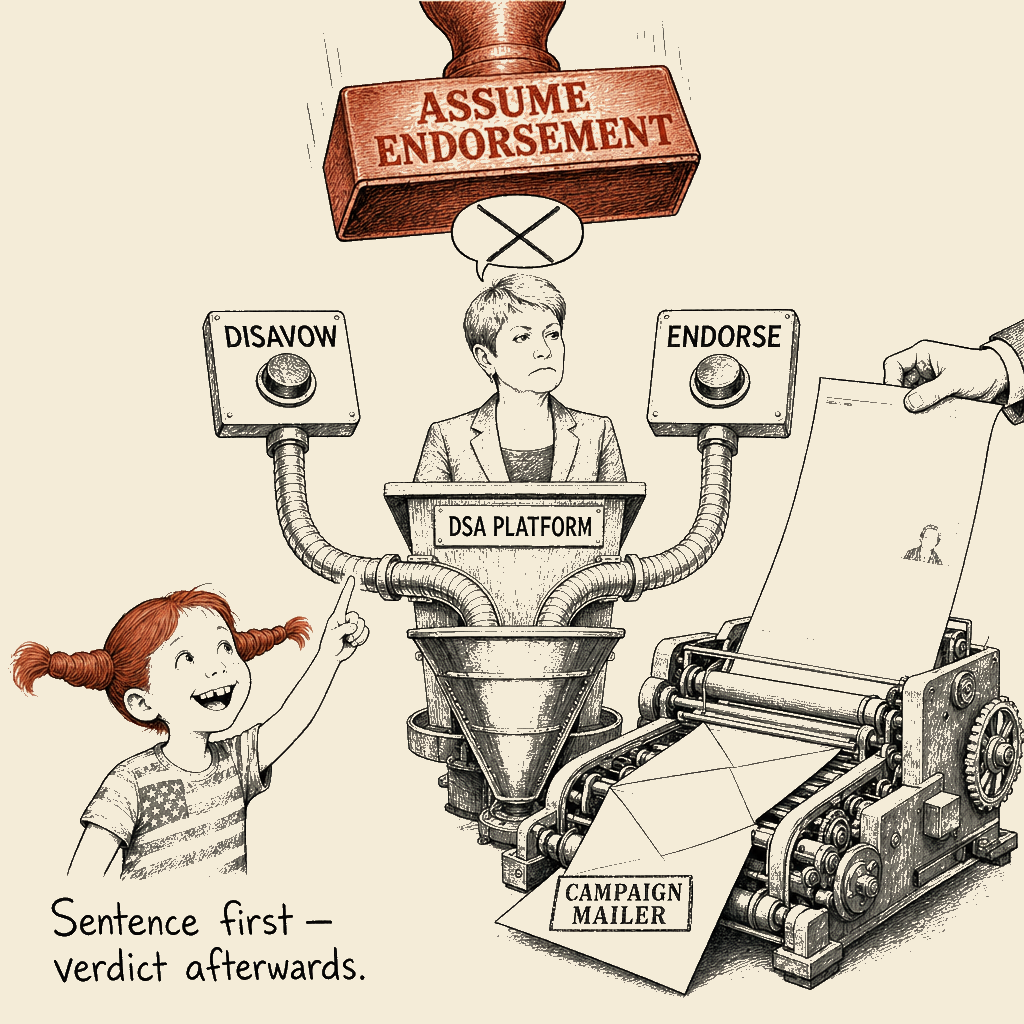
Karl Rove’s August 26 WSJ op-ed is not an argument — it is a deployable artifact. The thesis it carries is tactical, not analytical: the Democratic Socialists of America are a Republican asset, and every Democratic candidate on a 2026 Florida ballot must be forced into a binary — disavow the DSA platform plank-by-plank, or be treated as endorsing it. Silence equals confession. The piece announces itself as a script (“here’s a version of a simple speech to consider. I’ve written it for a candidate”) and the structure follows the announcement: an opening fear-priming load, a platform quotation block, a Soviet-imagery guilt-by-association, an inventory of straw-man amplifications, a foreign-policy whatabout, and a closing greenmail directive to “attack and attack again.” What Rove is selling is not a reading of the DSA. It is a procedure for converting a state representative’s party affiliation into a national indictment — and for converting the August 27 print edition of the Wall Street Journal into a Republican campaign mailer.
Receipts
The editorial is not subtle. The moves are run in the open, each one with a catalogue cross-reference for the reader to verify. Verbatim from the artifact:
- “It should scare the hell out of you.” — opening catastrophizing register; fear is loaded before any policy content arrives. (Bad-Faith Techniques Catalog — Catastrophizing Register.)
- “The DSA’s agenda is more radically leftist than any we’ve seen in our lifetime.” — universal superlative with no comparator, no anchor. (Bad-Faith Techniques Catalog — Unanchored Scope Claim.)
- “The DSA platform wants an America where ‘you don’t pay a mortgage or have a landlord.’” — direct quotation from the DSA platform, immediately reframed by “Sounds nice, until you get to the details.” (Bad-Faith Techniques Catalog — Pivot from Text to Spin.)
- “Some will remember those big, ugly apartment blocks in the Soviet Union. That’s DSA leaders’ vision, whether they admit it or not.” — visual guilt-by-association with no policy bridge connecting the housing plank to the Soviet referent. (Bad-Faith Techniques Catalog — Guilt by Association.)
- “Unless they say otherwise, you should assume Angie Nixon and my Democratic opponent support it.” — the presumption inversion; deployed across the piece in escalating register, each repetition tightening the noose. (Bad-Faith Techniques Catalog — Presumption Inversion / Silence-as-Confession.)
- “Since food would be a ‘common good,’ would farmers work for the government? … How about Ryder Trucks and CSX railroad? … Do we want federal bureaucrats to be in charge of Mickey Mouse and Disney World?” — straw-man amplification: eight Florida-headquartered companies (Publix, Lennar, Ryder, CSX, Carnival, Norwegian, Royal Caribbean, Disney) dragged into a policy debate the DSA platform does not name. The longer the concrete-name pile, the more the piece is manufacturing absurdity rather than analyzing policy. (Bad-Faith Techniques Catalog — Strawman.)
- “The DSA blames America’s problems on ‘private ownership and profit.’ It claims our free-enterprise system is ‘making us desperate and miserable.’” — direct platform quotation, then candidate-attribution via the silence-as-confession frame. (Bad-Faith Techniques Catalog — False Attribution.)
- “I promise you I don’t.” — the candidate’s self-exemption. The speech is a brand-distancing performance; the speaker must be visibly clean of the indictment he is pressing on his opponent. (WSJ Editorial Technique Catalogue — Self-Exemption Cue.)
- “A 32-hour workweek but with a 40-hour paycheck. … ‘Phase out the use of fossil fuels.’ ‘Fully abolishing the police and prison system.’ ‘Abolish ICE’ and ‘legalize migration’ — that is, open borders. The DSA would ‘defund the Department of War’ and ‘close overseas military bases.’” — plank-pile presentation; the sheer volume of items is the argument. (Bad-Faith Techniques Catalog — Gish Gallop.)
- “The DSA was silent at best following Hamas’s Oct. 7 attack and obsessively accuses Israel of ‘genocide.’” — foreign-policy whatabout inserted between platform planks and the disavowal demand; the paragraph’s job is to attach blame, not to make a point. (Bad-Faith Techniques Catalog — Whataboutism.)
- “If not, say so — emphatically and forcefully, loud enough so DSA supporters hear. But if Ms. Nixon and my opponent refuse to disavow DSA’s agenda or remain silent, then we Republicans should attack and attack again. Make them squirm as voters turn against them.” — the closing greenmail: an explicit directive to weaponize the silence-as-confession frame against any Democrat who refuses to engage. (Bad-Faith Techniques Catalog — Greenmail Escalation; WSJ Editorial Technique Catalogue — Op-Ed-as-Disavowal-Trap.)
- The relay structure. Rove writes the speech; the candidate reads it. The operator stays uncredited on the floor but visible to the reader and the donor class. The piece names a Senate race (Nixon) and writes the speech for a House candidate in the same paragraph — the geography mismatch is never resolved, because resolution would break the maneuver.
The Operation
This is the Karl Rove field manual, and it is built for replication. I have built versions of this artifact. The op-ed is not opinion about Florida’s U.S. Senate race — Nixon is the Senate nominee, the speech is for a House candidate, and the two are never reconciled because reconciliation would break the maneuver. A House candidate is handed a Senate race’s talking points. The geography mismatch is the tell. The mechanics, every layer drawn from the named catalogues:
-
False Dilemma (Bad-Faith Techniques Catalog). “Side with DSA’s extreme views or break with the group” — the voter and the Democratic candidate are both offered two options, both bad for the Democrat. A third position (ignore the framing; contextualize; agree-with-parts) is structurally excluded. The disavowal trap works because the false dilemma is procedurally enforced: every answer a Democrat gives must be either total endorsement or plank-by-plank rejection of items the Democrat may never have read.
-
Guilt by Association (Bad-Faith Techniques Catalog). The Soviet apartment blocks comparison assigns the historical weight of communist housing failures to a DSA housing plank (“publicly-owned social housing”). The comparison is visual and emotional, not analytical — no chain of reasoning connects the platform plank to the historical referent. The technique works because the visual of “big, ugly apartment blocks” is the durable takeaway; the actual housing plank is the technical detail voters will forget.
-
Presumption Inversion / Silence-as-Confession (Bad-Faith Techniques Catalog). The repeated “Unless they say otherwise, you should assume” construction flips the burden of proof. A candidate who refuses to disavow plank-by-plank is treated as endorsing the plank. This is a procedural weapon — it converts refusal to engage into an admission of guilt. The technique is the spine of the entire piece; every other layer feeds it.
-
Greenmail Escalation (Bad-Faith Techniques Catalog). The closing instruction to “attack and attack again” and “make them squirm as voters turn against them” is not analysis. It is a directive to weaponize the silence-as-confession frame in the campaign trail. The op-ed announces itself as a script and the announcement is fulfilled at the close.
-
Strawman (Bad-Faith Techniques Catalog). Publix, Lennar, Ryder, CSX, Carnival, Norwegian, Royal Caribbean, Disney World — eight Florida-headquartered companies dragged into the disavowal demand. None is named in the DSA platform. The amplification pile converts a policy debate into a surreal inventory; the absurd concreteness is the point. The technique is selectional — concrete employers are chosen because they are Florida-headquartered, recognizable to the voter, and absurd in the seizure frame the questions imply without ever alleging.
-
Whataboutism (Bad-Faith Techniques Catalog). The Hamas/Israel/genocide paragraph. Foreign-policy blame is inserted between platform planks and the disavowal demand, attaching an unrelated controversy to the target without evidentiary connection. The paragraph exists to convert a domestic-policy dispute into a foreign-policy indictment the candidate must also answer for.
-
False Attribution (Bad-Faith Techniques Catalog). Direct quotation of DSA platform planks, followed by candidate-attribution via the silence-as-confession mechanism. The candidates did not endorse the planks; the silence-as-confession frame manufactures their endorsement. The artifact’s load-bearing move.
-
Gish Gallop (Bad-Faith Techniques Catalog). The plank-pile — fossil fuels, police, ICE, migration, military bases, defense, Oct. 7, structural democracy — stacks eight planks into one indistinguishable mass so that rejecting any one plank becomes impossible without rejecting all. The volume is the argument; the candidate cannot engage each plank individually before the next arrives.
-
Loaded Paraphrase (Bad-Faith Techniques Catalog). “Legalize migration” → “(that is, open borders).” The parenthetical imports a different phrase’s nativist charge. The platform says “legalize migration”; the operator substitutes the charged phrase.
-
Op-Ed-as-Campaign-Memo (WSJ Editorial Technique Catalogue). The piece announces itself as a script: “here’s a version of a simple speech to consider. I’ve written it for a candidate in Florida.” This converts WSJ opinion real estate into GOP campaign infrastructure. The August 27 print edition is now a mailer template. The publication’s editorial page has been conscripted.
-
Manufactured Urgency / Catastrophizing Register (Bad-Faith Techniques Catalog). “It should scare the hell out of you” — the fear-priming opener; the audience is emotionally loaded before any policy content arrives.
-
Unanchored Scope Claim (Bad-Faith Techniques Catalog). “More radically leftist than any we’ve seen in our lifetime” — superlative with no comparator, no historical anchor, no measurement.
What Rove is doing to the Florida voter: he is installing a presumption of DSA guilt before the voter encounters any Democratic candidate’s actual position. He is teaching Republican candidates a procedural weapon — the demand for plank-by-plank disavowal. He is collapsing the difference between a Democratic Senate candidate who is a DSA member (Angie Nixon) and a Democratic House candidate who may have no DSA affiliation. He is weaponizing a local candidate’s name by making her the national face of an indictment she did not write. And he is converting the Wall Street Journal’s August 27 print edition into a Republican campaign mailer.
The candidate is told at the close: “Make them squirm as voters turn against them.” That is the operator’s-eye view of the entire piece. The speech is not persuasion. It is attrition.
The Record
The DSA platform quotations are largely real. The “publicly-owned social housing” language traces to the 2021 DSA Convention resolutions and the post-2021 Housing Justice Commission work; the “common goods” framing and “public ownership of the largest corporations and essential industries” language are part of the formal DSA program documents and have been quoted verbatim by multiple outlets (City Journal, Daily Signal, USA Today, Washington Examiner; program.dsausa.org).
The “you don’t pay a mortgage or have a landlord” sentence reads as the operator’s vernacular paraphrase of the de-commodification plank rather than as a verbatim platform quote. The substance — public ownership of housing, opposition to the landlord-tenant commodity relation — is corroborated by the 2021 housing-justice resolution; the phrasing is the operator’s.
“Phase out the use of fossil fuels,” “defund the Department of War,” “close overseas military bases,” and “abolish ICE” are real platform planks. “Legalize migration” is also real — and Rove’s parenthetical “(that is, open borders)” is the operator’s substitution, not the platform’s wording.
“Fully abolishing the police and prison system” is an accurate paraphrase of the DSA’s abolition plank; the platform uses abolition language routed through electoral and policy programs. The word “fully” is the operator’s intensifier.
On Oct. 7: The DSA did issue a statement within hours of the attack describing it as “a direct result of Israel’s apartheid regime” rather than condemning Hamas (ADL, Algemeiner, Washington Examiner, H.Res.775 record). The platform’s “Free Palestine” section uses the genocide framing. “Obsessively” is the operator’s behavioral characterization of behavior that is in fact documented.
Angie Nixon is a Florida state Representative, a DSA member, and the 2026 Democratic U.S. Senate nominee after defeating Alex Vindman in the August 18 primary (Wikipedia, Axios, Democracy Now, NYT, Guardian). She will face Republican Ashley Moody in November.
The structural-democracy bundle — extending the franchise to “all permanent U.S. residents” (the platform’s phrasing; “before they naturalize” is the operator’s looser gloss), DC statehood, abolishing the Senate and Electoral College, full public financing of campaigns, replacing the presidency and Supreme Court — is part of the formal DSA platform (USA Today, AMAC, Washington Examiner, Discern Report).
The Rove/Nixon/House-candidate mismatch is real and unresolved: Nixon is the Senate nominee; the speech is addressed to “my opponent in this House race.” The op-ed never explains how a House candidate is supposed to attack the Senate nominee’s positions on the same stage. The mismatch is the maneuver.
What the artifact does to a Florida voter’s information environment, beyond the quoted record:
- Presumption of guilt precedes evidence. Every Democratic candidate in Florida is now running against a phantom DSA platform they may have never read. The voter learns the planks before learning the candidate’s position.
- The disavowal trap is taught. A Democrat who engages with the disavowal is drawn into defending or attacking specific platform language — a losing frame. A Democrat who refuses to engage is convicted by silence. Either branch of the false dilemma is bad for the target.
- DSA is anchored to Soviet imagery. “Big, ugly apartment blocks” is the durable takeaway. The actual housing plank (“publicly-owned social housing”) is the technical detail voters will forget. The visual does the work the policy argument does not.
- A local candidate is nationalized. Angie Nixon, a Florida state representative, becomes the national face of DSA extremism for the circulation life of this piece. Her name is attached to a Soviet-imagery frame she did not choose.
- The House race and the Senate race are collapsed. Nixon is the Democratic Senate nominee; the House candidate Rove is writing the speech for is a different person running a different race. The artifact treats both as interchangeable targets of the same disavowal demand, because the disavowal trap works the same way on any Democratic candidate.
- The closing is a directive. “Attack and attack again” and “make them squirm” — the piece ends as a campaign memo, not an opinion column. The Wall Street Journal’s editorial page has been turned into a coaching document.
How to Recognize This
Reader-facing diagnostic markers for the Rove disavowal-trap pattern. If you see these in an op-ed, you are reading a campaign memo, not an argument:
- The “unless they say otherwise, you should assume” tell. Repeated across multiple planks, each repetition tightening the noose. This is the silence-as-confession frame in plain text. Any op-ed that demands disavowal of platform planks a candidate never endorsed is running this technique. Count the repetitions; more than two is a tell.
- The straw-man amplification pile. A sudden inventory of named local companies (Publix, Lennar, Ryder, CSX, Disney) dragged into a policy debate. The longer the concrete-name pile, the more the piece is manufacturing absurdity rather than analyzing policy. The companies are usually headquartered in the state where the campaign is being run.
- The Soviet / communist / authoritarian visual comparison. A historical anchor with no policy bridge. Recognize the guilt-by-association move by the absence of an analytical chain connecting the platform plank to the historical referent. The visual is doing the work the argument is not.
- The “if not, say so — emphatically and forcefully” coercion pattern. The piece is not asking a question. It is setting up a forced confession. Silence is framed as the answer. The louder the demand for “emphatic” disavowal, the more the silence-as-confession frame is in operation.
- The “attack and attack again” closing. The piece announces itself as a campaign directive. This is the greenmail escalation tell. An opinion column that ends with explicit instructions to attack is not an opinion column.
- The whatabout paragraph. A foreign-policy or unrelated controversy inserted mid-piece without a connecting argument. The paragraph’s job is to attach blame, not to make a point. Look for a sudden topic switch between platform planks.
- The op-ed-as-script structure. Any op-ed that explicitly says “here’s a version of a speech to consider” or “I’ve written it for a candidate” is a campaign memo. The Wall Street Journal’s editorial page should not be hosting mailer templates; if it is, you are reading deployment infrastructure.
- The “scare the hell out of you” opener. Catastrophizing register loaded before any policy content arrives. The fear-priming tell.
- The universal superlative. “More radically leftist than any we’ve seen in our lifetime” — superlative with no comparator, no historical anchor, no measurement. The unanchored scope claim tell.
- The self-exemption cue. “I promise you I don’t.” The speaker must be visibly clean of the indictment he is pressing on his opponent. The speech is a brand-distancing performance. The visible cleanliness is part of the operation.
- The geography mismatch. A House candidate handed a Senate race’s talking points, or vice versa, without the mismatch being reconciled. The unreconciled mismatch is the maneuver.
- The plank-pile. Eight or more platform planks stacked into one paragraph. The volume is the argument; no individual plank is meant to survive scrutiny; the candidate cannot engage each before the next arrives. The Gish gallop in domestic-politics form.
When you see four or more of these markers in a single op-ed, you are reading a propaganda artifact, not a policy argument. The appropriate response is to identify the technique stack by name, refuse to engage on the disavowal-trap’s terms, and demand that the candidate’s actual record — not the attributed platform — be the subject of the campaign. I drafted memos like this. I sat in the meetings where this template was refined. The artifact you have just read is the same artifact I helped build, with the polish that eight more years of practice buys. You can recognize it now. That recognition is the only thing I have to give back.

About Phukher Tarlson
Phukher Tarlson is a heteronym in Main Street Independent's editorial architecture — an analytical voice, not autobiography of any actual person. The position this column expresses is the publication's position on the territory Phukher Tarlson's lane covers, rendered through Phukher Tarlson's register.