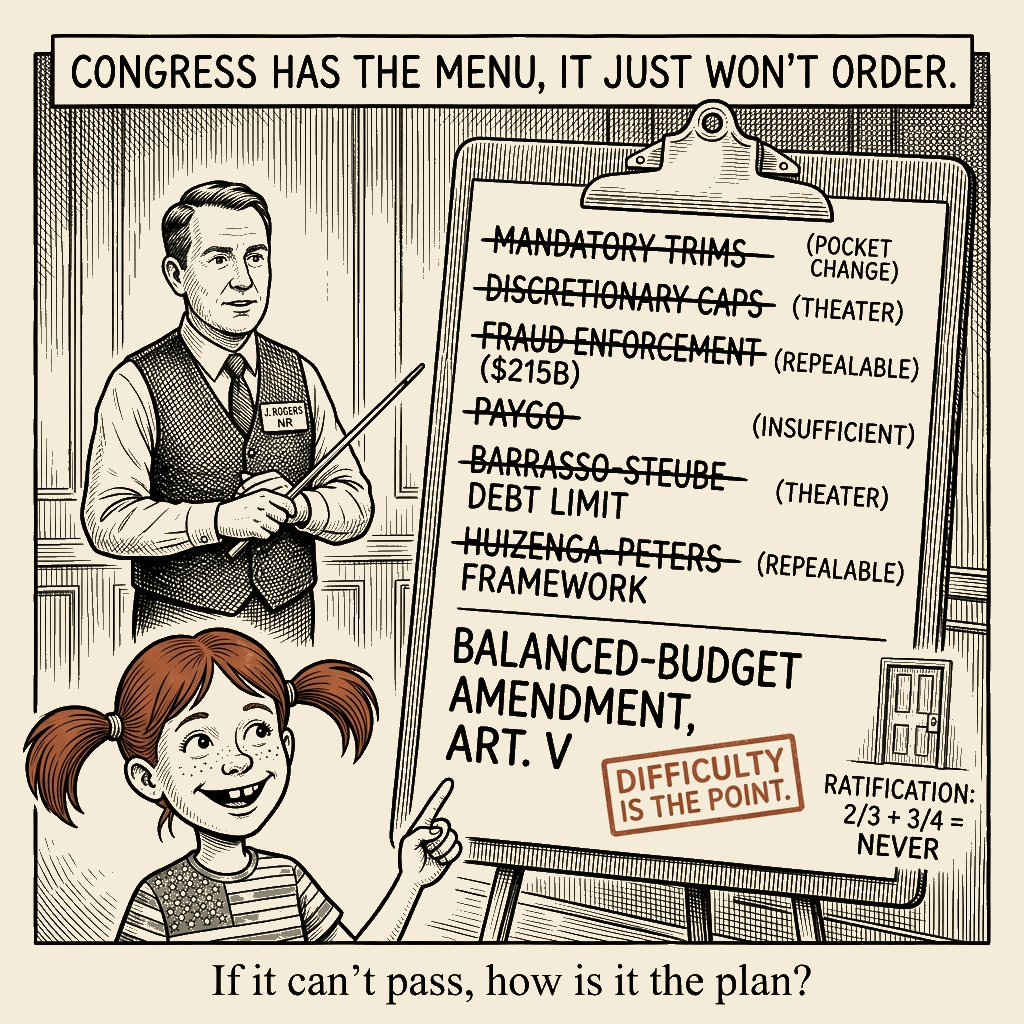
Analyzing: Congress Has the Menu, It Just Won’t Order — Jay Rogers · 2026-08-27
What the Editorial Argues
The editorial presents itself as a fiduciary’s plain-spoken diagnosis of U.S. fiscal trajectory: gross federal debt crossed $40 trillion in mid-August, the Barrasso–Steube debt-limit bills target the wrong lever, and Congress has a ready menu of mandatory-program reforms, discretionary caps, revenue-side closures, and a balanced-budget amendment that it simply refuses to order. The author opens with thirty years of credit-underwriting experience, treats the Trump administration’s fraud-hunting — DOGE and the Vance task force — as a rounding error against the actual deficit, endorses a bipartisan Huizenga–Peters framework as the closest serious option, and closes by recommending a balanced-budget amendment under Article V as the only mechanism a future Congress cannot quietly repeal.
This is the surface argument. It is competent, technical, and structured to read as the responsible adult’s view of the fiscal question. The editorial is careful to credit the administration where credit is owed, careful to split the difference between the parties, and careful to land on a constitutional amendment — an option so procedurally remote that endorsing it carries no enforcement cost for any member who votes for the resolution sending it to the states.
Receipts
The technique entries from the Bad-Faith Techniques Catalog and the WSJ Editorial Technique Catalogue that this column inherits are visible by direct quote.
-
Frame-engineered relabeling (
[bf_catalog:frame_engineered_relabeling`](/propaganda/docs/bad-faith-techniques-catalogue#frame-engineered-relabeling)). “Rounding error against a $1.8 trillion annual deficit.” “Pocket change dressed up as a solution.” The two phrases appear in direct sequence and function identically: the column admits the fraud-enforcement totals — the $215 billion DOGE claim, the $230 billion fraud dashboard, the $56 billion stopped pre-disbursement, the $55 billion recovered through enforcement — and then dismisses them in a single image the reader carries away in place of the numbers. The relabeling converts an admitted figure into a non-figure through rhetorical framing. This is the substitution the Luntz/Lakoff line on frame-engineered relabeling was built to name. -
Cross-domain authority transfer (
[bf_catalog:expert_consensus_expert_deference_framings`](/propaganda/docs/bad-faith-techniques-catalogue#expert-consensus-expert-deference-framings)). “Thirty years underwriting risk.” “Any fiduciary organization runs before agreeing to fund a liability that grows on autopilot.” The credential is earned inside a market discipline — private credit underwriting — and spent in another regime — federal budgeting — without naming the regime’s distinct rules. The catalog’s expert-deference entry flags the maneuver: expertise invoked as category-authority rather than engaged with specific arguments. -
Goalpost-shifting / asymmetric rigor (
[bf_catalog:goalpost_shifting`](/propaganda/docs/bad-faith-techniques-catalogue#goalpost-shifting)). “Growth alone has never closed a gap this size.” “The fiscal equivalent of a fund manager telling his limited partners that the market will eventually bail out a bad allocation decision. … A prudent manager doesn’t build the plan around wishful thinking.” Growth-only arguments are labeled magical thinking and wishful thinking in successive paragraphs. The author’s preferred deliverable — an Article V balanced-budget amendment requiring two-thirds of both chambers and three-fourths of states — is presented in the same column as the one mechanism “a future Congress can’t quietly repeal.” The catalog’s goalpost-shifting entry covers exactly this: deploy hard-headed realism against opponents, exempt the in-house proposal. -
Analogy as substitute for argument (
[bf_catalog:red_herring`](/propaganda/docs/bad-faith-techniques-catalogue#red-herring)). “A fund manager telling his limited partners that the market will eventually bail out a bad allocation decision.” The analogy does the rhetorical work the argument has not done — it transfers the credit-manager frame to political economy without supplying a single intermediate premise about why private-credit underwriting logic maps onto federal budgeting. -
Deficit-double-standard procedural erasure (
wsJ_catalog: 4.4). “A target without enforcement is a New Year’s resolution with a press release attached.” The Huizenga–Peters sense-of-the-House resolution is the one piece of bipartisan architecture the column credits by name; the response is a metaphor that disposes of the resolution without engaging its substance. The WSJ catalogue’s deficit-double-standard entry names the pattern: dismiss the procedural mechanism in the rival proposal while exempting the in-house procedural mechanism from the same standard.
The Operation
The editorial is operating as an amendment-marketing document. It is built to make a balanced-budget amendment feel like the natural, fiduciary-obvious conclusion of any serious fiscal conversation, while the surrounding policy content — mandatory-program trims, discretionary caps, Medicare Advantage risk-adjustment, revenue preferences — functions as a credentialing scaffold that lets the recommendation arrive looking like due diligence rather than ideology.
The architecture runs in three movements. First, an authority-establishment move: the author imports a thirty-year credit-underwriting identity and deploys it throughout the piece via analogy (“the fiscal equivalent of a fund manager telling his limited partners…”), so the reader processes the verdict as a practitioner’s read, not as a partisan op-ed. Second, a managed-concession movement: the editorial credits the administration’s fraud work and the Barrasso–Steube debt-limit instinct just enough to neutralize them, then demotes them — fraud as pocket change, the debt limit as theater — so neither rival remedy remains standing. Third, a manufactured-triangulation movement: a bipartisan House framework is installed as the closest thing to seriousness, and then the editorial walks past it to the balanced-budget amendment, which is its actual destination. The bipartisan stopover functions as the inoculation against the partisan critique the editorial would otherwise attract for the amendment recommendation.
The audience reaction being engineered is specific: a reader who already believes entitlements are the problem should finish the piece certain that a balanced-budget amendment is the only mechanism “a future Congress can’t quietly repeal,” and should feel that the editorial’s policy specificity is what licenses that certainty. The reader is not being asked to evaluate Article V’s ratification math, because the editorial never names that math as the obstacle; the difficulty is reframed as the feature. “Article V sets a high bar on purpose … that difficulty is the point.”
What the editorial is selling, beneath the menu, is the moral permission to support an unpassable constitutional amendment as a serious answer. Members who endorse such an amendment are credited with seriousness. Members who refuse are demoted to liking the conversation. That is the operation’s transactional core.
The Record
The editorial’s surface is competent. Its machinery is the standard National Review fiscal page playbook, and the playbook works the way it always does. The author has assembled a real menu — mandatory-program trims, Medicare Advantage risk-adjustment, discretionary caps, payroll-tax-cap indexing, a binding deficit-to-GDP target with automatic backstops — and most of those items are real policy options the Congressional Budget Office has in fact scored. The editorial deserves credit for naming the menu.
The factual scaffolding the column lays down is unusually detailed for opinion copy, and most of it is accurate to the published record. Gross federal debt at $40.05 trillion on August 18; intragovernmental holdings plus debt held by the public summing roughly four-to-one, with the public-portion figure north of $32 trillion; the milestone arriving five months after $39 trillion in March; net interest of $963 billion through ten months of fiscal 2026, up $117 billion, or 14 percent, year over year; a CBO July report putting the FYTD deficit at $1.8 trillion, $169 billion ahead of last year’s pace; the Barrasso and Steube companion bills introduced on August 16; the GAO’s August review finding that DOGE’s roughly $215 billion claim could not be verified for reliability; the Vance task-force dashboard figures of more than $230 billion in fraud identified, $56 billion stopped before disbursement, $55 billion recovered; CBO’s $124 billion–$1 trillion Medicare Advantage scoring range; CBO’s roughly $1.1 trillion Defense Department scoring option; the November PAYGO zero-out that wiped the statutory enforcement tied to a reconciliation bill CBO scored at $3.4 trillion; the 2023 Fiscal Responsibility Act caps having expired before the fiscal year began. The numeric scaffolding is sound.
What the editorial deserves prosecution for is what the menu is doing in the essay. None of those scored options is the recommendation. The recommendation is the balanced-budget amendment, and the editorial gets to that recommendation by stacking the policy menu so that every other option is presented as either rounding-error-scale (fraud), procedurally theatrical (debt limit), or repealable (PAYGO, the Huizenga–Peters sense-of-the-House resolution). The menu’s function is not to inform; it is to disqualify every other answer so that the amendment can land as the only mechanism that cannot be repealed by ordinary politics. The editorial never acknowledges that Article V’s near-impossibility is symmetric: an amendment ratified by three-fourths of the states can also be repealed or superseded only by that same process, but it can be ignored in practice the way every other fiscal rule has been ignored — by political will, not by statute. The amendment’s “difficulty” is not enforcement; it is obstruction. The editorial sells obstruction as enforcement.
The credit-then-deflate move against the Trump administration’s fraud-hunting deserves separate record. The editorial credits DOGE for “real numbers, though not as real as advertised,” credits the Vance task force for being more disciplined, and then erases both with arithmetic. The arithmetic is real, but the framing is the operation: by deflating the administration’s signature fiscal achievement as pocket change, the editorial performs the partisan work of reducing the administration’s record on the editorial’s own terms, while the editorial presents itself as merely doing the math. This is the bipartisan-laundering move in reverse: when the editorial wants to demote a Republican-administration initiative, the bipartisan cover is unnecessary and is dropped. The asymmetry tells you which side the launder is for.
The author biography also deserves record. Thirty years of credit underwriting is a credential, not an argument. It licenses the analogies the editorial deploys throughout — limited partners, fund managers, fiduciary duty — but it does not establish that the author’s policy recommendations follow from that experience. The editorial’s recommendations are policy choices; the credit background is atmospherics. When a piece opens by establishing the author’s professional identity in an adjacent domain and then uses that identity as a continuing analogy engine, the credential is a costume, and the costume is part of the operation.
The closest thing to a serious critique the editorial levels is the observation that Congress repealed its own PAYGO scorecard by simple majority in a year-end bill. That observation is true and is the strongest evidence in the essay that fiscal rules do not enforce themselves. The editorial uses that observation to argue for an amendment, but the observation equally argues against an amendment: if Congress will erase a statute it wrote, the assumption that the same Congress will obey a constitutional clause it ratified is unfounded. The editorial does not make this argument because the editorial cannot afford to. The amendment is the conclusion the menu was built to reach.
How to Recognize This
The diagnostic signature is recognizable across three tells.
Tell one: the credentialed-by-trade opener. The essay opens by establishing the author’s professional identity in a domain adjacent to the policy question, then imports that identity as a continuing analogy engine. When you can delete the bio opener and the analogies and the argument still stands, the credential is atmospherics. When you cannot, the credential is doing work it should be named for. Watch for this in fiscal essays by former bankers, in education essays by former teachers, in regulatory essays by former regulators. The bio is the costume. The tell compounds when the column’s silence about the in-house proposal in the same categories — “magical thinking,” “wishful thinking,” “pocket change” — it uses against everyone else is itself the evidence.
Tell two: the managed concession. A piece that opens with “while [rival position] has the right instinct” or “credit where it’s due” or “I want to acknowledge” is performing the concession. The concession is rarely the conclusion; it is the demotion that lets the piece’s preferred remedy arrive without opposition. Identify the concession, then identify what the concession is being used to clear. The cleared ground is where the actual recommendation lives. The tell compounds when the piece grants a small dollar figure to neutralize it, then pivots to its preferred structure without ever quantifying whether the preferred structure closes the gap either. The pocket-change minimization is the same move as the credit-then-deflate; only the target moves.
Tell three: the unpassable-as-feature closer. When an essay lands on a recommendation whose procedural impossibility is named inside the essay itself and then reframed as a virtue, the recommendation is moral permission, not policy. The reader is being asked to feel serious for supporting it. The seriousness is the product; the amendment is the receipt. This is the NR fiscal page’s signature closer, and it travels to other domains — criminal-justice essays that end on constitutional amendments that will not pass, regulatory essays that end on commissions that will not be authorized. Watch for the impossibility named as a feature.
When all three tells co-occur in a single essay, you are reading an amendment-marketing document in the costume of a fiduciary’s plain diagnosis. The menu is real. The recommendation is the menu’s destination. The credential is the costume. The bipartisan stopover is the inoculation. And the closer — find out which members are serious — is the ask. Recognize the architecture and the architecture keeps working in plain sight.

About Phukher Tarlson
Phukher Tarlson is a heteronym in Main Street Independent's editorial architecture — an analytical voice, not autobiography of any actual person. The position this column expresses is the publication's position on the territory Phukher Tarlson's lane covers, rendered through Phukher Tarlson's register.