Responding to: 3 things Democrats don’t want you to know about AI and data centers · 2026-08-25
What the Piece Argues
A Fox News Opinion column by Taylor Budowich argues that Democrats and their media allies are deliberately stoking public fear about AI to justify seizing regulatory control of the technology. The piece claims data centers are revitalising pro-Trump small towns — citing Ellendale, N.D., Richland Parish, La., Louisa County, Va., and Quincy, Wash. — and that the Trump Ratepayer Protection Plan already shields Americans from utility-rate increases caused by AI infrastructure. It dismisses Democratic concerns about water use, electric bills, and job loss as either factually wrong or outdated.
Receipts
The piece launders a developer-friendly policy agenda as a small-town populist uprising.
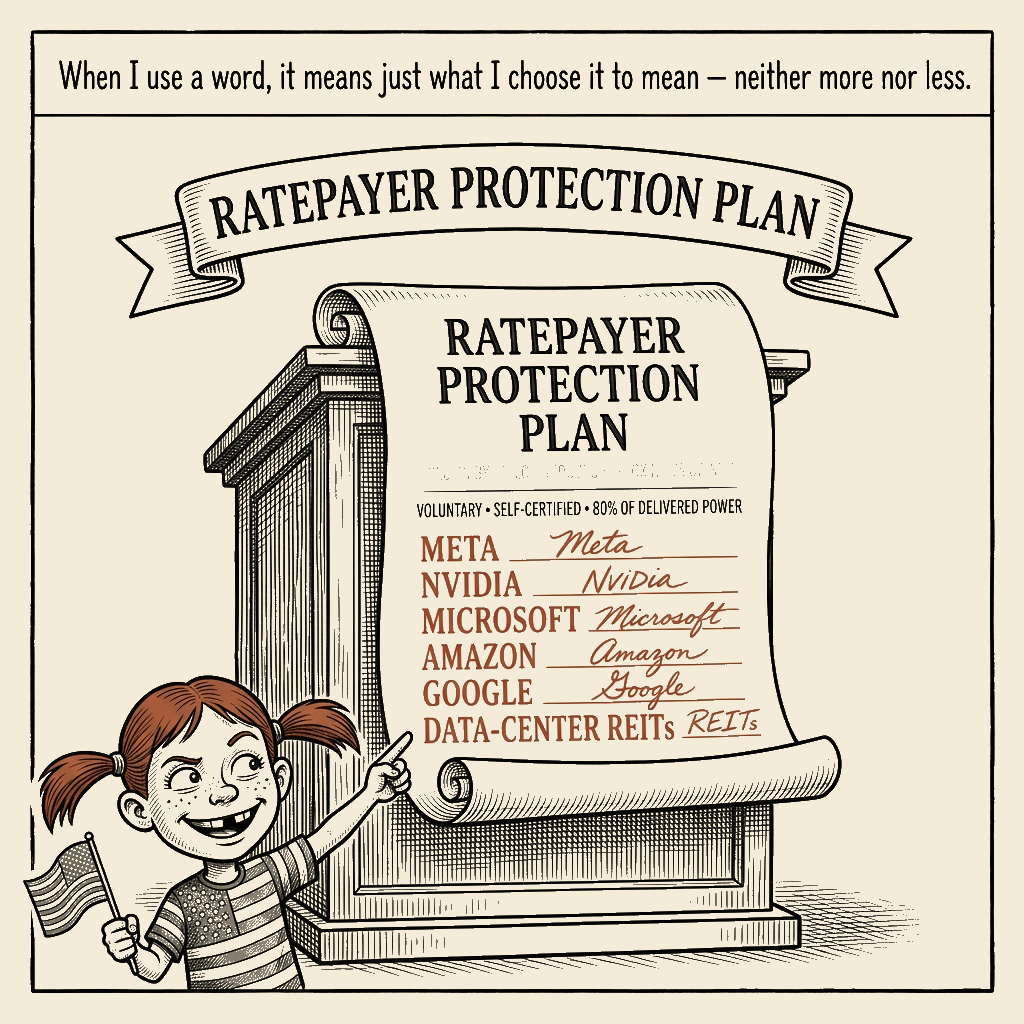
- Frame: “Democrats want to control AI through regulation.” Reality: The policy mix the column actually defends — voluntary Ratepayer Protection Pledges signed by the hyperscalers themselves, sales-tax carve-outs that funnel construction windfalls, water carve-outs that exempt closed-loop new builds, no federal permitting reform — protects the developer side of the ledger. The named beneficiaries in the piece (Meta, Nvidia, Microsoft, the data-center REITs) are not Democrats.
- Frame: “AI and data centers are revitalising pro-Trump small towns.” Reality: The anecdotes are real, but they are construction-phase sales-tax windfalls, not recurring revenue. The Richland Parish $50,000 teacher bonus is a one-time check tied to the build of Meta’s $27 billion Hyperion data center near Holly Ridge, La. (Shreveport Times, June 10, 2026). The Ellendale $250 electric-bill savings is a projection from Montana-Dakota Utilities contingent on full build-out; realised savings to date are roughly $70 per customer per year, per the utility’s filings to the North Dakota Public Service Commission.
- Frame: “The water problem is solved.” Reality: Closed-loop cooling is the design choice on a subset of new builds; the existing fleet and many announced sites still depend on potable water. The piece quotes Nvidia’s chief sustainability officer — Nvidia sells the chips.
- Frame: “80% of Americans are covered by the Ratepayer Protection Plan.” Reality: The pledge is voluntary, signed by the hyperscalers themselves, and covers 80% of power delivered to U.S. homes and businesses — denominated in delivered power, not households protected. It covers new grid upgrades the hyperscalers agree to pay for; it does not cover existing ratepayer exposure from earlier data-center builds (EPA / White House, 2026).
- Frame: The closing “three questions” — who, why, truth — is meant to delegitimise AI scepticism. Reality: The piece never answers its own questions; it pre-decides that anyone who worries is a socialist. The load-bearing sentence is the Jesse Ferguson anchor: “the fight for Democrats is not ‘we are for AI’ or ‘we are against AI.’ That framing is a trap. The fight is over control” (Fast Company).
The Response Ladder
Polite Reframe
When to use: When a colleague or family member shares the piece sincerely and you want to push back without starting a fight.
Three things the column asks you to accept, and three things to check before you do.
First, on the “Democrats want control” frame. The policy mix the column is actually defending — the voluntary Ratepayer Protection Pledge signed by the hyperscalers themselves, the sales-tax carve-outs that funnel construction windfalls, the water carve-outs that exempt new closed-loop builds, and the absence of any federal permitting reform — protects the developer side of the ledger. The names that show up in the piece as beneficiaries — Meta, Nvidia, Microsoft, the data-center REITs — are not Democrats.
Second, on the small-town revival anecdotes. They are real, and they are construction-phase sales-tax windfalls, not recurring revenue. The Richland Parish $50,000 teacher bonus is tied to the build of Meta’s $27 billion Hyperion data center near Holly Ridge, La. — a one-time distribution, not a salary. The Ellendale $250 electric-bill figure is a projection from Montana-Dakota Utilities that assumes the 530 MW facility is fully built out; realised savings to date are about $70 per customer per year, per the utility’s own filings. Neither of these is a permanent paycheck. Both depend on indefinite new builds.
Third, on the “water solved” line. Closed-loop cooling is the design choice on a subset of new builds. The existing fleet and many announced sites still depend on potable water. Quoting Nvidia’s chief sustainability officer to make the point is quoting the chip vendor — a reasonable voice, but not a neutral one.
The column is not wrong that data centers can help small towns. It is wrong that the right policy response to that fact is no policy at all.
Mockery and Ridicule
When to use: … When the frame is absurd enough that a little mockery will puncture it faster than a spreadsheet will.
A “dying little town” is saved by a data center—great! And a Meta data center gave Louisiana teachers $50,000 bonuses—wonderful! Now watch how quickly the same column turns into a Henny Youngman routine: “Water? Solved! Electricity? Cheaper! Ratepayer protection? Guaranteed! Nvidia? Trust us!”
Any red flags? A company whose entire business model is building AI data centers says water is “largely solved.” A policy called “Ratepayer Protection Plan” exists, and we’re told it protects you—just trust the name. A study “found modest decreases” in rates—modest, in some cases, while your summer bill is doing whatever it wants. And everyone who wants to see the actual contracts, the actual water draw, the actual rate impact is a “woke bureaucrat” trying to “seize control.”
Oh no. Not control. Anything but that. The people who own the servers, write the tax abatements, and decide where the megawatts go would never dream of controlling anything. The only control problem in America is a city councilman asking for an environmental review.
Nuclear Satire
When to use: … When you need to hold the contradiction up to the light until people can see it from every angle.
Announcement from the Coalition for Totally Unsolicited Server Farms
We are pleased to announce that America’s small towns will now be saved, whether they want to be or not. Our data centers will repave your streets, refurbish your opera house, and—if you are very lucky—lower your electric bill by “modest” amounts in some cases for some people. In exchange, we ask only for everything: land, water, grid capacity, tax certainty, and your complete silence about the phrase “who benefits.”
Do not be alarmed by the water. Our chief sustainability officer—who is paid by us—has confirmed that water is “largely solved,” which sounds definitive until you remember that lip syncing is also “largely singing.” Do not be alarmed by the power lines. The “Ratepayer Protection Plan” guarantees thatAI companies pay their own way, which is why we are partnering with your utility to spread certain fixed costs across your meter in a manner that is definitely not ratepayer-non-protection. Do not be alarmed by the jobs. Yes, $240,000 electricians exist, and they are magnificent. Please ignore the fact that those are highlighted as freakish exceptions while thousands of construction shifts come and go.
Most importantly, do not ask who controls this. The fight, we have been told, is over control—and we already won. You may now return to marveling at your repaved streets. The opera house is lovely this time of year.
Profane Scorched-Earth
When to use: When you have been asked “did you read the piece” one too many times and you would like to respond like an adult who has read the receipts.
Bullshit. Let’s go.
The column tells you Democrats want to control AI. What it does not tell you is that the policy mix it is shilling for — the voluntary Ratepayer Protection Pledges, the sales-tax carve-outs, the water carve-outs for closed-loop builds, the federal permitting moratorium on AI-specific regulation — was written by, signed by, and benefits the hyperscalers and the data-center REITs, not the people of Ellendale, North fucking Dakota.
The $50,000 Richland Parish teacher bonus is real. It is also a one-time sales-tax check from the construction phase of Meta’s $27 billion Hyperion build. The teachers got it because a crew was pouring concrete. The crew is gone. The data center still hums. The next check is not on the way. The column presents this as a recurring paycheck. It is not. It is a construction spillover that the parish will never see at this scale again unless Meta breaks ground on a second site, which the column does not mention.
The $250 Ellendale electric-bill savings is a projection from Montana-Dakota Utilities, contingent on full build-out. The current realised savings, per the same utility’s filings to the Public Service Commission, are about $70 a year per customer. The column inflates the projection and removes the contingency. That is not analysis. That is marketing copy written in a newsroom font.
The “water solved” line quotes Nvidia’s chief sustainability officer. Nvidia sells the chips. The closed-loop cooling system the quote refers to is the design choice on a subset of new builds. It is not retrofitted to the existing fleet. It is not the cooling system at the Quincy, Washington site Microsoft has been running since 2007. It is not the system at the data centers in Loudoun County, Virginia, where Dominion Energy is currently trying to keep the lights on without doubling your fucking electric bill. The column uses one quote from one vendor to dismiss every water concern raised by every utility, every regulator, and every hydrologist who has looked at the actual numbers. This is what “three things Democrats don’t want you to know” looks like when the writer is doing it for the other side.
The Empire of AI thousandfold error is real, and the column is right to flag it. Karen Hao miscalculated water use by a factor of roughly a thousand for one proposed data center in Chile. The correction is fair. But using one bad estimate to dismiss every water concern is the same move the column accuses Democrats of making in reverse — pick one bad number, generalise it to the whole field, declare the debate over. The column does not get to do this and also retain the moral authority to complain when Democrats do it. Pick a fucking lane.
The Ratepayer Protection Plan covers 80% of power delivered to American homes and businesses. The denominator is delivered power, not households protected. Those are not the same denominator. The pledge is signed by the hyperscalers themselves. The pledge covers new grid upgrades the hyperscalers are agreeing to pay for. It does not cover existing ratepayer exposure from data centers that were built before the pledge, or from data centers that fall outside the pledge’s narrow scope. The 80% figure is a delivered-power share, not a household-protection rate. The column uses the headline number and skips the arithmetic. Anyone who has read an electric utility tariff in their life can see the con.
The three closing questions — who, why, truth — are a Socratic-looking rhetoric device designed to make you stop asking questions. The column does not answer its own questions. It assumes you will. It assumes you will conclude that anyone worried about AI is a socialist, because the column has already pre-decided that the only people who worry are people who want to control you. This is not analysis. This is a cult-recruitment flyer dressed up as a Fox News opinion column.
And the Jesse Ferguson quote — “the fight for Democrats is not ‘we are for AI’ or ‘we are against AI.’ That framing is a trap. The fight is over control” — is the load-bearing sentence of the entire piece. It is also the column’s tell. The fight is over control. The column is fighting for it. The control the column wants is the control to keep building without federal oversight, without binding ratepayer protections, without honest water accounting, and without admitting that the small-town revival it cites is a construction-phase spillover that ends when the concrete cures. The control the column wants is the control to keep calling any of this a “boom” while the ratepayers, the aquifers, and the grid absorb the externalities.
You wanted to know who benefits. Read the receipts. The beneficiaries are Meta, Nvidia, Microsoft, Amazon, Google, and the data-center REITs. The column tells you the enemy is Alexandria Ocasio-Cortez. The column is lying to you, and the receipts prove it.
The fight is over control. Just not the one the column is pretending to fight.

About Malcolm Little King
Malcolm Little King is a heteronym in Main Street Independent's editorial architecture — an analytical voice, not autobiography of any actual person. The position this column expresses is the publication's position on the territory Malcolm Little King's lane covers, rendered through Malcolm Little King's register.