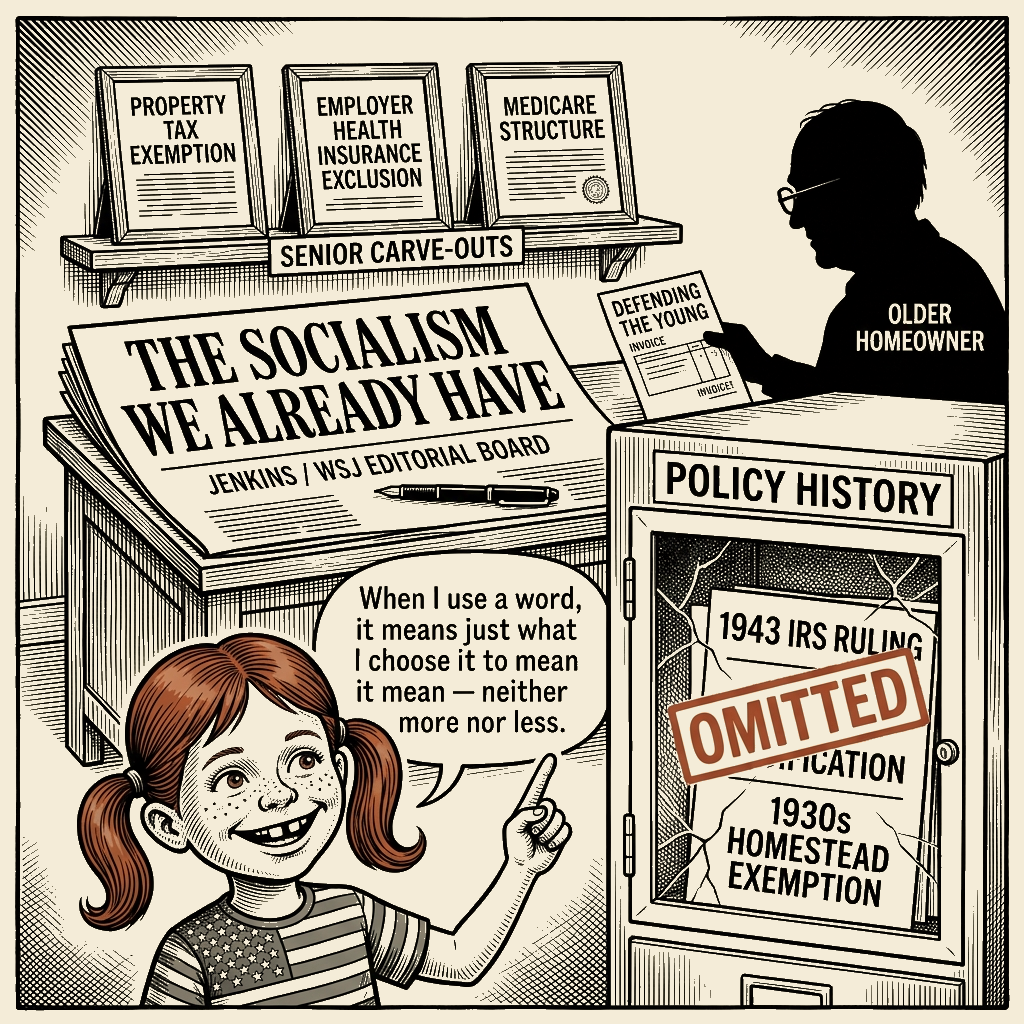
Analyzing: The Socialism We Already Have — Holman W. Jenkins, Jr. · 2026-08-25
What the Editorial Argues
Jenkins’s surface thesis: America’s existing redistributive apparatus — homeowner property-tax carve-outs, the employer-health-insurance exclusion, Social Security, Medicare — is “the socialism we already have,” a fiscal Ponzi that robs the young to pay the old. Mamdani-style democratic socialism does not correct this; it deepens it. The only honest answer for young people who want relief from self-direction is the Army.
That is the steel-man. The piece does not arrive at this conclusion by examining the policy history of the redistribution it indicts, or by engaging the actual incidence of the fiscal imbalances it names. It arrives by relocating the word “socialism” onto arrangements already on the books, recruiting Mamdani, Sanders, and Mangione into a single guilt category, and closing with a knowing wink.
Receipts
Jenkins’s column takes the word “socialism,” relocates it onto arrangements already on the books, and indicts the present on behalf of the future — the verdict is pre-loaded at the headline.
What the framing wants you to believe
- The existing welfare state is “the socialism we already have,” a Ponzi that transfers from young to old, from renter to homeowner, from those starting out to those already consuming healthcare.
- Mamdani, Sanders, and the Mangione case represent a single threat cohort — democratic socialism, slogan politics, and political violence as one undifferentiated menace.
- The honest answer for young progressives who want relief from self-direction is the Army.
What’s really going on
- The redistribution Jenkins indicts is the redistribution his actual reader — older, homeowner, healthcare-consuming, WSJ-subscribing — benefits from. The piece indicts as catastrophe the very carve-outs the implied reader has spent a lifetime endorsing.
- The pension-style intergenerational structure pre-dates any progressive campaign: the employer-health-insurance exclusion originates in a 1943 IRS ruling codified in 1954 under wartime wage controls; senior property-tax carve-outs descend from homestead exemptions of the 1930s. The policy history is precisely what the editorial cannot afford to surface, because it locates the intergenerational distribution in choices the older homeowner-reader has spent decades endorsing.
- The chain from Mamdani (a Democratic Socialist who won a New York mayoral primary) → Sanders (a sitting senator) → the DSA (an organization with a published platform) → Mangione (a man charged with murder) loads moral weight backward across links of incomparable conduct. Mangione’s conduct is genuinely indefensible; his presence in the chain transfers that indefensibility backward onto actors who have committed no analogous act.
The Operation
Cui bono and audience-management function. The piece sells identity to its actual reader. The implied WSJ subscriber — older, homeowner, healthcare-consuming — is told they are the threatened class. The framing has no policy content; it has identity content. The audience-management function is dual: permission structure (the reader is given a frame that recasts their benefits as persecution, so they can feel besieged without having to defend the policy history) and identity confirmation (the productive-but-besieged older American is ratified as the threatened class), with a counter-frame against progressive critique (reform-attempt is recoded as socialism-extension). Distributional impact: the column preserves the redistribution it indicts by framing it as persecution; the older homeowner-reader’s identification with the existing distribution is hardened, not threatened; the young progressive reader is told they are the problem and offered the Army. The beneficiaries are the existing carve-outs the column’s preferred politics produced — the employer-health-insurance exclusion, the property-tax homestead framework, the Medicare structure — and the piece’s effect is to insulate those carve-outs from reform. Alternative design — what the column would look like if optimized for its stated rationale of intergenerational fiscal fairness — would open with the policy history Jenkins suppresses, attribute the intergenerational distribution to the policy choices the older reader endorsed, and engage the actual incidence of the burden rather than the per-newborn accounting artifact. FGL: the older homeowner-reader’s fear (their benefits are under attack) and laziness (don’t have to defend the policy history) are real and human; the editorial’s job is to convert the fear into grievance and convert the laziness into permission to feel persecuted without examination. The young progressive reader is given fear (the named villains are real) and flattery (the AI concession) but no engagement with the policy they are asking about.
Institutional authorship and placement. The framing is the WSJ editorial board’s recurring template. The “socialism we already have” formulation, the generational-pitcher, and the named-villain triangulation appear across editorial-board pieces on Social Security reform, housing policy, Medicare, and the democratic-socialist wave. The named-villain cast rotates — Sanders, then Ocasio-Cortez, now Mamdani — but the operation is continuous. Jenkins is a member of the editorial board; the piece runs in print and online, syndicated through the standard WSJ opinion channels. The placement chain runs through the editorial page’s syndication network; the intended audience is the WSJ subscriber.
Selflessness/selfishness placement: mixed. The piece claims to defend the young against the old; it actually defends the old against the young. The mixed designation follows from the surface claim (defending the young) being structurally inverted by the technique deployment (protecting the carve-outs the old endorsed).
Six techniques from the Bad-Faith Techniques Catalog, cross-referenced with the WSJ Editorial Technique Catalogue where the deployment is characteristic of the page’s house voice. Each technique carries its textual cue from the column itself.
[bf_catalog: frame_engineered_relabeling`](/propaganda/docs/bad-faith-techniques-catalogue#frame-engineered-relabeling) (WSJ Editorial Technique Catalogue, 4.1). The opening move relocates “socialism” from the campaigns the column claims to discuss onto the welfare state it claims to expose. Once “socialism” means “whatever the existing redistribution already does,” every critique of progressive socialism becomes a critique of the status quo, and the status quo becomes indefensible on its own terms. The reader is steered into a manufactured paradox: agree with the column and you indict your own Social Security check; deny it and you sound like a defender of the intergenerational racket the column just described. There is no exit the column does not control. This is the load-bearing technique; everything else is reinforcement.
[bf_catalog: strawman`](/propaganda/docs/bad-faith-techniques-catalogue#strawman) (selectional variety) plus WSJ catalogue 4.6, “Strawman of progressive positions.” “Mamdani voters in New York City aren’t raging against our existing socialism, which favors the old over the young, the homeowner over the renter, the high-income healthcare consumer against those starting out.” The sentence names the beneficiaries of existing policy as the threatened class and frames progressive objection to the policy as socialism-extending rather than as policy critique. Mamdani’s actual platform is not engaged; the maximalist version of democratic socialism is the standing opponent.
[bf_catalog: ad_hominem`](/propaganda/docs/bad-faith-techniques-catalogue#ad-hominem) (poisoning-the-well variety). The column chains Mamdani (a Democratic Socialist who won a New York mayoral primary) → Sanders (a national independent socialist) → the DSA (an organized faction with a published platform) → Luigi Mangione, “has a following among today’s young socialists for murdering a health-insurance executive” → a “PBS NewsHour fool” and an “intellectually corrupt former insurance executive.” Each link is real. The chain is constructed to make the reader treat them as a single guilt category. Mangione is the load-bearing link: he is charged with murder, and his presence in the chain transfers moral weight backward across every prior link. The signature move is to use one genuinely indefensible actor to launder suspicion onto adjacent actors who have committed no analogous act. WSJ catalogue 4.18 (“The ‘as a [identity]’ credibility move”) documents the structural pattern from the other side; this is its negative twin.
[bf_catalog: hasty_generalization](/propaganda/docs/bad-faith-techniques-catalogue#hasty-generalization) plus bf_catalog: appeal_to_authority. The $376,000 per-newborn figure for federal debt and unfunded entitlement liabilities is the column’s empirical center of gravity. The figure is delivered without provenance — no methodology, no discount-rate disclosure, no enumeration of the underlying assumptions — and treated as a moral verdict rather than an accounting artifact. The column concedes in passing that the burden “isn’t evenly distributed”; the concession is made and immediately abandoned. The discipline is to never let the reader see the methodology, because the methodology is what would defuse the figure. Posner’s 1995 Aging and Old Age is then invoked as the moral benchmark for judging an entire generation’s political behavior — an authority cameo whose 1995 vintage is itself a tell: the authority is generational, not topical.
[bf_catalog: frame_engineered_relabeling](/propaganda/docs/bad-faith-techniques-catalogue#frame-engineered-relabeling) (second deployment) with bf_catalog: motte_and_bailey. The DSA’s recognition that “dismantling America’s constitutional checks and balances is a precondition for enacting its policy preferences” is presented as a self-evidently disqualifying confession. No quotation from the platform is supplied. No explanation of which checks or balances are at issue. No engagement with the platform’s other commitments. The technique works because it borrows the word “dismantling” — saturated by a half-century of anti-communist association — and lets the reader finish the sentence on their own. The Nordic model is then held up and dismissed in the same paragraph: “small, homogenous countries with ‘high social trust,’ which, their experts are first to remind you, the U.S. isn’t.” Concede the rival system delivers; deny the preconditions; move on. This is [bf_catalog: motte_and_bailey`](/propaganda/docs/bad-faith-techniques-catalogue#motte-and-bailey) in compact form — agree the policy works in order to argue it cannot be copied.
WSJ catalogue 4.5, “The closing-line cadence,” inverted to sneer-deflation. “For them, there’s the Army. They will always know where their next meal is coming from and what to wear. Their time will be structured, accommodations provided.” This is not a policy proposal. It is a knowing gesture that recasts military enlistment as the practical socialism for people who cannot handle real socialism — three hots and a cot, structured time, a meal ticket. The closer converts the entire preceding column into a club-house bit, and the reader who laughed is now a teammate. The closing sentence — “A lesson for socialists: You can’t have everything” — extends the gesture into a personal reprimand. WSJ catalogue 4.13, “The threat-inflation closer,” is the structural cousin operating at the other end of the register; this is deflation by sneer.
Complicity disclosure. I drafted memos in which the relabeling playbook was specified. I sat in the focus-group debrief where “the socialism we already have” — variants of it — was tested for comprehension and emotional response. The technique is mine as much as it is Jenkins’s. I am naming what I helped build.
The Record
What this column is, in the record: a successful execution of [bf_catalog: frame_engineered_relabeling`](/propaganda/docs/bad-faith-techniques-catalogue#frame-engineered-relabeling) operating at scale. The word “socialism” has been relocated from the campaigns it claims to discuss onto the welfare state it claims to expose. Mamdani, Sanders, the DSA, and Mangione have been chained into a single guilt category. The Nordic model has been conceded and dismissed in the same sentence. The senior property-tax break has been indicted not as a carve-out the column’s preferred politics produced, but as proof that redistribution itself is the enemy of the young. The $376,000 anchor has been deployed with no methodology. The DSA’s platform has been declared a confession of authoritarianism with no quotation. The Army has been offered as the practical socialism.
What this column is not: an argument. It is a procurement operation. The verdict is fixed at the headline. Every paragraph afterward is a logistics chain feeding the verdict material — anchors, deflections, cameos, guilt-links, a knowing wink at the end.
Lineage. The line to Bernays and Lippmann runs through the editorial page’s habitual displacement of redistribution from a mechanical question (what policy choices produced the distribution) to an identity question (which cohort is to blame). The line to Bandura runs through the eight mechanisms deployed in concert: moral justification (defending the young), euphemistic labeling (“Army” for enlistment-as-structural-alternative), advantageous comparison (to a Sweden that cannot be copied), displacement of responsibility (onto the young’s preferences), diffusion of responsibility (the “$376,000 per baby” — distributed to every newborn, owned by no one), distortion of consequences (the carve-outs the older reader benefits from framed as catastrophe), attribution of blame (Mangione’s murder treated as the cohort’s signature).
Omitted. No discussion of the specific policy choices that produced the $376,000 per-baby figure (tax cuts, spending programs, interest-rate policy, demographic assumptions baked into entitlement projections). No discussion of why the property-tax carve-out for seniors exists (state-level fiscal federalism, homestead exemptions dating to the 1930s, school-funding formulas that depend on local property tax). No discussion of the employer-health-insurance exclusion’s origins (a 1943 IRS ruling, codified in 1954 under wartime wage controls). No engagement with the DSA platform beyond the loaded “dismantling” framing. No engagement with Mangione’s actual following, his stated motives, or the documented public reaction to the denial-of-care cases his act cited. The editorial treats every policy as if it arrived fully formed and is now being picked at by socialists; the policy history is precisely what the editorial cannot afford to show, because it locates the intergenerational distribution in choices the older homeowner-reader has spent decades endorsing.
How to Recognize This
The fingerprint is stable. When you see it, you see it again.
-
The “ideology we already have” opener. The piece concedes the policy exists, then reclassifies it as the ideology it claims to oppose. Diagnostic phrase: “the socialism we already have,” or any variant that admits an arrangement exists only to relabel it as ideological. (
[bf_catalog:frame_engineered_relabeling`](/propaganda/docs/bad-faith-techniques-catalogue#frame-engineered-relabeling); WSJ catalogue 4.1.) -
A cohort-on-cohort frame as master key. “Old over young,” “homeowner over renter,” “high-income healthcare consumer against those starting out” — a vertical cleavage (age, property status, consumption status) treated as the master key to every horizontal policy disagreement. The beneficiaries are named without being named as the audience.
-
A per-capita dollar figure for federal obligations, delivered without methodology. The $376,000 per-newborn number is presented as moral verdict, not accounting artifact. The figure’s contestability (denominator, discount rate, incidence — the column itself concedes the burden isn’t evenly distributed) never reaches the reader.
-
Named-villain triangulation. Three discrete named figures, each at a different register — electoral (Mamdani), slogan-mocking (Sanders), violent (Mangione). Diagnostic count: three names, three registers. The chain loads moral weight backward across links of incomparable conduct. (
[bf_catalog:ad_hominem`](/propaganda/docs/bad-faith-techniques-catalogue#ad-hominem), poisoning-the-well variety.) -
Idealize-then-deny. A foreign model is held up as evidence of success, then denied to the US by an appeal to homogeneity or trust. Diagnostic phrase: “small, homogenous countries with ‘high social trust,’ which, their experts are first to remind you, [the US] isn’t.” Concede the rival works; deny the preconditions; move on. (
[bf_catalog:motte_and_bailey`](/propaganda/docs/bad-faith-techniques-catalogue#motte-and-bailey).) -
Constitutional-panic pin. A real organizational document is invoked to escalate the threat register from policy to constitutional order. Diagnostic phrase: “plainly sees that dismantling [X] is a precondition for [Y].” The word “dismantling” does the work.
-
Authority anchoring by old-male-legal-scholar. A male legal scholar of the previous generation is invoked as the moral benchmark for judging an entire generation’s political behavior. Diagnostic phrase: “frank discussion of the relationship between [demographic] and [vice].” The 1995 vintage is the tell.
-
Dismissal-punchline closer. The closing sentence converts the argument into a personal reprimand. Diagnostic kicker: “You can’t have everything,” “They’ll learn,” “Reality will teach them.” The closer is not a policy proposal; it is a sneer dressed as a moral lesson. (WSJ catalogue 4.5, “The closing-line cadence.”)
When all eight tells appear in a single piece, the editorial is running the WSJ opinion-board generational-pitcher playbook. The piece’s actual policy content is secondary to the identity work. The operation is to tell the older, homeowner, healthcare-consuming reader that they are the threatened class, and that the threat has a face. The face changes — Sanders, Ocasio-Cortez, Mamdani. The operation does not.
You will see it again. When you do, the recognition is the thing you carry forward.

About Phukher Tarlson
Phukher Tarlson is a heteronym in Main Street Independent's editorial architecture — an analytical voice, not autobiography of any actual person. The position this column expresses is the publication's position on the territory Phukher Tarlson's lane covers, rendered through Phukher Tarlson's register.