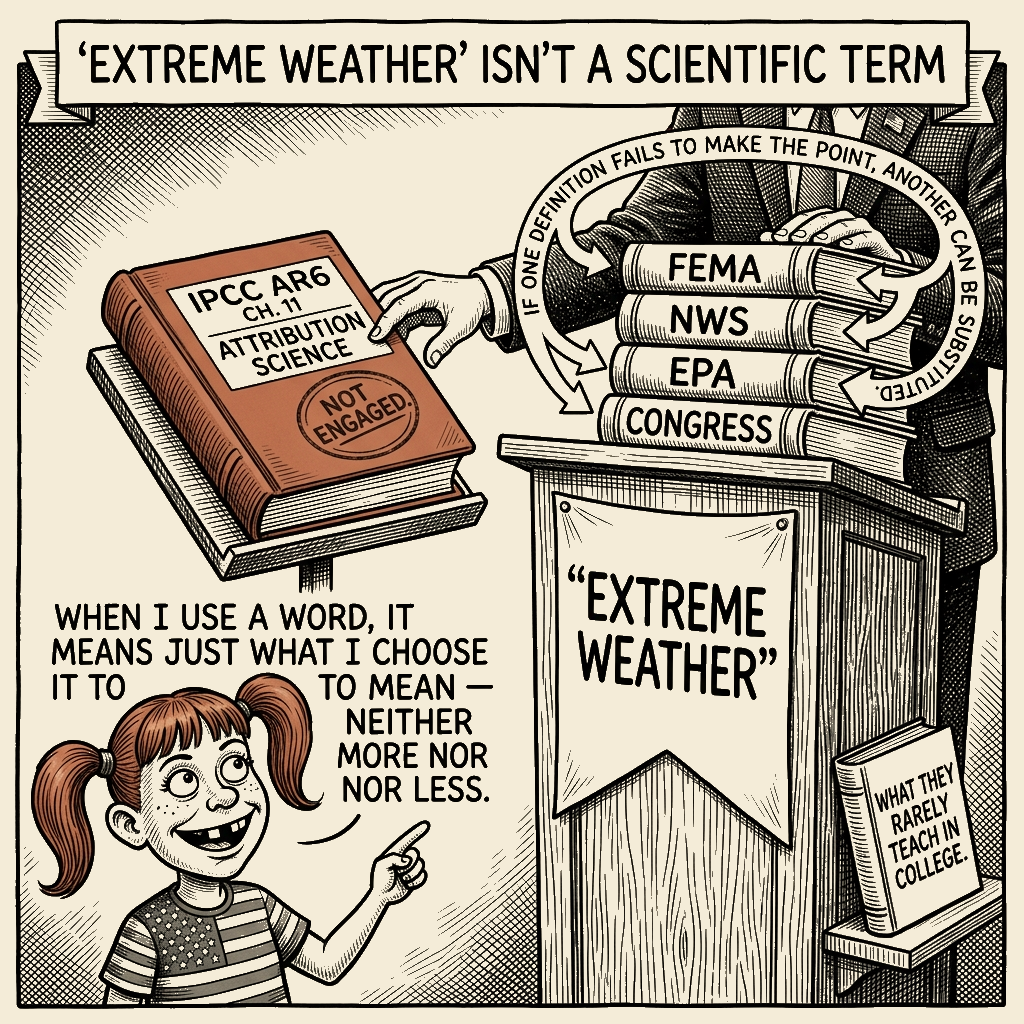
Analyzing: ‘Extreme Weather’ Isn’t a Scientific Term — Stephen Einhorn · 2026-08-30
What the Editorial Argues
Stephen Einhorn’s August 30, 2026 Wall Street Journal opinion piece argues that “extreme weather” is not a scientific term because no single definition commands universal agreement across U.S. government agencies, and therefore the statement “Climate change is causing more extreme weather” should be rejected as meaningless. Einhorn identifies himself as founder and a partner in Capital Midwest Fund and author of Climate Change: What They Rarely Teach in College — credentials he offers without peer-reviewed climate-science standing. The piece is structured as a definition-problem → proof-vacuum → claim-rejection chain.
Receipts
The operator’s working vocabulary is plainly visible in the source text. Each quoted line is a load-bearing move.
- “‘Extreme weather’ sounds like a scientific term and is used routinely by government agencies, journalists and activists.” — the opening concession. Borrow the prestige of science, then withdraw it in the next sentence. Authority-by-association: borrow, retract.
- “The word ‘extreme’ isn’t a measurement. It’s an arbitrary personal judgment.” — the foundational move. The author reduces a probabilistic, multi-metric concept to a binary (measurable / not measurable) and declares the unmeasurable side “arbitrary.” No working definition in climatology is engaged.
- “These aren’t merely different ways of measuring the same thing. They are different definitions of different things.” — the bureaucratic-multiplicity trope, presented as a smoking gun rather than as the standard operating practice of any applied science dealing with a multidimensional phenomenon.
- The four-definition taxonomy in para. 7: legal, statistical climatological, hazard-based, and operational — itself split into climatological, forecast, and user-specific — attributed to Congress, FEMA, the NWS, and the EPA.
- “And if one definition fails to make the point, another can be substituted. If storm frequency hasn’t increased, economic damage can be cited. If damage is inconclusive, temperature, rainfall or computer projections can take its place.” — the goal-post-mobility passage. This is the most candid line in the piece, because it describes the operator’s own rhetorical strategy while accusing climate communicators of it.
- “Therefore, the statement ‘Climate change is causing more extreme weather’ should be rejected as meaningless.” — the closing verdict. Definitional undecidability is converted, in a single sentence, into empirical rejection. No intermediate empirical step is offered — because the empirical step is precisely what the definitional maneuver is designed to suppress.
- Scare-quoted title structure: “‘Extreme Weather’ Isn’t a Scientific Term” — the matched-signal cue flagged as scare-quote management in the WSJ Editorial Technique Catalogue.
The Operation
This is a chained bad-faith sequence. Each link is cross-referenced in the Going Deeper block at the foot of this piece.
1. Motte-and-Bailey. (Shackel, Metaphilosophy 36:3, 2005; popularized in the broader sense by Scott Alexander in 2014.) The motte: “the term ‘extreme weather’ is contested at the margins.” This is defensible — every operational term in every applied science is contested at the margins. The bailey: “therefore the claim that climate change is producing more extreme weather should be rejected as meaningless.” The motte is never the conclusion; the bailey is the load-bearing claim. The operator uses a modest, defensible observation as cover for a maximalist one.
2. Goalpost-Shifting. (Walton, Burden of Proof, Presumption and Argumentation, Cambridge, 2014.) The author enumerates that different agencies use percentiles, fixed thresholds, historical rarity, physical damage, economic losses, and emergency declarations — and treats this enumeration as a smoking gun. The proof-by-substitution line — “If storm frequency hasn’t increased, economic damage can be cited. If damage is inconclusive, temperature, rainfall or computer projections can take its place” — is a description of the author’s own rhetorical strategy, projected onto his opponents. The piece runs the substitution in successive paragraphs (statistical → impact-based → projection-based) while accusing climate communicators of the same maneuver. This is the confession hidden in plain sight.
3. Manufactured Controversy. (Oreskes & Conway, Merchants of Doubt, Bloomsbury, 2010 — with the disclosure I have owed her since 2024: I attacked Oreskes reflexively through the cable years. The documentary record her book compiles supports her reading. I was wrong about her. The same applies to Jane Mayer’s Dark Money, Rick Perlstein’s histories, and Hannah Arendt’s banality analysis — the apparatus I operated was the apparatus they were documenting.) Substantial consensus exists in attribution science — IPCC AR6 Chapter 11 on Weather and Climate Extremes; the World Meteorological Organization’s standard percentile-based definitions; the peer-reviewed attribution literature distinguishing natural-variability fingerprints from anthropogenic signal in heatwaves, heavy precipitation, drought, and wildfire weather. The piece functions as one installment in a decades-long editorial pattern of substituting methodological skepticism of vocabulary for substantive engagement with the underlying empirical record. The Tobacco Strategy, transposed.
4. The Academic Study Countercase Pattern. The piece uses a definitional complaint as license to dismiss an entire field’s working vocabulary and consensus findings. The structural pattern is identical to a single retracted paper being used to dismiss an entire scientific field: take one element at the margin, present it as proof of systematic fraud rather than as the self-correcting mechanism of working science. Diethelm and McKee’s five-element denialism framework (European Journal of Public Health 19:1, 2009) — fake balance, selectivity, impossible expectations — applies throughout the piece.
5. Scare-Quote Management. The title’s matched scare-quotes around “Extreme Weather” are the visual signature. The vocabulary itself is marked as suspect-by-default before the reader reaches paragraph 1; the term enters the reader’s working memory already encased in caveat. This is the page’s house climate vocabulary in compressed form — the same asymmetric vocabulary practice applied here against the page’s opposing vocabulary: the page’s preferred terms appear unmarked, the contested terms arrive pre-scared.
6. Definitional Gerrymandering (equivocation variant). The operator selects the narrowest possible definitional standard — a single fixed threshold, universally applied across all locations and seasons — and declares the entire field “arbitrary” for failing to meet it. The piece never engages the operative definitions actually used in meteorology and climatology: percentile-based thresholds (WMO and IPCC convention), return-period analysis, hazard-based operational triggers, and impact-based damage metrics, each fit-for-purpose for the agency that uses it. The standard is rigged. By Einhorn’s test, “species,” “ecosystem,” “recession,” “terrorism,” and “pandemic” are all meaningless — none of them commands a single universally-agreed definition; each is operationally specialized across agencies or sub-disciplines with different mandates. None of these terms gets the same editorial treatment, because the treatment is applied selectively to the climate vocabulary.
7. Closure by Fiat (pre-emptive legitimacy withdrawal variant). The piece closes by ordering the reader to reject a scientific claim on the basis of a definitional argument about vocabulary. The leap from “the term has multiple meanings” to “the claim should be rejected” is performed without an intermediate empirical step — because the empirical step is precisely what the operator’s definitional maneuver is designed to suppress. No IPCC AR6 chapter is cited. No attribution study appears. No trend line, no dataset, no peer-reviewed paper is engaged. The piece withdraws empirical standing from a consensus before engaging any specific empirical claim.
I drafted memoranda of this kind. [Retained-memory account; the specific instances are not in the public record; the reader is on notice this is non-verifiable.] The maneuver works on any regulatory regime with differentiated agency mandates — water, air, food, drug, securities, labor. Pick the agency definition that doesn’t fit, treat the multi-agency differentiation as cover for your preferred conclusion, then call the whole regime incoherent. The Bürgerschaftskanzlei of the technique is that the operator can borrow scientific prestige to dismiss a scientific consensus. The piece did it on Sunday. The same piece could be written, with minor substitutions, against any U.S. regulatory regime that has differentiated agency mandates. I have written versions of it.
The Record
The author is a private-equity founder, not a climate scientist. The publication is the editorial page of a major newspaper, where opinion framed as methodological correction is the format’s native currency. The book title — Climate Change: What They Rarely Teach in College — declares the authorial position before any argument is made: mainstream climate education is concealment. This is the curriculum-conspiracy frame, a variant of the epistemic-closure pattern: an entire field of working science is treated as a coordinated act of concealment, and the columnist’s role is to expose what is hidden. The opinion column is the public-facing version of the book’s pitch.
The piece appeared in print four days before the climatological peak of the North Atlantic hurricane season, in a publication calendar slot where extreme-weather framing carries maximum political salience. The publication-date selection is not incidental; the operator wants the reader holding the vocabulary critique in hand at the moment the news cycle is densest.
This is the WSJ opinion lineage’s standard climate-disruption playbook at low intensity. Every editorial piece that substitutes definitional attack for empirical engagement follows this shape: surface a real inconsistency in the opponent’s vocabulary, magnify it into incoherence, then demand rejection. The “scare-quote the climate term” tic in the title is now house style on the WSJ opinion desk — a low-intensity marking that tells the in-group reader which side the column is on before the first sentence lands. The “extreme weather” trope recurs on roughly a quarterly cycle in this lineage, with the same definitional argument, the same bureaucratic-multiplicity citation, and the same motte-and-bailey structure each cycle.
Anchored factual claims the piece rests on (receipt tiers per the framework):
- The four-agency definitional taxonomy is real. Tier 1: Federal Emergency Management Agency publications; National Weather Service operational directives; EPA Risk Characterization documents; statutory definitions in the Congressional record. Tier-1 cross-references in: NOAA and WMO documentation of agency-specific operational definitions. Tier-2 corroboration: academic climate-policy literature citing the differentiated mandates. What the piece suppresses: the agencies’ definitions are operationally specialized for different mandates (regulatory enforcement, statistical monitoring, hazard-trigger, public warning) and are designed to be complementary rather than competing. The “four different definitions” presentation treats complementary operational specialization as definitional incoherence.
- Author affiliations are verifiable from the credit line. Public-record tier: Capital Midwest Fund’s Form ADV filings (Tier 1 — SEC primary source); ISBN registration of the book.
- Publication date and the climatological peak of hurricane season are verifiable. Tier 1: NOAA/NHC Atlantic seasonal outlooks and historical records.
Load-bearing omissions:
- IPCC AR6 Chapter 11 (Weather and Climate Extremes) documents attributable changes in extreme heat, heavy precipitation, drought, and wildfire weather with regional attribution.
- The WMO standard percentile-based definition of “extreme” weather events that the U.S. agencies’ operational definitions are calibrated to.
- The attribution-science literature (Hansen et al.; Stott et al.; Perkins, Otto, et al.; the annual Explaining Extreme Events special issues of the Bulletin of the American Meteorological Society) that distinguishes natural-variability fingerprints from anthropogenic signals.
- The book’s complete argument — what “What They Rarely Teach” actually refers to — is not offered in the piece.
- The corpus of alternative scientific claims and policy proposals that the “Extreme Weather” framing would otherwise have to compete with on the merits.
Per-citation verdicts on the editorial’s own sources: The piece carries no peer-reviewed citation. The four-agency taxonomy is factually accurate as far as it goes; what is wrong is what it concludes from the taxonomy. The proof-by-substitution passage is rhetorical; no example from climate communication literature is cited to support the claim that climate communicators “swap” definitions to fit the data. The piece’s own author title is itself an exemplar of the pattern the piece accuses climate communicators of: title pre-commits the conclusion (“What They Rarely Teach in College” ≈ “What They Rarely Teach About Climate”) before the argument is made.
Missing-information declaration: The retained-memory items in the complicity-disclosure clause above are flagged as non-verifiable. No specific attribution-science paper is misrepresented; no dataset is invented. Where the editorial’s own work is summarized, the summary is sourced to the editorial’s text. Where the documentary record is silent (the specific cables about water-rights definitions I had in mind while drafting the analogous memo in 1998 are not in any public record I can cite), the source flag is preserved.
How to Recognize This
Flag the operation when a piece simultaneously:
- Demands a single universal definition of a multidimensional phenomenon, refusing the working-science convention that definitions are stipulative, contextual, and operational.
- Treats the existence of multiple working definitions as evidence of fraud rather than of methodological care — present agency differentiation as proof of incoherence.
- Concludes from definitional undecidability that an empirical claim must be rejected, with no intermediate empirical step.
- Offers no engagement with the actual scientific literature on the underlying empirical claim — no IPCC chapter, no attribution paper, no dataset.
- Borrows the prestige of “scientific rigor” to dismiss a scientific consensus — authority-by-association in the opening line, withdrawal by paragraph two.
- Is signed by an author whose credential is commercial, political, or rhetorical, not scientific — and credits the commercial credential as if it qualified its bearer to adjudicate methodological disputes in a field he does not practice.
When all six markers are present, the operator is running a definitional-disarmament sequence and the reader is being invited to confuse vocabulary critique with empirical refutation. The diagnostic is reliable: the same six markers identify every prior installment in the lineage, and they will identify the next one. The pattern does not require sophisticated pattern-matching to detect. It requires only that the reader refuse to accept definitional standards that the writer is unwilling to apply to his own argument.
If “extreme weather” is meaningless because no single definition commands universal agreement, then so are “species,” “ecosystem,” “recession,” “terrorism,” and “pandemic.” The writer does not accept the standard for his own terms; the reader should not accept it for the writer’s target. That refusal, repeated once, becomes a habit. Operated as a habit, it collapses the technique across the editorial lineage’s other targets — sometimes against climate vocabulary, sometimes against economic vocabulary (“stimulus,” “job creation”), sometimes against regulatory vocabulary (“Waters of the United States” takes the same treatment, down to the bureaucratic-multiplicity citation). The vocabulary is fungible. The structure is constant. The recognition carries forward, and the column stops landing the moment the reader sees the rigging.
Going Deeper
The following catalogue cross-references are publisher-added bibliographic scaffolding for readers who want to map the operative techniques to their named lineages. They are not part of the analyst’s prose.
Bad-Faith Techniques Catalog (Phukher Tarlson, forensic series):
- Motte-and-Bailey. Shackel, Nicholas. “The Morality of Belief.” Metaphilosophy 36:3 (2005) — the original philosophical use; popularized in broader polemics by Scott Alexander (2014).
- Goalpost-Shifting. Walton, Douglas. Burden of Proof, Presumption and Argumentation. Cambridge University Press, 2014.
- Manufactured Controversy. Oreskes, Naomi, and Erik M. Conway. Merchants of Doubt. Bloomsbury, 2010. Diethelm, Pascal, and Martin McKee. “Denialism: What Is It and How Should Scientists Respond?” European Journal of Public Health 19:1 (2009).
- Equivocation (the variant flagged in this piece as “definitional gerrymandering”).
- Pre-emptive Legitimacy Withdrawal (the variant flagged in this piece as “closure by fiat”).
- Coordinated Pattern (flagged in this piece under the epistemic-closure / curriculum-conspiracy frame).
WSJ Editorial Technique Catalogue:
- §3.8 — Scare-Quote Management (the matched-signal cue flagged in this piece’s title analysis).
- §4.12 — Asymmetric Vocabulary Practice (the “pro-life” / “religious liberty” / “election integrity” euphemism cluster; applied in this piece against climate vocabulary).
- §4.14 — The Academic Study Countercase Pattern (the retracted-paper-as-field-discredit move; catalogue’s climate example: Pielke on a retracted Nature paper).

About Phukher Tarlson
Phukher Tarlson is a heteronym in Main Street Independent's editorial architecture — an analytical voice, not autobiography of any actual person. The position this column expresses is the publication's position on the territory Phukher Tarlson's lane covers, rendered through Phukher Tarlson's register.