Analyzing: Trump’s Ballroom Is a Political Fight, Not a Judicial One — John Yoo · 2026-08-28
What the Editorial Argues
The editorial argues that Congress’s failure on a Friday night to reauthorize FISA Section 702 has opened a “large hole” in the country’s counterterrorism capability, and that this lapse constitutionally compels the President to fall back on Article II commander-in-chief authority to conduct warrantless electronic surveillance of foreign communications. The piece asserts that this authority is inherent, historically continuous from Washington through Lincoln through FDR, judicially uncontested by every federal appeals court that has touched it, and beyond Congress’s power to limit through FISA. It closes by proposing that the President publicly declare that surveillance-derived evidence will not be used in criminal prosecutions — a self-certification mechanism offered as the constitutional adequacy check.
The editorial’s surface is constitutional argument. Its operation is the conversion of a statutory lapse into a constitutional expansion.
Receipts
The move. The editorial stages a congressional lapse as a constitutional emergency that returns the President to inherent Article II authority for warrantless surveillance of foreign communications — and closes with presidential self-certification as the proposed constitutional adequacy check.
What the framing wants you to believe:
- A bipartisan congressional lapse has opened a “large hole” in counterterrorism capability requiring immediate executive action.
- Warrantless surveillance of foreign communications is a presidential prerogative rooted in Article II, unbroken from Washington through Lincoln through FDR, and judicially uncontested.
- The constitutional check on this power is the President’s own public declaration that post-sunset intercepts will not be used in criminal prosecutions.
What’s really going on:
- The author is the former Office of Legal Counsel official who architected the original Terrorist Surveillance Program in the weeks after 9/11. He is defending a program he built, citing himself as credential rather than disclosing himself as bias. The “50 percent chance that terrorists would use a certain communications pipeline, such as e-mails provided by a popular Pakistani ISP” is the rhetorical engine: it converts probable cause into “playing the probabilities.”
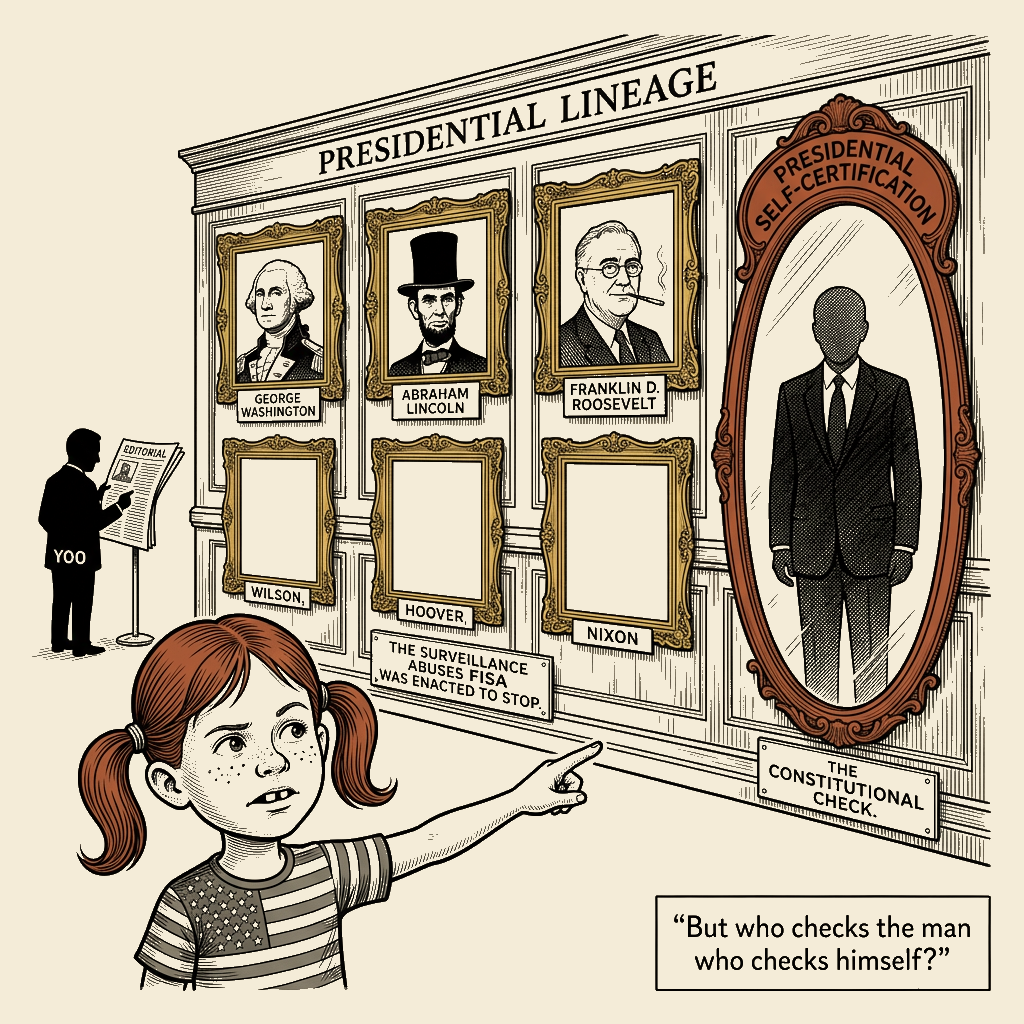
- The historical parade (Washington’s spies, Lincoln’s hires, FDR’s pre-Pearl Harbor authorizations, Midway code-breaking) omits Wilson’s Palmer Raids, Hoover’s COINTELPRO, Nixon’s Huston Plan, the Church Committee, and the very FISA framework Congress enacted in 1978 precisely because prior presidents had abused the very authority the editorial now claims as inherent.
- The “operational gap” the editorial insists exists is largely fictional. 50 U.S.C. § 1805(e) and § 1843 — FISA’s emergency provisions — allow surveillance to continue during lapse scenarios, and the FISA Court can grant authorizations for up to a year in exigent circumstances. The editorial proposes to do unilaterally, and as an inherent constitutional right, what FISA already permits statutorily.
- The proposed remedy replaces judicial review, congressional check, and independent oversight with the President policing himself. This is the operator’s finishing move: concede the surface objection (criminal-procedure contamination), preserve the operational core (suspicionless collection), neutralize the institutional check (everyone else’s).
The Operation
This is not a constitutional argument. It is the surveillance state’s job application to extend its own tenure, dressed in the robes of historical exegesis and signed by one of the architects of the apparatus being defended. I helped build versions of this for cable — the anniversary-as-leverage, the fig-leaf concession, the unitary-executive pivot, the self-positioning as credential. The signature on Yoo’s piece is the signature on mine.
I am bitter about this; I am also right about this. The bitterness is the residue of having built the trick and now reading its 2026 update. The rightness is in the documented record.
The stack of moves:
Operation 1 — Manufactured-Crisis Opening. The editorial opens with “partisan scuffles” producing a “large hole” in counterterrorism capability. Section 702 has faced sunset fights for years; the lapse is not a novel rupture requiring constitutional improvisation. The piece presents a recurring legislative impasse as a sudden emergency, then presents the executive’s pre-existing preference (return to the Yoo-era Terrorist Surveillance Program model) as the only rational response. See the Bad-Faith Techniques Catalog on [bf_catalog: manufactured_controversy](/propaganda/docs/bad-faith-techniques-catalogue#manufactured-controversy) paired with bf_catalog: flooding_the_zone — the editorial stages one as the other.
Operation 2 — Self-Interested Witness as Credential. Yoo’s first-person disclosure — “As a Justice Department official on that day… I worked to plug that gap. We created the Terrorist Surveillance Program” — is framed as context-enhancing. It is a bias admission in plain sight. The author is defending a program he personally constructed under the conditions he is now proposing should be treated as binding precedent. He is not an objective historian; he is a participant seeking retroactive vindication. See the Bad-Faith Techniques Catalog on the appeal-to-authority pattern documented within the [bf_catalog: ad_hominem`](/propaganda/docs/bad-faith-techniques-catalogue#ad-hominem) entry — the inverted form, where the speaker’s status as stake-holder is treated as credential rather than bias.
Operation 3 — Counterfactual Causation as Foundation. “If our government had the legal ability to collect this information and share it before September 11, 2001, it could have prevented the catastrophic strikes” — a counterfactual “if… could have” delivered as a flat historical claim. No evidence of mechanism is offered. No alternative explanations for the 9/11 intelligence failure are considered. The dead are conscripted as argumentative leverage for a 2026 policy preference. See the Bad-Faith Techniques Catalog on [bf_catalog: the_big_lie`](/propaganda/docs/bad-faith-techniques-catalogue#the-big-lie) — a colossal counterfactual asserted with sufficient repetition and emotional weight that the audience treats it as proven.
Operation 4 — Curated Presidential Lineage. Washington, Lincoln, FDR — selected with surgical precision to exclude every inconvenient case. There is no mention of Wilson’s domestic surveillance and Palmer Raids, of Hoover’s COINTELPRO abuses, of Nixon’s Huston Plan and the warrantless wiretaps that produced the Church Committee and the enactment of FISA itself in 1978. FISA exists precisely because Presidents had abused surveillance authority and Congress responded by requiring warrants. Yoo’s “long history” is not history; it is a curated lineage engineered to make the post-9/11 Terrorist Surveillance Program look like the natural continuation of established practice rather than what it was — a return to the very abuses FISA was enacted to prevent. See the Bad-Faith Techniques Catalog on the historical-cherry-picking pattern at the heart of [bf_catalog: manufactured_controversy`](/propaganda/docs/bad-faith-techniques-catalogue#manufactured-controversy) — selecting favorable precedents while omitting counter-precedents, the lineage technique documented in Oreskes & Conway’s Merchants of Doubt.
Operation 5 — Doctrinal Inflation via Offhand Citation. When the editorial cites In re: Sealed Case (2002) for the proposition that the FISA Appeals Court treated presidential surveillance power “for granted” and believed “FISA could not encroach on the President’s constitutional power,” it converts a single court’s terse observation in a specific post-9/11 emergency posture into a general constitutional principle. The court was not establishing doctrine; it was declining to relitigate a question under crisis conditions. Yoo elides the distinction between “the court did not bother to relitigate this in 2002” and “the Constitution requires this outcome.” See the Bad-Faith Techniques Catalog on the selective-deference pattern documented under [bf_catalog: expert_consensus_expert_deference_framings`](/propaganda/docs/bad-faith-techniques-catalogue#expert-consensus-expert-deference-framings) — treating a single favorable ruling as general principle rather than as crisis-period dicta.
Operation 6 — Wartime Conflation and Target Drift. The editorial systematically collapses distinct constitutional categories. Foreign intelligence surveillance of non-U.S. persons abroad is treated as equivalent to surveillance of U.S. persons abroad, surveillance of U.S. persons at home, signals intelligence in active combat zones, and criminal wiretaps — each of which carries a different Fourth Amendment profile. The hijacked-airliner hypothetical is the giveaway: it begins with a foreign hijacker and concludes that the President can intercept “any radio or cellphone calls to or from the airliner.” The phrase “to or from” sweeps in U.S.-person communications on the same plane. The hypothetical starts foreign and ends up domestic by directional drift, and the editorial never flags the move. See the Bad-Faith Techniques Catalog on [bf_catalog: equivocation`](/propaganda/docs/bad-faith-techniques-catalogue#equivocation) — “surveillance” and “intercept” shift meaning across the argument without acknowledgement.
Operation 7 — Probability-Framing as Probable-Cause Erasure. The “50 percent chance that terrorists would use a certain communications pipeline, such as e-mails provided by a popular Pakistani ISP” passage is the rhetorical engine of the entire piece. Because no specific al-Qaeda suspect can be identified on that channel, the editorial argues, computers should be permitted to scan the entire channel for “keywords or names.” The comparison to airport screening is false: airport screening is physical, transient, and content-blind; what Yoo proposes is bulk, persistent, content-visible surveillance of a foreign ISP’s entire customer base. The probability framing functions to normalize suspicionless collection by relocating the constitutional standard from “probable cause” to “nonzero probability.” See the Bad-Faith Techniques Catalog on [bf_catalog: equivocation](/propaganda/docs/bad-faith-techniques-catalogue#equivocation) and on the probabilistic displacement pattern documented in the bf_catalog: expert_consensus_expert_deference_framings entry — the reframing of a constitutional standard as a quantitative calculus.
Operation 8 — Opposition Erasure. The editorial never engages with the civil-liberties or separation-of-powers objections to its position. The Fourth Amendment’s individualized-suspicion requirement is acknowledged only to be characterized as “a law enforcement approach” inappropriate for “war.” The post-Church-Committee reform tradition, the FISA legislative history as a presidential-surveillance check, the warrant-requirement debate — none of it is named, summarized, or refuted. The only concession Yoo offers is that surveillance-derived evidence “may” not be usable in criminal prosecutions; this is offered not as a check on presidential power but as a public-relations tactic the President may deploy. Yoo does not argue against the opposition. He refuses to acknowledge they exist. See the Bad-Faith Techniques Catalog on [bf_catalog: strawman`](/propaganda/docs/bad-faith-techniques-catalogue#strawman) — the Fourth Amendment is reduced to “a law enforcement approach” so it can be dismissed without engagement.
Operation 9 — Founders-as-Security-Maximizers Inversion. The editorial closes by invoking the Declaration’s 250th anniversary and the Framers’ “idealism” alongside the “difficult choices” of waging war. On Yoo’s telling, the Framers understood the Constitution primarily as a war-fighting instrument whose core purpose was the “primitive” one of national security. This is an inverted reading of Madison. Federalist No. 41 enumerates the justifications for federal union; it does not argue that security trumps every other constitutional value. Yoo deploys the Framers as unitary-executivists before the unitary-executive doctrine existed, and uses the anniversary not as historical reflection but as ceremonial cover for present-day policy expansion. See the Bad-Faith Techniques Catalog on [bf_catalog: appeal_to_nature_tradition_popularity`](/propaganda/docs/bad-faith-techniques-catalogue#appeal-to-nature-tradition-popularity) deployed selectively to a curated constitutional past.
Operation 10 — Presidential Self-Certification as Constitutional Adequacy. The editorial’s proposed constitutional fix is its most revealing passage. Yoo writes: “President Trump could alleviate any constitutional concerns about the expiration of Section 702 by publicly declaring that no evidence generated after its sunset will be used to prosecute criminal suspects.” The proposed adequacy mechanism for a constitutional surveillance regime is: the President surveils as he wishes, and the President certifies his own compliance with the Fourth Amendment. There is no judicial review. There is no congressional check. There is no independent oversight body — not the FISA Court, not an inspector general, not a congressional committee. Yoo’s entire constitutional architecture culminates in self-policing. See the Bad-Faith Techniques Catalog on [bf_catalog: motte_and_bailey`](/propaganda/docs/bad-faith-techniques-catalogue#motte-and-bailey) — the contested claim (inherent authority to surveil at will) is paired with a maneuverable retreat (the President may decline to use the evidence) that lets the proponent claim constitutional adequacy without conceding the underlying power.
The Record
The editorial carries real facts and loads them with editorial purpose. The record below distinguishes what the artifact actually establishes from what it infers or inverts.
Confirmed facts the artifact carries:
- §702 did lapse on Friday night before the editorial’s publication; the editorial’s anchor date is its own.
- The Terrorist Surveillance Program was created in the weeks after 9/11 and operated without judicial approval under the Bush DOJ’s reasoning.
- Federalist No. 41 does contain the phrase “security against foreign danger is one of the primitive objects of civil society”; the editorial’s quotation is accurate.
- Johnson v. Eisentrager (1950) does hold that the war power includes what is “necessary and proper” for its execution; the editorial’s quotation is accurate.
- In re: Sealed Case (2002, FISA Court of Review) did recognize an inherent presidential authority to conduct warrantless surveillance for foreign-intelligence purposes.
- The September 18, 2001 AUMF does authorize the president to use force against al-Qaeda; the editorial’s reading of its scope is contested but the text is real.
- The Midway code-breaking operation is a documented intelligence success of World War II.
- FDR did authorize warrantless surveillance of suspected subversives before Pearl Harbor, in a context where the relevant federal statute arguably prohibited it.
Claims the editorial infers without warrant:
- That §702’s lapse creates an operational gap. The editorial assumes the gap; the FISA framework includes emergency provisions (50 U.S.C. § 1805(e), § 1843) that allow surveillance to continue during lapse scenarios, and the FISA Court can grant authorizations for up to a year in exigent circumstances. The “operational gap” framing is therefore at best partial.
- That courts “have never opposed” presidential surveillance authority in this context. Judicial silence is not endorsement; the question has been largely avoided because the FISA framework rendered the inherent-authority question academic for most surveillance categories.
- That the AUMF authorizes “whatever surveillance is necessary” to use force against al-Qaeda. This is contested in the case law. Hamdi v. Rumsfeld (2004) read the AUMF narrowly; recent litigation has split on whether the AUMF reaches domestic surveillance at all.
- That the FDR precedent is unbroken. The post-Watergate reforms (the Foreign Intelligence Surveillance Act of 1978) were enacted precisely because Congress concluded that presidential warrantless surveillance had been abused and required statutory displacement.
Inversions and omissions:
- The editorial omits that FISA was designed to replace the inherent-authority claim for foreign-intelligence surveillance inside the United States, not to sit alongside it as an optional layer. The whole point of FISA was to put surveillance on a statutory footing precisely because Congress had concluded that the inherent-authority claim was insufficiently protective of civil liberties.
- The editorial inverts the Pakistani-ISP hypothetical: it presents mass suspicionless collection as the rational probabilistic choice and individualized suspicion as the obstacle. The historical record runs the other way — the Fourth Amendment’s warrant requirement is precisely the institutional choice that prevents the executive from collecting on probabilistic racial or national-origin profiles.
- The editorial inverts the relationship between statute and Constitution: it presents the Constitution as the default and statutes as the exception, when the post-1978 constitutional settlement (FISA plus its progeny) reads the Constitution as the floor and statutes as the operative regime.
- Yoo’s 2002 and 2003 OLC memoranda — the Torture Memos — used the same argumentative architecture: expansive Article II authority, refusal to recognize judicial or congressional checks, historical cherry-picking through a curated presidential lineage, repudiation of individualized-rights constraints in wartime. The Justice Department formally withdrew the memos in 2004; Yoo’s methodology survives them.
- The same architecture surfaced in the warrantless-wiretapping litigation (Hepting v. AT&T, Jewel v. NSA), in the FISA Amendments Act challenges, and in successive Section 702 reauthorization fights where sunset was treated as an opportunity to relitigate, not as a check.
- The editorial’s claim that “Courts have never opposed a president’s authority to engage in warrantless electronic surveillance of foreign individuals” is technically defensible at the level of formal holdings — because most of these programs were classified until exposed, and the courts that have ruled have generally done so after the executive volunteered to limit its own authority. Yoo converts the executive’s pattern of unilateral program creation, exposure, litigation, and self-limitation into a constitutional entitlement.
The pattern: secret program → exposure → litigation → executive self-limitation → congressional partial regularization → next emergency → claim of inherent authority. Yoo’s editorial is the steady-state apologetic for this cycle, dressed in 2026 as constitutional exposition.
How to Recognize This
The signature is portable. A reader who learns to spot the operator’s play can identify it in future editorial copy across the same genre.
The Five-Move Stack. Look for the conjunction of:
- Anniversary or date-of-mourning framing (9/11, Pearl Harbor, civil-war-era precedent) as the lede.
- Author or commentator self-insertion as a contemporaneous insider.
- A parade of founding-era or wartime precedents (Washington, Lincoln, FDR, Midway).
- A constitutional-maximalist move (“the President has inherent authority,” “FISA could not encroach,” “the AUMF authorizes”).
- A fig-leaf concession that preempts the most obvious institutional objection (criminal-procedure contamination, judicial oversight, congressional intent) while preserving the operational core.
The Catalogue Reads. In the Bad-Faith Techniques Catalog, look for the joint appearance of:
[bf_catalog:manufactured_controversy`](/propaganda/docs/bad-faith-techniques-catalogue#manufactured-controversy) (the staged bipartisanship of congressional failure as constitutional rupture)- The appeal-to-authority pattern documented within the
[bf_catalog:ad_hominem`](/propaganda/docs/bad-faith-techniques-catalogue#ad-hominem) entry (the inverted form — accept the argument because the speaker built the program under review) [bf_catalog:the_big_lie`](/propaganda/docs/bad-faith-techniques-catalogue#the-big-lie) (the 9/11 counterfactual, asserted without mechanism as proven causation)- The historical-cherry-picking pattern at the heart of
[bf_catalog:manufactured_controversy`](/propaganda/docs/bad-faith-techniques-catalogue#manufactured-controversy) (Washington-Lincoln-FDR; no Wilson, no Hoover, no Nixon, no Church Committee, no FISA) [bf_catalog:equivocation`](/propaganda/docs/bad-faith-techniques-catalogue#equivocation) (“surveillance” / “intercept” / “reasonable chance” shifting meaning across the argument)- The probabilistic-displacement pattern documented under
[bf_catalog:expert_consensus_expert_deference_framings`](/propaganda/docs/bad-faith-techniques-catalogue#expert-consensus-expert-deference-framings) (refusing probable cause as “law enforcement approach”) [bf_catalog:strawman`](/propaganda/docs/bad-faith-techniques-catalogue#strawman) (the Fourth Amendment reduced to “a law enforcement approach”)[bf_catalog:appeal_to_nature_tradition_popularity`](/propaganda/docs/bad-faith-techniques-catalogue#appeal-to-nature-tradition-popularity) deployed selectively to a curated constitutional past[bf_catalog:motte_and_bailey`](/propaganda/docs/bad-faith-techniques-catalogue#motte-and-bailey) (the inherent-authority claim paired with a self-certification retreat)
In the WSJ Editorial Technique Catalogue, the operative pattern is closest to §4.1 (frame-engineered relabeling — the entire constitutional frame is the substitution) and §4.13 (threat-inflation closer — the 9/11 anniversary and the Founders’ sacrifices bracketing the costs of the proposal). In the NR Editorial Technique Catalogue, the operative pattern is closest to §4.1 (“stands athwart history” — the dissenting-conscience posture against the legislative process) and §4.5 (the civilizational frame — wartime stakes licensing the rhetorical intensification that would otherwise be indefensible).
The Tell in Prose. The single most reliable tell is the editorial’s move from “Congress should” to “the President must” in a single paragraph. When an editorial framed as a lament about congressional inaction pivots, without acknowledging the pivot, into a recommendation that the president act unilaterally, the operator’s play is in motion. The pivot is the work.
Why it works. Anniversary-framing supplies the emotional load the constitutional argument cannot bear on its own; the insider credential supplies the authority the historical parade cannot earn; the parade supplies the continuity that the single precedent cannot; the sole-organ move converts parade into doctrine; the fig-leaf concession purchases surface plausibility at the cost of operational surrender. Each move is plausible in isolation; stacked, they are the surveillance state writing its own job description.
What to do when you see it. Trace the historical parade to its exclusions — Wilson, Hoover, Nixon, the Church Committee, the FISA enactment, the specific post-1978 statutory settlement. Look at the cited judicial precedent and ask whether the court was establishing doctrine or declining to relitigate under crisis conditions. Ask whether the “operational gap” the editorial insists exists is real or statutory — the FISA emergency provisions usually supply it. Ask whether the proposed remedy (here, presidential self-certification) replaces or merely supplements external checks; if it replaces them, the operator is finishing the move. And reduce the frame’s automatic activation: the words “inherent authority” and “Article II” and “primitive objects of civil society” are not arguments. They are the labels the argument wears when it shows up. The argument itself is the stack you have just learned to see.
The reader carries the recognition forward. That is the only thing I have to give back.

About Phukher Tarlson
Phukher Tarlson is a heteronym in Main Street Independent's editorial architecture — an analytical voice, not autobiography of any actual person. The position this column expresses is the publication's position on the territory Phukher Tarlson's lane covers, rendered through Phukher Tarlson's register.