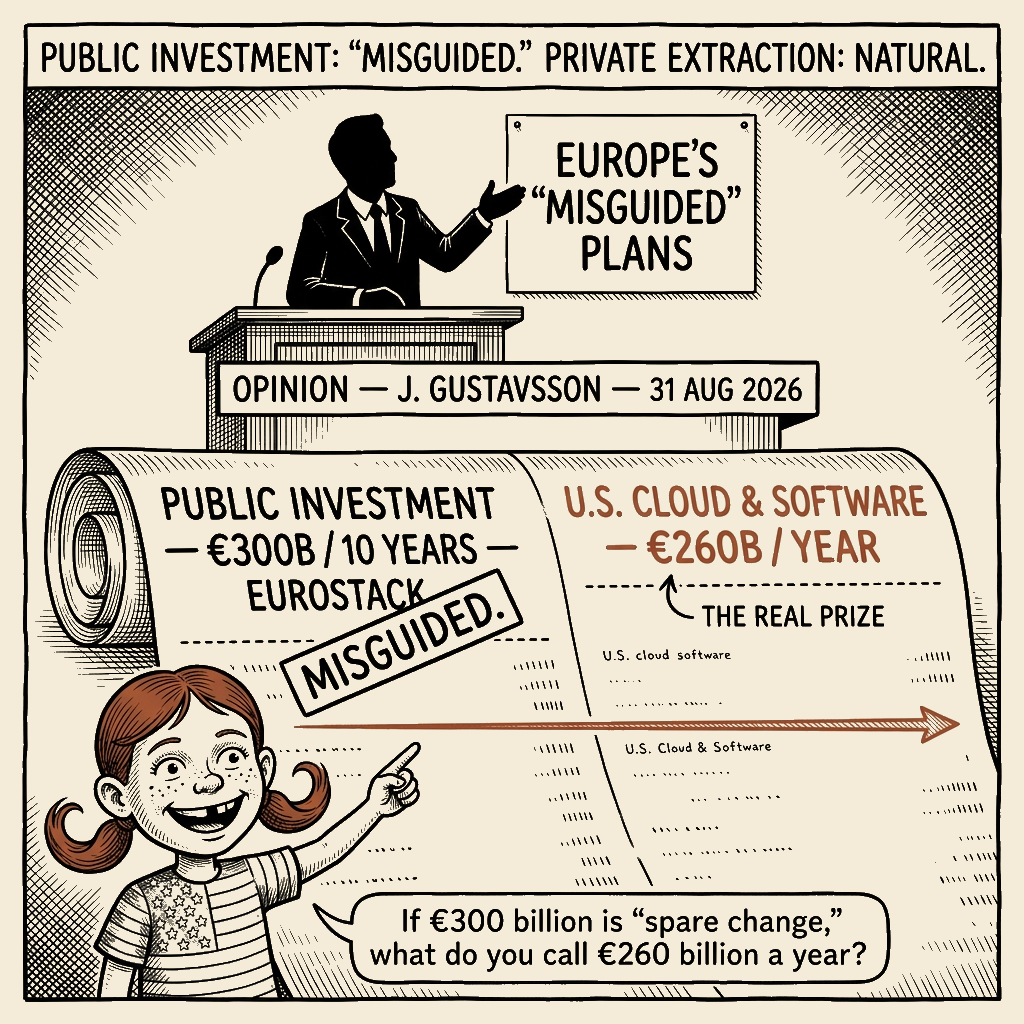
Analyzing: Europe’s Misguided Plans for Pursuing Digital Independence — John Gustavsson · 2026-08-30
What the Editorial Argues
The thesis is a double-barreled rejection. First, that EuroStack — a €300 billion, ten-year industrial and digital sovereignty initiative originating at a September 2024 European Parliament multiparty conference — cannot deliver digital independence because the sum is “ludicrous,” “spare change” by Silicon Valley standards, and “miserly alms to the impoverished EU tech sector.” Second, that EuroSky — a Netherlands-hosted AT Protocol-based social media infrastructure launched in April 2026 by the Modal Foundation — is functionally a politically motivated microblogging project whose first app, Mu, will fail because microblogging alternatives fail.
The connective tissue is a deregulation argument. The GDPR, the Digital Services Act, the Digital Markets Act, and the AI Act are lumped as a uniform “hostile attitude toward tech.” Public procurement is framed as a “bailout” producing “bureaucratic chest compressions” rather than innovation. Sweden’s treatment of stock options and the absence of a wealth tax are held out as the lone European counter-example worth following. The implicit North Star is Silicon Valley itself, invoked as axiom and never interrogated. The closing sentence is a catechism: “Neither public procurement nor a ‘safe space’ social media ecosystem will ever replace the successful formula that once built Silicon Valley: allowing people to build things that the state has not already approved.”
Receipts
The Bad-Faith Techniques Catalog and the WSJ Editorial Technique Catalogue light up across the editorial. The textual cues:
-
Scare Quotes as Defamiliarization —
[bf_catalog:frame_engineered_relabeling`](/propaganda/docs/bad-faith-techniques-catalogue#frame-engineered-relabeling) (WSJ Catalogue §3.8, §4.1): “digital independence,” “Buy European,” “Sell European,” “Fund European,” “unicorns,” “safe space,” “authoritarian infrastructure providers,” “regulate first, ask questions later.” The terms are placed in quotation marks to brand them as alien, foreign, or self-deceiving. The technique runs across virtually every paragraph. -
Portmanteau Coinage as Branding —
[bf_catalog:frame_engineered_relabeling`](/propaganda/docs/bad-faith-techniques-catalogue#frame-engineered-relabeling): “EuroStack” and “EuroSky” are introduced as proper-noun brand objects. They are not analyzed; they are catalogued. The naming is the analysis (“EuroStack, an initiative that originated from a multiparty conference at the European Parliament in September 2024”; “EuroSky, a project launched publicly in April this year”). -
Loaded Lexicon —
[bf_catalog:frame_engineered_relabeling`](/propaganda/docs/bad-faith-techniques-catalogue#frame-engineered-relabeling): “ludicrous,” “miserly alms,” “impoverished EU tech sector,” “hostile,” “culprit,” “silly things like wealth taxes,” “shockingly libertarian,” “leper colonies full of bitter people,” “bureaucratic chest compressions,” “enthralled.” Each adjective is doing structural work, not descriptive work. -
The Disclaimer-and-Completion Dog Whistle —
[bf_catalog:jaqing_off`](/propaganda/docs/bad-faith-techniques-catalogue#jaqing-off): “While he did not explicitly name Elon Musk as the ‘authoritarian’ in question, Musk has a long-running conflict with the EU.” The editor disclaims the naming in the same sentence that completes it. This is the technique’s textbook fingerprint. -
Strawman / Sectoral Caricature —
[bf_catalog:strawman`](/propaganda/docs/bad-faith-techniques-catalogue#strawman) (WSJ Catalogue §4.6): “the EU tech sector seems to have given up hope… seems to simply aim to have some of the costs of compliance reimbursed through public procurement contracts.” An entire continent’s technology workforce is collapsed into a defeatist caricature with “seems to” as the evidentiary basis. -
Survivorship Cherry-Pick —
[bf_catalog:hasty_generalization`](/propaganda/docs/bad-faith-techniques-catalogue#hasty-generalization) (WSJ Catalogue §4.6): “follow Sweden’s lead.” Sweden is selected because it produces “unicorns” while remaining high-tax. Other high-tax European countries with weaker venture outcomes are not consulted. The single counter-example is sold as a model. -
Quotation as Setup —
[bf_catalog:red_herring`](/propaganda/docs/bad-faith-techniques-catalogue#red-herring): Robin Berjon is quoted describing EuroSky as a way to get around “authoritarian infrastructure providers” — the quoted phrase is the spring from which the Musk identification is launched two sentences later. The quote does not argue; it primes. -
Motte-and-Bailey Reframe —
[bf_catalog:motte_and_bailey`](/propaganda/docs/bad-faith-techniques-catalogue#motte-and-bailey): “It is also debatable if such rules will even prove to be compatible with the World Trade Organization’s (WTO) Government Procurement Agreement — not that anyone seems to care about the WTO anymore.” WTO compatibility is introduced as a live question and dismissed in the same breath. The parenthetical is the answer. -
Metaphor as Argument —
[bf_catalog:red_herring`](/propaganda/docs/bad-faith-techniques-catalogue#red-herring): “bureaucratic chest compressions” — metaphor substitutes for evidence; “leper colonies full of bitter people” — metaphor substitutes for engagement with users; “miserly alms” — metaphor substitutes for budget arithmetic. -
Closing Moral Declaration —
[bf_catalog:slippery_slope`](/propaganda/docs/bad-faith-techniques-catalogue#slippery-slope) (WSJ Catalogue §4.13): “allowing people to build things that the state has not already approved.” The libertarian destination is delivered as a universal moral verdict, not a policy preference.
The Operation
The sequence is load-bearing and tightly choreographed. It runs in four movements.
Movement One: Frame the Policy as Self-Defeat. The €300 billion / ten-year figure is introduced, immediately tagged “ludicrous,” and measured against “Silicon Valley, this kind of money is spare change.” The comparator is chosen to ensure the conclusion: any European-scale spending is by definition insufficient. The piece then concedes the industry’s own admission that €300 billion is a “distraction” — and uses that concession to pivot the goalposts to the €260 billion that European organizations spend on U.S. cloud and software annually. The reader is being moved from “can Europe build?” to “should Europe spend on its own at all?”
This is [bf_catalog: frame_engineered_relabeling`](/propaganda/docs/bad-faith-techniques-catalogue#frame-engineered-relabeling) applied to a budget figure: the loaded quantifier dismissal (“Spare change” applied to €300 billion over a decade, “miserly alms to the impoverished EU tech sector”) operates by choosing a comparator — Silicon Valley’s private capital flows — that ensures the smallness of the European figure. No per-capita figure, no fraction-of-GDP figure, no public-investment reference point is consulted. The choice of comparator is the technique. The same family includes the strawman regulation move that joins GDPR, DSA, DMA, and AI Act as “such regulations” and characterizes them as a uniform “hostile” attitude; none is examined in detail, and their joint effect is asserted rather than analyzed (WSJ Catalogue §4.6).
Movement Two: Dehumanize the Constituencies. Sweden is held up as the lone exemplar, but the constituencies who would actually use EuroStack or EuroSky are not analyzed — they are characterized. Users of competing social media platforms are “intolerable leper colonies full of bitter people” who “use their competing platforms for little else than just complaining about the other platform and posting stuff that would not be allowed.” This is not a description. It is a disqualification. The reader is being told: do not bother listening to these people; they are not a market.
This is contempt-by-analogy: the move that compares competitors to a despised category rather than engaging their merits. The argument does not need to defeat any of them; the analogy does the work by labeling. The Sweden pivot is selection-bias exemplar: the editorial offers no examination of whether Sweden’s tech sector is causally downstream of stock-option taxation, no comparison to other small European economies with similar tax treatment and weaker tech sectors, no engagement with what Sweden’s unicorn production actually cost — in concentration, in exit patterns, in industrial spillovers (WSJ Catalogue §4.6).
Movement Three: The Dog Whistle. Robin Berjon is quoted using the phrase “authoritarian infrastructure providers.” The editorial notes he “did not explicitly name Elon Musk” and then names Musk anyway, in the same paragraph. The disclaimer performs deniability; the completion performs the indictment. The reader is taught that EuroSky’s founders are people who call American tech billionaires “authoritarian” — a posture the editorial then treats as disqualifying.
This is innuendo cluster — the rhetorical figure that points without naming. The double-negative structure is built so the reader fills in the target while the writer preserves the technical defense that nothing was alleged ([bf_catalog: jaqing_off`](/propaganda/docs/bad-faith-techniques-catalogue#jaqing-off)). The same construction has been used to identify George Soros behind “globalist” philanthropy critiques, specific federal judges behind “activist” rulings, and named tech founders behind “Silicon Valley oligarch” framings. Disclaimer and completion in a single sentence is the signature.
Movement Four: Deliver the Destination. The closing paragraph drops the policy frame entirely. The conclusion is not “deregulate” or “follow Sweden.” It is “allowing people to build things that the state has not already approved.” That sentence is the operation. It is libertarian moral theology delivered as the conclusion to a policy piece about cloud spending. Everything before it was the engineered pathway.
The closing frame — “Neither public procurement nor a ‘safe space’ social media ecosystem will ever replace the successful formula that once built Silicon Valley” — is the two-option forcing device. Industrial policy, mixed-economy approaches, late-stage European venture capital, public-private consortia modeled on ARPA, sovereign wealth deployment: none are available, because none are named. Silicon Valley is the American Exceptionalism Anchor invoked as axiom, never defended as claim.
The reader who arrives at that line is not the reader who started the article. The first reader was evaluating €300 billion. The last reader has been moved to a position on the moral legitimacy of state approval itself. The piece looks like an economic argument and functions as a political one. The catalogue is deployed, not merely invoked.
The Record
The technique set is not new. It is the operator’s standard sequence, recognizable from opinion-page deployments against digital sovereignty, content moderation, antitrust action, and platform regulation across WSJ/NR-adjacent coverage.
-
WSJ Catalogue §3.8 scare quotes around “digital independence” — the same defamiliarization pattern recurs across pieces treating “net neutrality,” “Section 230 reform,” “the fairness doctrine for the internet,” and “antitrust” as alien impositions on a previously free domain. The quotation marks are the technique; the terms are interchangeable.
-
[bf_catalog:jaqing_off`](/propaganda/docs/bad-faith-techniques-catalogue#jaqing-off) disclaimer-and-completion dog whistle — the “did not explicitly name X” construction is a documented operator fingerprint. The same move has been used to identify Soros behind “globalist” philanthropy critiques, specific federal judges behind “activist” rulings, and named tech founders behind “Silicon Valley oligarch” framings. Disclaimer and completion in a single sentence is the signature. -
[bf_catalog:hasty_generalization`](/propaganda/docs/bad-faith-techniques-catalogue#hasty-generalization) sectoral caricature via “seems to” — collapsing entire workforces into “seems to have given up hope” or “seems to simply aim to have the costs of compliance reimbursed” is a documented move in opinion-page coverage of European tech regulation. The “seems to” evidentiary posture is itself the technique: it permits the caricature to be deniable while still functioning. -
WSJ Catalogue §4.6 survivorship cherry-pick — Sweden as the European tech model is a recurring selection across opinion pieces that want a deregulatory precedent without conceding that high-tax European welfare states have produced weak tech outcomes. Ireland, Estonia, and Portugal have been used the same way in adjacent pieces; the country changes, the technique is stable.
-
[bf_catalog:red_herring`](/propaganda/docs/bad-faith-techniques-catalogue#red-herring) metaphor-as-argument — “leper colonies,” “bureaucratic chest compressions,” “miserly alms” belong to the documented metaphor clusters used to disqualify without engaging. They appear together because they are a unit. -
WSJ Catalogue §4.13 closing moral verdict — the move from policy recommendation to a declaration about the moral legitimacy of state approval (“allowing people to build things that the state has not already approved”) is the operator’s terminal signature. The destination is theological; the journey is policy.
What this editorial actually does to a reader: it forecloses. It forecloses the possibility that public investment is a rational industrial-policy tool. It forecloses the possibility that European regulatory choices reflect European values rather than European pathology. It forecloses the possibility that €300 billion over ten years is a credible counter-move to dependence on a foreign private sector. It forecloses the possibility that EuroSky is anything other than a politically motivated microblog. It forecloses the possibility that Silicon Valley’s “successful formula” was a historical accident, that it carried externalities, or that it is reproducible only at the cost of becoming America.
Who benefits: the U.S. tech incumbents whose roughly €260 billion in annual European cloud and software revenue the editorial explicitly identifies as “the real prize” the EuroStack industry wing is actually after. The editorial does not name them as beneficiaries; that is the point. The argument is constructed so that a reader who accepts the framing is also accepting the commercial outcome — that European demand for European tech is a pathology, that European demand for American tech is the natural state of things.
What it papers over: every alternative explanation for Europe’s tech deficit. Underinvestment in late-stage European venture capital (the editorial gestures at this only to flatter Sweden). The fragmentation of the European single market into 27 national regulatory regimes. U.S. defense and intelligence procurement that seeded the original American tech sector. H-1B and selective-immigration policy. Antitrust enforcement timing. The role of network effects in concentrating returns. None of these are available because they would shift the diagnosis away from “hostile regulation” toward “historical and structural conditions.”
The editorial’s most consequential move is its silence on what a successful European tech sector would actually mean. The reader is invited to imagine European dependence on U.S. cloud as benign — the natural complement to a thriving transatlantic partnership — rather than as a strategic vulnerability exposed by every recent geopolitical shock. The piece names the climate transition as the budget competitor to tech investment; it does not name industrial-policy success in China, Korea, or Taiwan as the relevant reference class for what €300 billion over ten years can actually do. That omission is the operator’s-eye indictment: the editorial reads Europe through America’s competitive interest and presents the result as European self-diagnosis.
The pattern this piece instantiates is the pattern of opinion-page coverage that frames any European or regulatory alternative to U.S. tech incumbency as simultaneously underfunded, over-regulated, captured by hostile bureaucrats, and staffed by defeatist or radical constituencies — then closes on a libertarian moral verdict. The recurrence is the point.
How to Recognize This
A reader can flag the same operator at work elsewhere with the following telltales:
-
The scare-quoted abstraction. A policy concept is named and put in quotation marks in the first paragraph (“digital independence,” “net neutrality,” “fairness,” “safety,” “Section 230 reform”). The quotation marks are not hedging; they are branding.
-
The portmanteau proper noun. A new initiative is introduced as a capitalized compound (“EuroStack,” “EuroSky,” “EuroFair,” “Project Liberty,” “NetChoice”). It is never analyzed; it is labelled.
-
The “ludicrous” / “spare change” comparator. A spending figure is introduced and immediately measured against an American or Silicon Valley figure chosen to ensure the European number looks small. The comparator is the conclusion.
-
The disclaimer-and-completion dog whistle. “While [actor] did not explicitly name [target], [target] has a long-running conflict with [institution].” The disclaimer performs deniability; the completion performs the indictment.
-
The “seems to” sectoral attribution. An entire workforce or constituency is characterized in passive, deniable language (“seems to have given up hope,” “seems to simply aim to”). The evidentiary posture is itself the technique.
-
The metaphor as disqualification. Users, regulators, or competitors are addressed through metaphor (“leper colonies,” “chest compressions,” “alms,” “captives,” “hostages”) rather than through argument. The metaphor is doing the work evidence is not.
-
The closing moral verdict. The piece ends not with a policy recommendation but with a moral declaration about the legitimacy of state approval. The destination is libertarian moral theology, not policy.
The recognition rule is simple: when an editorial argues that Europe lacks a vibrant tech sector because of regulation, names Sweden’s stock-option rules as the cure, treats EuroStack as a “bailout” and EuroSky as a microblog in search of an owner it will not name, and closes by quoting the Silicon Valley formula as catechism — it is performing the American Exceptionalism Anchor from the WSJ Editorial Technique Catalogue, and the operator’s-eye verdict is that the piece is not about Europe at all. When all seven markers are present, the reader is not reading analysis. They are being moved through an operator’s sequence.

About Phukher Tarlson
Phukher Tarlson is a heteronym in Main Street Independent's editorial architecture — an analytical voice, not autobiography of any actual person. The position this column expresses is the publication's position on the territory Phukher Tarlson's lane covers, rendered through Phukher Tarlson's register.