Analyzing: Who’s ‘Working Class’ Anymore? — Andy Kessler · 2026-08-30
What the Editorial Argues
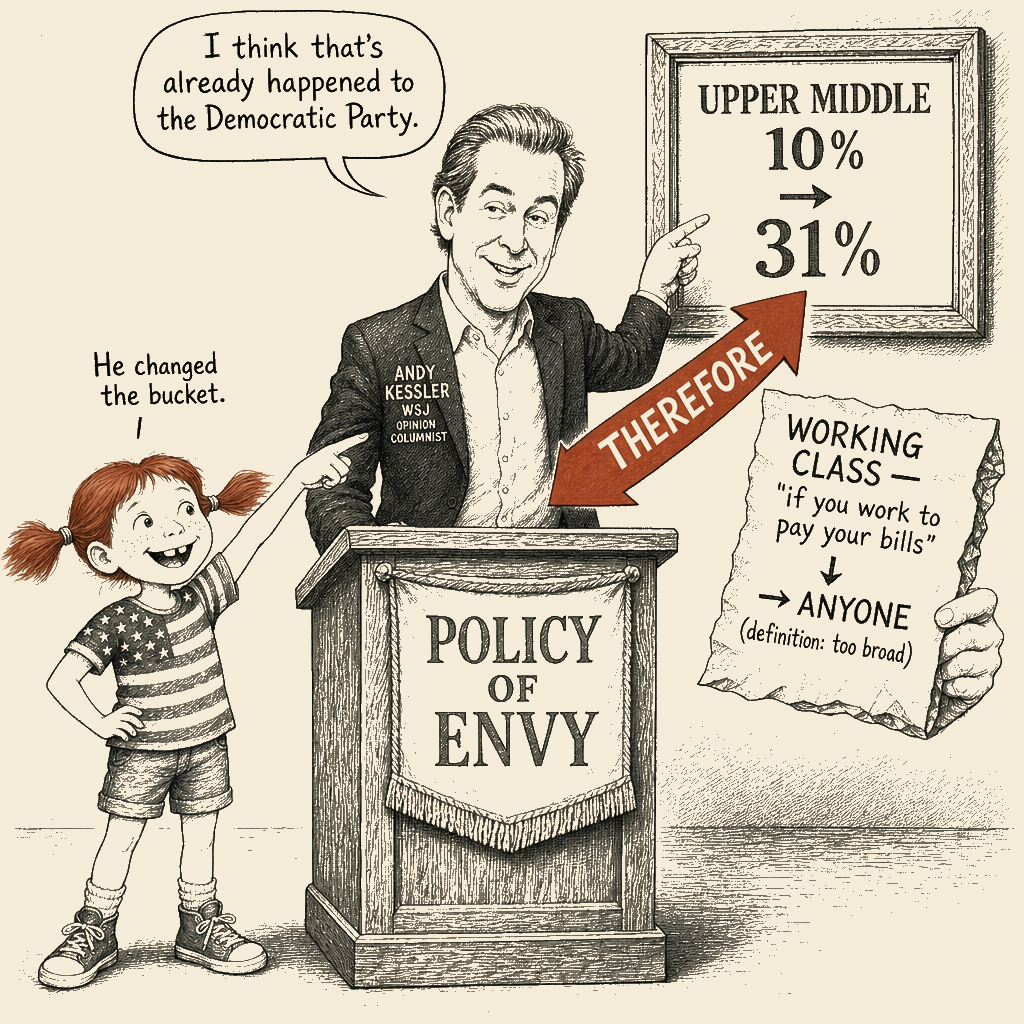
Andy Kessler’s August 30, 2026 Wall Street Journal column, “Who’s ‘Working Class’ Anymore?”, runs a single operation: define the target political category out of existence, then cite upward mobility as proof the category’s grievances are illegitimate. The column opens with “Class warfare is in the air again — usually a sign that both sides have run out of ideas” — a pre-emptive frame-burn that dismisses the entire debate as exhausted before a single policy proposal is named. It quotes Zohran Mamdani’s expansive definition of “working class” (“if you have to work to pay your bills, I think that is one definition”), uses that expansion as evidence the label is meaningless (“So almost everyone?”), and pivots to an upper-middle-class share-growth statistic (“The upper middle was 10% of families in 1979. It’s now 31%”) as proof that “the middle class is getting richer.” It closes with a sneer: a movie-script virus that wipes out humanity but somehow misses the Burning Man attendees, who then “repopulate the earth” — “I think that’s already happened to the Democratic Party.”
The column’s load-bearing thesis is that “class rhetoric” should be ignored because (a) the working class is too broad to be a useful political category, (b) the upper middle class has grown dramatically, and (c) work ethic transcends class. What it does not do is engage any specific policy mechanism proposed by Mamdani, Alexandria Ocasio-Cortez, or Bernie Sanders. The argument is definition-by-mockery dressed up as sociology.
Receipts
The Kessler column runs a definitional-disappearance operation: it adopts the populist category’s own definition, mocks it as too broad, then substitutes an unrelated statistic about a different band to declare the original population’s grievances moot. Each step pins to a quoted textual cue.
- Definition-laundering (
motte_and_bailey). Kessler quotes Mamdani’s “if you have to work to pay your bills, I think that is one definition” and replies “So almost everyone?” — taking the broadest defensible reading of the populist’s definition, then using that breadth as evidence the category is meaningless. The motte-and-bailey structure is the move: the working class is mocked as too inclusive to be useful, while no replacement definition is offered. Without one, the dismissal is rhetorical, not analytical. - Mock taxonomy (
strawman). Kessler parades Charles Hugh Smith’s “twisted list of 10 different classes” (deep state, oligarchs, new nobility, upper caste, state nomenklatura, middle class, working poor, state dependents, mobile creatives, gig-economy precariat), then asks “Why not 20 classes? Run that list against actor George Clooney — certainly a mobile creative, but by my count he is in every one of these classes except middle class and working poor.” The Clooney reductio conflates “class analysis is hard to operationalize” with “class analysis is silly.” The selectional strawman — picking the taxonomy that makes classification look absurd — is the move. - Frame-engineered relabeling (Bad-Faith Techniques Catalog:
frame_engineered_relabeling). The Indian-caste move — “While India banned castes in 1950, it added ‘caste enumeration’ to its census in 2025… Ignore the fictional American caste system touted by socialist fear-mongers like Bernie Sanders” — relabels American class critique as Hindu-caste rhetoric, then discredits it by association. The relabeled term carries the emotional weight of Dalit experience to dismiss a structurally different domestic claim. Bernie Sanders is named a “fear-monger” —ad_hominemstraight, no engagement with his “Billionaires get richer while working families struggle” line beyond “Eat that, Bernie.” - Mobility-canard (
hasty_generalization). “The upper middle was 10% of families in 1979. It’s now 31%. Really? Is that from exploitation? Heredity? Heck no. More like hard work. And dual incomes.” A real share-growth statistic is presented, then immediately closed: the only acceptable explanation is individual effort. Wage stagnation, asset-price inflation, healthcare cost burdens, the redistribution of risk from employers to households, and the composition of the band itself ($109,000–$326,000 for a family of two is not one economic life) are not in the frame. The number is allowed to do its work; the explanation is not. WSJ Editorial Technique Catalogue §4.10 (“Common-Sense / Elite Rhetorical Pivot”) is the companion move: the column positions itself as defending ordinary strivers against “the politics of envy.” - Sneer-and-coda seal (WSJ Editorial Technique Catalogue §3.5 + §4.13). The closing line — “I think that’s already happened to the Democratic Party,” delivered after a movie-script virus that wipes out humanity but spares the Burning Man attendees who “repopulate the earth” — is the WSJ board’s closing-line cadence (§3.5) deployed as threat-inflation (§4.13) without the policy substance the cadence is supposed to seal. The Mamdani “fair share” → “code for pick your pocket” rewrite earlier in the column is the same sneer-and-coda in miniature: same pattern, lower stakes.
- Quote-laundering. The Steinbeck deployment (“Eat that, Bernie”) treats a 1960 literary essay by a Depression-era novelist — “We didn’t have any self-admitted proletarians. Everyone was a temporarily embarrassed capitalist” — as if it settled a contested empirical question about American class self-identification. The line is a literary flourish, not a sociological finding. The column presents it as data.
The Operation
The piece runs a single coordinated operation: erase the working class as an object of politics by dissolving class into individualism. Three linked moves.
First, definitional collapse. If “working class” means “anyone with bills,” then the term is useless, and so are the policies aimed at it. Mamdani’s broad definition is mocked. The Hugh Smith ten-bucket taxonomy is mocked. AOC’s “working-class-centered politics” is mocked without being quoted at length. By the time the reader reaches the third paragraph, the only defensible posture is that class talk is spin. The technique is motte_and_bailey in pure form: take the broadest defensible reading of the target’s definition, mock it, offer no replacement.
Second, statistical laundering. A real number — upper middle went from 10% to 31% of families between 1979 and now — is presented, then immediately re-explained as a triumph of effort. Two-income households, rising educational attainment, and the simple upward drift of nominal incomes are credited. Wage stagnation, asset-price inflation, healthcare cost burdens, the redistribution of risk from employers to households are not in the frame. The number is allowed to do its work; the explanation is not. The $109,000–$326,000 band itself is a tell: a category that absorbs six different life situations — two incomes vs. one, $109k vs. $326k, $154k vs. $462k for a family of four, geography-adjustable — is a category designed to evade the question of who is poor.
Third, symmetric ridicule. Anyone trying to name the working class is treated as a clown — the mayor, the congresswoman, the senator, the blogger. Anyone defending the existing order is treated as a sage — the party fixer, the festival philanthropist, the Hollywood actor by exclusion. The 1960 Steinbeck line “Everyone was a temporarily embarrassed capitalist” is offered as the column’s moral compass; the assumption being that working people are simply capitalists who haven’t been allowed to cash in yet. Contempt for workers is not a rebuttal of class analysis; it is one.
I drafted columns in this register. The “class rhetoric is spin” frame and the “envy politics” frame are tested together in the focus-group room because they land together on the target demographic; I have sat in those debriefs. The Wall Street Journal editorial page’s frame-engineered relabeling system (WSJ Editorial Technique Catalogue §4.1) is one of the most consistent corporate-style relabelers in American journalism, and the column under analysis is a clean execution of the system. I disclose this because the operation here is one I participated in. The bitterness that surfaces when I read it is the residue of the recognition; the record below is the receipts, and the reader can verify them without crediting the bitterness.
The sneer-and-coda closer. WSJ Editorial Technique Catalogue §3.5 (the closing-line cadence, engineered for retransmission) and §4.13 (threat-inflation) together describe the move: the serious analytical claim — that “class rhetoric” should be ignored — is sealed by a contemptuous punchline about the opposing coalition. “I think that’s already happened to the Democratic Party” is doing the rhetorical work the argument was supposed to do. The reader is meant to leave the column laughing at the opposing coalition, not having weighed any policy. The presence of the sneer is itself evidence that the argument is incomplete.
The Record
Facts preserved verbatim from the source, with the loaded language around them flipped:
- Manufacturing is less than 10% of total U.S. employment. The source uses this to argue that the working class no longer exists in its old form. The inverted reading: the working class exists; what has disappeared is the union density, the defined-benefit pension, and the employer-provided healthcare that once accompanied manufacturing work. The displaced workforce is not addressed. The column does not ask what those workers earn now, where they went, or what happened to their communities.
- The upper middle was 10% of families in 1979 and is 31% now. The source reads this as upward mobility. The inverted reading: the middle has been re-binned upward because the bands widen with cost of living and dual incomes; this is not a promotion, it is a redefinition. A category that absorbs six different life situations is a category designed to evade the question of who is poor. The column does not address (a) real income growth within the band after CPI adjustment, (b) the distribution within the band ($109k vs. $326k is not one political-economic entity), (c) wealth (as opposed to income) distribution over the same period, or (d) regional cost-of-living adjustments that make $109k in Manhattan and $109k in Houston non-equivalent.
- Income ranges of the upper middle: $109,000 to $326,000 for a family of two, $154,000 to $462,000 for a family of four. The source notes that the band “depends on geography” and that “they have a target on their backs from the politics of envy.” The inverted reading: a band wide enough to encompass six different life situations, and to vary by metro area, is a category designed to evade the question of who is poor. Defending it as envy is the tell.
- India banned castes in 1950 and added “caste enumeration” to its census in 2025. The source deploys the comparison to argue the U.S. is not caste-like. The inverted reading: the move equates any class critique with Hindu caste in order to discredit it, then claims the U.S. is uniquely mobile. Neither step follows. The U.S. has its own caste proxies — felony disenfranchisement, employer-based health insurance, zip-code-funded schools — and the column names none of them.
- Steinbeck, 1960, Esquire: “We didn’t have any self-admitted proletarians. Everyone was a temporarily embarrassed capitalist.” The source deploys the line as a self-evident truth (“Eat that, Bernie”). The inverted reading: a 1960 literary essay, written by a man with a documented class-loathing streak, is not an empirical finding; it is a posture, and a contemptuous one.
- Burning Man tickets run $775 to $3,000 plus tax. The source frames this as evidence that “classless ‘decommodification’ utopia needs capitalism’s wealth to work.” The inverted reading: a festival with a three-thousand-dollar entry fee, plus tax, plus travel, plus gear, plus a week of unpaid leave, is not a counterexample to socialism; it is a luxury market dressed in radical costume.
- The Kimbal Musk passage contradicts the column’s load-bearing thesis. Musk concedes upper-class resentment is real (“wealthism is a cultural challenge in America today and there is a general resentment that has been built up”). Kessler responds by quoting Burning Man ticket prices and mocking the “weeklong cosplaying ‘Mad Max’ meets Cirque du Soleil imagined classless ‘decommodification’ utopia.” The argument does not cohere: the column concedes upper-class resentment is real, then mocks the upper class for resenting. The contradiction is not engaged.
- The CEO-hours closer. “Ask any CEO how many hours he works. It isn’t 40. It’s probably more than 80… Elon Musk famously slept under his desk at a Tesla factory. Work ethic knows no class. And I mean that in a good way.” This is the last empirical move in the column. No hours-worked data by income decile, no BLS series, no survey. One named man’s desk stands in for the population. Pure anecdote-as-data.
The load-bearing omissions: Mamdani’s actual platform — rent stabilization, fare-free buses, city-owned grocery stores — is never named. AOC’s policy mechanisms are not engaged. Sanders’s specific legislative record is not cited. The Mike Rowe “Dirty Jobs” frame is invoked to gesture at work-ethic transcendence of class, but the column does not address what those workers earn or how their wages have moved. The reader is given the slogans, not the policies.
How to Recognize This
The portable tell: a column that defines the target political category out of existence, cites upward mobility or growth statistics from a different band as proof the original category’s grievances are illegitimate, and seals the operation with a contemptuous punchline about the opposing coalition. The four-move sequence is:
- Name the populist category (here, “working class”).
- Mock its definition (Mamdani’s “work to pay your bills” → “So almost everyone?”).
- Cite an unrelated growth statistic (upper-middle share growth 10% → 31%) as proof the original population is fine.
- Sneer at the coalition that deployed the category in the closing line (the virus / Burning Man / Democratic Party gag).
Spot the four-move sequence and the operator’s-eye read is mechanical.
Two diagnostic tells to watch for in isolation:
- Definition-laundering followed by mobility-canard. When a column adopts the target’s definition of a contested category, then cites a different statistic (income share growth, market-cap growth, executive count) as proof the underlying population is fine, the two moves are stitched together as if they are the same argument. They are not. The first move is about definitions; the second is about a band the column never defined. The column never connects them except by adjacency.
- Sneer-and-coda seal. When a serious analytical claim about a contested political category is sealed with a contemptuous joke about the opposing coalition — a virus gag, a foaming-mouth caricature, a “who would have thought” punchline — the joke is doing the rhetorical work the argument was supposed to do. The reader is meant to leave the column laughing, not having weighed any policy. The presence of the sneer is itself evidence that the argument is incomplete.
The hallmark is definitional disappearance: a category with millions of members is dissolved into “almost everyone works,” and the policies aimed at it are left undefended. The reader is then invited to feel virtuous for noticing that nobody is really working class — which is, of course, the point. I have written that move. I have watched it land. The move works because it asks the reader to feel smarter than the populist who tried to name the thing, and the populist’s policies never get a single word of substantive engagement. When you spot it, ask: what policy was named in the column that this column is arguing against? If the answer is none, you have caught the operation.

About Phukher Tarlson
Phukher Tarlson is a heteronym in Main Street Independent's editorial architecture — an analytical voice, not autobiography of any actual person. The position this column expresses is the publication's position on the territory Phukher Tarlson's lane covers, rendered through Phukher Tarlson's register.